

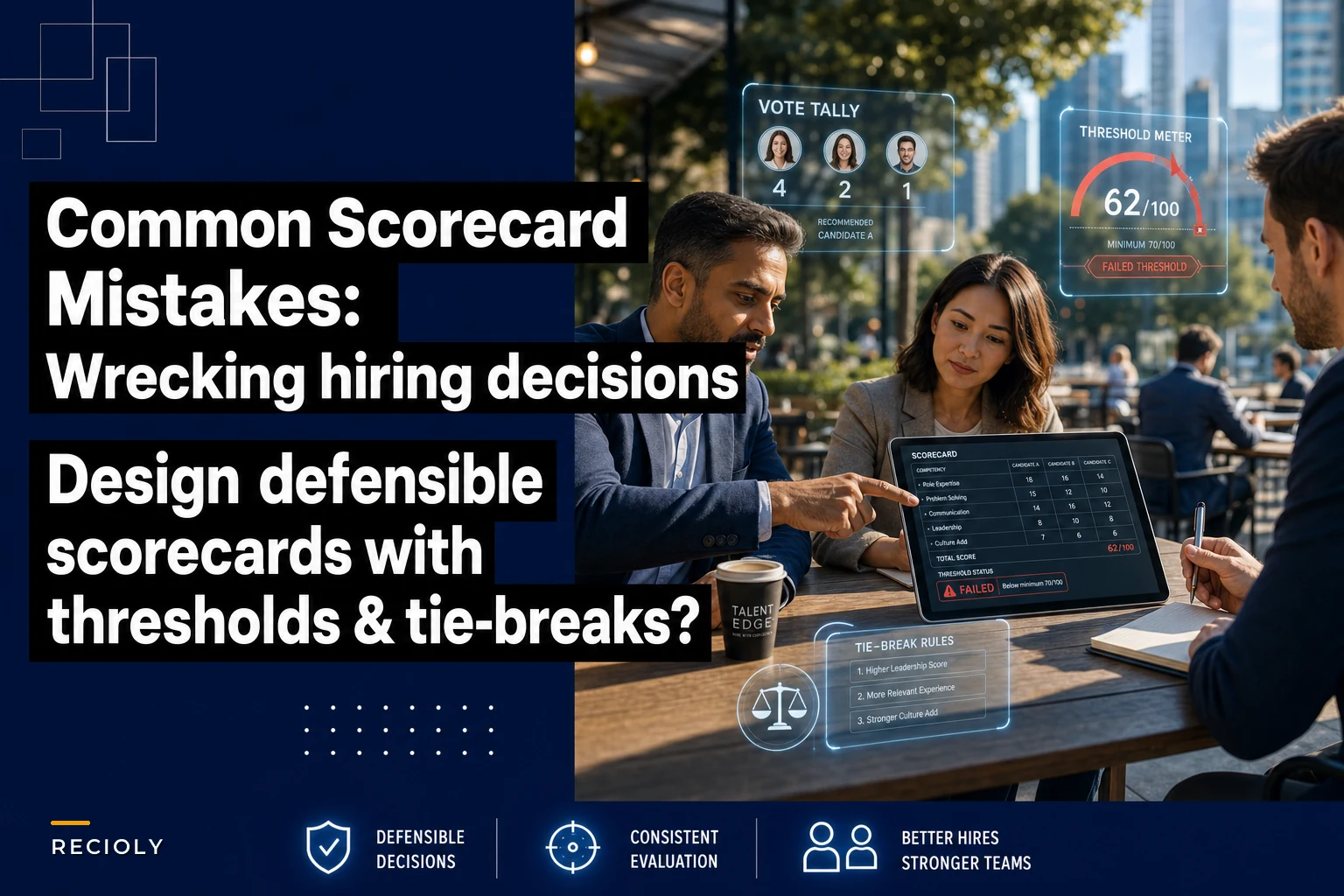

You've got five interviewers, clear role requirements, and everyone knows what you're looking for. Yet somehow your debrief turns into a 90-minute debate where the loudest voice wins, and three months later the new hire isn't working out.
The problem isn't your interviewers or even your process. It's the scorecard design setting everyone up to fail before the first candidate walks through the door.
Building operational software for recruiting teams across tech startups, healthcare systems, and retail chains, I keep seeing the same scorecard mistakes surface. Not the obvious ones like "forgetting to include technical skills" — the subtle design flaws that make scoring feel arbitrary, debriefs run long, and decisions impossible to defend when someone questions why you passed on a candidate six months later.
The ranking collapse that makes every candidate look "above average"
Pull up your last 20 interview scorecards. Count how many candidates scored 3 or 4 on your 5-point scale. If it's more than 16 or so, you've got ranking collapse.
This happens when your scorecard anchors are too vague. "Meets expectations" for communication skills means something completely different to a senior engineer who values technical precision versus a sales director who wants energy and rapport. Without concrete behavioral anchors, everyone defaults to safe middle scores.
Engineering teams run into this constantly. A backend engineer role might list "problem-solving ability" as a competency, scored 1-5. The junior interviewer gives a 4 because the candidate solved the coding challenge. The senior architect gives a 2 because they didn't consider system design implications. The engineering manager splits the difference at 3. Now you're debating subjective interpretations instead of observable behaviors.
Fix this with behavioral anchors for each score level.
-
1 (Below) Struggled with basic syntax, needed heavy hints for simple problems
-
2 (Developing) Solved problems but code was inefficient, didn't consider edge cases
-
3 (Solid) Clean working solution, handled main edge cases, decent time complexity
-
4 (Strong) Optimized approach, discussed tradeoffs, caught subtle edge cases independently
-
5 (Exceptional) Multiple solution approaches, explained complexity analysis, improved on initial problem framing
The specificity forces consistent scoring. An interviewer can't give a 4 just because they liked the candidate's energy when the actual behavior was clearly a 3.
Missing the must-have versus nice-to-have distinction
Here's a scorecard disaster waiting to happen: treating all competencies equally when some are deal-breakers and others are just bonuses.
Never lose track of top talent again.
Recioly helps you manage every stage of recruiting efficiently, from application to offer.
- Centralized candidate tracking
- Automated interview scheduling
- Collaborative hiring workflows
No credit card required
A fintech startup was hiring a compliance manager. Their scorecard had eight competencies, all weighted the same. The top candidate scored perfect 5s on relationship building, strategic thinking, and communication. They scored 2s on regulatory knowledge and audit experience. The team averaged everything out to a 3.75 and made an offer. Three months later they were scrambling to fix compliance violations because they'd prioritized personality over non-negotiable expertise.
Your scorecard needs enforceable thresholds for critical competencies. Not suggestions — hard stops.
Role-family threshold examples:
Customer Success Manager:
-
Customer empathy
Minimum 3 (no exceptions)
-
Technical troubleshooting
Minimum 2 (trainable)
-
Account management
Minimum 3 (no exceptions)
-
Data analysis
Minimum 2 (nice to have)
Data Analyst:
-
SQL proficiency
Minimum 4 (no exceptions)
-
Statistical knowledge
Minimum 3 (no exceptions)
-
Business communication
Minimum 3 (critical for stakeholder work)
-
Domain expertise
Minimum 2 (can learn on job)
Sales Development Rep:
-
Cold outreach comfort
Minimum 4 (no exceptions)
-
Coachability
Minimum 4 (no exceptions)
-
Industry knowledge
Minimum 2 (trainable)
-
CRM experience
Minimum 1 (easy to teach)
The threshold system means a candidate who scores 5s everywhere but gets a 2 on SQL proficiency doesn't move forward for a data analyst role, period. No averaging, no debates, no "but they seemed really smart" arguments.
The missing tie-break rules that turn debriefs into debates
Two candidates both clear your thresholds. Both average 3.8 overall. Both have strong references. Your debrief is now 45 minutes of circular discussion because nobody designed decision rules for this exact scenario.
Most scorecards stop at the scoring. They don't include decision logic for the common situations that eat up debrief time.
A healthcare recruiting team kept having hourlong debates until they built explicit tie-break rules directly into their scorecard system.
Tie-break hierarchy for Clinical Roles:
-
Higher score on patient safety competency wins
-
If still tied, higher score on technical skills wins
-
If still tied, candidate with relevant specialty experience wins
-
If still tied, candidate with shortest notice period wins
Tie-break hierarchy for Operations Roles:
-
Higher score on process improvement wins
-
If still tied, higher score on cross-functional collaboration wins
-
If still tied, candidate with experience at similar company size wins
-
If still tied, internal referral wins over external
These aren't universal rules — every company will tweak them — but having any documented tie-break system cuts debrief time significantly. The rules get decided when you're thinking clearly, not when you're exhausted after six back-to-back interviews and just want to pick someone.
The scorecard fields everyone forgets until it's too late
The lawsuit lands eight months after you rejected a candidate. HR asks for your interview documentation. You've got scores but no context. Why did the candidate score low on leadership? What specific examples led to that score? Your defense just got a lot harder.
Minimum required fields for defensible scorecards:
| Section | Field | Notes |
|---|---|---|
| Basic Scoring | Competency name | — |
| Basic Scoring | Score | With behavioral anchor reference |
| Basic Scoring | One specific example | Mandatory |
| Basic Scoring | Red flag indicator | Binary yes/no |
| Context | Interview date/time | — |
| Context | Interview format | Phone/video/in-person |
| Context | Technical issues noted | Connection problems, etc. |
| Context | Candidate questions about role | — |
| Decision | Threshold met/not met | For each must-have |
| Decision | Overall recommendation | Strong yes / yes / no / strong no |
| Decision | Would you want this person on your team? | Yes/no |
| Decision | One sentence rationale | — |
The "one specific example" requirement is the part teams resist most, and it's also the most important. Instead of just scoring "Communication: 2," the interviewer has to note something like: "Struggled to explain their project architecture, jumped between topics without clear transitions, used heavy jargon without checking understanding."
That protects you legally and helps future hiring. When you're trying to figure out why certain hires worked out and others didn't, you've got behavioral data — not just a number.
Building scorecard muscle memory with role families
Creating a new scorecard from scratch for every role is exactly why most teams give up and fall back on generic templates. Build three to five role-family templates with 80% of the work already done instead.
Technical Individual Contributor Template:
Must-have competencies (with thresholds):
-
Technical skill for level (minimum 3)
-
Problem-solving approach (minimum 3)
-
Code/work quality standards (minimum 3)
-
Learning agility (minimum 3)
Nice-to-have competencies:
-
Mentoring/teaching ability
-
Process improvement ideas
-
Cross-team collaboration
-
Industry/domain knowledge
People Manager Template:
Must-have competencies (with thresholds):
-
Previous management experience (minimum 3)
-
Conflict resolution (minimum 3)
-
Performance management comfort (minimum 3)
-
Strategic thinking (minimum 2)
Nice-to-have competencies:
-
Budget management
-
Vendor management
-
Executive communication
-
Change management
Customer-Facing Template:
Must-have competencies (with thresholds):
-
Customer empathy (minimum 4)
-
Communication clarity (minimum 3)
-
Stress management (minimum 3)
-
Problem ownership (minimum 3)
Nice-to-have competencies:
-
Technical troubleshooting
-
Upselling/expansion skills
-
Process documentation
-
Training ability
Each template includes behavioral anchors, minimum fields, and tie-break rules. You adjust thresholds and add role-specific competencies on top. A senior role might require minimum 4s where a junior role accepts 3s.
Making your scorecards actually work in practice
The best scorecard design means nothing if interviewers don't use it consistently. A few things actually move the needle on adoption.
Pre-interview calibration matters more than most teams think. Spend 15 minutes before the interview loop starts walking through examples of what a 2 versus 3 versus 4 looks like for each competency. Use real examples from previous hires, not theoretical descriptions.
Scorecard submission deadlines are non-negotiable. Scorecards must be submitted within 24 hours of the interview. After 48 hours, the interviewer gets pulled from that loop. Harsh, but one company saw completion rates jump from around 60% to 95% after implementing this rule.
Monthly calibration reviews catch drift early. Pull scorecards from the last month and look for scoring patterns. If one interviewer consistently scores a point higher than everyone else, that's a calibration issue, not generosity. Address it directly.
The debrief structure that actually works follows a clear order:
-
Everyone states their hire/no-hire vote upfront — no hedging
-
Review threshold failures first, since these are automatic no-hires
-
For remaining candidates, the highest scorer presents their case
-
Apply tie-break rules if needed
-
Document decision rationale in 2-3 sentences
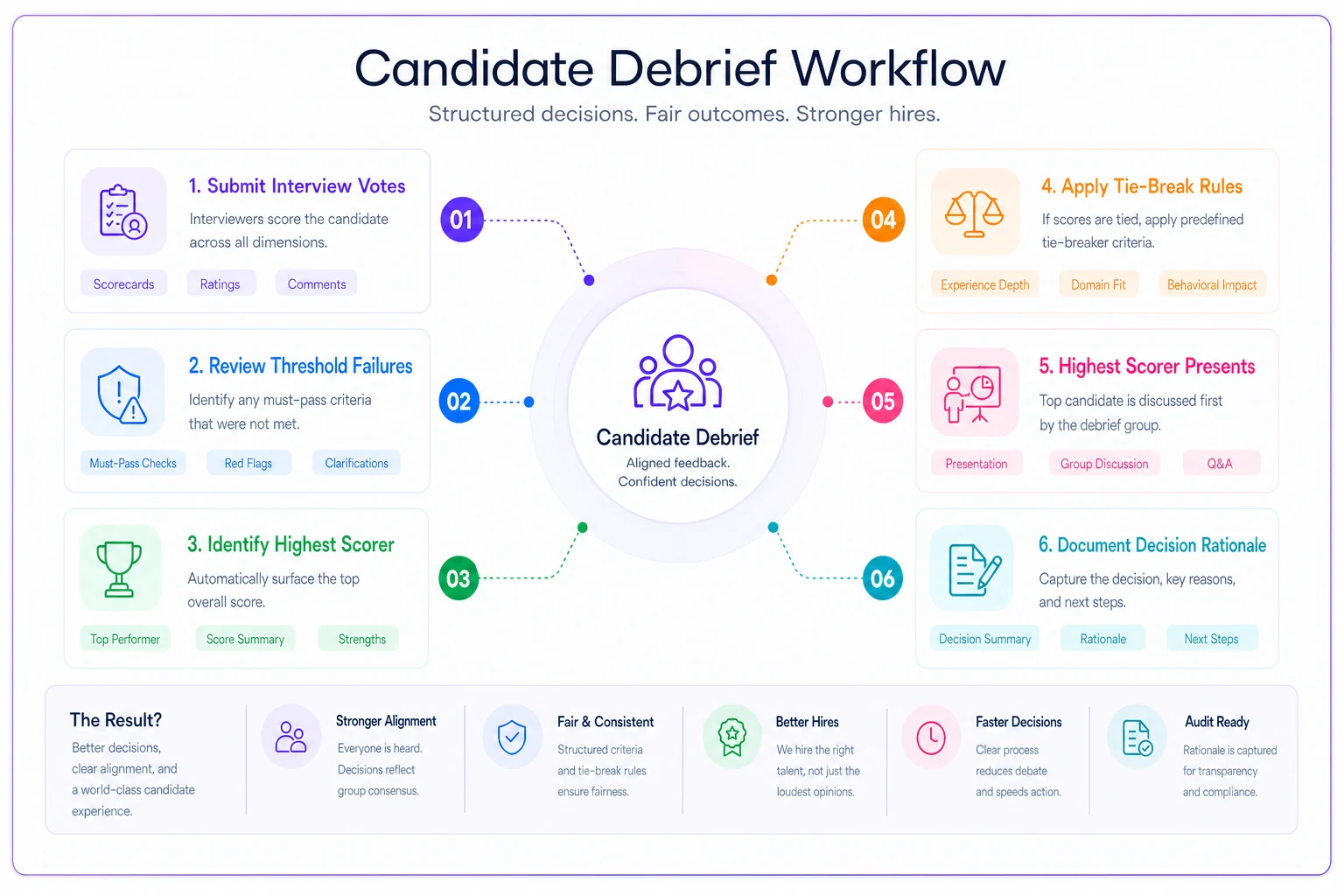
The whole debrief should take 15-20 minutes for a clear no, around 30 minutes for a clear yes, and 45 minutes absolute maximum for genuinely borderline cases.
Real-world scorecard transformation
A 200-person SaaS company was averaging two-hour debriefs and had two discrimination claims in one year from rejected candidates. Their scorecards were basically free-form text boxes with 1-5 ratings and no structure around them.
They rebuilt everything with five role-family templates, behavioral anchors for every score, must-have thresholds clearly marked, mandatory example fields, and documented tie-break rules.
Six months later, average debrief time dropped to around 30 minutes. Zero discrimination claims, largely because the documentation was actually usable. Quality of hire scores went up roughly 20% based on manager ratings at the 90-day mark, and interviewers felt noticeably more confident in their assessments.
They didn't start with a perfect system. They launched with just two role families and basic behavioral anchors. But having any structure beat the free-for-all they'd been running.
The operational reality of scorecard design
Scorecard design feels like administrative overhead until you're sitting in your third hour-long debrief of the week, arguing about whether "good communication" means the same thing to everyone in the room. Or worse, trying to explain eight months later why you rejected a candidate who's now filing a discrimination claim.
The teams that get this right don't treat scorecards as forms to fill out. They treat them as operational tools that enforce consistency, speed up decisions, and create defensible documentation. Once you've got the foundation working, you can layer in operational software to handle submission tracking, threshold checking, and debrief scheduling automatically — but the structure has to come first. Automation on top of a broken process just makes the problems faster.
Start with one role family. Build behavioral anchors for the three most important competencies. Add threshold requirements. Run it through five hires, then expand. The goal isn't a perfect academic framework — it's a practical tool that makes your Monday morning debrief take 25 minutes instead of 90.
Your next hire is probably being interviewed this week. If your scorecard doesn't have behavioral anchors, enforceable thresholds, and tie-break rules, you're about to waste another afternoon debating subjective opinions instead of comparing observable behaviors. The fix takes a couple hours of upfront design work. Every hiring decision after that gets faster, clearer, and easier to defend.
Ready to elevate your hiring process?
Join 1,500+ recruiting teams using Recioly to save time, improve collaboration, and hire smarter.