


Most recruiting teams measure everything but enforce nothing. They've got conversion rates for each stage, time-to-fill metrics, quality-of-hire scores—all sitting in spreadsheets that nobody looks at until something goes catastrophically wrong. The data exists, but there's no system that forces anyone to actually use it when making hiring decisions.
I spent the last eighteen months watching recruiting teams try to become "data-driven" and fail in pretty predictable ways. They'd implement fancy dashboards, set up tracking for every possible metric, then continue making the same gut-based decisions they always had. The problem wasn't the data. It was the absence of enforcement mechanisms that made the data matter.
What breaks: a recruiter sees that phone screen pass rates have dropped from 65% to 35% over the past month, but there's no automatic trigger forcing a review of the screening criteria. A hiring manager rejects 12 straight candidates without any escalation. Interview-to-offer ratios tank for a specific role, but nobody notices until the position has been open for four months.
The teams that actually succeed at data-driven hiring don't just measure—they build systems with teeth. Automatic escalations when metrics drift. Mandatory review meetings when conversion rates tank. Decision thresholds that can't be quietly ignored.
Why measurement without enforcement creates worse outcomes than no measurement at all
Tracking metrics without enforcement mechanisms creates a dangerous illusion of control. Everyone thinks the system is working because the numbers exist. Meanwhile, actual hiring decisions happen in complete isolation from those numbers.
Take a typical mid-size tech company recruiting operation. They're tracking:
-
Application-to-screen ratio
8%
-
Screen-to-interview ratio
42%
-
Interview-to-offer ratio
18%
-
Offer acceptance rate
71%
Looks comprehensive. But here's what actually happens day-to-day:
A recruiter notices their screen-to-interview ratio dropped to 20% for engineering roles. They mention it in passing during a team meeting. The manager says "let's keep an eye on it." Three weeks later, it's at 15%. Nobody remembers the earlier conversation. Two months later, engineering leadership complains about the lack of candidates reaching final rounds. Only then does someone pull the historical data and realize the problem started 10 weeks ago.
Or worse—the data shows clear patterns but nobody has the authority to act on them. A particular hiring manager rejects candidates at 3x the rate of their peers. Everyone knows it, the data proves it, but there's no mechanism to force a conversation about their evaluation criteria. The pattern continues, that team stays understaffed, and eventually good recruiters just stop sending candidates their way.
The measurement theater continues while real problems compound. You end up with recruiting teams that can tell you exactly how broken their process is but have no power to fix it.
Building enforcement mechanisms for each hiring stage
Application Review Stage
Never lose track of top talent again.
Recioly helps you manage every stage of recruiting efficiently, from application to offer.
- Centralized candidate tracking
- Automated interview scheduling
- Collaborative hiring workflows
No credit card required
Key Metrics:
-
Application completion rate
-
Time from application to first review
-
Reviewer agreement rate (for dual-review systems)
-
Source quality score
Weekly Enforcement Cadence:
Every Monday at 9am, an automated report triggers showing any role where:
-
Applications sit unreviewed for more than 72 hours
-
Completion rates drop below 60%
-
Reviewer disagreement exceeds 40%
If any threshold is breached, the responsible recruiter has 24 hours to either clear the backlog or escalate to their manager with a specific blocker. No exceptions.
Decision Rules:
When application volume exceeds 150% of normal:
-
Automatic escalation to recruiting ops
-
Mandatory decision within 4 hours
add reviewer capacity or tighten pre-screening
-
If no decision made, applications auto-pause until resolved
When completion rates drop below 50%:
-
Application process audit triggered
-
Must identify and fix the dropout point within 48 hours
-
If not fixed, role posting suspended
Phone Screen Stage
Key Metrics:
-
Schedule-to-complete rate
-
Pass rate by recruiter
-
Candidate feedback scores
-
No-show rate
Weekly Review + Monthly Calibration:
Wednesday 2pm weekly: Any recruiter with pass rates outside the 40–60% range must present three recorded screens for team calibration. Monthly first Monday: Full team calibration on borderline candidates. Must reach 80% agreement or screening criteria get revised.
Enforcement Thresholds:
No-show rate above 20%:
-
Mandatory switch to different scheduling system
-
Add confirmation touchpoint 24 hours prior
-
Escalate if continues for 2 weeks
Pass rate variance more than 25% between recruiters:
-
Immediate pair-screening requirement
-
Must complete 5 joint screens before returning to solo
-
Manager reviews all borderline decisions
Individual recruiter pass rate below 30% or above 70%:
-
Automatic calibration trigger
-
Must shadow senior recruiter for next 10 screens
-
Manager approval required for all decisions until normalized
Technical/Skill Assessment Stage
Key Metrics:
-
Assessment completion rate
-
Score distribution by evaluator
-
Time from invite to completion
-
Correlation with later interview performance
Bi-weekly Technical Reviews:
Every other Thursday: Review all assessments with scores in the bottom or top 20%. If more than 30% get overturned on review, assessment criteria must be revised within one week.
Monthly Correlation Check:
First Tuesday monthly: Compare assessment scores with interview outcomes. If correlation drops below 0.4, assessment must be redesigned or eliminated.
Hard Thresholds:
Completion rate below 65%:
-
Assessment must be shortened by 25%
-
Or switched to alternative format
-
Decision required within 72 hours
Single evaluator's scores deviate more than 1.5 standard deviations:
-
All their assessments flagged for secondary review
-
Must complete evaluator recalibration before continuing
-
If pattern persists for two cycles, removed from evaluation pool
Interview Stage
Key Metrics:
-
Interview-to-decision time
-
Interviewer participation rate
-
Score variance by interviewer
-
Candidate experience ratings
Weekly Pipeline Review:
Every Friday at 10am: Any candidate stuck in the interview stage for more than 10 business days gets automatic escalation. Hiring manager must provide a decision or specific next steps within 24 hours.
Monthly Interviewer Audit:
Third Wednesday monthly: Review all interviewers with participation rate below 75%, score variance outside normal range, or candidate experience rating below 7/10.
Non-compliant interviewers get one warning, then removal from the interview pool.
Real-time Enforcement:
If an interviewer doesn't submit feedback within 24 hours:
-
Automated reminder at 24 hours
-
Manager CC'd at 48 hours
-
Escalation to department head at 72 hours
-
Interviewer locked out of system until feedback submitted
If three interviewers score a candidate oppositely (yes/yes/strong no):
-
Automatic debrief requirement within 48 hours
-
Must identify scoring criteria misalignment
-
Cannot proceed to decision until aligned
Offer Stage
Key Metrics:
-
Offer acceptance rate
-
Time from decision to offer
-
Negotiation cycles
-
Competitive loss rate
Daily Offer Review:
Every morning at 8:30am: Any offer pending more than 48 hours triggers automatic escalation:
-
Recruiter manager (hour 48)
-
HR Director (hour 72)
-
Department head (hour 96)
Weekly Competitive Intelligence:
Monday 3pm: Review all declined offers. If acceptance rate drops below 65%, mandatory comp review with finance within 72 hours.
Enforcement Mechanisms:
Offer approval taking more than 24 hours:
-
Auto-escalation to next approval level
-
If pattern repeats 3 times, approver removed from chain
Acceptance rate below 60% for specific role:
-
Immediate comp analysis required
-
Must adjust range or improve sell process
-
Decision documented within one week
Decision documented within one week
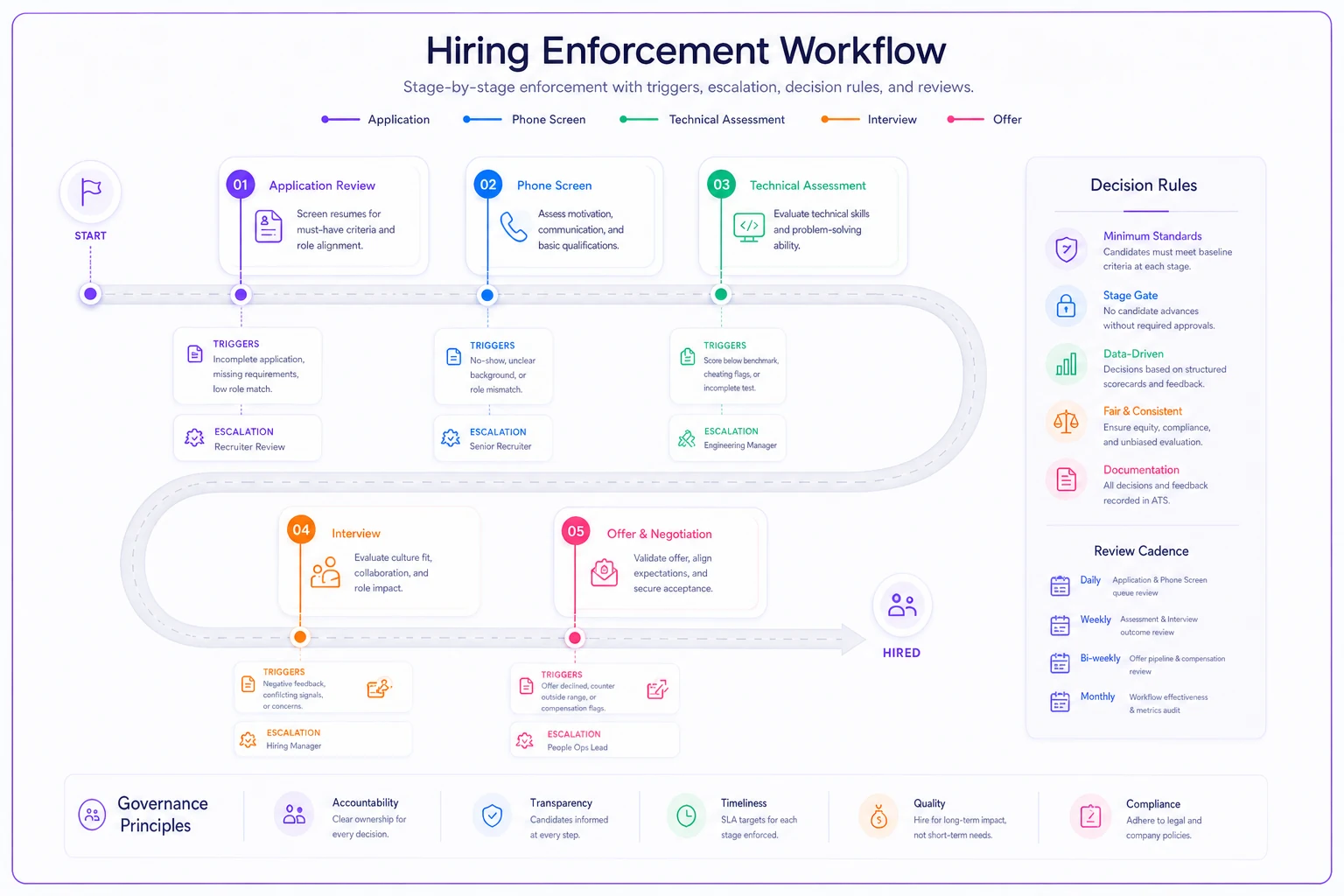
The enforcement mechanisms above map to automated triggers, mandatory reviews, and escalation chains that are auditable and time-boxed.
The quarterly calibration system that keeps everything aligned
Every quarter needs a complete system review, but most teams treat this as a reporting exercise rather than an enforcement checkpoint.
Quarterly Business Review Format
Week 1 of Quarter: Data Preparation
Pull all metrics for the previous quarter—but don't just pull numbers, pull specific examples:
-
Three best hires with their path through the funnel
-
Three rejected candidates who got hired elsewhere successfully
-
Every instance where a threshold was breached
-
Every escalation that occurred and its resolution
Week 2: Stage-by-Stage Deep Dives
Monday: Application stage review
-
Compare source performance to cost
-
Identify any sources below 5% conversion
-
Make keep/cut decisions (not recommendations—actual decisions)
Tuesday: Screen stage review
-
Play back 5 random recorded screens per recruiter
-
Score independently, then compare
-
Anyone with more than 30% variance gets retrained
Wednesday: Assessment review
-
Compare assessment scores to 90-day performance ratings
-
If correlation is below 0.5, assessment gets redesigned
-
No exceptions, no delays
Thursday: Interview stage review
-
Analyze interviewer reliability scores
-
Bottom 20% of interviewers get removed or retrained
-
Review every candidate who spent more than 15 days in process
Friday: Offer stage review
-
Break down every declined offer by reason
-
Identify patterns in compensation, timing, or competition
-
Adjust offer strategy for next quarter
Week 3: Enforcement Mechanism Audit
This is where most teams fail. They review the metrics but not the enforcement system itself.
Check every automatic trigger:
-
How many times did it fire?
-
How many times was it overridden?
-
What was the resolution time?
If any enforcement mechanism was overridden more than 30% of the time, it either needs to be adjusted to be more realistic, given more teeth through higher escalation, or eliminated as useless.
Week 4: Forward-Looking Adjustments
Based on everything learned, adjust:
-
Thresholds (tighter or looser based on reality)
-
Escalation chains (add or remove levels)
-
Review cadences (increase or decrease frequency)
-
Decision authorities (who can override what)
Based on everything learned, adjust:
When automated escalations beat human judgment
There's this persistent belief that experienced recruiters should be able to override the system when they "know better." That belief kills data-driven hiring faster than anything else.
A real example: a 200-person startup had clear thresholds—if a hiring manager rejected more than 5 candidates in a row, it triggered a criteria review. But they added an override: recruiters could skip the escalation if they felt candidates genuinely weren't qualified.
The override got used 94% of the time. The whole system became meaningless. One hiring manager rejected 18 consecutive candidates over three months, and each time the recruiter justified it as candidates just not being strong enough. When they finally did a forced review, they found the manager was evaluating against criteria that didn't match the job posting at all.
Automated escalations work because they're ruthlessly consistent. When your ATS detects that phone screen pass rates dropped 30% week-over-week, it doesn't care that the recruiter thinks they're "maintaining a high bar." It forces the conversation that humans routinely avoid.
The key is making these escalations impossible to ignore. Lock access to scheduling tools until the review happens. Automatically CC the next-level manager after 24 hours. Prevent new job postings until issues are resolved. Auto-generate calendar holds that can't be declined.
One company implemented a simple rule: if any stage's conversion rate dropped by more than 40%, all recruiting for that role paused automatically. No override possible below VP level. In the first month, it caught three real problems—a technical assessment that was literally throwing an error page, an interviewer who had been rejecting everyone based on personal bias, and a job description that didn't reflect what the team actually needed.
Building review agendas that actually drive decisions
Weekly Team Review (30 minutes max)
First 5 minutes: Automated Scorecard
-
Red metrics (outside threshold)
-
Yellow metrics (trending wrong direction)
-
Green metrics (within bounds)
No discussion of green metrics allowed.
Next 15 minutes: Red Metrics Only
-
What's the root cause? (2 minutes max)
-
What's the fix? (1 minute to propose)
-
Who owns it and by when? (30 seconds)
If discussion exceeds the time limit, it gets escalated to a separate deep-dive.
Final 10 minutes: Decision Queue
-
Approve override request? Yes/No
-
Add interview capacity? Yes/No
-
Adjust compensation range? Yes/No/Escalate
-
Remove underperforming source? Yes/No
No "let's think about it." Every item gets a decision or formal escalation.
Monthly Department Review (60 minutes)
First 15 minutes: Trend Analysis
-
Show 3-month trends for each key metric
-
Identify any metric that's deteriorated for 2 or more months
-
No solutions discussed yet—just problem identification
Next 20 minutes: Forced Rankings
-
All sources by ROI
-
All interviewers by reliability score
-
All roles by time-to-fill vs. importance
-
All recruiters by composite performance
Bottom 20% of each category must have an improvement plan or get cut.
Next 15 minutes: Resource Allocation
-
Recruiter assignments (move best recruiters to hardest roles)
-
Interview slots (reduce for poor interviewers)
-
Source budget (cut bottom performers, increase top)
Final 10 minutes: Policy Changes
-
New thresholds needed?
-
New escalation paths?
-
New decision authorities?
Must be implemented before next monthly review.
The tie-breaking rules that prevent analysis paralysis
When metrics conflict, most teams get stuck in endless debate. You need pre-agreed tie-breaking rules that make decisions automatic.
Scenario-Based Decision Rules
| Conflict | Primary Rule | Secondary Rule | Tie-Breaker |
|---|---|---|---|
| Speed vs. quality | Quality wins for senior (L5+) or critical-path roles | Speed wins for junior or high-volume roles | Hiring manager preference with VP approval |
| Candidate experience vs. efficiency | Experience wins for passive or executive candidates | Efficiency wins for active or junior candidates | Market conditions (candidate-driven = experience) |
| Cost vs. speed | Cost wins if department is over budget | Speed wins for revenue-generating roles | CFO makes call within 24 hours |
| Hiring manager vs. recruiter assessment | Recruiter wins on culture and soft skills | Hiring manager wins on technical skills | Skip-level manager interviews candidate |
Numerical Thresholds for Auto-Decisions
-
If phone screen pass rate drops below 25%, auto-trigger
loosen screening criteria by one level.
-
If interview-to-offer ratio drops below 10%, auto-trigger
reduce interview rounds by one.
-
If offer acceptance falls below 50%, auto-trigger
increase offer range by 10%.
-
If time-to-fill exceeds 90 days, auto-trigger
add contract recruiter or agency.
-
If candidate experience scores drop below 6/10, auto-trigger
reduce process by 25% or add human touchpoints.
These aren't suggestions—they're automatic. The system makes the change unless explicitly overridden at the C-level.
Making measurement stick when everyone wants to return to gut feelings
The hardest part isn't building the system—it's maintaining it when things get urgent. The moment hiring gets stressful, everyone wants to abandon the process and just make good hires.
Lock enforcement into the tools themselves. Don't rely on people remembering to check thresholds. Build them into your ATS so certain actions literally can't happen until conditions are met. Can't schedule an interview until phone screen feedback is submitted. Can't extend an offer until all interviewers have scored. Can't post a new req until the previous role's metrics are reviewed.
Make the data visible everywhere. Put a dashboard on screens in the recruiting area. Add metric summaries to every calendar invite for hiring meetings. Include threshold status in email signatures. Make it hard to ignore the numbers.
Celebrate enforcement, not just outcomes. When someone triggers an escalation that catches a problem early, make it public. When a threshold prevents a bad hire, document and share it. Following the system should feel like a badge of honor, not bureaucracy.
Start with willing early adopters. Pick one team that actually wants to be data-driven. Build the system with them, prove it works, then expand. Nothing convinces skeptics like seeing their peers succeed with the same constraints they claim are impossible.
One startup tied recruiter bonuses to enforcement compliance, not just hiring metrics. If you overrode thresholds without proper escalation, it hit your quarterly bonus directly. Compliance went from around 40% to 95% in one quarter.
The operational reality of keeping this system running
Running a truly data-driven hiring system isn't a set-it-and-forget-it situation. It needs constant maintenance, adjustment, and sometimes complete overhauls. Most teams underestimate the operational overhead by a wide margin.
You need someone owning this full-time. Not a recruiter with "additional duties" but someone whose primary job is maintaining the measurement system—tracking whether escalations are firing correctly, adjusting thresholds as the business changes, and pushing back against the constant drift toward gut decisions.
The tools matter too. Spreadsheets won't hold this together. You need systems that can automatically track metrics, fire escalations, and prevent process violations. Most ATS platforms handle basic tracking, but the enforcement layer usually needs custom configuration or additional tooling. AI-powered operational software can monitor patterns across your pipeline, surface when metrics are trending toward a breach before they actually breach, and automatically adjust review schedules based on workload shifts.
Track override rates weekly and publish them in the team scorecard to spot erosion early.
Weekly maintenance tasks: check every automated trigger, review override requests, adjust thresholds based on the past week's data. Monthly: recalibrate scoring rubrics, audit interviewer performance, update decision trees. Quarterly: complete system reviews, interviewer retraining, threshold adjustments based on strategy changes.
The compound effect is real. After six months of disciplined enforcement, most teams see meaningful reductions in time-to-fill, better offer acceptance rates, and a significant drop in early turnover. But only if you maintain the discipline. The moment you start making exceptions, the system erodes. That's why enforcement mechanisms need to be automatic, escalated, and structurally difficult to ignore—the system has to be stronger than any individual's desire to bypass it.
Building your first 90-day implementation roadmap
Don't try to implement everything at once. Here's a realistic rollout:
Days 1–30: Foundation
-
Pick your five core metrics (no more)
-
Set initial thresholds based on current performance
-
Build basic tracking into your existing tools
-
Create simple weekly review agenda
-
Run practice reviews without enforcement
Days 31–60: Enforcement Layer
-
Add automatic escalations for two critical metrics
-
Implement first tie-breaking rules
-
Create override request process
-
Start weekly enforcement reviews
-
Document every exception and why
Days 61–90: Expansion
-
Add remaining metrics to enforcement system
-
Implement monthly calibration sessions
-
Create quarterly review process
-
Train all stakeholders on escalation chains
-
Begin measuring enforcement compliance itself
The teams that succeed treat this like any other critical business system—with dedicated resources, clear ownership, and non-negotiable standards. The ones that fail treat it like a nice-to-have overlay on their existing process.
Measurement without enforcement is expensive theater. Build the enforcement mechanisms first, make them automatic, and give them real power to change outcomes. That's when hiring actually becomes data-driven instead of just data-decorated.
Ready to elevate your hiring process?
Join 1,500+ recruiting teams using Recioly to save time, improve collaboration, and hire smarter.