


Most recruiting teams build bias reduction backwards. They start with training sessions about unconscious bias, add diversity statements to job posts, then wonder why their hiring outcomes look exactly the same six months later.
The problem isn't awareness—it's operational design. After helping dozens of companies rebuild their hiring workflows, the pattern becomes obvious: bias lives in the gaps between good intentions and actual screening decisions. You need systematic controls, not inspirational posters.
Where Operational Inclusive Hiring Actually Breaks
Bias doesn't announce itself during hiring. It slides through standard workflows that seem perfectly reasonable until you audit the outcomes.
Take sourcing patterns. A growing tech company I worked with insisted they posted jobs everywhere. Their ATS data showed 14 different job boards. Sounds diverse, right? The outcome audit revealed 78% of hires came from the same two universities and three referral sources. The other 12 posting channels were basically window dressing.
This happens because recruiting teams optimize for speed under pressure. When you need to fill 8 positions this month, you naturally gravitate toward channels that worked before. Your brain doesn't consciously think "let's only hire from these schools"—it thinks "these candidates moved fast last time."
The compounding effect destroys diversity over time. Each successful hire from the same source reinforces the pattern. Hiring managers start saying things like "we need someone who fits our culture" which really means "someone from the same background as our last three hires."
Manual screening amplifies these patterns. Recruiters spending 6 seconds per resume don't carefully evaluate each candidate against objective criteria. They pattern-match against successful past hires. If your last five good engineers went to MIT, your brain automatically lights up when it sees MIT on a resume.
Structured interviews fail without operational controls too. Companies create elaborate interview rubrics, train their interviewers extensively, then throw it all away when the hiring manager says "I just have a good feeling about this one."
The Sourcing Control Framework
Real operational inclusive hiring starts with sourcing targets, not job posts. You need predetermined ratios before you start collecting applications.
Never lose track of top talent again.
Recioly helps you manage every stage of recruiting efficiently, from application to offer.
- Centralized candidate tracking
- Automated interview scheduling
- Collaborative hiring workflows
No credit card required
Set channel quotas upfront. Before posting anywhere, document your sourcing mix. For a standard professional role, aim for something like:
-
Traditional job boards
25%
-
University partnerships (including HBCUs, community colleges)
20%
-
Professional associations (especially underrepresented groups)
20%
-
Internal referrals
15%
-
Direct outreach
20%
Track source effectiveness by conversion, not volume. Most companies celebrate getting 500 applications from Indeed while ignoring that only 2 converted to hires. Meanwhile, that partnership with the local coding bootcamp generated 12 applications and 3 hires.
Build source-specific messaging. Generic job posts perform terribly with diverse candidates. A posting that resonates with Stanford MBA grads won't connect with self-taught developers from coding bootcamps. You need different messaging for different channels—same role, different framing.
Every Monday morning, pull your source distribution report.
Are you hitting your targets? If referrals are at 45% instead of 15%, you've got a problem regardless of how many diversity training sessions you've conducted.
Anonymized Screening Workflows That Scale
Removing bias during resume review requires more than just hiding names. You need systematic anonymization that doesn't slow down hiring.
Start with data extraction, not redaction. Instead of trying to black out identifying information on resumes, extract the relevant data into standardized formats. Pull out:
-
Years of experience
-
Technical skills
-
Quantified achievements
-
Relevant certifications
-
Education level (not school names)
Create evaluation templates that force objective scoring. Each requirement gets a 1-5 scale with specific anchors. "Experience with Python" becomes:
-
No mention of Python
-
Python listed, no context
-
1-2 years Python experience
-
3-5 years Python with deployed projects
-
5+ years Python with architectural decisions
The workflow sequencing prevents contamination. Screener A evaluates anonymized profiles and passes candidate IDs to the next stage. Screener B schedules interviews without seeing the initial scores. The hiring manager only sees de-anonymized profiles after the phone screen.
Here's a simple workflow diagram of the anonymized screening process.
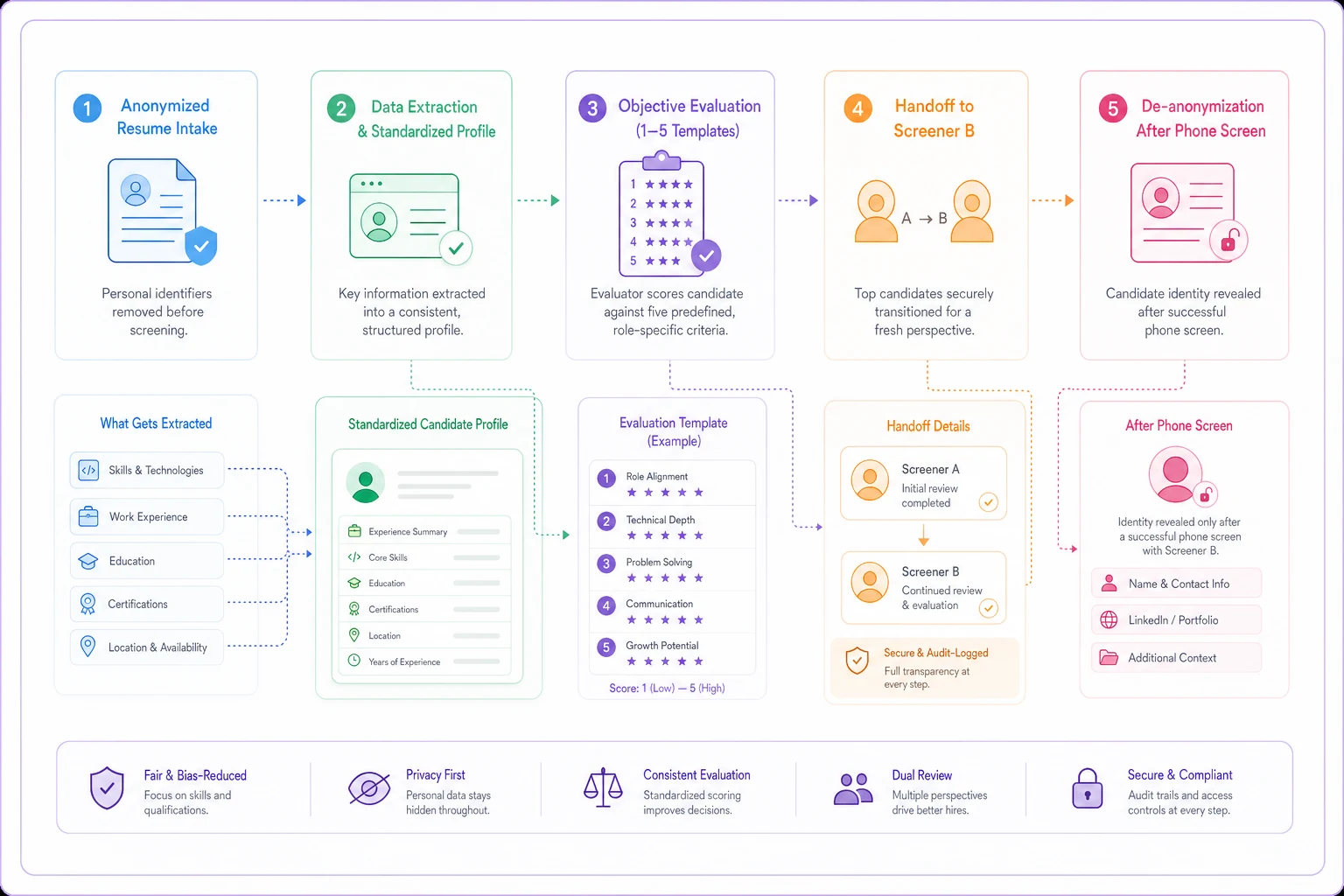
This sounds complicated but it's not. A marketing agency I worked with implemented this using basic spreadsheets and saw their diversity hire rate jump from 12% to 34% in four months. They spent maybe 2 extra hours per week on process overhead.
Building Calibration Rituals
Interview calibration usually means one training session where everyone nods along then goes back to their subjective preferences. Real calibration requires ongoing operational rituals.
Weekly calibration sessions work better than quarterly training. Every Friday, gather interviewers who conducted sessions that week. Review one recorded interview together—everyone scores independently, then compares notes. The gaps in scoring reveal bias patterns.
Create "shadow interview" rotations. New interviewers shadow experienced ones for their first 5 interviews. Experienced interviewers shadow each other once per month. They score independently, then compare. Scoring gaps over 20% trigger recalibration.
Document decision reversals. When a hiring manager overrules interview panel recommendations, require written justification. Review these monthly. Patterns emerge quickly—the engineering manager who consistently rejects qualified female candidates, the sales director who only advances candidates from specific backgrounds.
The uncomfortable truth about calibration: it reveals how arbitrary most hiring decisions really are. Two experienced interviewers watching the same interview often disagree completely. That's not failure—it's awareness that drives improvement.
Scheduled Outcome Audits
Most companies audit hiring when someone complains or when lawyers get involved. By then, patterns are entrenched and fixes are expensive. Operational inclusive hiring means regular audits before problems compound.
Monthly Pipeline Health Checks
Funnel Analysis by Demographics
Compare conversion rates at each stage. If women convert from application to phone screen at 8% while men convert at 24%, you've found a leak. Don't just note it—dig into which reviewers show the biggest gaps.
Source Channel Performance
Track which channels produce diverse hires, not just diverse applicants. That university partnership might generate 100 diverse applications, but if none convert to offers, the partnership isn't working.
Interviewer Scoring Patterns
Plot each interviewer's scores by candidate demographics. Some patterns are obvious—the interviewer who rates every diverse candidate 2 points lower than average. Others are subtle—the interviewer whose scores correlate with whether candidates went to "name brand" schools.
Quarterly Deep Dives
Every quarter, conduct deeper analysis:
Review recorded interviews from borderline decisions. Why did Candidate A advance with a 3.2 average while Candidate B got rejected with a 3.4? Document the subjective factors that tipped decisions.
Survey rejected candidates about their experience. Low response rates are normal, but patterns in feedback are valuable. If multiple underrepresented candidates mention feeling rushed or dismissed, that's actionable data.
Analyze "quality of hire" metrics by source and interviewer. Which interviewers' recommendations correlate with 12-month retention? Which sources produce high performers versus quick departures?
Annual Systemic Reviews
Once per year, step back for systemic analysis.
Compare your hiring demographics to your market's qualified talent pool. If your local market has 30% female software engineers but you're hiring 10%, something's broken operationally.
Audit job requirement inflation. That "10 years experience" requirement you added last year—did hires actually have 10 years? Requirement inflation excludes diverse candidates who don't overclaim qualifications.
Review promotion and retention by hiring source. If referral hires get promoted 2x more often than other sources, you're creating systemic advantages that compound over time.
The Audit Report Template That Drives Action
Generic audit reports get filed and forgotten. You need templates that force specific actions.
Section 1: The Numbers That Matter
| Metric | Current State | Market Benchmark | Trend |
|---|---|---|---|
| Team composition vs market | 15% underrepresented | 28% available talent | -2% YoY |
| Application conversion rate | 12% diverse, 23% overall | Industry avg 18% | Stable |
| Cost per diverse hire | $8,500 | $6,200 overall | +15% YoY |
Section 2: The Breakage Points
Document the top 3 stages where diverse candidates drop disproportionately, specific interviewers showing bias patterns, and source channels underperforming on diversity. No sugarcoating.
Section 3: The Required Actions
Not recommendations—requirements. Each action needs specific owner, completion deadline, success metric, and budget if needed.
Example: "Sarah (Recruiting Manager) will establish 3 new sourcing partnerships with HSI-serving institutions by March 31. Success = 20+ qualified candidates from these sources in Q2. Budget = $3,000 for job board partnerships."
Section 4: The Resistance Points
-
"Engineering claims they can't find qualified diverse candidates"
-
"Sales director insists culture fit matters most"
-
"CEO wants to prioritize speed over process"
These aren't footnotes—they're the actual barriers to operational change.
Corrective Actions That Stick
Most corrective actions fail because they're either too vague ("increase diversity outreach") or too punitive ("mandatory 8-hour training for everyone").
Start with process fixes, not people fixes. If five interviewers show bias patterns, the problem isn't five bad people—it's a process that allows bias. Change the workflow before attacking individuals.
For sourcing problems, implement channel minimum requirements. No moving to interview stage until you have:
-
At least 30% of candidate pool from underrepresented groups
-
At least 3 sources represented
-
At least 2 non-referral qualified candidates
For screening bias, add buffer stages. Instead of one person deciding who advances, require two independent reviews. Disagreements go to a third reviewer. This triples screening time initially but drops to 1.5x once people calibrate.
For interview bias, rotate panel composition. The same three engineers interviewing every candidate creates echo chambers. Mix panels by department, seniority, and background.
The Technology Integration Point
Manual tracking of all these controls becomes impossible at scale. Spreadsheets work for 10 hires per month, but break at 50.
AI-powered operational software makes the difference here. Modern platforms can automatically anonymize applications, distribute them for blind review, track scorer patterns, and flag statistical anomalies in real-time.
The key isn't replacing human judgment—it's augmenting human operations with systematic controls. AI agents handle the anonymization, distribute reviews evenly, compile calibration data, and generate audit reports automatically. Humans still make hiring decisions, but within frameworks that structurally reduce bias.
Small companies often assume they can't afford sophisticated hiring operations software. But the cost calculation flips when you factor in bad hires, legal risk, and lost talent. A retail chain I worked with spent $40k annually on hiring software but saved $200k in reduced turnover and avoided one discrimination lawsuit that would have cost millions.
When This Actually Makes Business Sense
Not every company needs this level of operational rigor. If you're hiring 2 people per year, elaborate controls create more friction than value.
This framework makes sense when:
-
You're hiring more than 20 people annually
-
You're in regulated industries with compliance requirements
-
You've noticed homogeneous team composition limiting innovation
-
You're scaling rapidly and need to build diverse talent pipelines
-
Legal and PR risks from biased hiring could damage your business
Skip this framework if you're a tiny team where everyone knows each candidate personally, you're in a hyper-specialized field with genuinely limited talent pools, or you're prioritizing speed over everything else (though this usually backfires).
Building Sustainable Inclusive Operations
Real operational inclusive hiring isn't about perfection—it's about systematic improvement. Every audit reveals new breakage points. Every corrective action creates new edge cases.
The goal isn't eliminating bias entirely (impossible) but reducing it systematically over time. Companies succeeding at this treat inclusive hiring like any other operational system. They measure it, optimize it, document it, and improve it continuously. They don't rely on good intentions or inspiring mission statements.
They build processes that structurally promote fairness even when individuals make imperfect decisions.
Most importantly, they recognize that inclusive hiring isn't a compliance exercise or PR initiative—it's operational excellence. Systematic hiring processes that reduce bias also reduce bad hires, accelerate time-to-fill, and improve team performance. The same controls that promote diversity also promote quality.
The path forward is straightforward: audit your current state, implement systematic controls, measure outcomes regularly, and adjust based on data. Not because it's morally right (though it is) but because operational inclusive hiring builds stronger, more innovative, more resilient organizations.
Ready to elevate your hiring process?
Join 1,500+ recruiting teams using Recioly to save time, improve collaboration, and hire smarter.