


Most recruiting teams think their interview process breaks because they don't have enough interviewers. The real problem runs deeper. It's not a headcount issue—it's an architecture issue.
Think about what happens when you go from hiring 5 engineers a quarter to 15. You've tripled your interview load, but the senior engineers handling system design rounds? Same four people. Your behavioral interviewers might grow from 6 to 10, but now they're juggling product managers, engineers, and data scientists across completely different competency frameworks.
The system starts creaking around 12-15 hires per month. Candidates wait two weeks for final rounds because your VP of Engineering travels constantly. Your best technical screeners burn out after doing 8 interviews a week on top of their regular jobs. Recruiters start pulling in people who haven't interviewed in months and give wildly inconsistent scores.
What fixes this isn't recruiting harder or begging for more volunteers. You need a scalable interview process built on the same operational principles that manufacturing and logistics companies figured out decades ago: standardized tracks, rotation schedules, capacity planning, and redundancy rules.
Why traditional interview scheduling creates its own ceiling
Picture how most companies schedule interviews. A recruiter looks at a resume, decides the candidate needs a technical screen, a coding interview, a system design round, and a behavioral interview. Then they open everyone's calendars and play Tetris.
Fine at 3 interviews a week. Scale it to 30 and scheduling alone becomes a full-time job—before accounting for cancellations, sick days, or the one principal engineer who's the only person supposedly "qualified" to assess distributed systems.
-
Recruiters spend 3-4 hours per candidate on logistics. Dozens of emails back and forth. Candidates drop out because they can't wait three weeks for availability. Best interviewers hit 12+ interviews a week and their regular work suffers. New interviewers get thrown in without training because you're desperate.
-
The irony is most of these interviews follow predictable patterns. A backend engineer role needs roughly the same interview structure whether it's for the payments team or infrastructure. But every time, recruiters rebuild the wheel, hunting for the "perfect" combination.
What typically happens around the 20-hire mark:
Recruiters spend 3-4 hours per candidate on logistics. Dozens of emails back and forth. Candidates drop out because they can't wait three weeks for availability. Best interviewers hit 12+ interviews a week and their regular work suffers. New interviewers get thrown in without training because you're desperate.
Role families: the foundation of repeatable interview tracks
Instead of treating every hire as unique, group your roles into families with standardized interview tracks. Not identical—standardized. There's a difference.
Never lose track of top talent again.
Recioly helps you manage every stage of recruiting efficiently, from application to offer.
- Centralized candidate tracking
- Automated interview scheduling
- Collaborative hiring workflows
No credit card required
A role family shares core competencies and evaluation criteria. All your backend engineers, junior or senior, API team or data pipeline team, go through the same base track. You might layer on specialized rounds for specific teams, but the foundation stays consistent.
-
Engineering roles Frontend engineers (React/Vue specialists, mobile developers)
-
Engineering roles Backend engineers (API developers, service architects)
-
Engineering roles Infrastructure/DevOps engineers
-
Engineering roles Data engineers
-
Product & Design Product managers
-
Product & Design Product designers
-
Product & Design UX researchers
-
Operations Customer success managers
-
Operations Sales development reps
-
Operations Account executives
Each family gets its own interview track. Backend engineers always go through: a technical phone screen (45 min), a coding exercise (90 min), a system design discussion (60 min), and a behavioral interview with the hiring manager (45 min).
This does three things immediately. Interviewers know exactly what they're evaluating—no more confusion about whether to test algorithms or practical debugging. Candidates get consistent experiences regardless of which specific interviewers they meet. And you can actually plan capacity because you know how many coding interviews you'll need next month based on your pipeline.
Building interviewer pools with rotation schedules
Once you have role families defined, you need interviewer pools for each interview type within that family. Not individual interviewers—pools.
Most companies make the mistake of having their "best" technical interviewer handle all the hard assessments. This burns out your top performers and creates a bottleneck that's one vacation away from collapse. Build pools of 6-8 qualified interviewers for each interview type and rotate them on a schedule.
Here's a rotation model from a 150-person SaaS company worth borrowing:
For backend engineering coding interviews, they maintain a pool of 8 interviewers. Each commits to 2 slots per week, scheduled in advance for the full quarter. They rotate who takes which days—Monday/Wednesday slots go to one group, Tuesday/Thursday to another. Everyone gets predictability, nobody burns out.
They treat interviewing like on-call duties.
The detail that makes it work? They treat interviewing like on-call duties. You're either on the rotation or you're not. When you're on, those slots are blocked and protected. When you're off, you're completely off. No ad-hoc requests, no emergency coverage asks.
They also build in substitution rules. Each interviewer has a designated backup from the same pool. If someone's sick or has an emergency, their backup automatically covers. The backup knows this might happen and keeps those times reasonably clear.
Here's a simple workflow for interviewer rotations.
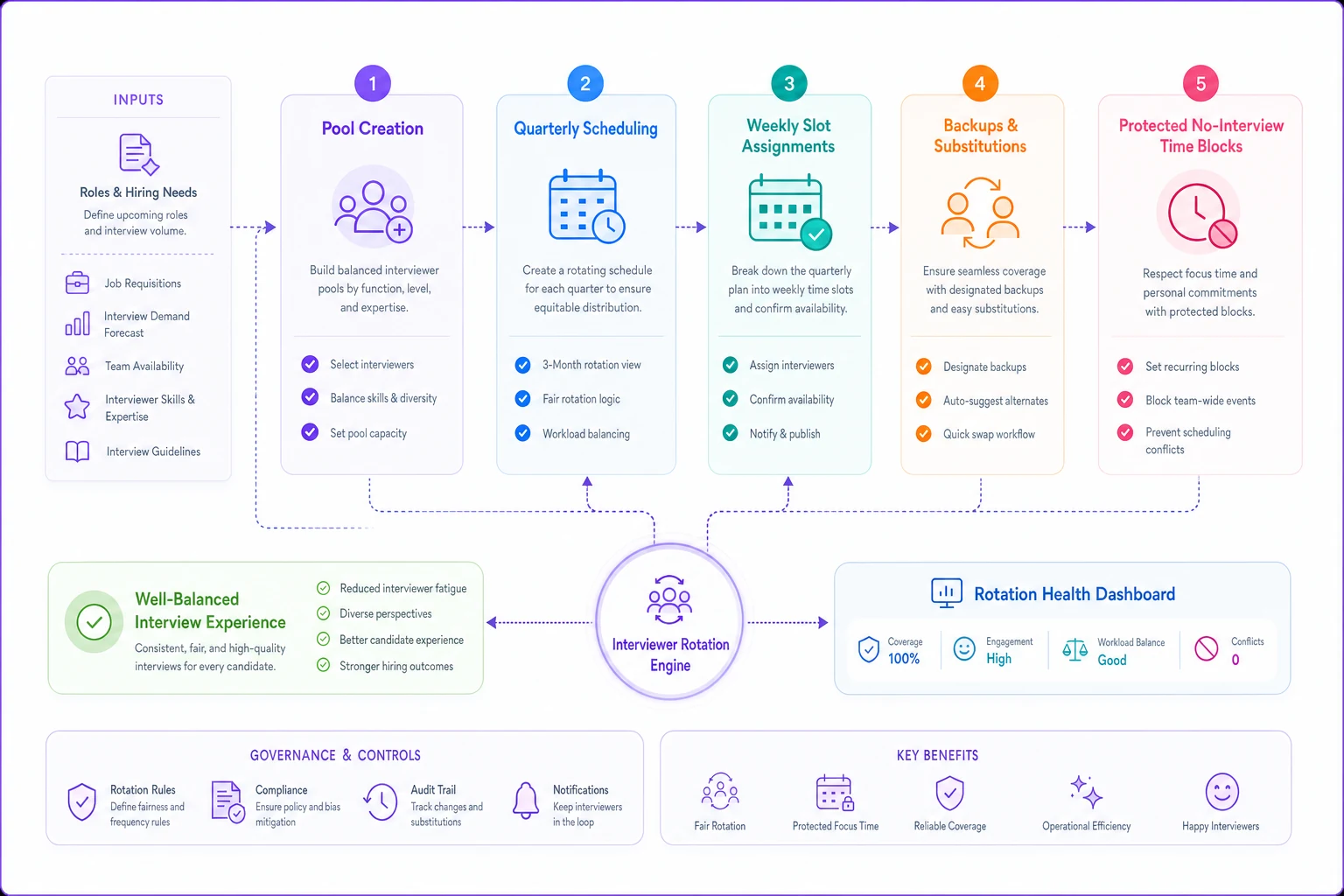
They also build in substitution rules. Each interviewer has a designated backup from the same pool. If someone's sick or has an emergency, their backup automatically covers.
Capacity math that actually works in practice
Most scaling companies never do the actual capacity math. They assume that if enough people are willing to interview, the system will hold together.
Walk through realistic capacity planning for a 100-person startup planning to hire 20 engineers next quarter.
Start with your track requirements. Each engineering hire needs:
-
1 technical screen (45 minutes)
-
1 coding interview (90 minutes)
-
1 system design interview (60 minutes)
-
1 behavioral/culture interview (45 minutes)
Now add reality. Not every candidate who gets a technical screen makes it to coding. Industry averages show roughly 50% pass rates at each stage, though it varies. To make 20 hires with a 25% offer acceptance rate, you need 80 offers. To get 80 offers, you need around 100 final-round candidates. Working backward through pass rates, that means roughly 400 technical screens.
400 technical screens × 45 minutes = 300 hours. Spread over 12 weeks, that's 25 hours per week just for technical screens. With prep and debrief time, round up to 35-40 hours weekly.
If each interviewer does 2 technical screens per week (90 minutes of interviewing plus about 30 minutes prep/debrief), you need a pool of 10-12 technical screeners. Not 3 or 4—which is what most companies have.
And here's the part everyone misses: buffer capacity. Interviewers get sick, take PTO, hit critical project deadlines. Build in at least 30% buffer. That pool of 10-12 becomes 13-15. Suddenly the math shows exactly why interview processes break—most companies are operating at roughly half the capacity they actually need.
Redundancy rules that prevent single points of failure
The biggest operational risk in interview processes isn't running out of interviewers. It's depending on specific individuals who become bottlenecks.
You know these people. The principal engineer who's the only one "qualified" to do system design rounds. The hiring manager who insists on personally running every final behavioral interview. The VP who wants to meet every candidate but travels three weeks per month.
-
No single-interviewer dependencies Every interview type must have at least 3 qualified interviewers in the pool. If you can't find 3 people capable of conducting a particular interview, the requirement itself is probably too narrow.
-
Maximum weekly load limits No interviewer does more than 4 interviews per week. Once someone hits their limit, the system routes to others in the pool. No exceptions.
-
Escalation timeboxes If a required interviewer can't schedule within 5 business days, the system automatically escalates to their designated backup. Define backups in advance—usually a peer manager or skip-level.
-
Panel overlap rules For panel interviews, no more than 50% of panelists from the same team. This ensures broader perspective and prevents entire panels from being unavailable due to team deadlines.
A marketing automation company learned this the hard way. Their technical co-founder insisted on personally vetting every engineer. When he got COVID and was out for two weeks, they lost 6 candidates who accepted offers elsewhere while waiting. Now they run a simple rule: if any single person's absence would delay interviews by more than 3 days, that's an architectural failure that needs fixing.
Interview track templates for different role families
Backend Engineer Track (4 stages, 4.5 hours total):
| Stage | Duration | Details |
|---|---|---|
| Stage 1: Technical screen | 45 min remote | Basic coding exercise in preferred language Discussion of recent technical projects Any interviewer from technical screen pool can conduct |
| Stage 2: Coding exercise | 90 min remote or onsite | Practical problem similar to actual work Focus on code quality, testing approach Conducted by coding interview pool (8-10 engineers) |
| Stage 3: System design | 60 min | Design a system relevant to your product domain Evaluate tradeoff thinking, not memorized patterns Senior engineer pool (5-6 people minimum) |
| Stage 4: Behavioral with hiring manager | 45 min | Team fit, communication style Career goals alignment Hiring manager or peer manager as backup |
Product Manager Track (4 stages, 4 hours total):
-
Stage 1
Product sense screen (60 min) - Product improvement exercise Market analysis discussion PM pool members (6-8 people)
-
Stage 2
Analytical exercise (90 min) - Data interpretation Metric definition and success measurement Data-savvy PM or analyst pool
-
Stage 3
Cross-functional simulation (60 min) - Mock feature planning with engineering/design Stakeholder management scenario Mixed pool of PMs and key stakeholders
-
Stage 4
Executive review (30 min) - Strategic thinking, cultural fit VP Product or Director as backup
Every stage has multiple qualified interviewers, clear evaluation criteria, and defined backups. No stage depends on one person's calendar.
Early warning systems for capacity problems
The best time to fix capacity problems is before candidates start dropping out. Build early warning indicators into your recruiting operations.
Track these weekly:
-
Average time from recruiter ready to interview scheduled
-
Percentage of interviews rescheduled due to interviewer availability
-
Number of candidates waiting more than 7 days for next stage
-
Interviewer load distribution (how many people at max capacity)
When any metric crosses your threshold, trigger your expansion protocol. Don't wait for the actual breakdown.
One useful pattern: a "yellow zone" system. When your technical screen pool drops below 5 available interviewers, that's yellow. Start training 2-3 new screeners immediately. When coding interview scheduling pushes beyond 10 days out, yellow. Add slots or temporarily raise the weekly limit for willing interviewers.
A 200-person fintech company tracks what they call "interview debt"—total hours of interviews needed based on current pipeline divided by available interviewer hours. When that ratio exceeds 0.7, they pull in backup interviewers and reduce non-critical meetings for the core pool. They haven't missed a hiring target in about 18 months.
Rotation schedules that prevent interviewer burnout
Burnout kills more scaling interview processes than raw capacity problems. Someone sharp and engaged at 2 interviews per week becomes robotic and checked-out at 6.
-
Quarter-based commitments
Interviewers join the pool for one quarter at a time. They know exactly when it starts and ends. This prevents the "forever interviewer" problem where good interviewers never get a break.
-
Weekly load balancing
Use round-robin within each pool. If Ahmad did 3 interviews last week and Beth did 1, Beth gets priority this week until loads even out.
-
Protected time blocks
Establish no-interview periods. Many companies protect Monday mornings and Friday afternoons. Others designate one full day per week as interview-free for deep work.
-
Recovery weeks
After particularly heavy interview periods—end-of-quarter hiring pushes, for instance—give core interviewers a full week off from the rotation, even if it means slower scheduling.
The rotation schedule also needs to account for seasonal patterns. University recruiting floods the system with entry-level candidates. End-of-year tends to bring more senior movement. Build your schedule assuming 20-30% surge capacity needs during those windows.
Technology coordination without overengineering
You don't need expensive scheduling software to run a scalable interview process. You need basic operational coordination that actually gets used.
-
Interviewer pool assignments A simple spreadsheet showing who's in which pool, weekly commitment, and designated backup. Update monthly, not daily.
-
Interview load tracking Another spreadsheet tracking interviews completed by person, by week. This feeds your rotation logic and flags overload early.
-
Track template library Document standard tracks for each role family—timing, evaluation criteria, and which pool covers each stage.
A lot of teams try to automate too much too early. They buy complex ATS systems with scheduling modules that need 40 hours to configure. Meanwhile, a shared Google Calendar per interviewer pool solves 80% of coordination problems.
The automation that actually helps comes from standardizing coordination patterns. Recurring calendar blocks for interview slots. Template emails for candidate scheduling. A simple Slack notification posting daily interview schedules. These compound into real time savings without requiring massive system changes.
Quarterly calibration to maintain system health
Your process needs regular tuning to stay effective. Every quarter, run a systematic review.
Start with interviewer pool health. Survey every interviewer: Are they burning out? Is the time commitment working? Do they need training updates? A short survey surfaces problems before they become crises.
Review track performance. Look at pass rates by stage—if your system design round fails 90% of candidates, either your phone screens aren't filtering or the bar is unrealistically high. Check time-to-hire by role family. If product managers consistently take 50% longer than engineers, find where the bottleneck actually sits.
Adjust capacity forecasts based on what's coming. If you're launching a new product line next quarter and need 10 more engineers, start expanding interviewer pools now, not when the requisitions open.
And prune what's not working. That experimental case study round that seemed brilliant? If it's not predicting performance after 6 months, cut it. The executive final round adding 2 weeks to every process? Replace it with a 30-minute call or skip it entirely for non-senior roles.
The compound effect of systematic interview operations
When you shift from ad-hoc scheduling to systematic interview operations, the improvements stack in ways you don't fully anticipate.
Candidates notice immediately. Their experience becomes predictable. They move through stages quickly. They meet prepared interviewers who know exactly what they're evaluating. Word spreads—acceptance rates improve because candidates trust your process.
Interviewers become more effective too. When someone knows they're doing exactly 2 coding interviews every Tuesday afternoon, they prepare better, develop rhythm, and give more consistent evaluations.
The biggest impact is on your recruiting team. Instead of spending more than half their time on scheduling logistics, they focus on sourcing, selling candidates, and building relationships. A recruiter who previously managed 15 active candidates can handle 25-30 when scheduling runs itself.
The math gets real at scale. Reducing time-to-hire by 5 days across 100 hires per year saves roughly $400,000 in lost productivity (assuming ~$150k total comp and a 3-month ramp). Improving offer acceptance by 10% means 10 fewer searches to run—probably 400 hours of recruiter time.
Building your own scalable interview architecture
Start with one role family. Pick your highest-volume area—usually engineers or sales. Map the current process, find every dependency on specific individuals, and rebuild with pools and rotations.
Document it simply. One page per role family covering the track, timing, and interviewer requirements. Another with your pools and rotation schedule. A third with your capacity math and buffer calculations.
-
Train interviewers in batches. Run monthly "interview skills" sessions where new interviewers learn from experienced ones.
-
Create simple rubrics for each interview type so everyone evaluates consistently.
-
Establish your non-negotiables early
no single points of failure, maximum 4 interviews per person per week, all tracks documented and followed.
The transition takes roughly one quarter to implement fully. You'll hit resistance from executives who want to personally meet every candidate, from star interviewers who like being indispensable, from recruiters comfortable with their current chaos. Push through. The systematic approach proves itself quickly through faster hiring, happier candidates, and less stressed teams.
When scaling actually demands architectural change
There are clear signals when you need fundamental redesign, not just tuning.
-
If you're rescheduling more than 20% of interviews due to interviewer conflicts, your pools are too small.
-
If candidates regularly wait more than 10 business days between stages, you have a capacity problem.
-
If more than half your interview team turns over each quarter, you're burning people out.
Fixes here require structural changes. You may need to make interviewing part of formal job expectations with explicit time allocation. You may need to hire dedicated technical interviewers for screening rounds. You may need to cut stages entirely.
A 300-person enterprise software company hit this wall not too long ago. Their 7-stage process for senior engineers was averaging 8 weeks. They rebuilt it as 4 stages with parallel evaluations instead of sequential. Time to hire dropped to 3 weeks. Quality of hire actually improved—probably because they stopped losing strong candidates to faster competitors.
Your interview architecture should evolve with your company's scale. What works at 50 people breaks at 150. What works at 150 gets unwieldy at 500. Build in the expectation of evolution from the start.
Building a scalable interview process isn't about recruiting harder or finding more volunteers. It's about creating operational architecture that handles volume without depending on heroes.
Role families give you standardization without rigidity. Interviewer pools with rotation schedules provide capacity without burnout. Buffer calculations and redundancy rules prevent single points of failure. Early warning metrics let you adjust before things break.
The companies that scale well don't just hire faster—they build interview operations that get more robust over time. Each new interviewer strengthens the system. Each completed hire refines the process. Each quarterly calibration makes the next quarter smoother.
Stop treating interviews like one-off events and start treating them like an operational system. The architecture you build today determines whether you can hire 50 people next year or get stuck at 15.
Your candidates are judging your company based on their interview experience. Your best employees are deciding whether to stay based on how much interview burden they carry. Your growth targets depend on hiring the right people fast enough. Get the architecture right, and scaling interviews becomes a solved problem. Get it wrong, and it becomes the bottleneck that limits everything else.
Ready to elevate your hiring process?
Join 1,500+ recruiting teams using Recioly to save time, improve collaboration, and hire smarter.