


Most recruiting teams track time-to-fill obsessively but completely ignore time-to-productivity for their own people. A recruiter making $75,000 who takes six months to hit full stride instead of three costs you somewhere in the range of $15,000–$20,000 in lost capacity—and that's before counting the pipeline damage from mediocre candidate experiences during ramp.
The hidden cost of slow recruiter ramp time
The standard approach hands new recruiters some logins, schedules a few meetings with hiring managers, and expects them to figure it out. Then everyone acts surprised when that person either quits inside 90 days or never quite finds their groove.
The difference between a three-month ramp and a six-month ramp almost always comes down to structure. Not more training content. Not better recruiter candidates. Just actual operational structure around onboarding.
Why standard recruiter onboarding fails
The typical onboarding goes like this: IT sets up accounts, someone walks through the ATS, there's a company orientation, maybe some role-play interviews, and then good luck. No measurable checkpoints. No shadowing schedule. No early productivity metrics.
Never lose track of top talent again.
Recioly helps you manage every stage of recruiting efficiently, from application to offer.
- Centralized candidate tracking
- Automated interview scheduling
- Collaborative hiring workflows
No credit card required
New recruiters waste time on the wrong activities because nobody defined what "productive" looks like at day 30 versus day 60. They pick up bad habits from whoever happens to be around that week. They miss critical context about why certain processes exist, so they skip steps that seem unnecessary but actually prevent downstream problems.
I watched a team bring on three recruiters in a single quarter—all experienced hires, all from solid companies. Within four months, two had quit, and the third was still operating at maybe half capacity. The hiring manager kept blaming the recruiters. But when I looked at what their onboarding actually looked like, it was basically nothing. A shared Google doc with some links. A few intro calls. No structure whatsoever.
It's not a training content problem. Most teams have plenty of material sitting around. It's the absence of operational rigor around progression. You'd never onboard a sales rep without quotas, activity metrics, and a ramp schedule. Yet recruiting teams—who are essentially selling the company to candidates—get thrown into production with no structured plan at all.
Breaking down the structure that actually works
Days 1–30: Foundation and observation
The first month isn't about recruiting. It's about understanding the operational context. New recruiters need to absorb how your specific recruiting engine works before they can contribute meaningfully.
Week 1–2: System orientation
-
Shadow 3 full-cycle recruiting processes (different roles)
-
Document 5 observations about current workflows
-
Complete ATS certification (measurable
pass proficiency test)
-
Map out the candidate journey for your top 3 req types
Week 3–4: Role deep-dive
-
Interview 5 hiring managers (recorded, with standard questions)
-
Create role summaries for assigned req types
-
Shadow 10 screening calls (different recruiters)
-
Practice scorecard calibration on 5 recorded interviews
Measurable checkpoint at Day 30:
-
Complete orientation quiz (80% minimum)
-
Submit workflow improvement suggestion (shows understanding)
-
Successfully navigate 3 test scenarios in ATS
-
Present role summary to team lead
Days 31–60: Supervised execution
Month two transitions from watching to doing, but with guardrails. This is where most programs fall apart—they jump from observation to full autonomy with nothing in between.
Week 5–6: Assisted recruiting
-
Co-manage 2 requisitions with senior recruiter
-
Conduct screening calls with silent observer (feedback after each)
-
Write 5 outreach sequences (reviewed before sending)
-
Schedule and coordinate 3 interview loops
Week 7–8: Increasing autonomy
-
Own sourcing for 2 roles (senior recruiter reviews pipeline weekly)
-
Conduct 15 screening calls independently
-
Present 3 candidates at intake meetings
-
Manage candidate communication for co-managed reqs
Measurable checkpoint at Day 60:
-
20 screening calls completed (quality score 7/10 minimum)
-
40 qualified candidates sourced
-
5 candidates advanced to hiring manager
-
Response rate on outreach above 15%
Days 61–90: Ramped productivity
Month three is about validating whether the recruiter can handle standard volume while maintaining quality.
Week 9–10: Full ownership with oversight
-
Own 3–4 requisitions independently
-
Weekly pipeline review with manager
-
Present candidates at team calibration
-
Handle all candidate communications
Week 11–12: Performance validation
-
Maintain full req load (typically somewhere in the 15–20 open roles range)
-
Hit weekly activity metrics consistently
-
Receive direct hiring manager feedback
-
Complete first monthly metrics review
Measurable checkpoint at Day 90:
-
2 placements or 5 offers extended
-
Screening-to-submittal ratio above 3
1
-
Hiring manager satisfaction score 4/5
-
Time-to-fill within 10–15% of team average
Below is how the full 90-day progression maps out operationally, from orientation through ramped production:
This diagram shows the phase transitions and milestone checkpoints for each 30-day segment.
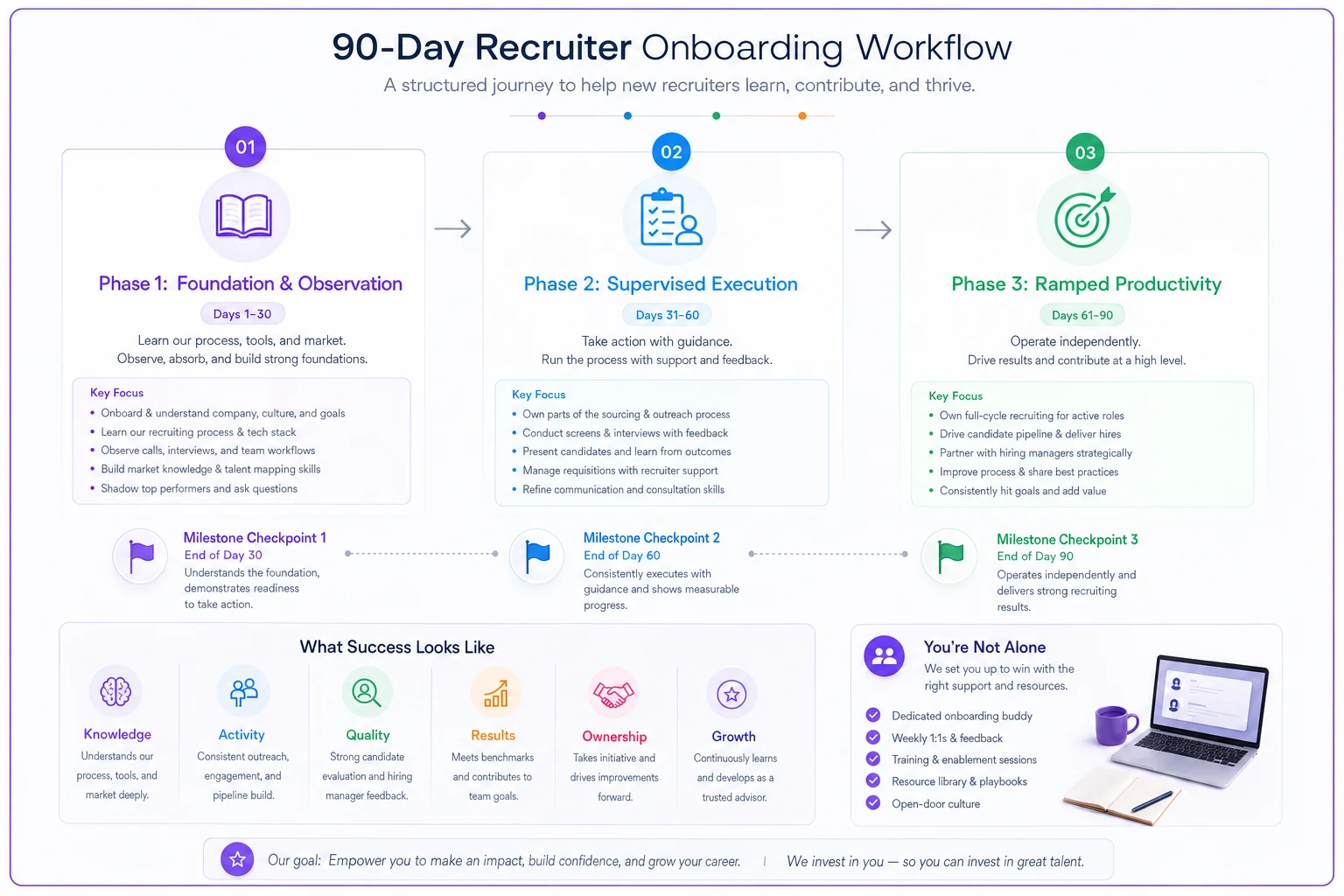
Use this as an operational checklist to assign tasks, schedule shadowing, and validate checkpoints.
The shadowing schedule that prevents knowledge gaps
Random shadowing wastes everyone's time. Structure it around specific learning objectives, not just "watch Sarah do some interviews today."
Week 1 Shadowing Focus: Full cycle visibility
-
Monday
Intake meeting for new req (understand requirement gathering)
-
Tuesday
Sourcing session for hard-to-fill role (see search strategies)
-
Wednesday
3 screening calls for different levels (observe qualification)
-
Thursday
Hiring manager debrief (understand feedback loops)
-
Friday
Offer negotiation call (see closing techniques)
Week 2 Shadowing Focus: Edge cases and problems
-
Difficult candidate situation (withdrawal, counter-offer)
-
Rejected candidate conversation
-
Urgent req firefighting session
-
Diversity sourcing strategies
-
Technical assessment coordination
Week 3–4 Shadowing Focus: Role-specific mastery
Shadow only recruiters working similar roles. If the new recruiter will handle engineering, don't waste time shadowing sales recruiting. Seems obvious, but plenty of teams ignore this. The focus should be:
-
Specific technical screening approaches
-
Common objections for that role type
-
Preferred sourcing channels
-
Typical compensation discussions
Shadow only recruiters working similar roles to keep onboarding time focused and relevant.
Shadow only recruiters working similar roles. If the new recruiter will handle engineering, don't waste time shadowing sales recruiting. Seems obvious, but plenty of teams ignore this. The focus should be:
Early productivity metrics that predict success
Generic metrics don't help during onboarding. You need stage-appropriate indicators that show progression, not just activity.
Phase 1 Metrics (Days 1–30)
These validate comprehension and retention:
-
Orientation assessment score
-
Number of process observations documented
-
System navigation speed (time to complete test tasks)
-
Quality of role summaries produced
It sounds basic, but most onboarding programs skip these entirely. If you're not measuring comprehension in the first month, you're guessing.
Phase 2 Metrics (Days 31–60)
These measure assisted performance:
| Metric | Target | Why It Matters |
|---|---|---|
| Screening calls conducted | 20+ | Building phone confidence |
| Call-to-submittal rate | 25% | Understanding qualification |
| Outreach response rate | 15% | Message quality |
| Calendar efficiency | 85% | Basic coordination skills |
| Feedback incorporation rate | 90% | Coachability indicator |
Phase 3 Metrics (Days 61–90)
These confirm readiness for full productivity:
-
Submittal-to-interview rate (should be within 20% of team average)
-
Time-to-fill on owned reqs (tracking toward standard)
-
Candidate NPS scores (quality check)
-
Activity metrics consistency (3 consecutive weeks hitting targets)
-
Hiring manager feedback scores (minimum 4/5)
By day 90, you should have enough data to know whether someone is on a solid trajectory or needs a different kind of intervention. Waiting longer than that usually just delays the harder conversation.
Common onboarding failures to actively prevent
The "sink or swim" mentality
Some recruiting managers genuinely believe pressure creates diamonds. It doesn't—it creates turnover. New recruiters who get overwhelmed in month one rarely recover. They either quit or develop bad habits that take months to undo. One team I worked with had a director who was proud of the fact that he "threw people in the deep end." They had burned through five recruiters in eighteen months and couldn't figure out why.
Inconsistent shadowing
When shadowing depends on who's free that day, new recruiters absorb conflicting information. One recruiter says always call references before submittal; another says only for finalists. The new person doesn't know who's right and either freezes or picks randomly. This sounds small but compounds badly over time.
No documentation requirements
Without requiring new recruiters to document their learnings, you can't verify comprehension. They can sit through twenty shadowing sessions and retain almost nothing. Make them write observations, create process maps, explain workflows back to you. If they can't explain it, they don't understand it yet.
Skipping the basics for experienced hires
Experienced recruiters still need your specific onboarding. Every recruiting operation has unique quirks, unwritten rules, and context that isn't obvious from the outside. That senior hire from a Fortune 500 won't automatically understand a startup's sourcing approach—or why you close candidates a certain way, or which hiring managers need extra communication, or any of the dozen things that exist only in institutional memory.
Building role-specific playbooks that accelerate ramp
Generic onboarding creates generic recruiters. Role specialization during ramp noticeably improves early performance.
For technical recruiters:
-
Days 1–15
Focus on understanding tech stack conversations
-
Days 16–30
Shadow only technical screens
-
Days 31–45
Practice with junior technical roles
-
Days 46–60
Add mid-level positions
-
Days 61–90
Full technical requisition load
For executive recruiters:
-
Days 1–20
Study company strategy and competitive landscape
-
Days 21–35
Shadow executive sourcing and mapping
-
Days 36–50
Support executive search research
-
Days 51–70
Co-manage director-level search
-
Days 71–90
Own first VP-level search with oversight
For high-volume recruiters:
-
Days 1–10
Master rapid screening techniques
-
Days 11–25
Learn batch processing workflows
-
Days 26–40
Practice pipeline velocity management
-
Days 41–60
Handle partial requisition load
-
Days 61–90
Full volume responsibilities
The specifics matter here. A high-volume recruiter who spends week one learning executive mapping is wasting time they don't have. Build the playbook around the actual work they'll be doing.
Technology setup that removes operational friction
New recruiters lose hours to basic system confusion. Front-load the technical setup to eliminate these bottlenecks before they start.
Before Day 1:
-
All system accounts created and tested
-
Calendar integrated with ATS
-
Email templates loaded
-
Sourcing tools activated
-
Communication platforms configured
Week 1 Technical Checkpoints:
-
Successfully schedule a mock interview (tests calendar integration)
-
Send test InMail sequence (validates sourcing access)
-
Generate pipeline report (confirms analytics permissions)
-
Update candidate records (proves ATS proficiency)
-
Join team Slack channels (ensures communication flow)
When new recruiters spend their first week fighting password resets and permission issues, they start discouraged and already behind. When everything works on day one, they can actually focus on learning the job.
Creating feedback loops that accelerate improvement
Waiting 90 days to give meaningful feedback guarantees a slow ramp. Build multiple feedback mechanisms that provide steady course correction throughout.
Daily feedback (first 30 days):
-
What worked well today
-
What felt confusing
-
One specific area to improve tomorrow
-
Any blockers to remove
Weekly feedback (days 31–60):
-
Screening call recordings (pick 2, discuss specific improvements)
-
Written communications (review 3 candidate emails)
-
Pipeline decisions (walk through submittal logic)
-
Time management (identify efficiency opportunities)
Bi-weekly feedback (days 61–90):
-
Metrics trends
-
Hiring manager feedback
-
Process adherence
-
Professional development goals
Feedback frequency should decrease as confidence builds—not because the recruiter needs less input, but because they're starting to self-correct. That shift is itself a signal worth tracking.
The coordination challenge nobody plans for
Executing structured onboarding consistently is harder than it looks. You need shadowing schedules that align with senior recruiter availability. You need hiring managers willing to spend time with someone who's still learning. You need documented processes, recorded examples, and someone actually tracking all these checkpoints.
This is where operational software starts earning its keep. Instead of managing onboarding through spreadsheets and hoping everyone remembers their commitments, you can build the entire ramp program into your workflow system—automatic task assignment for each phase, reminder notifications for shadowing sessions, built-in checkpoint assessments, and progress tracking that shows exactly where each new recruiter stands.
The recruiting teams that run this well have turned onboarding into a repeatable operation. They use workflow automation to assign the right training content at the right time, track milestone completion, and flag when someone's falling behind pace. The onboarding checklist becomes a living system, not a static document that gets ignored after day three. When the administrative overhead—scheduling, reminders, progress tracking, feedback collection—is handled by the system, senior recruiters can focus on actual knowledge transfer instead of chasing people down.
Measuring onboarding ROI through improved ramp velocity
A recruiter without structured onboarding typically takes around five to six months to reach full productivity. With the approach above, most teams see that drop to around three months. Here's a rough breakdown:
| Factor | Without Structure | With Structure |
|---|---|---|
| Average recruiter salary | $75,000 | $75,000 |
| Monthly fully-loaded cost | ~$8,000–$9,000 | ~$8,000–$9,000 |
| Productivity at month 3 | ~35–45% | ~80–90% |
| Estimated lost capacity (months 3–6) | $10,000–$13,000 | Minimal |
For a team hiring three or four recruiters a year, that productivity gap adds up fast—real money just sitting on the table.
The retention angle matters too. Recruiters who feel supported and set up to succeed in their first 90 days stay longer. Structured onboarding tends to meaningfully reduce early turnover. Given that replacement costs typically run $15,000 or more per recruiter when you factor in sourcing, interviewing, and ramp time, preventing even one unnecessary departure pays for the entire program several times over.
Making the checklist sustainable long-term
The biggest mistake after building a solid onboarding program is letting it decay. The first few recruiters get the full experience, then people get busy, steps get skipped, and within a year you're back to sink-or-swim. I've watched this happen at multiple companies—they invest in building something real, it works, and then nobody maintains it because there's no single owner accountable for its health.
Sustainability requires:
-
A single owner accountable for onboarding outcomes
-
Quarterly reviews of program effectiveness
-
Regular updates based on feedback from recent hires
-
Technology that enforces consistency
-
Clear metrics that prove the ROI
Teams that maintain excellent onboarding programs treat them like any other critical business process. They measure, optimize, and invest in continuous improvement rather than hoping new recruiters figure it out on their own. The ones that don't? They rebuild from scratch every eighteen months and wonder why ramp time never improves.
Final thoughts
Every recruiting leader wants their team productive faster, but most rely on hope instead of structure. The checklist above isn't revolutionary—it's operational discipline applied to talent development.
The teams getting new recruiters productive in three months instead of six aren't doing anything magical. They've broken down progression into measurable stages, created clear checkpoints, and built systems that ensure consistency. Whether you implement this manually or use operational software to automate the workflow, the key is committing to structure. Random onboarding creates random results. In recruiting operations, predictability is everything.
Every recruiting leader wants their team productive faster, but most rely on hope instead of structure. The checklist above isn't revolutionary—it's operational discipline applied to talent development.
The teams getting new recruiters productive in three months instead of six aren't doing anything magical. They've broken down progression into measurable stages, created clear checkpoints, and built systems that ensure consistency. Whether you implement this manually or use operational software to automate the workflow, the key is committing to structure. Random onboarding creates random results. In recruiting operations, predictability is everything.
Ready to elevate your hiring process?
Join 1,500+ recruiting teams using Recioly to save time, improve collaboration, and hire smarter.