

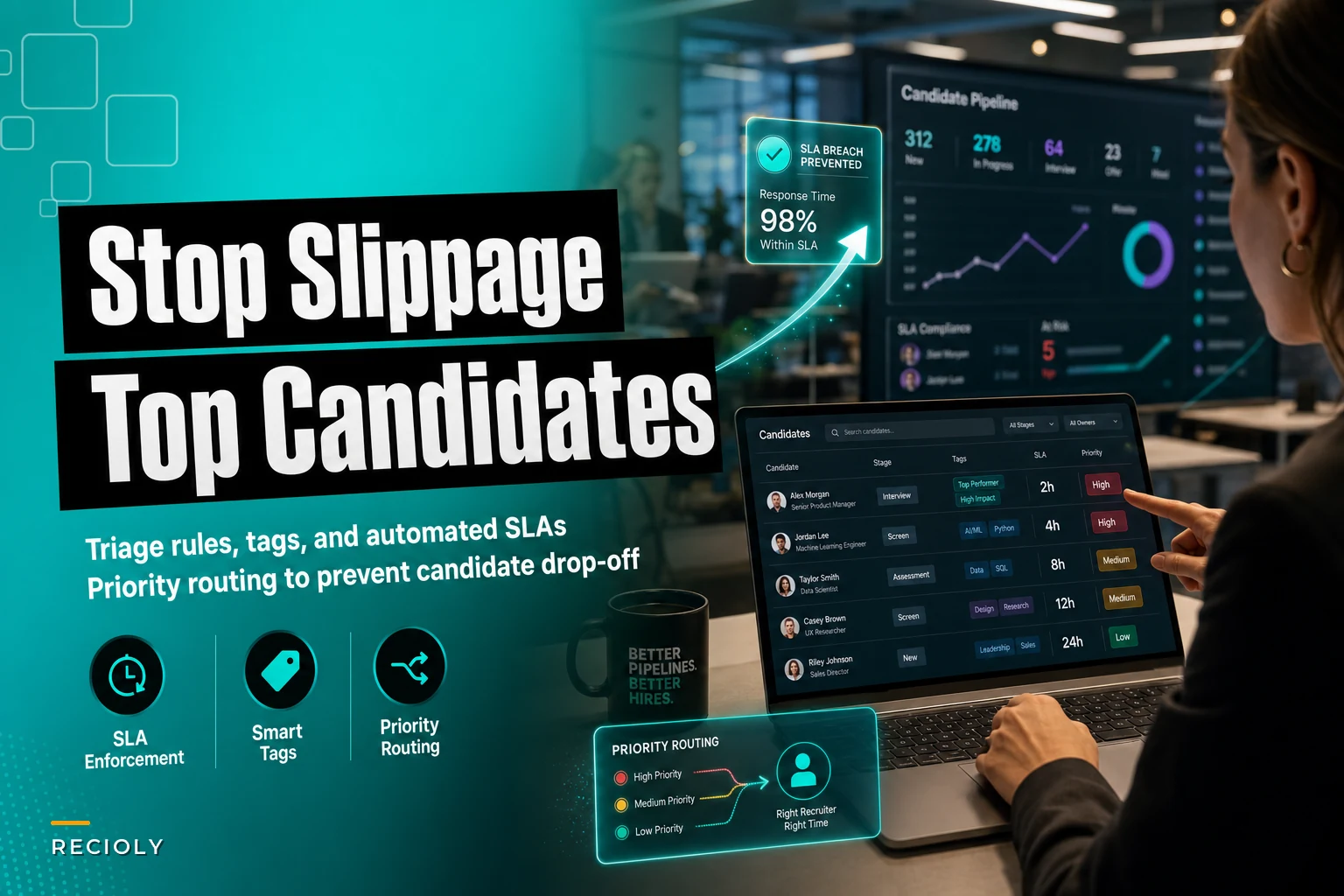

Remember that senior engineer you lost to a competitor because their application sat unread for nine days? Or the marketing director who withdrew after waiting three weeks for a second interview? These aren't isolated incidents. They're symptoms of a broken triage system that treats all candidates equally when they absolutely shouldn't be.
Most recruiting teams operate like an emergency room without a triage nurse. Every patient gets seen in the order they arrive, whether they have a paper cut or a cardiac arrest. Your recruiting pipeline works the same way — that junior admin role gets the same urgency as your VP of Sales opening, and the passive candidate your CEO personally referred sits in the same queue as the hundreds of spray-and-pray applications.
The real damage happens in week two. That's when top candidates start accepting other offers while their application sits somewhere between "initial review" and "schedule phone screen" in your ATS. By week three, you've lost the majority of your tier-one candidates. Not because they weren't interested. Because your process couldn't tell the difference between someone worth dropping everything for and someone worth a polite rejection email.
Why traditional recruiting workflows hemorrhage top talent
The standard recruiting workflow treats candidate flow like a production line. Application comes in, gets reviewed within 3-5 days, moves to phone screen, progresses through interviews. Clean, organized, democratic. Also completely broken for competitive hiring.
Here's what actually happens. Your recruiting team gets 400 applications for that product manager role. The first 50 get decent attention. By application 200, they're skimming. By 300, they're scanning for obvious disqualifiers just to reduce the pile. Meanwhile, the perfect candidate who applied on day four — the one with the exact experience you need — is buried under 396 others.
The democracy problem runs deeper than volume. When every candidate gets equal treatment, recruiters spend 45 minutes carefully rejecting obviously unqualified applicants while rush-reviewing the director-level candidate who needed attention yesterday. Interviews get scheduled in the order requests came in, not based on candidate market value or how critical the role actually is.
Time decay is brutal in competitive markets. A software engineer with strong experience typically has multiple active opportunities at any given moment. Every day you don't respond, another company does. By day five, they've had two phone screens elsewhere. By day seven, they're scheduling on-sites. By day ten, they've mentally written you off.
The coordination overhead makes everything worse. Your hiring manager wants updates on those three priority candidates. Your recruiter has to check four different places — email, ATS notes, Slack messages, calendar invites — just to piece together where each one stands. The senior candidate who needs CEO approval for comp? Their file is sitting in limbo because nobody owns the next step.
Building a functional triage system: classification before democracy
Real triage starts with ruthless classification. Not every candidate deserves equal treatment, and pretending otherwise guarantees you'll lose the ones that matter.
Never lose track of top talent again.
Recioly helps you manage every stage of recruiting efficiently, from application to offer.
- Centralized candidate tracking
- Automated interview scheduling
- Collaborative hiring workflows
No credit card required
Start with role criticality. Revenue-generating roles that directly impact growth get priority over support functions. A sales director opening that's costing you $50k monthly in missed quota outranks a facilities coordinator hire. Your engineering lead who'll unblock six developers ranks above your third customer success hire. This isn't about human worth — it's about business impact.
Layer in candidate rarity. Some profiles barely exist in your market. That full-stack developer with healthcare compliance experience? White-glove treatment. The junior marketer with two years of general experience? Standard process. When only a handful of people in your city have the exact skills you need, every day you delay has real cost.
Then add competitive heat. Certain candidates will have multiple offers within two weeks. Others might job search for months. The passive candidate your board member referred needs contact within 24 hours. The active job seeker who applied to your job posting can wait 72. Your process needs to recognize that difference.
Your classification system needs at least three tiers:
Priority One: Role is revenue-critical or blocking other hires. Candidate has rare skills or came through executive referral. Contact within 24 hours, first interview within 3 days, full cycle complete within 10 days.
Priority Two: Important role but not critical path. Strong candidate but not a unicorn profile. Contact within 72 hours, first interview within 7 days, full cycle within 21 days.
Priority Three: Nice-to-have role or volume hiring. Standard candidate pool. Contact within 5 days, first interview within 14 days, full cycle within 30 days.
This segmentation happens at application, not after initial review. The classification triggers different workflows, different reviewers, and different SLAs from the start.
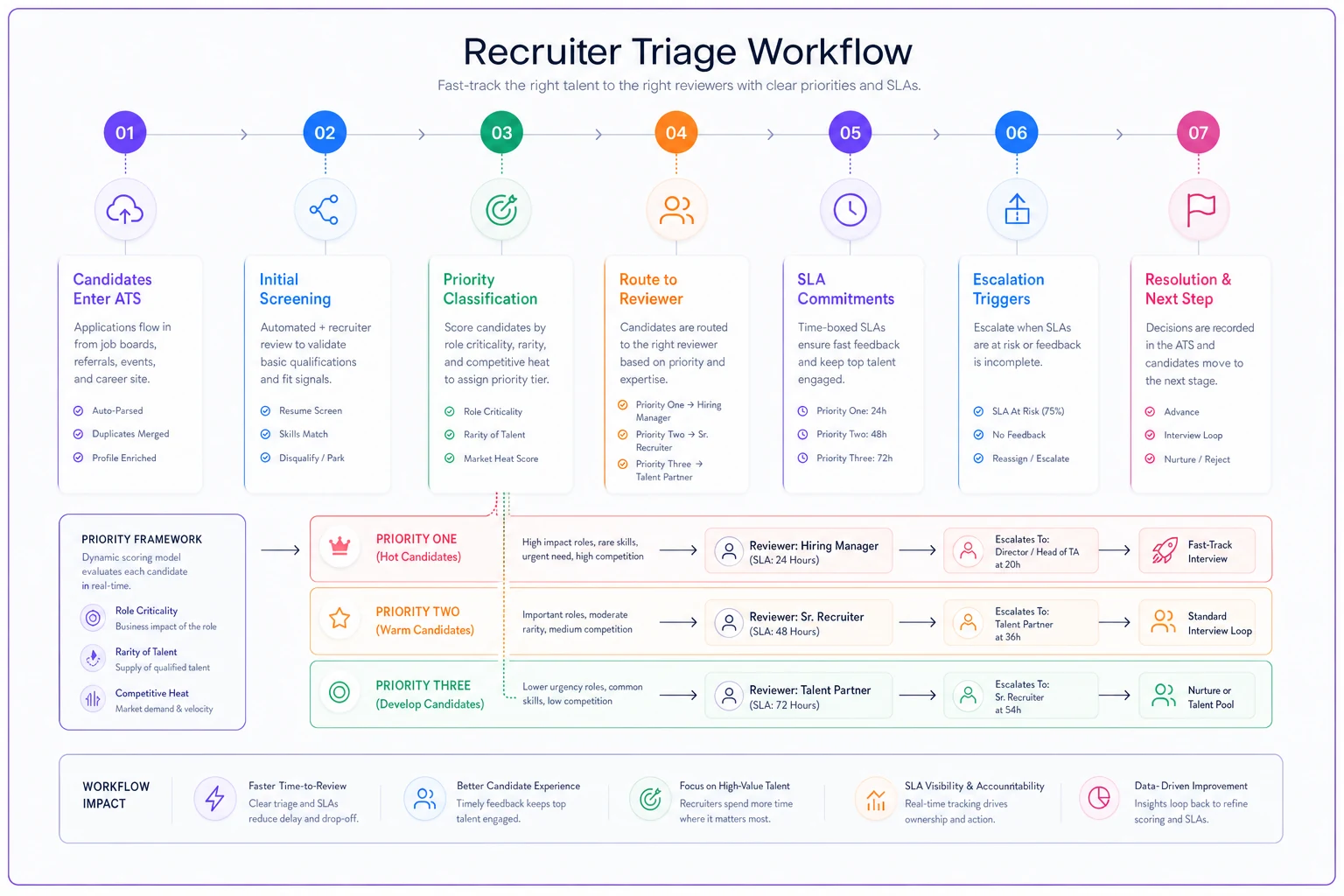
This diagram shows the flow from classification to routing and the SLA checkpoints that trigger escalations.
Tagging conventions that actually scale
Tags fail when they multiply without structure. After six months you end up with "urgent," "URGENT," "high-priority," "exec-referral," "board-referral," and "CEO-refer" all meaning roughly the same thing. Your team spends more time decoding tags than actually using them.
Build a hierarchical tagging system with clear ownership. Start with source tags that never change: referral-exec, referral-employee, sourced-passive, applied-job-board. These tell you competitive context immediately.
Add status tags that expire: needs-review, pending-scheduler, awaiting-references. If a candidate stays pending-scheduler for 48 hours, something's broken. These tags should have built-in escalation rules attached to them.
Include market tags for competitive context: multiple-offers, passive-looking, immediate-availability. When someone has multiple-offers attached to their profile, every delayed response raises your risk of losing them.
Your tag hierarchy might look like:
Source (permanent) ├── referral-exec ├── referral-board ├── referral-employee ├── sourced-passive ├── applied-direct └── applied-job-board Status (temporary) ├── needs-review [24hr expire] ├── needs-scorecard [48hr expire] ├── pending-scheduler [48hr expire] ├── awaiting-decision [72hr expire] └── on-hold [7day review] Market (context) ├── multiple-offers ├── passive-looking ├── active-searching ├── immediate-start └── flexible-timeline
Never create tags without expiration rules. A candidate tagged needs-review three weeks ago isn't "needing review" - they're abandoned. Build automatic cleanup into your system or the taxonomy collapses under its own weight.
SLA nudges: automation that prevents fumbles
SLAs without enforcement are wishful thinking. Saying "we'll respond within 48 hours" means nothing if nobody tracks it or gets alerted when you miss it.
Start with simple time-based triggers. Priority One candidate hits 20 hours without contact? Automated Slack message to the recruiter. Hit 23 hours? Message their manager. Hit 24 hours? Escalate to the recruiting lead with the candidate's details and last action taken.
20 hours: @recruiter - P1 candidate [Name] approaching SLA limit 23 hours: @manager - URGENT: P1 candidate [Name] needs immediate action 24 hours: @recruiting-lead - SLA BREACH: P1 candidate [Name] - [Role]
Build smart nudges, not just annoying reminders. Instead of "Interview scheduled for tomorrow," send "Interview tomorrow 2pm with Sarah Chen — prep notes attached, scorecard here: [link]." Context prevents dropped balls far better than a generic ping.
Watch for stall patterns too. Candidate stuck in "pending scheduler" for three days usually means calendar deadlock. Sitting in "awaiting references" for a week probably means they never followed up with their references — or you forgot to ask. Nudges should suggest next actions, not just flag delays.
-
Initial response
12 hours max
-
Phone screen scheduled
within 48 hours
-
Each interview round
within 3 days
-
Decision communicated
same day as final interview
-
Offer extended
within 24 hours of decision
The nudges escalate faster too. Miss the 12-hour response window? Skip the manager and go straight to the department head. These candidates won't wait for your process to catch up.
Pro-tip: Attach a one-line candidate summary and the next recommended action to every escalation so the recipient can act immediately without context-gathering.
For competitive candidates tagged multiple-offers, compress everything:
Priority routing: making sure the right people see the right candidates
Default round-robin routing kills top talent acquisition. Your best recruiter spending time on junior roles while the VP opening gets whoever's next in rotation makes zero sense.
Match recruiter expertise to role requirements. The recruiter who came from a technical background handles all engineering roles. The one with executive search experience owns director-level and above. The high-volume specialist handles early career and internship programs. This isn't complicated, but most teams still don't do it.
Create automatic routing rules based on triggers:
Referral routes: Executive referrals go to senior recruiters only. Board referrals skip the queue entirely and alert the recruiting lead directly. Employee referrals route to the referring employee's usual recruiter for continuity.
Skill routes: Specialized roles need recruiters who actually understand them. Your technical recruiter can evaluate a DevOps engineer properly. Your generalist recruiter probably can't. Route based on capability, not whose turn it is.
Speed routes: When a candidate has multiple-offers or immediate-availability, route to whoever can act fastest — not whoever's next in rotation. Better to break the round-robin than lose the hire.
| Trigger | Primary Route | Backup Route | Escalation |
|---|---|---|---|
| Exec referral | Senior recruiter | Recruiting lead | VP Talent |
| P1 role | Specialist recruiter | Senior recruiter | Immediate |
| Multiple offers | First available | Any recruiter | 2 hours |
| Technical role | Technical recruiter | Tech-trained backup | 24 hours |
| High volume | Junior recruiter | Coordinator | Standard |
Don't load-balance equally. Your top recruiter should handle your most critical roles, even if that means a smaller overall volume. One great VP hire creates more value than twenty adequate junior hires.
The compound effect of systematic triage
A manufacturing client implemented this exact triage system for their skilled trades recruiting. Before triage, they were losing a significant portion of experienced welders and machinists to faster-moving competitors. Every opening took 6-8 weeks to fill, often requiring multiple attempts.
They segmented candidates into three tiers. Experienced trades with specific certifications became Priority One — 24-hour response SLA, dedicated senior recruiter, compressed interview cycle. Entry-level positions stayed Priority Three with standard timelines.
The operational shift was immediate. P1 candidates got phone screens within 48 hours instead of two weeks. The senior recruiter knew to lead with overtime rates and tool allowances — things that actually matter to experienced trades. Hiring managers received pre-screened candidates with verified certifications rather than a pile of maybes.
Within four months, their P1 fill rate improved substantially. Time-to-fill for critical roles dropped from 6 weeks to around 18 days. They stopped losing experienced candidates to the factory two towns over that used to snatch everyone good before they even got a call.
The unexpected benefit was overall efficiency. Junior recruiters stopped getting stuck on complex skilled trades evaluations they weren't equipped for. Senior recruiters stopped wading through hundreds of entry-level applications. Everyone worked to their actual strengths.
Warning signs your triage is still broken
Even with structure, triage systems decay. Watch for these failure patterns:
Tag proliferation: You have more than 15 active tags, multiple tags mean essentially the same thing, or people keep inventing new ones instead of using existing ones. This means your taxonomy is either too complex or poorly communicated — usually both.
SLA gaming: Recruiters mark candidates as "contacted" after sending a generic "we received your application" email. Or they push candidates to "on hold" to stop SLA clocks from running. This means your metrics are incentivizing box-checking over actual outcomes.
Route hoarding: Senior recruiters cherry-pick easy roles while complex ones bounce around. Or recruiters trade candidates privately to avoid certain hiring managers. Routing rules need enforcement, not an honor system.
Abandonment patterns: Certain tags like "awaiting scheduling" become graveyards. If any status consistently leads to drop-offs, your process has a black hole somewhere.
Escalation fatigue: Your recruiting lead gets twenty "urgent" escalations daily. Either your SLAs are too aggressive or your team is using escalation as a first resort instead of a last one.
The fix usually isn't more rules. It's simpler rules with real enforcement. Cut your tags in half. Extend your SLAs but make them absolute. Create one clear path for each candidate type and stop adding complexity.
Technology leverage without losing the human element
This is where operational software genuinely changes the game — not by replacing recruiters, but by handling the mechanical parts that burn them out. AI automation handles classification, routing, and nudging well. These are the systematic parts of triage that humans do inconsistently when they're juggling 30 open requisitions.
Modern recruiting platforms with AI automation can scan incoming applications and auto-classify based on your criteria. That senior engineer with the rare skillset gets flagged as P1 before any human touches it. The junior marketer gets correctly routed to standard process. No human judgment needed for initial sorting.
SLA enforcement runs continuously in the background. The system tracks every candidate's timeline, sends contextual nudges, and escalates exactly when needed. Your recruiter doesn't need to remember that P1 candidate from Tuesday — the system surfaces them at hour 20, not hour 48 when it's already too late.
Smart routing happens instantly. Executive referral comes in at 9pm Friday? The system alerts the senior recruiter immediately, queues a Saturday morning reminder, and sets up the phone screen scheduling link. Monday morning, they're already in process while competitors haven't even opened the application.
The practical effect is that recruiters spend their time evaluating and selling rather than tracking and sorting. Response times drop from days to hours. Top candidates experience a tight, professional process that signals your organization actually has its act together.
But automation shouldn't paper over the need for real human interaction. Use it to enable more personal engagement, not eliminate it. Auto-classification means your recruiter can write a thoughtful, personalized response instead of rushing through generic replies. SLA tracking means they can actually focus on candidate experience instead of maintaining spreadsheets.
The uncomfortable truth about recruiting prioritization
Not every candidate deserves equal treatment. Not every role deserves equal urgency. Not every application deserves careful review. This feels wrong if you've been taught that fair means identical. But recruiting isn't about fairness — it's about business outcomes.
Your P3 candidates aren't less valuable as people. They're less critical to your business's immediate needs. Being honest about that creates clarity, not discrimination. The entry-level applicant understands their process takes longer. The senior specialist understands why they're fast-tracked.
Systematic triage also forces uncomfortable decisions. That culture-fit hire your CEO loves but who lacks critical skills? They might be P2, not P1. The difficult-to-work-with engineering manager role that's been open six months? Probably P3 until you address the underlying team issues.
These classifications change your entire recruiting operation. Instead of pretending you can give everyone premium service, you deliver exactly what each tier actually needs. P1 gets white-glove treatment. P2 gets solid professional process. P3 gets efficient, respectful service that doesn't waste their time or yours.
Moving from reactive scramble to systematic execution
Most recruiting teams live in permanent crisis mode. Every requisition is urgent. Every candidate needs immediate attention. Every hiring manager wants updates now. The scramble never ends because there's no system to create any kind of order.
Triage changes the operating rhythm. Monday morning, you know exactly which candidates need attention first. Tuesday afternoon is blocked for P1 phone screens. Wednesday's hiring manager sync covers only P1 and P2 roles. Thursday and Friday handle P3 volume.
Recruiters stop context-switching between executive searches and intern programs. They know their swim lanes and SLAs. The senior recruiter working three P1 searches has clear focus. The coordinator handling P3 volume has defined processes to follow.
Hiring managers learn the system too. That P3 backfill role won't have candidates by tomorrow. But their P1 revenue-critical position will have three qualified candidates by Friday. Expectations align with reality, and the constant "where are we on this?" conversations start to go away.
The approach also scales. Add another recruiter? They slot into defined routes and workflows. Double your requisition load? The triage system maintains priority order. Hit busy season? P3 SLAs flex but P1 stays protected.
This isn't about perfect process. It's about sustainable operations that don't depend on heroic individual effort. Your top recruiter shouldn't burn out juggling dozens of unorganized searches. Your junior recruiter shouldn't accidentally deprioritize executive referrals. The system should prevent both failures without anyone having to micromanage it.
The path forward
Your recruiting pipeline will always have some leakage — the question is whether you're losing water or losing gold. Without triage, you genuinely can't tell the difference. Every lost candidate looks the same in your metrics. But losing a P1 candidate costs exponentially more than losing a P3.
Start with basic classification. Pick three factors that matter most — role criticality, candidate rarity, competitive heat — and segment everything against them. Don't overthink the criteria. Even rough segmentation beats treating everyone identically.
Add simple SLAs with real consequences. P1 candidates get 24-hour response or someone escalates. P2 gets 72 hours. P3 gets five days. Build the nudges into your existing tools — calendar reminders, Slack alerts, email automation. You don't need a fancy new platform to start.
Route based on capability, not rotation. Your best recruiter handles your hardest searches. Your volume specialist handles the flood of entry-level applications. Stop pretending everyone can do everything equally well.
Watch what breaks and fix it. Tags proliferating? Simplify the taxonomy. SLAs missed constantly? Extend them or add resources. Routes creating bottlenecks? Adjust the distribution.
The goal isn't perfection. It's stopping those moments when you realize you lost the perfect candidate because their application sat in a queue for two weeks while your team worked through everything else in order. It's knowing that when that rare specialist applies, your system will flag them, route them, and engage them before a competitor even knows they exist.
Build the triage system that matches your reality. Stop pretending all candidates are equal. Stop treating all roles the same. Stop losing the candidates that matter because you're too buried processing the ones that don't.
Ready to elevate your hiring process?
Join 1,500+ recruiting teams using Recioly to save time, improve collaboration, and hire smarter.