


Most recruiting teams stumble into asynchronous interviews out of desperation. You're trying to coordinate schedules between four hiring managers across different time zones, candidates keep dropping out because they can't make the narrow interview windows, and your best applicants accept other offers while you're still playing calendar Tetris.
The disconnect between convenience and consistency breaking recruiting teams
So you switch to async video interviews. Candidates record responses on their own time. Reviewers watch and evaluate on their own schedule. The scheduling bottleneck disappears.
Then three weeks later, you're staring at wildly inconsistent scoring. One reviewer gives a candidate 9/10 for communication skills. Another gives the same candidate a 4. Your hiring manager is frustrated because nobody seems to be evaluating the same things. The convenience you gained turned into a consistency nightmare that's actually making hiring decisions harder.
The scoring drift problem
Here's what typically happens when teams adopt asynchronous interviews without proper scoring infrastructure. Your first reviewer watches a candidate's response at 9am, fresh coffee in hand, taking detailed notes. They're focused on technical competence and problem-solving.
Never lose track of top talent again.
Recioly helps you manage every stage of recruiting efficiently, from application to offer.
- Centralized candidate tracking
- Automated interview scheduling
- Collaborative hiring workflows
No credit card required
Your second reviewer squeezes in the same video during lunch three days later. They're unconsciously comparing this candidate to someone they just rejected. They focus on presentation style over content, and their scoring reflects confidence and polish rather than actual capability.
By the time your third reviewer gets to it a week later, they've forgotten half the job requirements and are scoring on general impressions and gut feel. The rubric you hastily created sits unopened in their inbox.
This drift compounds across every candidate. You end up with evaluation data that looks rigorous on the surface — numbers, categories, comments — but actually reflects three completely different evaluation frameworks mashed together. Making a fair hiring decision from that mess is nearly impossible.
When asynchronous actually makes sense (and when it doesn't)
Asynchronous interviews aren't universally better. They solve specific operational problems well and create disasters in other contexts. Most vendors won't tell you that.
Scenarios where it fits well
-
High-volume entry-level screening where you need to evaluate 200+ candidates for similar roles — retail seasonal hiring, call center expansion, entry-level sales. The math is simple: coordinating 200 live interviews would consume weeks of recruiter time. Asynchronous lets you process the same volume in days.
-
Geographically distributed teams where reviewers genuinely cannot overlap schedules. Companies hiring across the US, Europe, and Asia simultaneously — the alternative isn't just inconvenient, it means asking people to conduct interviews at 3am.
-
Technical skill demonstrations where candidates need to show actual work. Developers walking through code, designers explaining portfolio pieces, analysts presenting findings. These benefit from candidates having time to prepare rather than reacting on the spot.
-
Roles requiring specific presentation skills like sales, training, or customer success, where you want to see how candidates structure thoughts and communicate when they have time to prepare — which mirrors how the job actually works.
When asynchronous becomes a liability
-
Senior leadership positions where cultural fit and interpersonal dynamics matter more than demonstrable skills. You need to see how executives think on their feet, handle pushback, and navigate complex conversations in real time.
-
Collaborative team roles where real-time interaction is the actual job. Product managers facilitating heated stakeholder discussions. Scrum masters reading room dynamics. These require synchronous evaluation.
-
Final round decisions for any position. Once you're down to two or three finalists, the efficiency gain disappears and the stakes are too high.
-
Small hiring volumes where you're filling one or two positions per quarter. The overhead of setting up proper asynchronous infrastructure and training reviewers won't pay off. Just coordinate the calendars.
Asynchronous interviews aren't universally better. They solve specific operational problems well and create disasters in other contexts. Most vendors won't tell you that.
Building a rubric that actually prevents scoring chaos
The difference between asynchronous interviews that work and those that create chaos comes down to one thing: structured scoring that reviewers actually follow. Not a generic rubric you downloaded, but something built specifically for asynchronous evaluation where reviewers can't clarify or follow up.
Start with your non-negotiables — the three or four capabilities that actually predict success in the role. For a customer success manager, that might be problem diagnosis speed, technical explanation clarity, and de-escalation ability. Everything else is secondary.
Most teams mess up by creating criteria that require information asynchronous interviews can't provide. "Team collaboration skills" sounds important, but how do you evaluate that from a recorded video? "Cultural fit" means nothing when reviewers can't probe with follow-up questions. Your rubric needs criteria that are observable in a one-way video format, specific enough that two reviewers would notice the same things, and tied directly to job performance rather than general impressions.
Here's a scoring framework that actually works:
| Evaluation Element | What to Look For | Scoring Anchor Points |
|---|---|---|
| Problem Structure | How candidate breaks down complex scenario | 1-3: Rambles without clear framework<br>4-6: Basic structure but misses key elements<br>7-9: Clear framework, addresses all aspects |
| Technical Accuracy | Correctness of specific knowledge claims | 1-3: Multiple errors or misconceptions<br>4-6: Generally accurate with minor mistakes<br>7-9: Precise and fully accurate |
| Communication Clarity | Ability to explain complex ideas simply | 1-3: Confusing, requires multiple replays<br>4-6: Clear but occasionally hard to follow<br>7-9: Crystal clear, easy to understand |
| Response Completeness | Addressing all parts of the prompt | 1-3: Misses major prompt elements<br>4-6: Covers basics but lacks depth<br>7-9: Thoroughly addresses everything |
Anchor each scoring level to a concrete observable behavior to reduce interpretation variance between reviewers.
Notice what's not on that list: personality, energy, enthusiasm, culture fit. Those subjective elements are where scoring divergence explodes. Save them for synchronous rounds.
The structured prompt design that changes everything
Bad async interview prompts create bad data. "Tell me about yourself" generates rehearsed speeches that reveal nothing about actual capability.
Prompts need to simulate real work scenarios — specific enough that candidates can't rely on generic prep, but clear enough they understand what's being evaluated. A well-structured async prompt has four parts:
-
Context Setup (30 seconds max) Enough background for the scenario to make sense. Include relevant constraints, resources, and stakeholder dynamics.
-
Specific Situation (45 seconds) Exactly what happened or what problem exists. Concrete details, not abstractions. Numbers where relevant.
-
Clear Ask (15 seconds) Tell them what you want — their approach, their solution, their analysis. Be specific about scope.
-
Time Boundary Three to five minutes to respond. Less than three prevents thorough answers. More than five encourages rambling.
Example prompt for a project manager role:
"Your team is building a mobile app feature scheduled to launch in 4 weeks. Today, your lead developer informed you that a critical dependency from another team is delayed by 3 weeks. The marketing campaign is already scheduled, and the CEO mentioned this feature in the latest investor update. You have a team of 3 developers, 1 designer, and a QA engineer. Walk me through your immediate response plan and how you'd communicate with stakeholders."
That prompt forces candidates to demonstrate prioritization, stakeholder management, problem-solving, and communication in a measurable way. Generic answers won't hold up against it.
The review panel coordination most teams completely botch
Even with solid rubrics and prompts, your review panel can destroy consistency if they're not properly coordinated. The biggest mistake is assuming reviewers will naturally align on what they're looking for.
Set up review pairs instead of full panels. Rather than having four people independently review every candidate, pair reviewers for specific batches. Reviewer A and B take candidates 1-10, Reviewer C and D take 11-20. This cuts review burden while maintaining multiple perspectives.
Calibrate before reviewing real candidates. Pick two or three sample recordings — internal volunteers work fine — and have all reviewers score them using your rubric. Then compare scores and discuss the discrepancies. This surfaces interpretation differences before they affect actual hiring decisions.
When one reviewer scores communication at 8 and another at 4, dig into why. Usually they're weighing different things — one values conciseness, another values thoroughness. Decide which matters more for this specific role before anyone reviews the actual candidate pool.
Set explicit scoring timelines. Reviews submitted more than 72 hours after watching create reliability problems. Memory fades, context shifts, and scores drift toward general impressions rather than specific observations.
Real workflow: How a 50-person customer success team fixed their broken async process
A SaaS company with around 50 customer success reps was drowning in coordinator overhead. They needed to hire 12 new reps across three time zones but kept losing candidates to faster-moving competitors. Their switch to asynchronous interviews initially made things worse — scoring was inconsistent, good candidates were rejected on subjective impressions, and hiring managers lost trust in the process entirely.
Here's what they changed, week by week:
-
Week 1 — Rubric rebuild. They scrapped generic "communication skills" and "culture fit" criteria and built scoring around three observable behaviors: technical troubleshooting approach, explanation clarity, and objection handling without getting defensive.
-
Week 2 — Prompt overhaul. Out went "Why customer success?" questions. In came scenario-based prompts pulled from actual support tickets. Candidates had to diagnose an integration problem, explain a pricing model change, and handle an upset customer threatening to cancel.
-
Week 3 — Reviewer calibration. All six reviewers scored the same three sample recordings. Initial scores varied by around 40%. After discussing specific examples and anchoring to the rubric, variation dropped to roughly 15%.
-
Weeks 4-6 — Execution. They processed 84 candidates asynchronously for first-round interviews. Each candidate was reviewed by two people within 48 hours. Scores showed around 78% inter-rater agreement, compared to 45% before the changes.
Results: They filled all 12 positions in 6 weeks instead of the usual 12. Time-per-hire dropped from 32 total hours to 14. Of the 12 hires, 11 were still with the company at the 6-month mark, compared to their previous average of 8.
The improvement wasn't magic. It came from treating the process as an actual operational system rather than a loose collection of individual judgment calls.
The week-by-week changes looked like this:
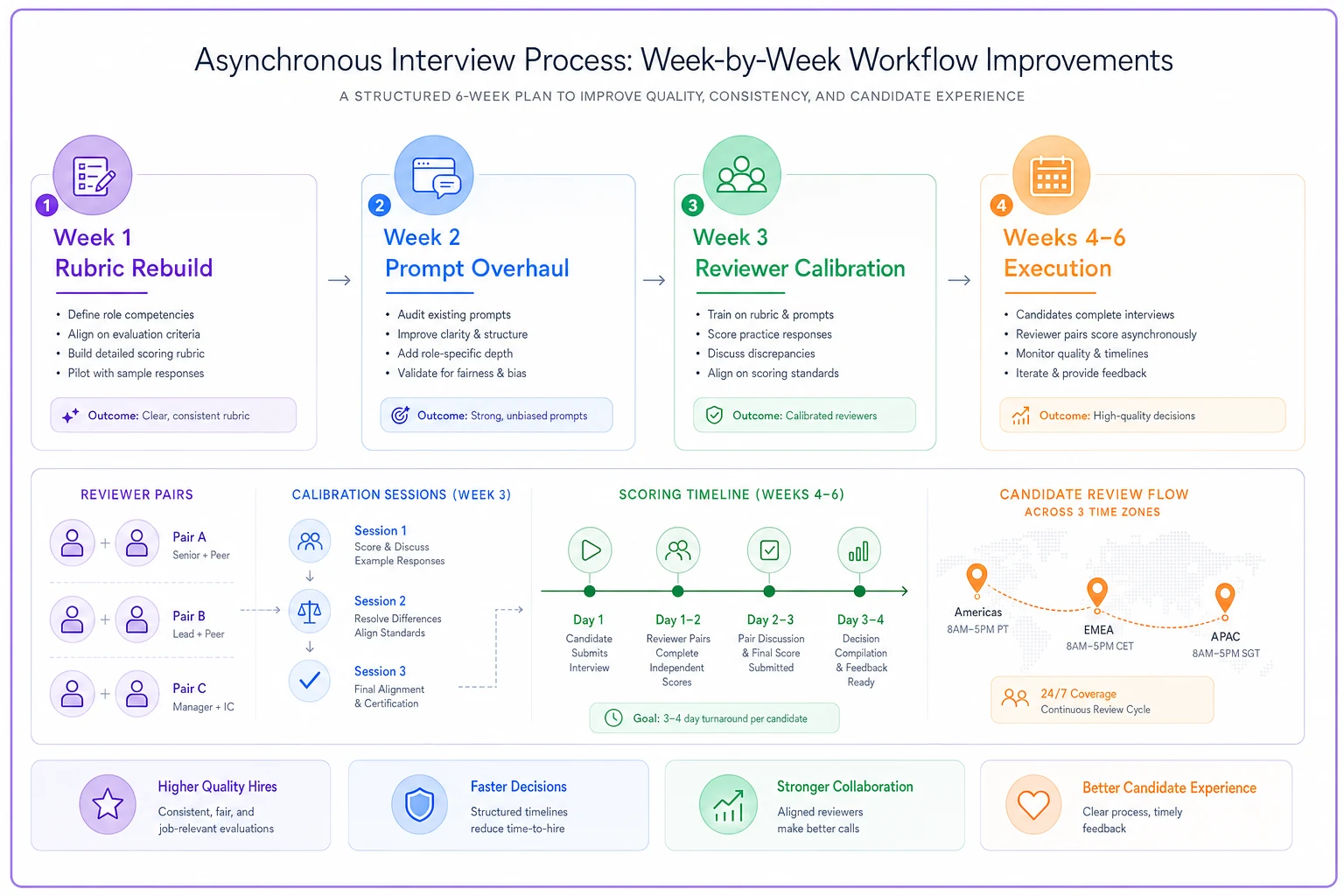
This visualization highlights the operational flow and timing.
The coordination tech stack that makes or breaks async interviews
Running asynchronous interviews without proper operational infrastructure is asking for trouble. It works for a few weeks before everything falls apart.
Your minimum viable tech stack needs three components. First, a recording platform that handles video capture and submission reliably — don't overthink this. Second, a review workflow system where recordings get assigned, tracked, and scored. Most teams fail here. They dump videos in a shared folder and hope reviewers remember to watch them. You need assignment logic, deadline tracking, and score collection in one place. Third, scoring aggregation that automatically compiles reviewer scores and flags discrepancies. When two reviewers differ by more than two points on any criterion, the system should surface it for calibration discussion.
The integration between these systems determines whether async interviews save time or create chaos. Manual handoffs — downloading videos, uploading to shared drives, copying scores into spreadsheets — introduce errors and delays that eliminate the efficiency gains you were chasing.
More sophisticated teams layer on automated scheduling for review assignments based on reviewer availability, built-in rubric guidance during scoring, and candidate pipeline tracking. But even basic coordination beats the email-and-spreadsheet chaos most teams default to.
AI-powered operational platforms can handle a lot of this automatically — flagging score divergence, routing review assignments based on availability, and keeping candidate status current across reviewers without anyone having to chase anyone else down. That kind of coordination overhead is exactly where automation earns its keep in a recruiting workflow.
When to pull the plug on async (recognizing failure patterns)
Sometimes asynchronous interviews just aren't working, and pushing forward only damages your hiring outcomes. Watch for these patterns:
-
Persistent scoring divergence despite calibration efforts. If reviewers consistently score the same candidates differently by three or more points after multiple calibration sessions, your role might require synchronous evaluation.
-
Candidate quality disconnect where async high-scorers consistently fail in synchronous final rounds. This suggests your prompts aren't capturing what actually matters for role success.
-
Reviewer avoidance patterns where team members consistently delay reviews, rush through them, or provide minimal feedback. Often this means the async format isn't giving them enough information to feel confident in their evaluations.
-
Hiring manager revolt where the people who actually work with new hires report consistent capability gaps in async-sourced employees — essentially telling you the process isn't identifying the right skills.
When you see these patterns, don't just tweak the rubric or retrain reviewers. Consider whether asynchronous evaluation fundamentally misaligns with what you're trying to assess. Some capabilities require real-time interaction to evaluate properly, and no amount of rubric refinement will change that.
The bottom line on asynchronous interview scoring
Asynchronous interviews solve real operational problems — coordinator overhead, schedule conflicts, geographic barriers. But they only work when paired with structured scoring systems that prevent reviewer drift.
Most teams fail because they treat async as a drop-in replacement for synchronous interviews. Same vague rubrics, generic questions, loose review processes. The result is faster chaos instead of better hiring.
The teams doing this well recognize async as a fundamentally different evaluation method requiring different operational infrastructure. They build rubrics around observable async behaviors. They design prompts that simulate actual work. They coordinate reviewers through calibration and paired assignments. That's not complicated, but it does require deliberate setup that most teams skip because they're in a hurry.
The choice isn't really between synchronous and asynchronous. It's about matching the evaluation method to what you're actually trying to assess. High-volume screening, technical demonstrations, and structured problem-solving work well async. Leadership evaluation, team dynamics, and anything requiring back-and-forth still need synchronous interaction. Get the operational infrastructure right — rubrics, prompts, reviewer coordination — and asynchronous interviews become a genuinely useful tool for the right hiring scenarios. Skip that work, and you're just creating efficiently inconsistent hiring decisions.
Ready to elevate your hiring process?
Join 1,500+ recruiting teams using Recioly to save time, improve collaboration, and hire smarter.