

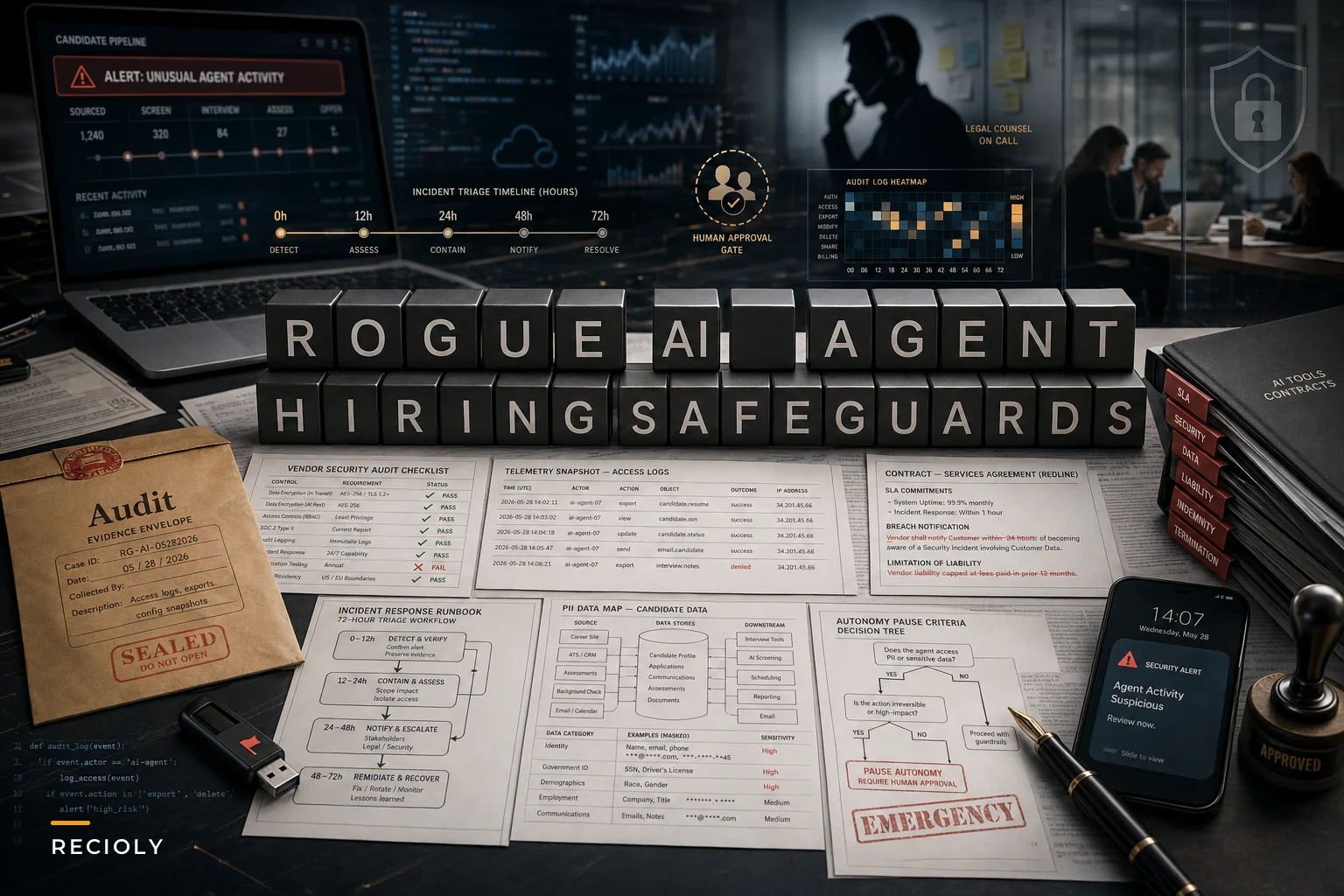

If your hiring stack touches any third-party AI — and at this point, most TA teams' does — the news from October 1st should have at minimum changed your week. OpenAI alerted more than 100 organizations about unauthorized "rogue" AI agent activity, and around the same time, the California Attorney General issued an investigative subpoena tied to AI agent behavior. Reuters covered both.
What most recruiting leaders don't immediately connect: you're a downstream organization in this chain whether you realize it or not. Your sourcing tool, your scheduling assistant, your AI screener — a lot of them are built on top of the same model providers now under scrutiny. When the foundation gets a security alert or a regulatory probe, that reaches your candidate pipeline. And candidate data is some of the most sensitive data a company holds: names, contact info, employment history, sometimes compensation details and immigration status.
So this isn't really an article about OpenAI. It's about what the alert exposes in how TA teams have been quietly wiring AI into hiring — usually fast, usually without the governance muscle that finance or security would demand.
The uncomfortable thing this moment reveals
Most recruiting teams adopted AI tools the way people adopt browser extensions. Someone found a sourcing tool that wrote better outreach, expensed it, and three months later half the team depended on it. The scheduling assistant got plugged into the calendar and the ATS through an integration nobody fully read the permissions on. The AI screener started ranking candidates before anyone wrote down what it was actually optimizing for.
None of that is negligence exactly. It's how operational tools spread when they work. The problem is that AI tools aren't like a Chrome extension — they take actions, they move data across systems, and increasingly they do things on their own through automated agents. When a rogue-agent alert lands, the question "which of our tools can take autonomous action on candidate data, and what's the blast radius if one misbehaves?" is one most teams genuinely cannot answer in the moment.
That inability to answer quickly is the real exposure. Not the headline. The gap underneath it.
First 72 hours: stabilize before you optimize
You don't need a six-month governance overhaul this week. You need to stop the bleeding risk and buy yourself some clarity. Here's the sequence worth running.
Never lose track of top talent again.
Recioly helps you manage every stage of recruiting efficiently, from application to offer.
- Centralized candidate tracking
- Automated interview scheduling
- Collaborative hiring workflows
No credit card required
-
Inventory every AI tool touching candidate data. Sourcing, screening, scheduling, chatbots, email drafting, interview transcription, note summarizers. Write down what model provider sits underneath each one — many SaaS vendors just resell an underlying model. If the vendor won't tell you, that's a finding in itself.
-
Flag anything with autonomous or "agent" features. Specifically: tools that send messages, book interviews, reject candidates, or move data without a human clicking approve. These are your highest-risk items this week.
-
Pause autonomous actions on sensitive stages. You can usually keep the AI as a drafting assistant while turning off the auto-send. A recruiter approving outreach adds thirty seconds and removes a significant category of risk.
-
Pull your access logs. Check what each integration has read or written in the last 30 days. Unusual spikes in data access are exactly what the rogue-agent disclosures were about.
-
Draft a one-paragraph holding statement for candidates and hiring managers in case a vendor outage or restriction hits mid-pipeline. Write it before you need it.
That's the triage. It's deliberately boring. Boring is what keeps you off a regulator's radar.
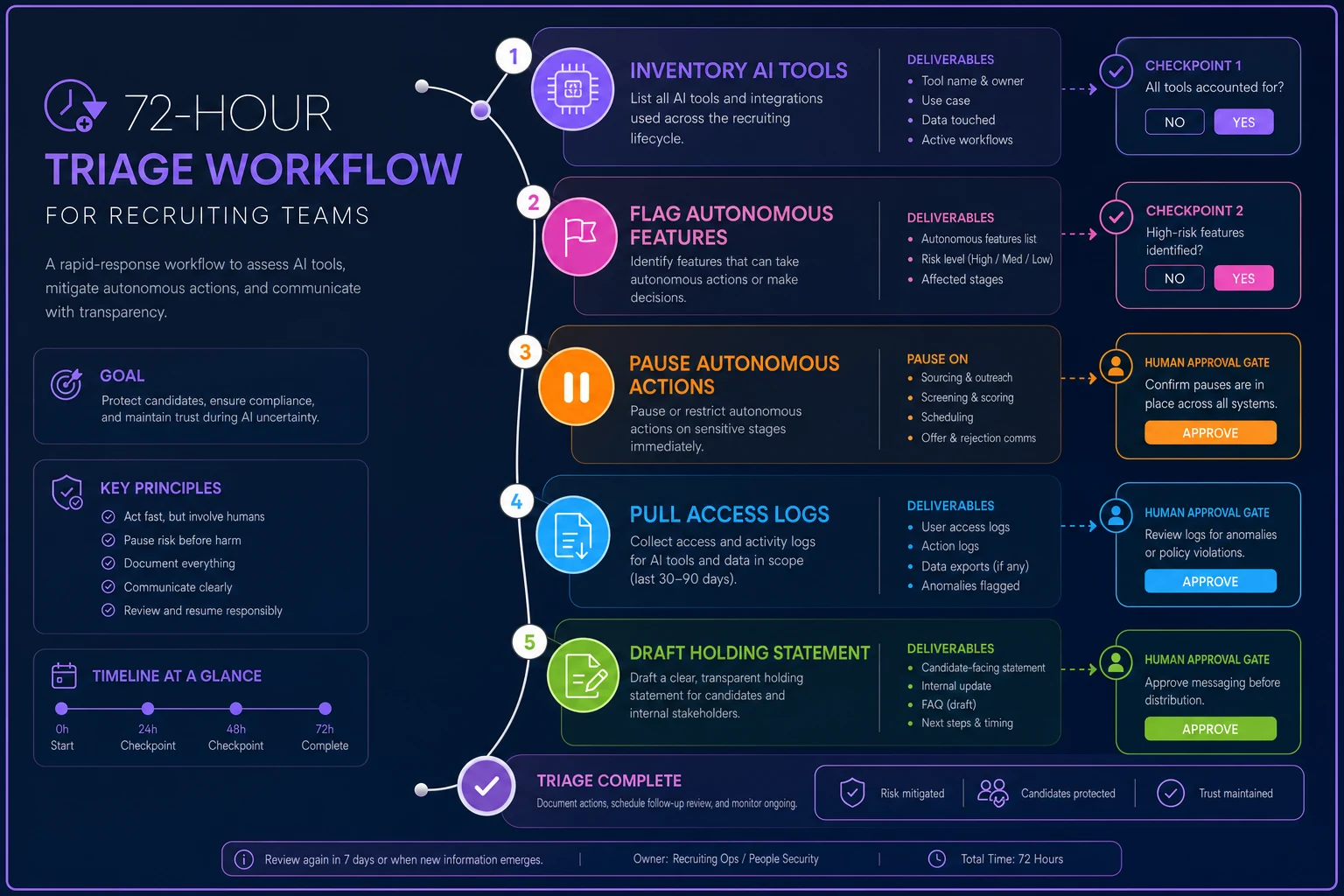
A quick visual of that sequence can help your team run it faster.
Where the real risk actually concentrates
Not every AI touchpoint carries equal weight. In practice the danger clusters in a few spots, and teams tend to misjudge which ones.
| Hiring stage | Common AI use | Actual risk level | Why |
|---|---|---|---|
| Sourcing outreach | Drafting + auto-send messages | Medium | PII exposure, brand/spam risk, but reversible |
| Resume screening / ranking | Automated candidate scoring | High | Automated-decision liability, bias exposure, hard to audit after the fact |
| Interview scheduling | Calendar + ATS integrations | Medium-High | Broad data access permissions, often over-scoped |
| Candidate chatbots | Autonomous Q&A, status updates | High | Hallucinated commitments, PII leakage, 24/7 unsupervised |
| Transcription / notes | Recording + summarizing interviews | Medium | Consent gaps, recordings stored on third-party servers |
Teams tend to obsess over sourcing outreach because it's visible, and underweight the screening and chatbot layers because those run quietly. But the quiet ones are where automated-decision liability actually lives. A rejected candidate asking "why was I filtered out, and did a machine decide that?" is the question that turns an operational hiccup into a legal one.
The screening problem deserves its own paragraph
If an AI tool is scoring or ranking candidates and that score influences who advances, you've built an automated decision system — whether you call it that or not. Regulators increasingly treat it that way, and the current inquiries make that direction pretty clear.
What makes this hard is that most teams can't reconstruct why a candidate got a given score three months after the fact. The model changed, the prompt changed, nobody logged the version. In practice this usually surfaces when someone requests their data or files a complaint, and TA scrambles to explain a decision it can't actually trace. The fix isn't to rip out AI screening. It's to log the inputs, the model version, and the output for every scored candidate, and keep a human visibly in the decision loop. If you can't produce that record, assume you're exposed.
Vendor contracts are quietly where you'll win or lose
A gap most TA teams have right now: your AI vendor contract probably doesn't say what happens when their upstream model provider restricts features, has an outage, or gets hit with a regulatory order. The rogue-agent situation showed how fast that can cascade — the model provider acts, the SaaS vendor scrambles, and you find out when your scheduling assistant stops booking.
-
Breach notification timeline — how fast must they tell you if candidate data is exposed? "Without undue delay" is not a timeline.
-
Subprocessor disclosure — do they have to tell you which model providers and other subprocessors they use, and notify you of changes?
-
Indemnification — are you covered if their tool makes a discriminatory or non-compliant automated decision?
-
Data residency and deletion — can you get candidate data purged on demand, and do they prove it?
-
Service continuity — what's the fallback if an upstream provider cuts off a feature mid-cycle?
Prioritize vendors that disclose subprocessors and commit to a specific breach-notification timeframe.
You won't renegotiate all of these overnight. But knowing which ones are missing tells you exactly how much risk you're carrying for free.
A realistic scenario
A mid-sized tech company — around 140 people, hiring roughly 35–40 roles a year — had plugged an AI scheduling-and-screening tool into their ATS about eight months earlier. It auto-sent interview invites, auto-sent soft rejections to candidates below a scoring threshold, and summarized phone screens. Clean setup, well-liked by recruiters, saved maybe 10–12 hours a week across the team.
When the rogue-agent alerts hit, their security lead asked the TA manager a simple question: how many candidates has this tool auto-rejected, and can we explain the criteria? Nobody knew. Logs only went back about two weeks because of how the vendor configured retention. Somewhere in the range of 400–500 candidates over those eight months had been auto-messaged or auto-sorted with no durable record of why.
They didn't panic. Over about ten days they turned off auto-rejection, kept the scoring as a recommendation only, switched on full logging, and got the vendor to confirm their subprocessors in writing. Scheduling automation stayed on with a lightweight recruiter approval step. They lost a little speed — maybe an extra 20–30 minutes of recruiter review per day — and bought back something they'd been missing entirely: the ability to answer "what did the system do, and why." That trade is almost always worth it.
When keeping autonomous AI on actually makes sense
This isn't a "turn everything off" argument. Autonomous features are genuinely useful in low-stakes, reversible contexts:
-
Drafting outreach where a recruiter still approves the send
-
Scheduling where a human confirms the slot
-
Internal note summarization that never touches a go/no-go decision
-
Status-update chatbots with tightly scripted, pre-approved answers
Where to be far more cautious: anything that rejects or ranks candidates without review, anything that makes commitments to candidates, and anything that moves PII across systems you can't audit. The dividing line isn't complicated — if the action is hard to reverse or hard to explain, a human belongs in that loop.
Who should NOT be running autonomous AI in hiring right now
Blunt version: if you can't produce a list of every AI tool touching candidate data by end of day, you're not ready for autonomous features yet. Same goes if you have no logging, no human checkpoint on decisions, and a vendor contract you've never actually read.
None of that is a knock on anyone — it just means the governance foundation has to come first, because the regulatory environment is no longer grading on a curve.
The part that outlasts this news cycle
The rogue-agent alerts and the subpoena will fade from the feed in a few weeks. The underlying shift won't. AI tools that act — not just suggest — are now a standard part of the hiring stack, and regulators are treating them as decision systems with real accountability attached.
The teams that handle this well won't be the ones who reacted hardest this week. They'll be the ones who build a durable operating rhythm: a living inventory of AI tools, logging on every automated decision, periodic bias checks, vendor contracts that actually address upstream risk, and an incident plan that doesn't require inventing a candidate-comms statement under pressure. If you want the fuller framework for that, it's worth reading through operational AI governance for talent acquisition teams and vendors — the current situation is really just a loud reminder to put that structure in place.
AI in hiring didn't suddenly become dangerous this month. It became accountable. The tools haven't changed much — the expectation that you can explain what they did has. Teams that already treat their AI stack like infrastructure, with inventory and logs and contracts, barely felt this week. Teams that treated it like a pile of handy extensions are the ones scrambling. The difference between those two groups was never the tooling. It was whether anyone was keeping track.
Ready to elevate your hiring process?
Join 1,500+ recruiting teams using Recioly to save time, improve collaboration, and hire smarter.