

Most TA teams treat AI governance like a policy document. They write a two-page statement, get legal to sign off, mention "human in the loop" a few times, and file it somewhere nobody reads. Then a resume-screener quietly starts down-ranking candidates from a particular set of schools, or a scheduling model routes callbacks unevenly across zip codes, and nobody notices for four months because there's no telemetry — nothing actually watching the model in production.
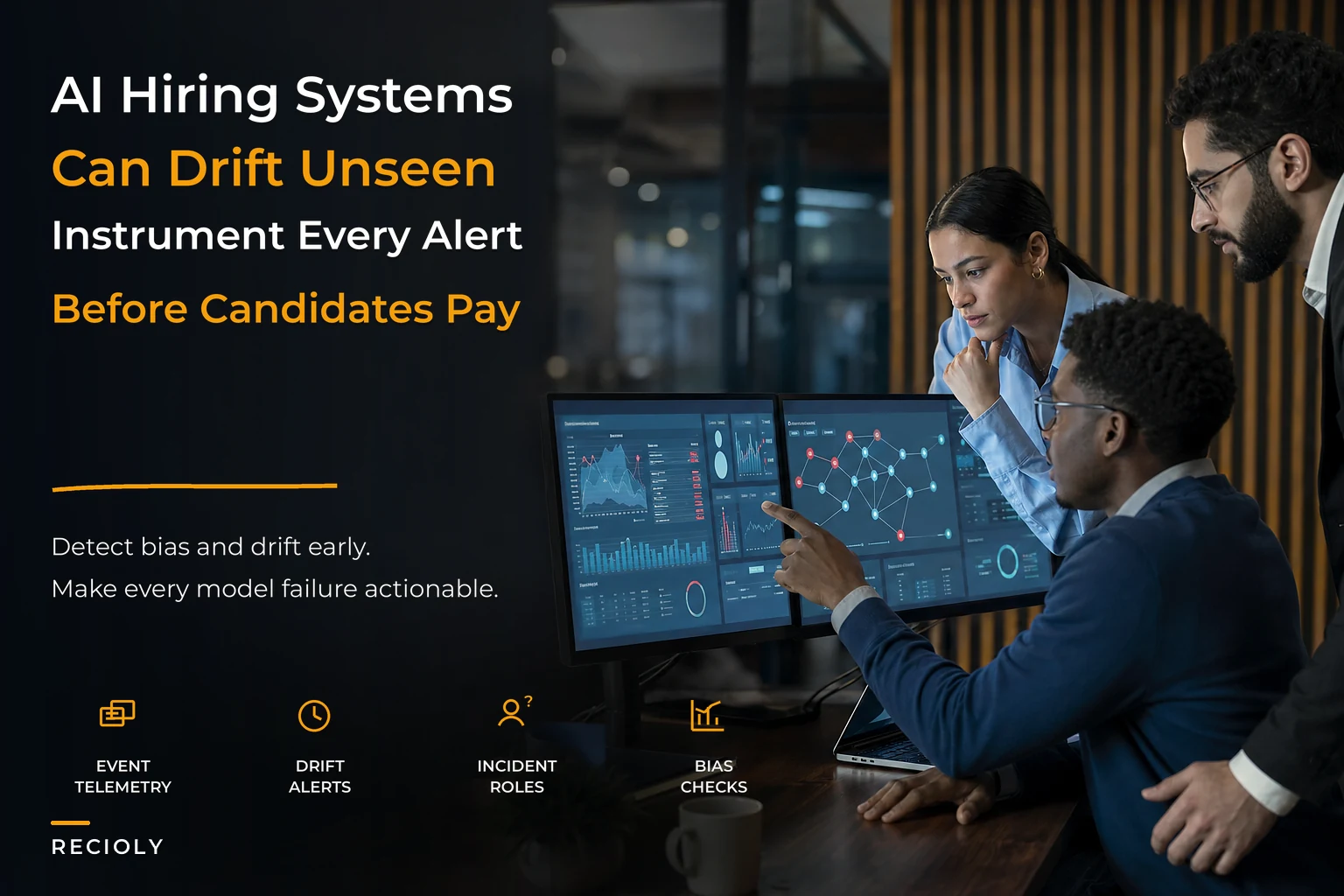
That gap is the whole problem. Governance-as-policy tells you what you intend to do. Governance-as-operations tells you what the system is actually doing right now, at 2pm on a Tuesday, in the requisition your hiring manager is staring at. This piece is about the second kind — the plumbing. Telemetry schemas, log formats, alert thresholds, drift-detection recipes, bias-monitoring checks, incident playbooks, and the vendor contract language that lets you get at the data in the first place.
If you already have consent flows and retention schedules handled — and if you don't, the candidate data governance runbook is the place to start — this is the layer that sits on top and watches the models themselves.
Why AI in hiring breaks quietly instead of loudly
Software bugs usually announce themselves. A page 500s, a job fails, an integration times out, and someone gets paged. Model failures don't work like that. A screening model that's slowly drifting still returns a score. A ranking model that's developed a disparity still produces a ranked list. Everything looks fine. The output is well-formed. It's just wrong in a way that's invisible unless you're specifically measuring for it.
This is the core reason AI governance for talent acquisition can't live in a policy binder. The failure modes are statistical, not functional. You don't catch them by testing whether the feature works — you catch them by continuously measuring distributions, pass-through rates, and score patterns across groups over time.
-
- Silent drift. The candidate population shifts (a layoff wave floods the pool with senior engineers, say), and a model tuned on last year's applicants starts scoring everyone lower. Nobody retrained anything. The world just moved.
-
- Proxy leakage. A model that never sees gender or race still learns to approximate them through school names, zip codes, employment gaps, or even resume formatting. Remove the protected attribute and the proxy quietly takes its place.
-
- Threshold creep. Someone tweaks a match-score cutoff from 0.62 to 0.71 to reduce recruiter workload during a hiring freeze. Pass-through drops 30%. Nobody logs it as a governance event because it felt like a config change.
-
- Vendor black boxes. The model isn't even yours. A sourcing tool or assessment vendor runs the scoring, and you get a number back with no visibility into what produced it or how it's changed since you signed.
None of these trip an error. All of them are governance incidents. And you can only see them if you've instrumented for them ahead of time.
What you actually need to log
The mistake most teams make is logging outcomes without logging the inputs and context that would let you explain those outcomes later. You end up with a pile of "candidate X scored 0.44" records and no way to reconstruct why, or whether 0.44 meant the same thing in March as it did in June.
Never lose track of top talent again.
Recioly helps you manage every stage of recruiting efficiently, from application to offer.
- Centralized candidate tracking
- Automated interview scheduling
- Collaborative hiring workflows
No credit card required
A workable telemetry schema captures the decision, the model state, and enough context to reproduce and audit it. Here's a baseline event table for any scoring or ranking model in the pipeline:
| Field | Type | Purpose |
|---|---|---|
event_id | uuid | Unique decision record |
timestamp_utc | datetime | When the score was produced |
requisition_id | string | Ties decision to a role/req |
candidate_ref | hashed id | Pseudonymized candidate reference |
model_id | string | Which model produced this |
model_version | string | Exact version/build hash |
stage | enum | screen / rank / match / schedule |
raw_score | float | Model output before thresholding |
threshold_applied | float | Cutoff active at decision time |
decision | enum | pass / hold / reject / route |
featuresnapshotref | string | Pointer to input features used |
override_flag | bool | Did a human override the model? |
override_reason | string | Free-text or coded reason |
latency_ms | int | Time to produce score |
The two fields people consistently forget are modelversion and thresholdapplied. Without version pinning, you can't distinguish "the model changed" from "the candidates changed." Without recording the live threshold at decision time, you can't reconstruct why two identical candidates got different decisions a month apart. Those two columns are what turn a log into an actual audit trail.
Capture
modelversionandthresholdappliedon every event — they're what convert a log into an auditable decision trail.
A second table matters just as much — the aggregate monitoring table, computed on a rolling basis rather than per-event:
| Field | Type | Purpose |
|---|---|---|
windowstart / windowend | datetime | Measurement period |
modelid / modelversion | string | What's being measured |
stage | enum | Pipeline stage |
group_dimension | string | e.g. source, region, cohort |
group_value | string | The specific segment |
n | int | Sample size in window |
pass_rate | float | Pass-through for this group |
mean_score | float | Average raw score |
score_p10 / p50 / p90 | float | Distribution shape |
psivsbaseline | float | Population stability index |
That second table is where drift and disparity actually become visible. Individual events don't tell you anything about fairness or drift — only distributions across windows do. This connects directly to how you structure identity and lineage across systems, which the recruiting data ownership and cross-system attribution piece covers in depth. If your candidate IDs don't reconcile across the ATS, the assessment tool, and the sourcing platform, none of these aggregates will be trustworthy.
Drift and bias detection you can actually run
You don't need a data science org to run basic drift and disparity checks. You need a handful of recipes running on a schedule against the aggregate table above.
Population Stability Index (PSI) for drift. Bucket your input feature (or score) distribution, compare the current window against a locked baseline, and sum the weighted log-differences. The rough convention:
-
Split the score/feature range into 10 buckets from the baseline period.
-
Compute the % of records in each bucket for baseline vs. current window.
-
For each bucket
(current% − baseline%) × ln(current% / baseline%). -
Sum across buckets.
-
Interpret
under 0.1 is stable, 0.1–0.25 is worth watching, above 0.25 means the input world has shifted enough to retrain or re-baseline.
Adverse-impact ratio for disparity. For any group dimension you can legally and ethically monitor, compute pass-through per group and take the ratio of the lowest group's rate to the highest. The four-fifths rule of thumb flags anything under 0.80, but treat that as a trigger for investigation, not a verdict — small sample sizes throw this off badly, which is why the n column matters. Don't fire an alert on a group with 11 candidates in the window.
Score-distribution shift by segment. Track mean_score and p50 per group over rolling windows. A model developing a proxy problem often shows up here first — one segment's median quietly sliding down two weeks before the pass-rate gap becomes obvious.
One thing worth calling out: teams that only monitor outcomes (pass rates) catch problems late. Teams that also monitor input distributions (PSI on features) catch the same problems weeks earlier, before a single candidate is unfairly rejected. Input monitoring is your early warning; outcome monitoring is your confirmation.
Alert thresholds that don't cry wolf
The fastest way to kill a monitoring system is to make it noisy. If every minor wiggle pages someone, people mute it within a week. Thresholds need to be tiered by severity and tied to concrete actions.
A reasonable starting set of alerting rules:
-
- PSI > 0.25 on any production model input → warning; schedule re-baseline review within 5 business days.
-
- PSI > 0.4 → critical; freeze auto-reject on that model, route to human review, open incident.
-
- Adverse-impact ratio < 0.80 with n ≥ 100 per group, sustained across 2 windows → critical; pause automated decisions at that stage, open bias incident.
-
- Pass-rate change > 20% week-over-week with no logged config change → warning; investigate for silent threshold or model change.
-
- Override rate > 35% at any stage → warning; the model and the humans disagree too often, which usually means the model is wrong or the threshold is miscalibrated.
-
- Any deploy without a recorded
model_versionchange in telemetry → critical; you've lost version traceability, which is an audit failure on its own.
The override-rate alert is underused and genuinely valuable. When recruiters override a model more than a third of the time, they've stopped trusting it — and they're often right. High override rates are a leading indicator of a model that's about to become a governance problem, and they show up in your own logs before any statistical test fires.
The incident playbook: what happens when an alert fires
Alerts without a runbook just create anxiety. Everyone needs to know, before the incident, who does what. Here's a workable incident flow for a bias or drift event:
-
Contain. For critical alerts, the on-call owner switches the affected stage from automated decision to human-review mode immediately. You do not debug in production while the model keeps rejecting people.
-
Snapshot. Freeze the current model version, the active thresholds, and a copy of the aggregate table for the affected windows. This is your evidence set.
-
Triage. Classify
is it drift (inputs moved), disparity (group gap), a config change (someone moved a threshold), or a vendor change (their model updated without notice)?
-
Identify affected candidates. Using
eventidandrequisitionid, pull the list of candidates decided under the faulty state during the incident window. This is the step teams skip and later regret. -
Remediate. Re-baseline or roll back the model, revert the threshold, or escalate to the vendor. Re-adjudicate affected candidates where the decision may have been wrong.
-
Document. Timestamped record of detection, decision, actions, and affected population. This is what an auditor or regulator will ask for.
-
Postmortem. What monitoring should have caught this earlier? Add the missing check.
Here's a simple flow diagram you can use to visualize the runbook and hand off responsibilities quickly.
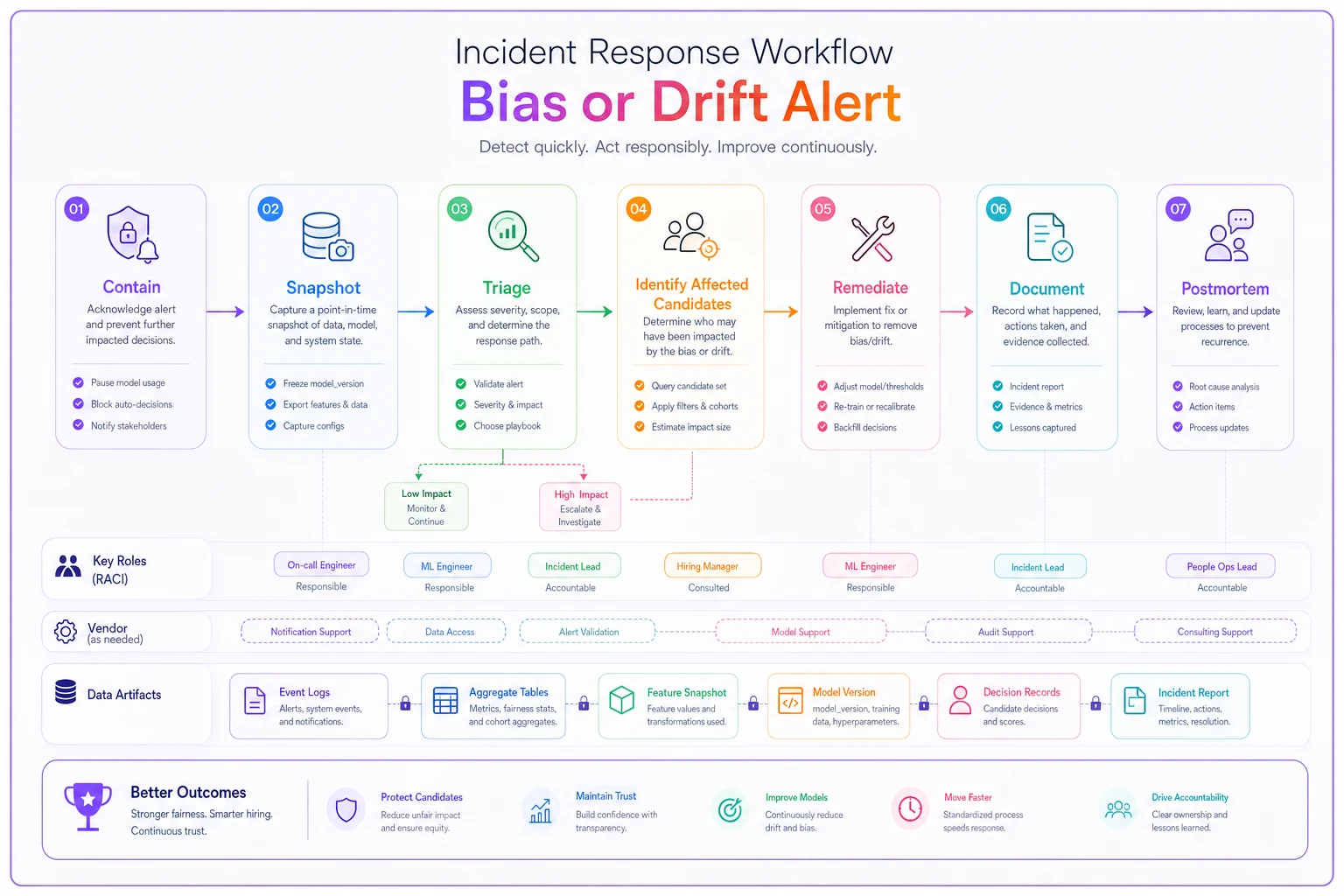
Step 4 is the one with legal teeth. If a screening model was quietly rejecting a group for six weeks, "we fixed it" is not a complete answer. "We fixed it and re-reviewed the 240 candidates decided during the incident window" is. Your telemetry is what makes that re-review possible at all — which is the entire argument for logging the input snapshot reference in the first place.
Vendor contracts: the governance you can't instrument yourself
Most AI in TA stacks isn't built in-house. It's a sourcing tool, an assessment platform, a chatbot, a matching engine — vendors whose models you can't see and can't monitor unless the contract forces the door open.
If your assessment vendor updates their scoring model and doesn't tell you, every calibration you've done is silently invalidated. This is exactly why your assessment architecture needs to treat vendor scores as inputs you validate, not truths you accept. And validation requires contractual access.
-
- Model-change notification. Vendor must notify you at least 30 days before any material model or scoring change, with a description of expected impact on score distributions.
-
- Telemetry export. Vendor provides per-decision score data and version identifiers in a machine-readable format, exportable to your systems — not just a dashboard you can look at but can't query.
-
- Bias-audit cooperation. Vendor supports and does not obstruct adverse-impact testing, including providing aggregate pass-through by requested dimensions where lawful.
-
- Right to audit. You may audit the model's outputs and documentation, with defined cadence, on reasonable notice.
-
- Version pinning on request. You can freeze on a specified model version during a hiring cycle rather than being force-migrated mid-req.
-
- Incident SLA. Defined response times for bias or drift issues you surface.
Sample SLA language you can adapt: "Vendor shall acknowledge Bias/Drift Incidents reported by Client within one (1) business day and provide a root-cause assessment within five (5) business days. For Critical Incidents affecting candidate adjudication, Vendor shall, within two (2) business days, provide sufficient telemetry to enable Client to identify all candidates scored under the affected model state during the incident window."
The pattern that shows up repeatedly in procurement: teams negotiate hard on price and integration, then accept whatever governance terms the vendor's standard MSA offers. That's backwards. The governance clauses are the ones that determine whether you can defend a hiring decision two years from now.
A short real scenario
A mid-sized company — a few hundred hires a year — ran a third-party resume-matching tool at the top of funnel. Match scores above roughly 0.65 auto-advanced; below that got deprioritized. It worked fine for a while.
Then the vendor pushed a model update. No notification, because the contract didn't require one. Over about six weeks, pass-through for candidates from non-traditional backgrounds — bootcamp grads, career-changers — dropped by something like a third, while pass-through for traditional CS degrees held steady. Recruiters noticed the pipeline "felt more corporate" but couldn't put a number on it.
What surfaced it wasn't a formal audit. A recruiter's override rate had crept up — she kept manually pulling bootcamp candidates back into the funnel because they kept scoring low, and someone finally asked why. Once they pulled the aggregate numbers, the disparity was obvious. But they had no telemetry from the vendor, no version history, and no contractual right to demand it. They couldn't even confirm when the change happened, let alone identify everyone affected.
The fix took a quarter of painful cleanup: instrument their own aggregate monitoring on the scores they did receive, renegotiate the contract for change-notification and telemetry export, and set an override-rate alert at 35%. The disparity itself was fixable in an afternoon once they could see it. The problem was six weeks of blindness over something the human signals were already flagging.
When heavy instrumentation makes sense — and when it's overkill
You don't need all of this for every model. A scheduling assistant that only sends calendar invites doesn't warrant a bias-monitoring pipeline. Match the governance weight to the decision weight.
This full stack makes sense when: the model influences who advances or gets rejected, you operate at enough volume that patterns are statistically meaningful, you're in a regulated jurisdiction (NYC Local Law 144, the EU AI Act's high-risk classification for hiring tools, and similar), or you rely on vendor models you can't inspect.
-
- the model influences who advances or gets rejected
-
- you operate at enough volume that patterns are statistically meaningful
-
- you're in a regulated jurisdiction (NYC Local Law 144, the EU AI Act's high-risk classification for hiring tools, and similar)
-
- you rely on vendor models you can't inspect
This is overkill when: the AI does formatting, summarization, or logistics with a human making every substantive decision, your volume is too low for the statistics to mean anything (a five-person startup hiring six people a year doesn't need PSI monitoring), and there's no automated adjudication happening.
-
- the AI does formatting, summarization, or logistics with a human making every substantive decision
-
- your volume is too low for the statistics to mean anything (a five-person startup hiring six people a year doesn't need PSI monitoring)
-
- there's no automated adjudication happening
Who should not attempt the full build at once: teams without reconciled candidate identity across systems. If you can't reliably match a candidate across your ATS, sourcing tool, and assessment platform, your aggregates will be garbage and you'll chase phantom drift. Fix identity and lineage first, then instrument.
An audit-ready rollout checklist
Work through these in order; each depends on the ones before it:
-
- [ ] Inventory every model touching hiring decisions, including embedded vendor models.
-
- [ ] Classify each by decision weight (advisory / influential / adjudicating).
-
- [ ] Confirm reconciled candidate identity across all relevant systems.
-
- [ ] Stand up the per-decision event table with
modelversionandthresholdappliedcaptured. -
- [ ] Stand up the rolling aggregate monitoring table with group dimensions.
-
- [ ] Lock a baseline period for PSI and disparity comparisons.
-
- [ ] Implement PSI, adverse-impact, and score-shift checks on a schedule.
-
- [ ] Set tiered alert thresholds tied to concrete actions, including override-rate.
-
- [ ] Write the incident playbook and assign an on-call owner.
-
- [ ] Renegotiate vendor contracts for change-notification, telemetry export, and audit rights.
-
- [ ] Add version-change events to the telemetry stream so config changes are logged as governance events.
-
- [ ] Run a tabletop incident once, end to end, before you need it for real.
If you can produce, on demand, the version history of a model, the threshold in effect on a given date, the group-level pass rates over any window, and the list of candidates affected by a past incident — you're audit-ready. Most of governance is just being able to answer those four questions with data instead of a shrug.
Teams that get this right stop thinking about AI governance as a document they wrote once. They treat it as a running system that watches the other systems — quietly logging, comparing, and flagging, so that when a model starts drifting, someone finds out in an alert instead of in a discrimination complaint.
Ready to elevate your hiring process?
Join 1,500+ recruiting teams using Recioly to save time, improve collaboration, and hire smarter.