

Most hiring processes aren't broken because any single step is bad. They break because the steps don't talk to each other. A resume screen filters on one thing, a work sample tests something loosely related, and then three interviewers ask whatever comes to mind. By the time the hiring committee meets, you've got four data points measuring four different constructs, and everyone's forced to argue about a decision the process was never designed to support.
That's the real problem with assessment architecture. Not "do we have enough stages" — it's whether the stages compound into a coherent prediction or just cancel each other out. When a screen accepts for X, the work sample measures Y, and the interview scores Z, you don't have a funnel. You have three funnels stacked on top of each other, leaking candidates for unrelated reasons.
This piece is about how the whole thing fits together: what each layer is actually for, what sequence produces the cleanest signal, where legal and validity risk creeps in, and what falls apart once you're hiring at volume across role families instead of one req at a time.
Start with what each layer is supposed to do
The clearest way to think about assessment architecture is by construct — what each stage is genuinely capable of measuring — rather than by format. Formats are interchangeable; constructs are not.
A screen is a filter for disqualifiers and hard requirements. It answers "should this person continue?" not "how good are they?" That distinction matters more than most teams give it credit for. When teams try to make the screen do fine-grained ranking, they end up rejecting people on weak signals — a keyword that didn't appear, a gap that had a reasonable explanation — and the false-negative rate quietly climbs. You never see the cost of a false negative, which is exactly why it's so dangerous.
A work sample is your highest-fidelity predictor. It's the closest thing to watching someone do the job. Decades of validity research put structured work samples at or near the top of predictive power, and in practice it's where the strongest correlation with on-the-job performance shows up. But work samples are expensive — for the candidate and for the reviewers — so they belong after the screen, not before. Front-loading a two-hour take-home before you've confirmed basic fit burns goodwill and shrinks your top-of-funnel.
A structured interview is where you probe the things a work sample can't isolate: reasoning under ambiguity, collaboration signals, how someone handles being wrong. The keyword there is structured. An unstructured interview drops back down toward the bottom of the validity ranking, roughly where "years of experience" sits — which is to say, close to noise. If your interview isn't tied to defined competencies with anchored rating scales, it's not really part of the architecture. It's a vibe check wearing a lanyard.
The core sequencing logic, worth internalizing before anything else:
| Layer | Primary job | What it measures well | What it measures badly | Cost to run |
|---|---|---|---|---|
| Screen | Filter disqualifiers | Hard requirements, obvious no's | Skill depth, potential | Low |
| Work sample | Predict performance | Actual job tasks, applied skill | Personality, culture add | High |
| Structured interview | Probe & confirm | Reasoning, collaboration, edge cases | Raw technical ability | Medium–high |
The mistake teams make constantly is inverting this — a heavy technical interview early, then a light work sample late, then a rubber-stamp screen that lets almost everyone through. The sequence should move from cheap-and-broad to expensive-and-narrow, and each stage should measure something the previous one couldn't.
The sequencing that actually holds up
Screen → work sample → structured interview isn't arbitrary. It's ordered by cost-per-signal and by what each stage can rule out before you spend more.
Never lose track of top talent again.
Recioly helps you manage every stage of recruiting efficiently, from application to offer.
- Centralized candidate tracking
- Automated interview scheduling
- Collaborative hiring workflows
No credit card required
The screen removes people who can't legally, geographically, or fundamentally do the role. The work sample removes people who look good on paper but can't perform. The interview removes people who perform in isolation but won't work inside your constraints — the team, the ambiguity, the pace. Each stage is a different kind of filter, and the order minimizes wasted effort.
-
Screen against a fixed disqualifier list. No ranking, just pass/hold/reject with a documented reason for each.
-
Work sample administered to everyone who clears the screen, graded blind by at least two reviewers against the same rubric, scores reconciled before anyone sees them.
-
Structured interview built to fill the gaps the work sample left open — not to re-test the same thing. If your interview and your work sample measure the same construct, you paid twice for one data point.
-
Committee decision where the constructs are laid side by side, and disagreement between stages is treated as information, not an inconvenience to be averaged away.
That last point is underrated. When the work sample says "strong" and the interview says "weak," the instinct is to split the difference. Don't. That contradiction is a signal — usually it means one stage tested something the role genuinely needs and the other didn't. Dig into why they disagree before you resolve how.
If you're leaning on take-homes or recorded responses to keep the top of the funnel moving, the scoring discipline matters even more — the logic in scoring asynchronous interviews reliably with a review-panel rubric applies directly to how you keep work-sample grading consistent across reviewers.
This diagram shows how the stages flow while keeping reviewers blind to previous stages.
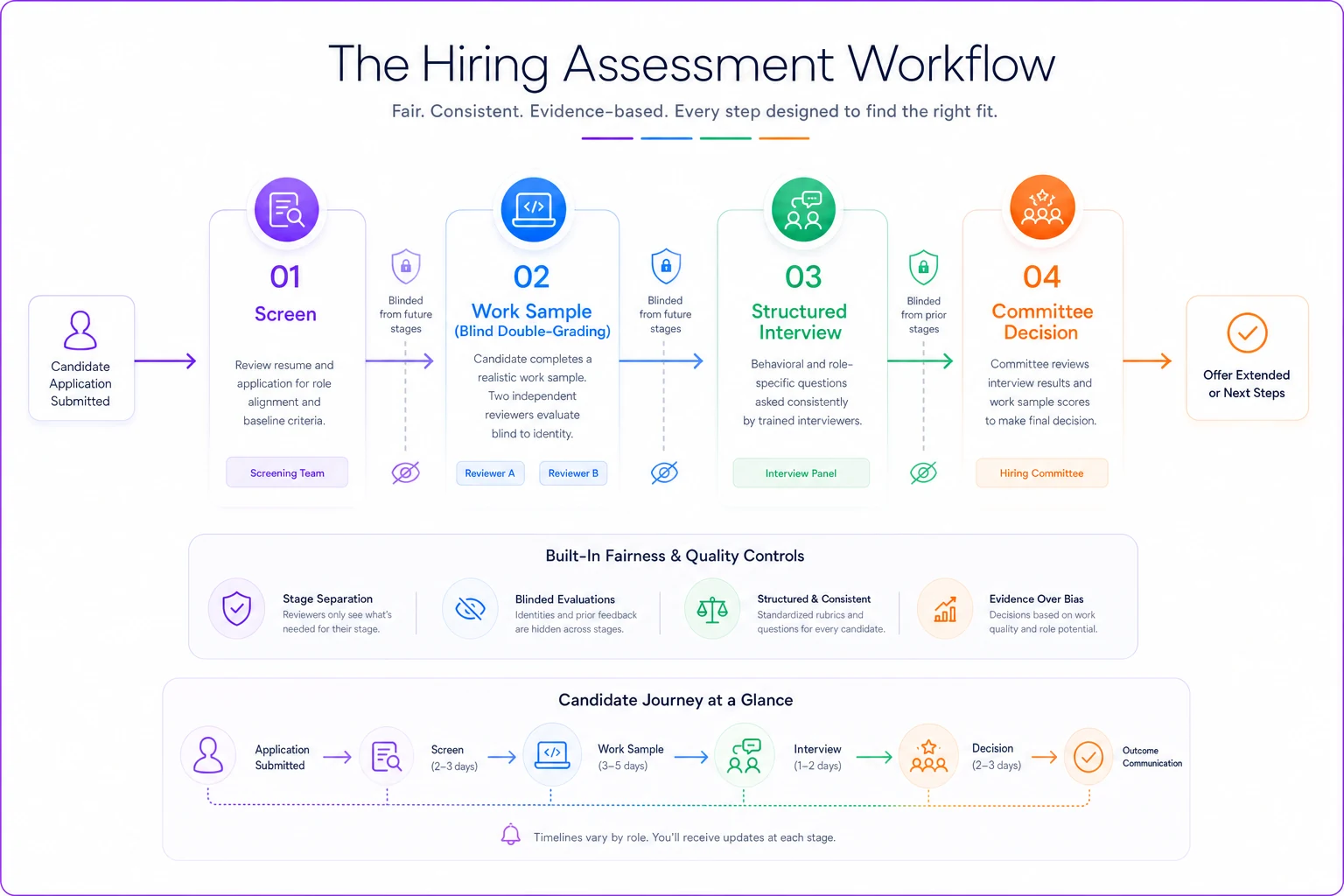
When the stages are arranged and insulated this way, each adds independent signal rather than confirmation bias.
Where legal and validity risk actually lives
Assessment architecture is where hiring quietly accumulates legal exposure, and most teams don't notice until something forces an audit.
The governing principle is job-relatedness. Every stage should measure something the role demonstrably requires. That sounds obvious, but the violations are subtle. A work sample that takes six hours disproportionately screens out people with caregiving responsibilities or second jobs — and if it isn't demonstrably tied to the actual scope of work, you've built adverse impact into your funnel without meaning to. A screen that filters on a specific degree when the role doesn't require one is the same problem in a different coat.
The other quiet failure mode is inconsistency. If two candidates for the same role go through different stages, different rubrics, or different interviewers asking different questions, you've lost the ability to defend the decision as fair. Validity depends on standardization. The moment the process becomes bespoke per candidate, every reject becomes harder to justify and every hire becomes harder to explain if it goes wrong.
-
Every stage maps to a documented competency. If you can't name what a stage measures and why the role needs it, cut the stage.
-
Rubrics before candidates. The scoring criteria are locked before anyone applies. Rubrics written mid-process bend toward whoever's already in the pipeline.
-
Consistent stages within a role. Same sequence, same instruments, same rating anchors for everyone competing for the same job.
-
Reject reasons are recorded and reviewable. Not for bureaucracy — because patterns in your rejects are where adverse impact shows up first.
-
Scores are stored, not just decisions. "We passed on them" is indefensible. "They scored 2/5 on the two competencies the role weights highest, here's the rubric" is defensible.
Most of the defensibility problems in assessment trace back to weak scoring instruments — the breakdown of common scorecard mistakes that wreck hiring decisions covers the failure modes that quietly poison the whole architecture from the scorecard up.
What breaks when you scale across role families
Everything above works reasonably well for one req. The architecture starts groaning the moment you're running dozens of roles across multiple families, because now you need the same construct discipline applied to different jobs — and the temptation to copy-paste one role's process onto another is enormous.
A software engineering role, a sales role, and an operations analyst role need genuinely different work samples and different competency weights. But you don't want to invent a new architecture for each one — that's unmaintainable and it destroys consistency. The answer is a role-family mapping matrix: define the assessment shape once per family, then vary the content within the fixed structure.
| Role family | Screen filters on | Work sample type | Interview competencies (weighted) |
|---|---|---|---|
| Engineering | Core stack, level, location | Scoped coding / system design task | Problem decomposition, code quality, collaboration |
| Sales | Territory, cycle experience, quota history | Live discovery / mock call | Discovery rigor, objection handling, coachability |
| Ops / Analytics | Tooling, domain, level | Realistic data / process exercise | Analytical reasoning, communication, prioritization |
| Support | Product familiarity, comms, schedule | Ticket-response simulation | Empathy, accuracy, escalation judgment |
The structure stays constant — screen → work sample → structured interview, blind grading, competency-weighted committee — while the instruments change per family. This is what lets you keep the process defensible and consistent even as headcount and role variety grow.
Where this genuinely breaks down at scale is coordination, not design. You can have a solid matrix on paper and still watch it collapse because the work-sample reviewers are a bottleneck, or because interviewers keep drifting off the rubric, or because nobody's tracking whether stages are actually being run in order. The architecture is only as good as its weakest operational link, and at volume the weakest link is almost always human consistency across a growing panel of graders and interviewers.
That drift compounds fast. Ten interviewers each interpreting a "3" slightly differently produces scores that look comparable but aren't, and by the time you notice, you've made months of decisions on numbers that don't mean the same thing. Keeping raters aligned is an ongoing operational task, not a one-time training — the mechanics of an interviewer calibration program that stops score drift are what keep the whole matrix producing comparable signal as the panel grows.
A real scenario: a services company hiring across three families
A professional services firm was scaling from around 40 to roughly 90 people in under a year, hiring across consulting, sales, and internal operations. Their process had grown organically — each hiring manager ran interviews their own way, work samples existed for some roles and not others, and the screen was basically "recruiter reads the resume and forwards the good ones."
The symptom that got attention: 90-day early-attrition was running high, somewhere around one in five new hires either leaving or being managed out in the first quarter. When they pulled the thread, the pattern was ugly. Strong interviewers were passing candidates who couldn't do the work; roles with work samples had noticeably better outcomes than roles without; and two different consulting hires had gone through completely different stages, making it impossible to compare them.
They rebuilt around a role-family matrix. Three families, one fixed sequence, family-specific work samples, and competency-weighted rubrics locked before candidates entered the pipeline. Work samples got blind double-grading. Interviewers were assigned to specific competencies instead of "general fit."
The changes weren't instant, but over the next two quarters early attrition dropped to roughly 7–8%, and — this surprised them — time-to-decision actually shortened, because committees stopped re-litigating candidates. When everyone was scoring the same constructs against the same rubric, disagreement became rare and, when it happened, informative. Hiring managers also reported spending less time in interviews overall, since the work sample was now doing the heavy predictive lifting instead of a fourth conversation.
The lesson wasn't "add more stages." They actually removed some. It was that the stages they kept finally measured different things and fed a single coherent decision.
When this level of architecture makes sense — and when it doesn't
It makes sense when you're hiring at enough volume that consistency pays off, when roles cluster into families you'll hire repeatedly, when the cost of a bad hire is high, or when you're in a regulated or litigation-sensitive environment where defensibility isn't optional. If you're making the same kind of hire more than a handful of times a year, the upfront design cost amortizes quickly.
It's overkill when you're hiring one truly unique senior leader and the "role family" is a family of one. Bespoke assessment for a bespoke role is appropriate — forcing it into a matrix adds ceremony without signal. Same for very early-stage teams making a handful of foundational hires where the founders are directly assessing everyone and the coordination problem doesn't really exist yet.
Who should not do this: teams that won't commit to running the process consistently. A half-implemented architecture is arguably worse than none — it creates the appearance of rigor while the underlying decisions are still ad hoc. If you're going to build blind grading and locked rubrics, you have to enforce them. A rubric everyone ignores is just documentation of a process you're not following.
Rollout: how to put this in place without a six-month project
You don't roll out assessment architecture all at once. You sequence it the same way you sequence the assessment itself — cheap and broad first, expensive and precise later.
-
Start with the screen. Convert it from "recruiter judgment" to a documented disqualifier list per family. This is a day of work and immediately reduces false negatives and inconsistency.
-
Add or fix work samples for your two or three highest-volume families first. Don't try to build them all. Get the roles you hire most into a defensible, blind-graded work sample and prove the outcome before expanding.
-
Convert interviews to structured, competency-weighted rubrics — locked before candidates, tied to named competencies, assigned per interviewer so nobody's grading everything.
-
Build the role-family matrix as documentation of what you've already standardized, not as an upfront spec. Let it grow to reflect real practice rather than inventing structure you haven't tested.
-
Add a governance cadence a monthly review of reject-reason patterns, score distributions by interviewer, and stage completion order. This is where drift and adverse impact surface early enough to fix.
Start by fixing the screen and one high-volume family to prove impact before expanding.
A short governance checklist to keep it honest over time:
-
Are all stages for a given role being run in the defined order?
-
Is every stage still mapped to a competency the role actually requires?
-
Are rubrics locked before candidates enter?
-
Are work samples being blind double-graded?
-
Do reject reasons and scores exist for every declined candidate?
-
Are interviewer score distributions comparable, or is someone drifting?
-
Do stage-level pass rates show adverse impact against any group?
Run that checklist quarterly at minimum. The architecture doesn't fail loudly — it erodes. A reviewer stops grading blind here, an interviewer improvises there, a new role gets bolted on without a matrix entry, and six months later you're back to four contradictory data points and a committee arguing about a decision the process was never designed to support.
The point of all of it
Assessment architecture isn't about adding stages or looking rigorous. It's about making sure each thing you measure is different from the others, that the sequence spends effort in the right order, and that the signals compound into a single defensible decision instead of fighting each other.
The teams that get this right aren't the ones with the most elaborate process. They're the ones whose screen, work sample, and interview each measure exactly one thing the role needs — in an order that respects cost, graded by people who aren't contaminated by each other's conclusions. Get the constructs right and the sequence right, and the hard decisions mostly make themselves. Because for once, all your data is actually pointing at the same thing.
Assessment architecture isn't about adding stages or looking rigorous. It's about making sure each thing you measure is different from the others, that the sequence spends effort in the right order, and that the signals compound into a single defensible decision instead of fighting each other.
The teams that get this right aren't the ones with the most elaborate process. They're the ones whose screen, work sample, and interview each measure exactly one thing the role needs — in an order that respects cost, graded by people who aren't contaminated by each other's conclusions. Get the constructs right and the sequence right, and the hard decisions mostly make themselves. Because for once, all your data is actually pointing at the same thing.
Ready to elevate your hiring process?
Join 1,500+ recruiting teams using Recioly to save time, improve collaboration, and hire smarter.