

Your engineering manager rates a candidate 4/5 on technical skills. Your junior interviewer gives them a 2/5. The hiring committee spends forty minutes arguing about whether that reflects different observations or different standards. Meanwhile, that candidate accepted an offer somewhere else.
This is more common than most recruiting teams want to admit. Not because interviewers are bad at their jobs, but because maintaining consistent scoring standards across a growing team — multiple offices, different role families, interviewers with different backgrounds — gets exponentially harder as you scale.
Score drift sneaks in through predictable entry points
Scoring standards don't collapse overnight. They erode through specific gaps that most teams ignore until something is obviously wrong.
New interviewers join without proper baseline calibration. They bring habits from previous companies where a "3" meant something different. Nobody catches the misalignment for weeks because their scores just get averaged in with everyone else's.
Experienced interviewers quietly shift their standards based on recent candidate quality. After a string of weak candidates, that thirteenth mediocre person suddenly looks decent by comparison. The interviewer doesn't realize their anchor has moved.
Different departments develop their own unwritten scoring conventions. Sales interviewers start treating "3" as a solid baseline while engineering treats it as barely acceptable. These micro-cultures form naturally when teams interview in isolation and never compare notes.
Remote interviewers miss the casual calibration that happens in office hallways. They don't hear when the team informally agrees that "strong communication" now includes async documentation skills. Their rubric understanding drifts without anyone noticing.
The most damaging drift happens in specialized roles. Your machine learning interviewers and your frontend interviewers slowly develop incompatible interpretations of "problem-solving ability" because they never calibrate together. Each group becomes internally consistent but externally incompatible with the rest of the organization.
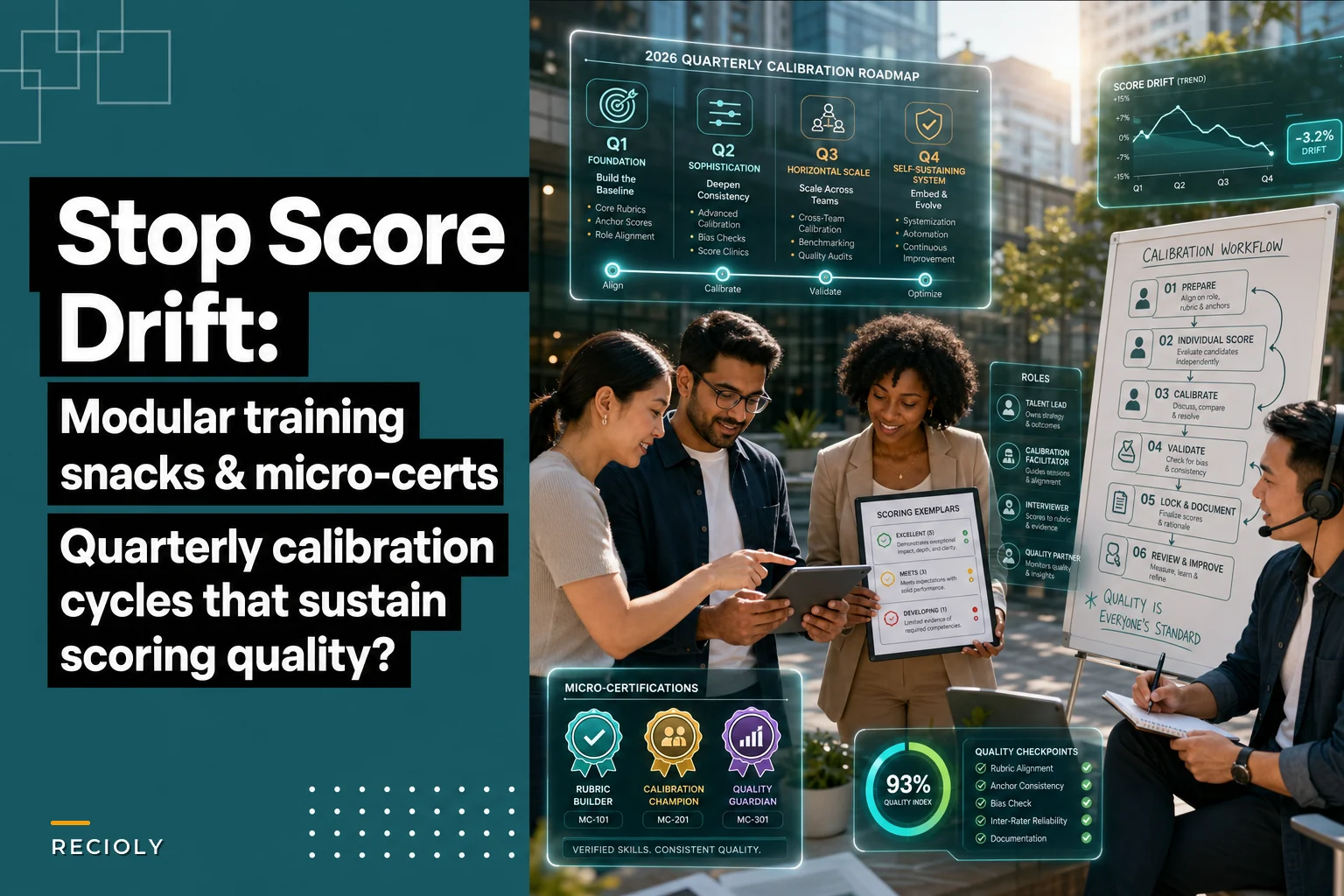
Quarterly calibration cycles catch drift before it compounds
Most teams treat calibration as an annual event. Everyone blocks a Friday afternoon, reviews generic examples, then goes back to interviewing with gradually diverging standards for another year.
Never lose track of top talent again.
Recioly helps you manage every stage of recruiting efficiently, from application to offer.
- Centralized candidate tracking
- Automated interview scheduling
- Collaborative hiring workflows
No credit card required
Quarterly cycles work better because they catch drift while it's still correctable. Every three months, each interviewer reviews role-specific scoring scenarios — not generic examples, but actual recorded interviews from their exact role family with predetermined scores.
-
Month one covers technical skill scoring.
-
Month two focuses on behavioral competencies.
-
Month three handles role-specific attributes.
That rotation ensures every scoring dimension gets recalibrated before meaningful drift accumulates.
Between quarters, micro-corrections happen through score monitoring. When an interviewer's scores deviate more than 0.5 points from team average across three consecutive interviews, they get flagged for a quick recalibration check — not a performance conversation, just a fifteen-minute scoring discussion with a calibrated peer.
The key is keeping these cycles light enough that people actually complete them. No workshops, no group sessions. Focused recalibration on specific scoring dimensions, done asynchronously.
Modular training snacks replace overwhelming calibration marathons
Traditional calibration training tries to cover everything at once. Interviewers sit through presentations on twenty different competencies, review dozens of scoring examples, and forget most of it within a week.
Modular training snacks break this into digestible pieces. Each module covers one specific scoring dimension in fifteen minutes or less. An interviewer struggling with technical assessment scores doesn't sit through behavioral rubrics they already understand.
A typical training snack looks like this: watch a three-minute interview clip, score it yourself, compare your score to the expert baseline, review a two-minute explanation of the scoring rationale. Total time around eight minutes. Retention is noticeably better than marathon sessions.
Serve the modules asynchronously and track completion so you can nudge only those who need the calibration.
These modules stack based on individual needs. New interviewers work through a full foundation series — roughly twelve modules covering basic scoring principles. Experienced interviewers only consume modules for dimensions where their scores show drift.
The modularity also means customization without extra overhead. A sales interviewer gets different technical assessment modules than an engineering interviewer. A recruiter reviewing director-level candidates gets different leadership modules than someone interviewing individual contributors.
AI-powered operational platforms make this manageable at scale. Instead of manually tracking who needs which training, the system automatically assigns modules based on score deviation patterns. An interviewer whose technical scores run consistently low gets served technical calibration content until their scoring realigns.
Role-family clustering prevents false standardization
The biggest mistake in calibration programs is forcing all interviewers to use identical standards regardless of role. A "strong communicator" for a sales role means something fundamentally different than for a data scientist. Pretending otherwise creates false consistency that actually damages hiring quality.
Role-family clustering groups interviewers who assess similar positions. Frontend engineers calibrate with other frontend engineers. Account executives calibrate with other sales interviewers. Each cluster maintains internal consistency without forcing artificial standardization across incompatible roles.
Within each cluster, scoring standards evolve based on actual hiring outcomes. If candidates scoring 4+ on technical skills consistently struggle in the role, the cluster adjusts the rubric. These adjustments happen through collective discussion, not top-down mandate.
Clusters meet virtually once per quarter for about thirty minutes. They review three borderline scoring examples specific to their role family, score independently, then discuss where they diverged. No lectures, no training decks — just practical calibration through real examples.
Cross-cluster calibration only happens where it actually matters. Leadership assessment might be standardized across all senior roles. Culture fit might be consistent company-wide. But technical skills, communication style, and problem-solving approaches stay role-specific.
This clustering also speeds up onboarding. A new engineering interviewer shadows interviews within their cluster, not random interviews across the company. They learn the scoring nuances that matter for their specific role family.
Micro-certifications create accountability without bureaucracy
Annual interviewer certification creates a false sense of security. Someone passes a test in January and interviews with drifting standards for eleven months. By December they're miscalibrated but technically still "certified."
Micro-certifications verify specific competencies on an ongoing basis. Instead of one massive certification covering everything, interviewers earn focused certifications for each dimension they assess — technical screening, behavioral interviews, case study evaluation.
Each micro-certification requires demonstrating consistent accurate scoring across five real examples. Not multiple choice tests — actual interview recordings requiring nuanced scoring decisions. Score within 0.3 points of the expert baseline on all five and you're certified. Miss the mark, you get additional calibration before trying again.
Certifications expire based on usage rather than time. Interview regularly and your certification auto-renews through continuous score monitoring. Go sixty days without interviewing and you need a quick recertification check before rejoining the panel. This prevents rusty interviewers from quietly damaging hiring quality after extended gaps.
Building on scorecard design fundamentals becomes more critical when multiple interviewers need consistent certification standards. Without clear scorecard structure, even well-calibrated interviewers can't score consistently.
The micro-certification system also enables graduated interviewing privileges. New interviewers start certified only for initial screens. After demonstrating consistency there, they earn certification for technical rounds. Senior interviewers eventually earn certification for final round executive assessments.
Scoring exemplars anchor subjective assessments to objective standards
Every interviewer thinks they know what a "3" versus a "4" looks like — until they're forced to articulate the specific difference. Without concrete exemplars, scoring becomes subjective gut feel dressed up as objective assessment.
Scoring exemplars give exact examples of what each score looks like for each dimension. Not generic descriptions — actual candidate responses with specific scores and detailed explanations of why that score was assigned.
For technical problem-solving, a "2" might show a candidate who identified the problem but proposed an inefficient O(n²) solution. A "3" shows someone who found an O(n log n) approach but missed an edge case. A "4" demonstrates an optimal solution with a clear explanation of tradeoffs. Real recordings from actual interviews, not scenarios someone invented for a training deck.
The exemplar library grows organically from real interviews. When scoring discussions surface interesting borderline cases, those examples get added. When new types of responses emerge, they become new exemplars. The library stays relevant because it's built from what's actually happening.
Each role family maintains its own exemplar set. Sales interviewers reference examples of discovery call roleplay at different score levels. Engineering interviewers study system design responses ranging from barely acceptable to exceptional.
This connects directly to asynchronous interview scoring standards, where consistent exemplars become even more critical without real-time clarification opportunities.
Score monitoring catches drift through statistical patterns, not spot checks
Manual score audits catch obvious problems but miss gradual drift. By the time a human reviewer notices something off, weeks of miscalibrated scoring have already influenced decisions.
Automated score monitoring tracks patterns continuously. Every interviewer's scores get compared against team baselines through distribution analysis, not just simple averages. An interviewer who never scores below 3 or never scores above 3 gets flagged even if their average looks fine.
-
Grade inflation
scores creeping upward over time without corresponding improvement in hire quality
-
Compression
defaulting to only the middle range of the scoring scale
-
Polarization
scoring only at extremes without nuanced middle scores
-
Dimension skew
consistently scoring one competency higher or lower than peers
-
Temporal drift
scores shifting based on time of day or day of week
When patterns emerge, the system triggers targeted interventions. An interviewer showing grade inflation gets a refresher module on maintaining consistent standards. Someone showing compression gets examples that emphasize the full scoring range. These interventions happen automatically, before bad habits get entrenched.
Monitoring also reveals systemic issues. When an entire role family shows score inflation, it might mean the rubric needs updating for market realities. When remote interviewers consistently score lower than in-office peers, it might reveal communication gaps in calibration materials.
Implementation sequence: start with your highest-volume roles
Rolling this out across all roles simultaneously is how these programs fail. Too much complexity, too many edge cases, too much resistance from interviewers who don't think they need it.
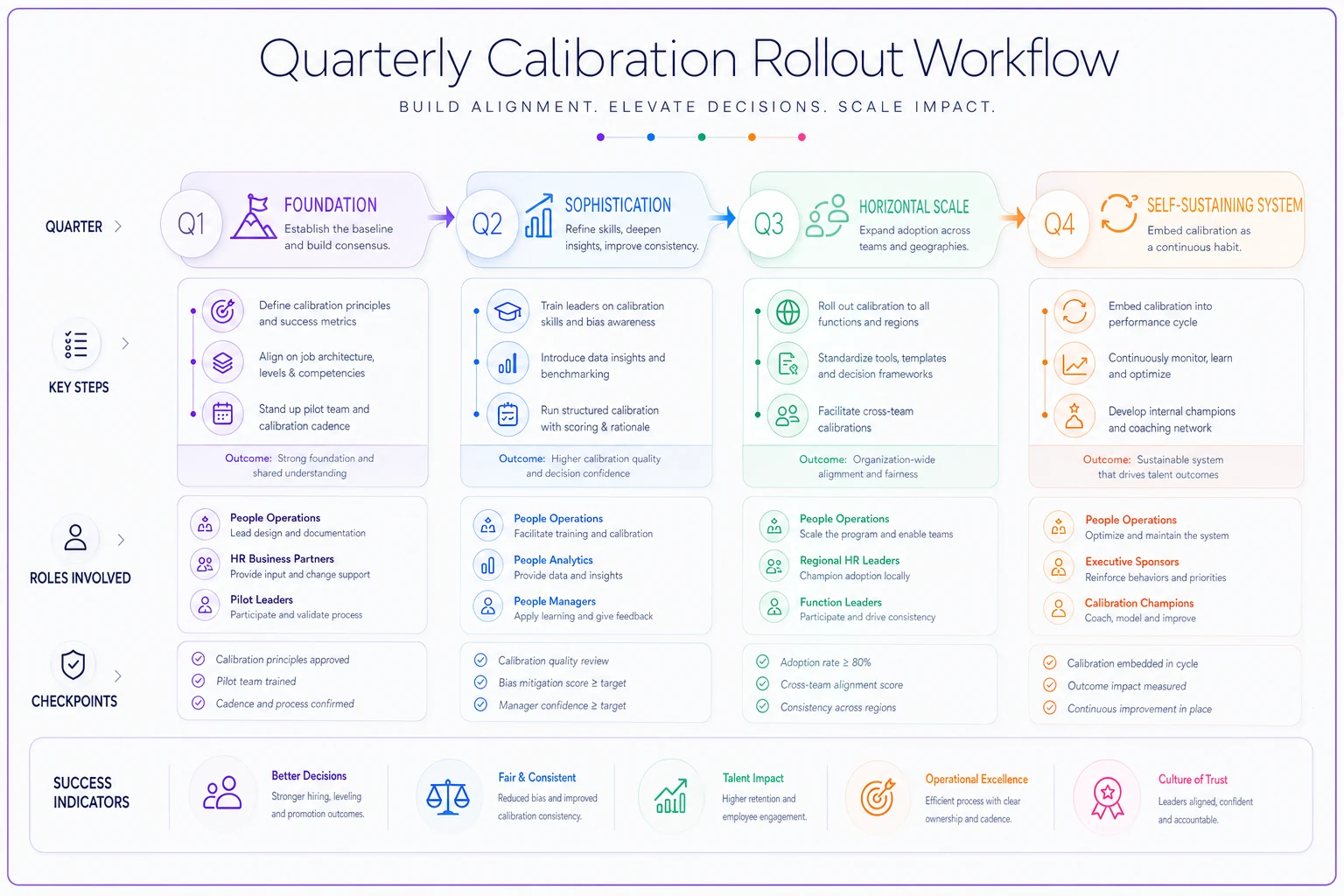
The first quarter is foundation-building. Create exemplars for your top three role families. Design micro-certification modules for the most critical competencies. Set up basic score monitoring for drift detection. Keep it simple enough that people actually participate.
Quarter two adds sophistication. Introduce modular training snacks based on patterns from quarter one. Expand exemplar libraries with borderline cases discovered through monitoring. Add automated module assignment based on score deviation. The system starts running more on its own.
Quarter three scales horizontally. Add more role families using the proven framework. Develop calibration champions within departments who can support their teams independently. Introduce cross-cluster calibration for shared competencies like leadership or culture fit.
By quarter four, you have something self-sustaining. Score drift gets caught within days instead of months. New interviewers onboard with role-specific calibration built in. Experienced interviewers stay aligned through continuous micro-adjustments rather than disruptive annual resets.
The compound effect of consistent scoring standards
Most companies underestimate how much inconsistent scoring costs them operationally. It's not just a fairness issue — it's an efficiency problem.
When scoring standards align, hiring committees spend less time debating what scores mean and more time evaluating actual fit. Interview debriefs that used to run an hour drop to twenty minutes because everyone shares the same scoring vocabulary.
The real payoff shows up in quality of hire. When you can trust that a 4/5 means the same thing across all interviewers, you make faster decisions with higher confidence. You stop losing candidates while committees debate whether different scores reflect different standards or different observations.
Strong calibration also enables better interviewer analytics. You can identify your best assessors based on correlation with eventual performance, not just score averages. That data helps you assign your most calibrated interviewers to your most critical roles.
| Calibration Component | Primary Benefit | Frequency |
|---|---|---|
| Quarterly calibration cycles | Catches drift before it compounds | Every 3 months |
| Modular training snacks | Targeted skill correction | As triggered by score monitoring |
| Role-family clustering | Prevents false standardization | Ongoing |
| Micro-certifications | Ongoing competency accountability | Usage-based expiry |
| Scoring exemplars | Anchors subjective scoring | Updated from real interviews |
| Automated score monitoring | Detects statistical drift patterns | Continuous |
The best calibration programs become invisible — part of how the team operates, not a special event that disrupts it. Quarterly cycles align with business quarters. Modular training happens during natural downtime. Score monitoring runs in the background.
Building sustainable calibration into operational rhythm
Make calibration part of interviewer expectations from day one. Include micro-certification requirements in onboarding. Build calibration activities into performance expectations. Recognize teams that maintain the tightest score consistency.
The technology matters but it's not the whole answer. You need systems that track scores, serve training modules, and flag drift. But you also need cultural buy-in around consistent standards. A well-designed operational platform can't fix an organization that doesn't actually value calibration.
Regular calibration isn't overhead — it's operational hygiene. The cost of recalibrating regularly is far less than the cost of bad hires from inconsistent evaluation.
The path forward isn't complicated, but it does require consistency
Perfect calibration doesn't exist. Even with quarterly cycles, modular training, and continuous monitoring, some drift will occur. The goal isn't perfection — it's keeping drift within bounds where it doesn't materially affect hiring decisions.
Your calibration program works when score differences reflect genuine observations, not different standards. When a senior engineer and a junior recruiter disagree on a candidate's technical skills, you want that disagreement to mean something — not just reflect different interpretations of what "technical skills" even means.
Start small with your highest-impact roles. Build exemplar libraries from real interviews. Create lightweight training modules people will actually complete. Monitor scores continuously. Scale gradually as each component proves itself.
Companies that maintain calibration at scale don't rely on annual training marathons. They build it into operational rhythm through continuous small adjustments. Their interviewers stay aligned not through force but through well-designed systems that make calibration easier than drift. Each consistent scoring standard reduces future debate. Each caught drift pattern prevents dozens of miscalibrated assessments down the line.
The path from inconsistent scoring chaos to calibrated evaluation isn't complicated. It requires commitment to continuous small corrections rather than sporadic major overhauls. Build the system once, maintain it consistently, and the compound effect of consistent standards shows up in your hiring quality over time.
The path from inconsistent scoring chaos to calibrated evaluation isn't complicated. It requires commitment to continuous small corrections rather than sporadic major overhauls. Build the system once, maintain it consistently, and the compound effect of consistent standards shows up in your hiring quality over time.
Ready to elevate your hiring process?
Join 1,500+ recruiting teams using Recioly to save time, improve collaboration, and hire smarter.