


Most recruiting teams don't have a data governance problem until the day they suddenly do. It shows up as a data subject access request from a candidate who interviewed 14 months ago, or a legal team asking where exactly a rejected applicant's resume lives across your stack, or an auditor wanting proof that consent was captured before a background check ran. And in that moment, the answer is usually some version of "give me a few days to figure it out."
That gap — between how recruiting actually stores candidate data and what you'd need to prove under scrutiny — is where the real risk sits. Not in the policy PDF someone wrote two years ago, but in the day-to-day workflow where recruiters copy resumes into Slack, sourcers export lists to spreadsheets, and agency partners email PII around without anyone tracking it.
This is a runbook for closing that gap. Not a legal treatise — you have counsel for that — but the operational scaffolding that makes candidate data governance something your team actually runs, instead of something that panics everyone once a year.
Why recruiting data quietly becomes ungovernable
Recruiting is unusually messy from a data standpoint because it touches so many systems and people, most of whom don't think of themselves as data handlers. A single candidate can generate records in your ATS, your scheduling tool, your assessment vendor, your background check provider, three recruiters' inboxes, a shared drive, and a hiring manager's downloaded PDF.
The core issue: candidate data multiplies faster than anyone tracks it, and it almost never gets cleaned up.
The pattern plays out across teams of every size. Early on, a small recruiting team runs lean — one ATS, a couple of recruiters, everyone knows where things are. Governance feels like overkill. Then you scale. You add sourcers, agency vendors, an assessment platform, maybe expand hiring into a second country. Each addition creates a new copy of candidate data and a new place it can leak or linger.
Nobody deliberately builds this mess. It accumulates. A recruiter exports a pipeline to a spreadsheet to share with a hiring manager who "can't get into the ATS." A sourcer builds a personal tracker because the ATS reporting is clunky. An agency sends over 40 candidate profiles as email attachments. None of these are malicious. All of them create ungoverned copies of personal data that no retention schedule will ever touch, because nobody knows they exist.
The failure isn't a single bad decision. It's the absence of a system that keeps data flowing into known, controlled locations — and out of them on a predictable schedule.
The four pillars, and how they connect
People tend to treat consent, retention, vendor mapping, and access control as four separate checkboxes. In practice they're a single loop, and a weakness in one undermines the others.
Never lose track of top talent again.
Recioly helps you manage every stage of recruiting efficiently, from application to offer.
- Centralized candidate tracking
- Automated interview scheduling
- Collaborative hiring workflows
No credit card required
-
Consent capture determines what you're allowed to do with the data.
-
Vendor dataflow maps tell you where the data actually goes.
-
Retention and erasure schedules control how long it survives.
-
Role-based access governs who can touch it while it exists.
If you capture consent but can't map where the data flows, your consent is meaningless — you promised to delete data you can't locate. If you have retention schedules but no access controls, data expires on paper while three people keep private copies. The pillars only work together.
Pillar 1: Consent capture that survives an audit
Most consent problems aren't about missing consent. They're about consent that can't be proven later. Someone checked a box, but there's no timestamp, no record of what version of the notice they saw, and no link between that consent event and the specific processing that followed.
The operational fix is to treat every consent event as a logged record, not a UI state. When a candidate agrees to something, you should capture:
-
Who consented (candidate identifier)
-
What they consented to (specific purpose — application, talent pool retention, background screening, reference checks)
-
When (timestamp)
-
Which version of the notice or script they saw
-
The channel (application form, recruiter script, email confirmation)
That last point matters more than people expect. A common gap: recruiters capture verbal consent for reference checks over the phone but never log it. Then an offer stalls, the candidate complains, and there's no record the conversation happened. If you run a fast reference process — and you should, we've written before about a tight 48–72 hour reference-check workflow with consent scripts — consent capture has to be baked into the script itself, not treated as an afterthought.
Consent template starters
Keep your templates modular so each processing activity has its own consent record rather than one giant blanket agreement. A candidate might consent to being contacted about one role but not to being retained in a talent pool for two years. Bundling those into a single checkbox is exactly what regulators dislike, and it makes erasure requests harder because you can't separate what they agreed to.
A minimal template set covers: application processing, talent-pool retention (with a defined duration), background/reference screening, assessment data, and — if relevant — cross-border transfer. Each one stands alone. Each one is versioned.
Pillar 2: Vendor dataflow maps (the part everyone skips)
This is the pillar teams most often ignore, and it's the one that turns a small incident into a large one. You cannot govern data you can't locate, and candidate data almost always lives in more places than the org chart suggests.
Build a map — an actual document — that traces every place candidate PII moves through. For each vendor or system, record:
| Field | What to capture |
|---|---|
| System / vendor | ATS, scheduler, assessment tool, BGC provider, agency |
| Data types held | Name, contact, resume, ID docs, assessment scores |
| Purpose | Why they have it |
| Data location | Which region/country the data is stored in |
| Retention on their side | How long they keep it after you're done |
| Deletion mechanism | API, ticket, manual request, contractual |
| Sub-processors | Who they share it with |
The row that trips people up is "retention on their side." Your ATS might purge a candidate on schedule, but your background check vendor keeps the report for seven years under their own compliance rules. Your assessment platform may retain scores indefinitely unless you actively request deletion. If your policy says candidate data is erased after 18 months but two vendors hold copies for far longer, your policy is fiction.
A realistic example of how bad this gets: a mid-size company doing distributed hiring found, during a routine review, that candidate data lived in nine distinct systems, and only four of them had any configured retention setting. The other five just kept everything. Two of them were tools a single recruiter had signed up for with a corporate card. Nobody in HR or legal knew they existed.
That's the real value of the dataflow map — it surfaces the shadow systems before an auditor or a data subject request does.
Pillar 3: Retention and erasure schedules that actually fire
A retention policy that nobody enforces is worse than none, because it creates a written promise you're constantly breaking. The goal is to move from "we should delete old candidates eventually" to "records in this category are erased X days after this trigger, automatically, with a log."
The key design decision is anchoring retention to the right trigger event, not just a calendar. Different candidate states need different clocks:
-
Rejected applicants — retention clock starts at rejection date. Typical window is short unless you have a documented reason to keep longer.
-
Talent-pool candidates — clock starts at the last meaningful contact, and consent should be re-confirmed before the window expires.
-
Hired candidates — their recruiting data usually transitions into employment records under a different policy, so you need a clean handoff, not a deletion.
-
Withdrawn candidates — clock starts at withdrawal, similar to rejections.
-
Background/reference data — often governed by the vendor's mandatory retention, so your job is to ensure you're not holding a second copy longer than needed.
The mistake here is running a single retention rule across all candidates. When you delete "everything older than 24 months," you accidentally purge active talent-pool people you had permission to keep, and you hold onto rejected applicants longer than you should. State-based retention fixes that.
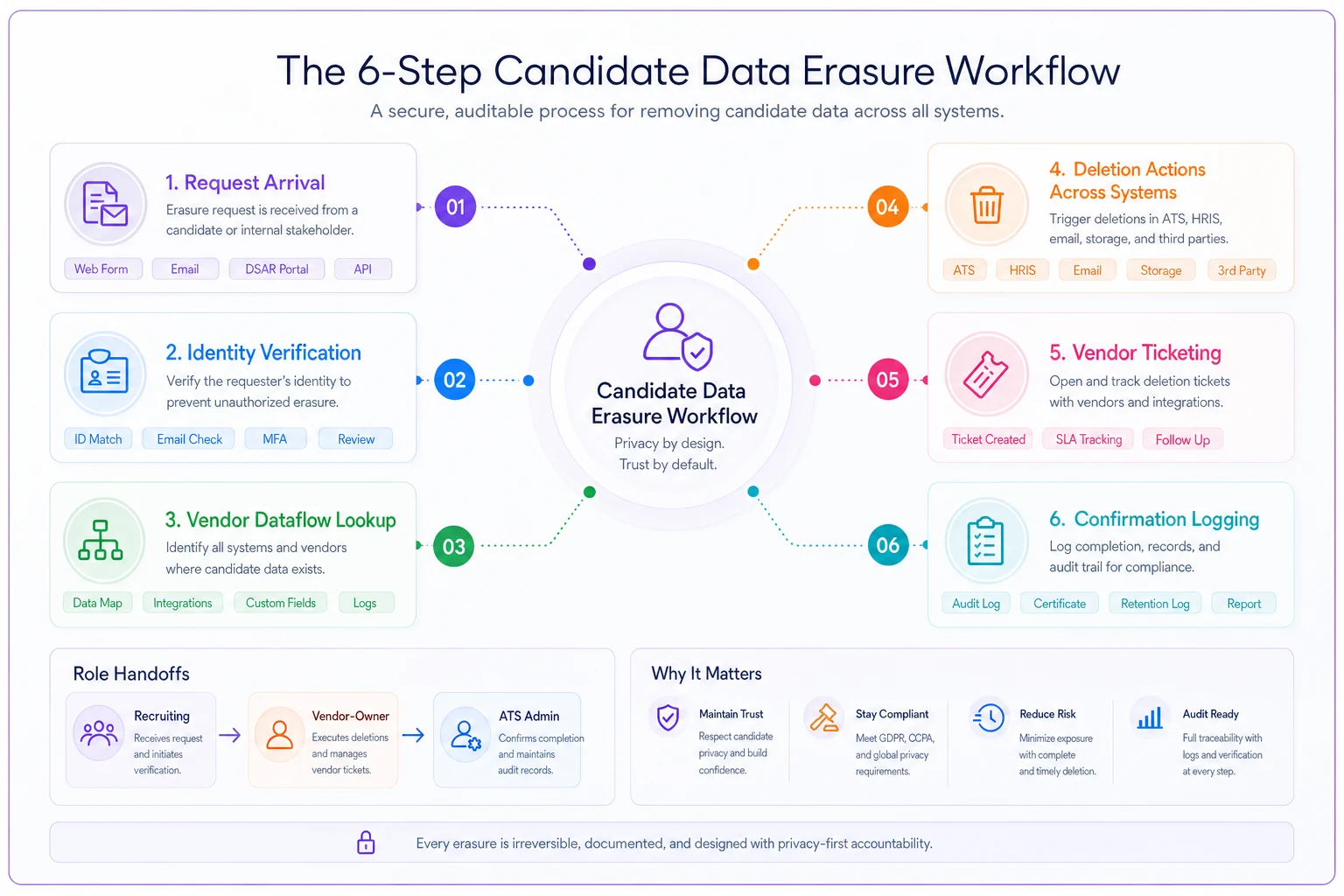
A simple erasure workflow
-
Request arrives (candidate email, form, or scheduled purge trigger).
-
Identity is verified — you don't erase or export data based on an unverified email.
-
The dataflow map is pulled up to identify every system holding that person's data.
-
Deletion is executed in each system using the mechanism recorded in the map.
-
Vendors that require a request-based deletion get a ticket, tracked to completion.
-
A confirmation record is logged
what was deleted, from where, when, by whom.
Step 3 is why the vendor map isn't optional. Without it, every erasure request becomes a scavenger hunt, and you'll always miss a system.
This six-step sequence is straightforward on paper. Where it actually breaks down is the handoffs — between the person who received the request, the person who owns the vendor relationships, and whoever controls the ATS configuration. If those three people aren't clear on their role in the process before a request arrives, the whole thing slows to a crawl.
A quick visual of this erasure workflow clarifies the handoffs.
If those three people aren't clear on their role in the process before a request arrives, the whole thing slows to a crawl.
Pillar 4: Role-based access control tuned for recruiting
Recruiting access tends to be far too broad because it's easier that way. Everyone gets access to everything so nobody's ever blocked. Fine at five people, genuinely dangerous at fifty.
The principle is straightforward: people should see the candidate data they need for their actual role, and nothing more. In practice that means defining a small set of roles and mapping data visibility to each:
-
Recruiters — full access to their req's candidates, limited or no access to others'.
-
Sourcers — contact and profile data, not assessment scores or background results.
-
Hiring managers — candidates for their own roles only, and usually not sensitive fields like compensation history or protected characteristics.
-
Coordinators — scheduling and contact data, not evaluation content.
-
Admins / compliance — configuration and audit logs, not necessarily the ability to alter decision records.
The most common failure isn't over-permissioning at the start — it's permission drift. Someone moves teams, covers a leave, gets temporary access for one project, and the access never gets revoked. Six months later a coordinator can still see the full candidate database from a team they left. Access reviews on a fixed cadence — quarterly is reasonable for most teams — catch this before it becomes an audit finding.
Access control also connects directly to defensibility. If you're keeping timestamped decision records — which you should be, and we've covered how to close defensibility gaps with required logs and audit cadences — then controlling who can edit those records is part of the same system. A decision log that anyone can quietly alter isn't much of a log.
Cross-border hiring: where all four pillars get tested at once
Domestic hiring can survive sloppy governance for a long time. Cross-border hiring can't, because the moment candidate data crosses a border, you inherit the rules of both places and the transfer itself becomes a governed event.
When you start recruiting in a new country, you're not just adding candidates. You're adding new consent requirements, new retention expectations, new lawful bases for transferring data back to your systems, and often new vendor obligations. A US-based ATS holding EU candidate data is a cross-border transfer, and it needs to be documented as one.
What breaks first is usually the dataflow map, because your existing map assumed everything lived in one region. A candidate in Germany applies, their resume flows to your US ATS, gets scored in an assessment tool hosted somewhere else, and a background vendor in a fourth location touches it. Four jurisdictions, one applicant. If your consent template never mentioned cross-border transfer, you have a problem before the first interview.
-
Confirm the lawful basis for processing and transferring candidate data.
-
Add region-specific consent language and versioning.
-
Update the dataflow map with data-location fields per system.
-
Check each vendor's ability to store or process data in-region if required.
-
Set retention windows to the stricter of the two jurisdictions, since that's the one that binds you.
None of this is especially complicated, but it does require someone to actually own it. The teams that struggle most with cross-border governance aren't missing the knowledge — they're missing the assigned responsibility.
When lightweight governance is fine — and when it isn't
Lightweight is genuinely fine when: you're a small team hiring domestically, using one or two vetted systems, with low candidate volume. A single documented retention rule, consent captured cleanly in your ATS, and access limited to your handful of recruiters covers most of your real risk.
You need the full runbook when: you're hiring across borders, running multiple vendors, handling sensitive data like ID documents or background reports, scaling headcount fast, or operating in a regulated industry. At that point the informal approach doesn't just create risk — it creates invisible risk, because the volume hides the gaps.
Who should not try to DIY the legal side: anyone entering a new jurisdiction, anyone handling special-category data, and anyone who's received their first data subject request. That's the signal to bring in counsel and build the operational scaffolding to support what they tell you. The runbook is how you execute the legal requirements — it doesn't replace defining them.
A short real scenario
A company scaling from roughly 40 to 120 employees opened hiring in two European markets while running everything through a US-centric stack. Their governance was a two-page policy and a vague "we delete old candidates sometimes" habit.
The trigger was a candidate erasure request from someone who'd interviewed about a year earlier. It took the recruiting team most of a week to track down every copy of that person's data — and they still weren't confident they'd found all of it. During that scramble they discovered candidate PII sitting in three tools nobody had inventoried, plus two recruiters' personal spreadsheets.
The fix wasn't dramatic. Over about six weeks they built a vendor dataflow map (nine systems, it turned out), moved to state-based retention triggers instead of one blanket rule, versioned their consent templates and added cross-border language, and ran a first access review that pulled permissions from four people who'd changed roles. The next erasure request took under a day to fulfill, with a clean confirmation log. Nothing about the recruiting outcomes changed — but the risk that had been quietly accumulating for two years was finally visible and controlled.
Bringing it together as a system
The reason these four pillars belong in one runbook is that governance fails at the seams, not the centers. Teams write a decent consent form and a reasonable retention policy, then lose everything in the gap between them — the untracked vendor, the personal spreadsheet, the stale access grant, the country nobody re-checked.
The operational habit that holds it together is boring and consistent: every new system, every new hire on the team, every new hiring region triggers an update to the same four artifacts — consent templates, dataflow map, retention schedule, access matrix. When those four stay current, an audit or a data subject request is a lookup, not a fire drill. When they drift, you're back to guessing where the data lives while the clock runs.
Candidate data governance isn't a project you finish. It's a maintenance rhythm you either keep or don't — and the teams that keep it are the ones who never have to spend a week hunting for a single candidate's records again.
Ready to elevate your hiring process?
Join 1,500+ recruiting teams using Recioly to save time, improve collaboration, and hire smarter.