

Reference checks break more offers than compensation negotiations.
Most recruiting teams treat reference collection like an afterthought—something that happens after the hiring decision but before the offer letter. This creates a bottleneck that regularly stretches what should be a 48-hour process into 10–14 days of chasing down former managers, playing phone tag, and watching top candidates accept competing offers while you wait for someone to return a voicemail.
The typical workflow looks like this: recruiter gets three names, sends a generic email asking for a call, waits several days for responses, schedules calls across the following week, conducts 20-minute conversations that yield minimal insight, writes up notes, and finally clears the candidate. By day 12, your top choice has already started somewhere else.
What most teams miss is that reference checking isn't really about validation—it's about risk mitigation and pattern confirmation. Once you understand that, you can build a workflow that finishes in 48–72 hours without sacrificing quality or compliance.
Why traditional reference workflows fail at scale
The fundamental problem with reference checks isn't the references. It's an operational design that treats every reference equally, uses the same questions for every role, and relies entirely on synchronous phone calls.
Think about what happens when you're hiring for multiple roles at once. A recruiter managing 15 open positions might have 8–10 candidates in various stages of reference checking. Each candidate provides 3 references—now you're tracking 24–30 conversations. If even half those references require multiple contact attempts, you're looking at 60+ touchpoints just to schedule calls. The math breaks down fast.
There's also a role mismatch problem. Asking a software engineer's former manager the same questions you'd ask about a sales rep tells you nothing useful. Yet most teams use identical reference forms across all positions because nobody's taken the time to build role-specific question libraries.
Then there's legal exposure. Reference calls can surface information about personal situations, health issues, or other protected characteristics. Without proper consent scripts and documentation, every conversation is a potential liability.
Building your 48–72 hour reference check workflow
A well-designed reference check workflow runs on three parallel tracks: immediate consent collection, asynchronous reference gathering, and risk-based escalation. Each track has specific triggers and timelines that keep things moving regardless of individual reference availability.
Never lose track of top talent again.
Recioly helps you manage every stage of recruiting efficiently, from application to offer.
- Centralized candidate tracking
- Automated interview scheduling
- Collaborative hiring workflows
No credit card required
Track 1: Consent and preparation (Hours 0–4)
The moment a candidate moves to reference stage, consent collection should kick off automatically. Not just sending a form—a structured process that sets expectations and creates urgency.
Your consent script needs four elements:
-
Clear timeline expectations (references will be contacted within 24 hours)
-
Specific information about what will be asked
-
Alternative contact methods for each reference
-
Escalation permissions if primary references don't respond
Something like this works well: "We'll begin reference checks immediately and aim to complete them within 48 hours. Please confirm your references are aware they'll be contacted today or tomorrow. If any reference is unavailable this week, provide an alternate or let us know if we can proceed with two references."
This does three things. It creates urgency for the candidate to prep their references. It establishes a clear timeline. And it provides an escape valve if someone's traveling or unreachable.
Track 2: Prioritized outreach (Hours 4–24)
Not all references carry the same weight. Your most recent direct manager matters more than a peer from three jobs ago. Build outreach accordingly.
Priority 1 (contact within 4 hours):
-
Current or most recent direct manager
-
Direct manager from the role most similar to the open position
-
Hiring manager who originally recruited the candidate
Priority 2 (contact within 12 hours):
-
Skip-level managers
-
Cross-functional partners with direct collaboration
-
Internal customers or stakeholders
Priority 3 (contact within 24 hours):
-
Peers or subordinates
-
Managers from 3+ years ago
-
Personal references (if required)
Each priority level gets different outreach methods. Priority 1 gets an immediate phone call followed by email and text if provided. Priority 2 gets email first with a calendar scheduling link. Priority 3 gets email with an async form option.
Prioritize current or most recent managers first to surface the most role-relevant insights quickly.
Track 3: Asynchronous collection (Hours 0–48)
Stop requiring phone calls for every reference. This is the single biggest lever in the whole workflow.
Build structured async forms that take 8–10 minutes to complete. But make them role-specific and progressively detailed—a reference checking an engineer should answer different questions than one checking a customer success manager.
For engineering roles, your async form might include:
-
Technical competency ratings across specific skills
-
Code quality and documentation habits
-
Collaboration patterns with product and design
-
Response to technical feedback
-
Performance during incidents or high-pressure debugging
For sales roles, completely different territory:
-
Pipeline management and forecasting accuracy
-
Client relationship building
-
Response to quota pressure
-
Territory planning capabilities
-
Competitive deal strategies
The key is branching logic. Start with role-family questions, then drill into specifics based on initial responses. If someone rates a candidate low on "technical decision-making," the form automatically requests specific examples.
A quick visual of the three parallel tracks and escalation thresholds.
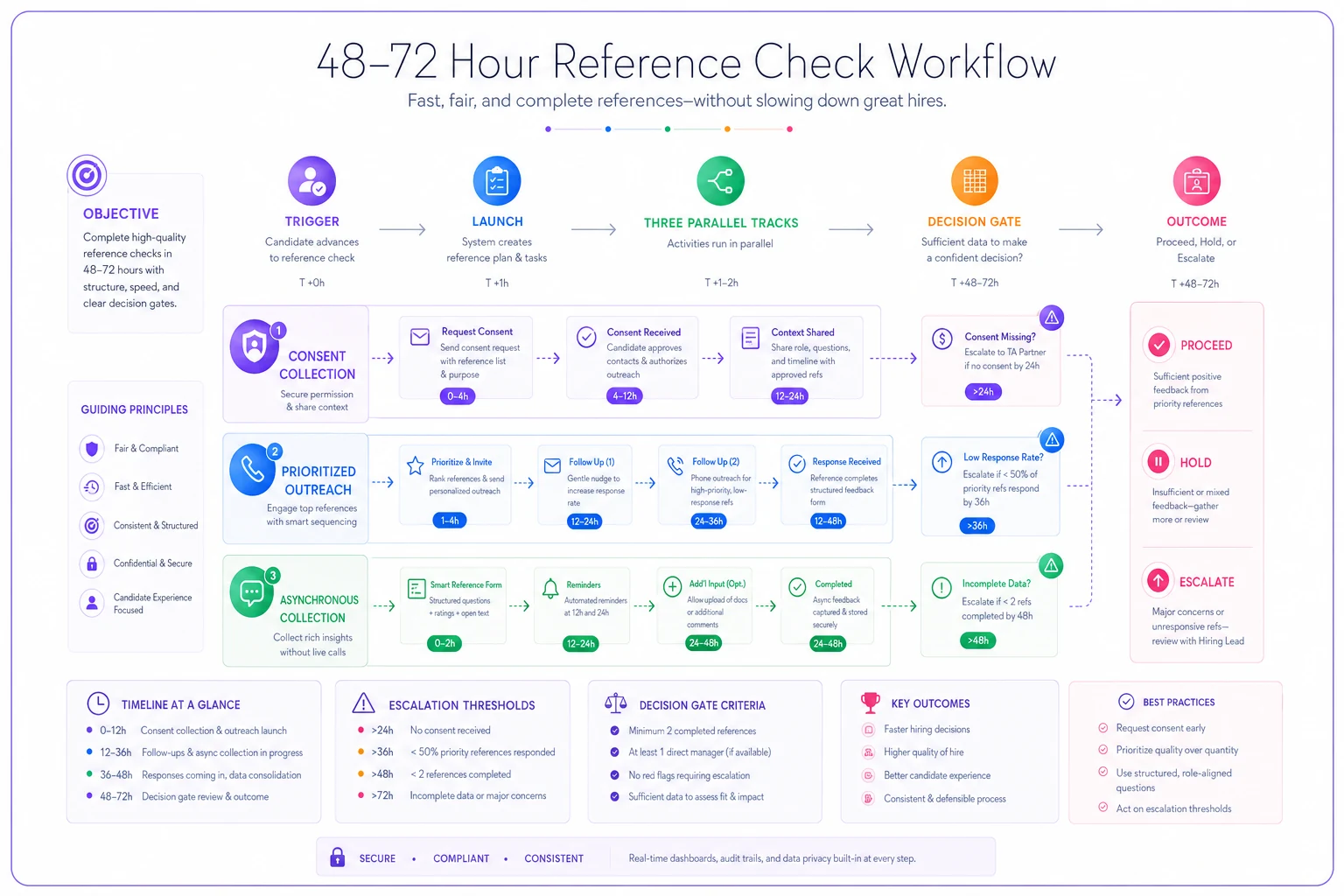
Place this visual where your team documents workflows to make the triggers easy to reference during handoffs.
Risk scoring and escalation triggers
Not every reference check needs the same depth. Build a risk scoring system that determines how many references are actually required and when to escalate.
Your risk score factors in:
-
Seniority of role (Director+ = higher risk)
-
Access to sensitive data or systems
-
Customer-facing responsibilities
-
Budget authority
-
Team size if managing people
-
Employment gaps
-
Inconsistencies between resume and interview responses
Low-risk roles—junior, individual contributor, limited access—can clear with two strong references. High-risk roles with significant budget authority or large team management require three references plus possible background verification.
Where most teams mess up: treating all reference feedback equally. Build escalation triggers for specific responses.
Immediate escalation triggers:
-
"Would not rehire" response
-
Performance improvement plan mentioned
-
Termination or resignation under pressure
-
Integrity or ethics concerns
-
Major discrepancies with candidate's description of role
Secondary review triggers:
-
Consistently average ratings across multiple references
-
Reluctance to provide specific examples
-
Very brief or vague responses
-
Mismatch between stated title and described responsibilities
When an escalation trigger hits, you don't automatically reject the candidate. You dig deeper with targeted follow-up questions or require additional references from that specific workplace.
Question libraries by role family
Generic reference questions waste everyone's time. Build modular question libraries organized by role family, then customize for the specific position.
Engineering question modules
Technical competency module:
-
How would you rate their code quality compared to peers at their level?
-
Describe their approach to technical documentation
-
How did they handle disagreements with senior engineers?
-
What types of problems did they excel at solving?
-
Where did they need the most technical growth?
Collaboration module:
-
How effectively did they communicate technical concepts to non-technical stakeholders?
-
Describe their participation in code reviews
-
How did they handle competing priorities from multiple teams?
-
What was their approach to mentoring junior developers?
Incident response module:
-
How did they perform during production incidents?
-
Describe their debugging approach under pressure
-
How did they contribute to post-mortems?
-
What was their availability for critical issues?
Sales question modules
Performance module:
-
How consistently did they hit quota?
-
What was their average deal size compared to peers?
-
How accurate were their pipeline forecasts?
-
Describe their strongest and weakest quarters
Process module:
-
How well did they maintain CRM hygiene?
-
Describe their approach to territory planning
-
How effectively did they qualify opportunities?
-
What was their follow-up discipline like?
Relationship module:
-
How did they build rapport with different buyer personas?
-
Describe a complex deal they navigated successfully
-
How did they handle competitive situations?
-
What was their approach to expanding existing accounts?
Operations question modules
Process improvement module:
-
What operational improvements did they drive?
-
How did they identify inefficiencies?
-
Describe their approach to change management
-
How did they measure operational success?
Stakeholder management module:
-
How effectively did they manage up versus down?
-
Describe their approach to cross-functional collaboration
-
How did they handle resistance to operational changes?
-
What was their communication style during implementations?
Data and systems module:
-
How comfortable were they with operational metrics?
-
Describe their experience with relevant systems
-
How did they approach data quality issues?
-
What was their documentation discipline?
The point isn't to ask every question—it's to have the right questions ready based on role requirements and how initial responses unfold.
Consent scripts that protect everyone
Reference checks create legal exposure that most teams ignore until something goes wrong. Build consent protocols that protect both your organization and the candidate's references.
Your candidate consent script should include:
-
"I authorize [Company] to contact the references I've provided to verify my employment history, performance, and qualifications for the [Role] position. I understand that:"
-
References will be contacted within 24–48 hours
-
Information gathered will be used solely for employment evaluation
-
I can provide alternative references if any listed are unavailable
-
Reference feedback will remain confidential within the hiring team
-
I may request general themes from reference feedback after the process concludes
-
"I release my references from liability for providing truthful information about my performance and qualifications."
For references themselves, open every conversation with:
-
"Thank you for serving as a reference for [Candidate] who is being considered for [Role] at [Company]. Before we begin:"
-
This conversation is confidential within our hiring team
-
We're seeking honest feedback about work performance and qualifications
-
You're not required to answer any question you're uncomfortable with
-
This should take approximately 10–15 minutes
-
[Candidate] has consented to this reference check
-
"Do I have your permission to proceed?"
Document verbal consent in your notes. For async forms, include a consent checkbox before questions begin.
Async reference collection that actually works
Most async reference forms fail because they're either too long—45 questions nobody finishes—or too basic, with three questions that tell you nothing. The sweet spot is 8–12 questions with branching logic based on responses.
Structure your async forms in three sections:
Section 1: Relationship context (2–3 questions)
-
How long did you work with [Candidate] and in what capacity?
-
What was their role and primary responsibilities?
-
How frequently did you interact?
Section 2: Performance assessment (4–6 questions)
-
Role-specific questions from your library
-
Scaled ratings with required explanations for low scores
-
One open-ended strength question
-
One open-ended development area question
Section 3: Rehire and recommendation (2–3 questions)
-
Would you rehire this person? Why or why not?
-
What type of environment would they thrive in?
-
Any additional context we should know?
Make forms mobile-responsive. Many references complete them on their phones during lunch or a commute. Include progress indicators so people know how much is left.
Time-bound the forms: "This form will remain active for 48 hours. If you need more time, let us know." Creates urgency without being aggressive.
Escalation rules and decision gates
Your workflow needs clear decision gates—when to proceed, when to dig deeper, when to pause.
Green light gates (proceed to offer)
-
All required references completed
-
Overall positive feedback
-
No escalation triggers hit
-
Risk score below threshold
-
Candidate's stories align with reference feedback
Yellow light gates (additional review needed)
-
One reference unreachable but others strongly positive
-
Minor inconsistencies between references
-
One lukewarm reference among otherwise positive feedback
-
Risk score at threshold but not exceeded
-
Delayed response from current employer reference
Red light gates (pause or decline)
-
"Would not rehire" from direct manager
-
Pattern of performance issues across references
-
Major inconsistencies with candidate's claims
-
Ethical or integrity concerns raised
-
Risk score significantly exceeded
For yellow light situations, have clear escalation paths:
Level 1 escalation (recruiter handles):
-
Request one additional reference
-
Conduct follow-up questions via email
-
Review with hiring manager for context
Level 2 escalation (recruiting manager reviews):
-
Significant discrepancies to investigate
-
Legal or compliance concerns raised
-
High-risk role with marginal feedback
Level 3 escalation (HR/Legal involvement):
-
Potential misrepresentation by candidate
-
Protected class information disclosed
-
Threat of legal action from reference
Document every escalation decision with reasoning and outcome.
The timeline that keeps offers on track
Here's exactly how a 48–72 hour reference check workflow runs:
| Timeframe | Actions |
|---|---|
| Hour 0–2: Initiation | Candidate provides references via structured form; Consent scripts sent and acknowledged; References categorized by priority; Risk score calculated; Outreach sequence triggered |
| Hour 2–6: First contact wave | Priority 1 references called; Email follow-ups sent to all references; Async form links distributed; Calendar scheduling links provided; Candidate notified that process has started |
| Hour 6–24: Collection phase | Completed async forms reviewed; Phone screens scheduled and conducted; Follow-up attempts for non-responders; Initial patterns assessed; Escalation triggers evaluated |
| Hour 24–36: Follow-up phase | Second attempt for missing references; Clarifying questions sent if needed; Hiring manager briefed on initial findings; Decision on whether minimum requirements are met; Alternative references requested if needed |
| Hour 36–48: Completion phase | Final push for outstanding references; Risk assessment completed; Reference packet compiled; Hiring team review if concerns exist; Clear for offer or escalation decision made |
| Hour 48–72: Buffer zone | Only used when absolutely necessary; CEO/executive references on different timeline; International references in difficult timezones; Legal review if concerns raised; Final attempts before proceeding with available information |
This timeline assumes normal business hours. For urgent hires, compress by running parallel tracks simultaneously rather than sequentially.
Software that automates reference operations
Manual reference checking starts breaking down somewhere around 10–15 hires per month. The coordination overhead alone—tracking who's been contacted, which forms are complete, what follow-ups are pending—consumes recruiter time that should go toward candidate engagement.
AI-powered operational software changes this meaningfully. Instead of spreadsheets and sticky notes, you get automated workflows that handle the repetitive coordination while surfacing what actually needs human attention. These platforms can trigger reference requests the moment a candidate clears final interviews, send customized outreach based on reference type, track response rates in real time, and automatically flag when escalation triggers are hit. The AI components handle initial pattern recognition—inconsistencies between references, concerning language patterns, divergence from interview scores.
But the deeper value is turning reference checks into operational data. When every reference process flows through the same structured workflow, patterns emerge over time: which interview scores actually predict reference feedback, which managers give the most useful insights, which questions yield actionable information versus safe, generic answers.
For teams scaling quickly, that institutional knowledge compounds. You're not just running faster reference checks—you're building a system that gets smarter about what strong references actually look like for each role.
Common mistakes that derail reference checks
Even with a solid workflow, certain mistakes keep coming up.
Waiting too long to start. Teams often wait until they're ready to make an offer before starting references. By then, the candidate has momentum with other companies. Start references the moment someone passes final interviews.
Treating all references equally. A peer reference tells you different things than a direct manager reference. One from five years ago has less relevance than one from last year. Weight accordingly.
Asking generic questions. "Tell me about their strengths and weaknesses" yields nothing useful. Ask specific, behavioral questions tied to what the role actually requires.
Not preparing candidates. Candidates should prep their references before you contact them. Send a message explaining exactly when references will be contacted and what they'll be asked.
Ignoring response patterns. If three references all hesitate before answering the rehire question, that pattern matters more than their eventual "yes." Train recruiters to note these things.
Over-relying on current employer references. Many candidates can't provide current employer references without risking their position. Have alternatives ready—former colleagues who've since left, clients, stakeholders from other departments.
Accepting "company policy" deflections. Many companies claim policy prevents detailed references, but individuals often share more when approached correctly. Have backup questions ready that focus on factual confirmation rather than evaluation.
When to break the rules
Sometimes the 48–72 hour timeline needs flexibility. The framework should bend in specific situations—it just shouldn't collapse entirely.
Executive hires often require deeper checking including formal background verification and conversations with board members or investors. Build a parallel track that extends to 5–7 days while maintaining urgency on initial references.
Confidential searches where the candidate hasn't resigned yet create real limitations. Focus on former colleagues, customers, or partners who won't put the candidate's current position at risk. Accept that full reference checking might happen post-offer with a contingency clause.
International references across major timezone differences need buffer time. Send async forms immediately but accept that phone conversations might take 3–4 days to coordinate. When possible, start these references earlier in the interview process.
Regulated industries may require specific verification for compliance. Healthcare needs license verification; financial services requires regulatory checks. Build these into the workflow from the start rather than tacking them on at the end.
Internal transfers still need references—the process just looks different. Think 360 feedback from current teammates, skip-level manager input, cross-functional partner perspectives. A modified 24-hour process focused on internal stakeholders usually works well here.
Measuring reference check effectiveness
Most teams have no real idea whether their reference checks predict anything. They run them because compliance requires it, but never validate whether feedback actually correlates with performance.
Track these metrics quarterly:
Process metrics:
-
Average time from initiation to completion
-
Response rate by reference type
-
Percentage requiring escalation
-
Offers delayed by reference checking
Quality metrics:
-
Correlation between reference ratings and 90-day performance
-
False positive rate (great references, poor performance)
-
False negative rate (concerning references, strong performance)
-
Prediction accuracy by question type
Operational metrics:
-
Recruiter hours per reference check
-
Cost per reference including tools and time
-
Candidate drop-off during reference phase
-
Competing offer acceptance during reference delays
The data usually reveals that certain questions have no predictive value while others consistently correlate with success. One company found their "areas for improvement" question was essentially useless—references always gave safe, rehearsed answers—but "describe their reaction to critical feedback" surfaced real behavioral patterns worth knowing.
Use this data to refine question libraries, adjust risk scoring, and optimize the workflow over time.
A reference check workflow in action
A software company is hiring a senior engineering manager. The candidate finishes final interviews on Tuesday afternoon.
By 4 PM Tuesday, the candidate receives the reference request form: references will be contacted within 24 hours, the process aims to wrap by Friday, and they should let references know outreach is coming.
Wednesday 9 AM: The recruiter calls the candidate's most recent manager, now at a different company. No answer—immediately sends an email with async form link and texts the secondary number provided. Moves to reference #2, the skip-level manager from the same company. Connects right away, runs a 15-minute structured interview using the engineering manager question module.
Wednesday 2 PM: First async form comes back from a peer reference. Strong positive feedback, but flags that the candidate sometimes struggled with executive communication. Recruiter adds a follow-up question about presentation skills to remaining reference conversations.
Wednesday 4 PM: A second peer reference who left the company completes a phone screen. Confirms strong technical leadership, echoes the communication growth area. Pattern is emerging but not alarming for this role level.
Thursday 10 AM: The original manager finally responds via async form. Glowing review, would "absolutely rehire," provides specific examples of successful team scaling. Three references now complete with consistent themes.
Thursday 3 PM: Recruiter compiles the reference packet—technical expertise, team building, strategic thinking are the consistent strengths; executive presence is the consistent development area. Risk score is low, no escalation triggers hit. Cleared for offer.
Friday 9 AM: Offer extended. Candidate accepts Monday. Total elapsed time: 72 hours from final interview to accepted offer.
Compare that to the traditional process where the same references might take two weeks of phone tag, resulting in a lost candidate who accepted elsewhere while waiting. The references weren't the problem. The operational structure was.
The competitive advantage of speed
Fast reference checks aren't about cutting corners. They're about respecting everyone's time while maintaining quality.
Candidates appreciate knowing exactly when references will be contacted and how long the process takes. They can manage their job search instead of sitting in limbo wondering what's happening.
References appreciate async options that let them respond when it works for them. A 10-minute form during lunch beats a week of phone tag trying to find mutual availability.
Your recruiting team gets clear workflows that don't require constant judgment calls about edge cases. When everyone knows the escalation triggers and decision gates, the process largely runs itself.
The competitive advantage is real. While other companies take two weeks on references, you're extending offers in 48 hours. In tight talent markets, that difference determines who gets the best people.
The framework here reflects what actually works across a lot of hiring processes. The timelines, risk scores, and question libraries come from real operational experience—what predicts success, what wastes time, and where things break down without structure.
Start with one piece. Build async forms for non-priority references, or draft your first role-specific question module, or write proper consent scripts. Don't try to overhaul everything at once.
Fix the biggest bottleneck in your current process first. Then layer in additional components as your team finds the rhythm.
The candidates you're losing right now to faster-moving competitors—those losses are avoidable.
Ready to elevate your hiring process?
Join 1,500+ recruiting teams using Recioly to save time, improve collaboration, and hire smarter.