


Three months ago, a mid-sized fintech company got hit with a discrimination complaint. Not unusual, except this one came with something devastating: their own hiring data worked against them.
The plaintiff's attorney requested decision records for 47 similar roles over two years. What the company produced was a mess — inconsistent notes, missing interview feedback, some positions with detailed scorecards while others had nothing but "not a culture fit" scribbled in an ATS comment field. The lack of hiring decision governance became a $2.3 million problem, not counting the reputation damage.
This keeps happening because most companies treat hiring documentation like an afterthought. They focus on filling seats fast, assume good intentions protect them from bad outcomes, and only think about governance when something explodes. By then, you're trying to reconstruct decision logic from fragments while attorneys circle overhead.
The governance gap most recruiting teams don't see coming
Every recruiting team I've worked with cares deeply about making good hires and genuinely wants fair processes. But caring about fairness and proving fairness are completely different operational challenges.
The real issue usually isn't bias or bad intentions. It's that hiring happens through dozens of micro-decisions spread across multiple people, systems, and timeframes. Without proper governance structures, those decisions become invisible even to the people making them.
Think about your last open requisition. How many actual decision points happened between posting and offer? Not just the obvious ones like "move to final round" — but the smaller ones. Why you sourced from certain channels, why you prioritized certain backgrounds, why some candidates got faster callbacks. Each choice shaped your outcome, but how many are actually documented?
Most organizations can't answer basic governance questions about their own hiring:
-
What specific factors determined advancement at each stage?
-
Who made which decisions and when?
-
What evidence supported those decisions?
-
How do patterns vary across departments or interviewers?
You end up with what looks like a hiring process but operates more like organized chaos with a nicer interface.
Required fields that actually protect your decisions
What trips people up is thinking required fields are about compliance checkboxes. They're not. Required fields create decision infrastructure that makes good hiring easier while automatically building your defense.
Never lose track of top talent again.
Recioly helps you manage every stage of recruiting efficiently, from application to offer.
- Centralized candidate tracking
- Automated interview scheduling
- Collaborative hiring workflows
No credit card required
Start with rejection reasons. Most ATS platforms let you require a disposition code, but that's not enough. You need structured rejection data that captures:
Primary rejection category (skills gap, experience mismatch, compensation misalignment, timing, culture/values, communication, other)
Specific evidence points supporting that category — not "lacks technical skills" but "unable to describe implementation of distributed systems despite listing 5 years experience"
Stage-specific context because rejecting after a phone screen versus final round means completely different things
One healthcare company went from generic rejection tracking to requiring evidence-based disposition notes. It bumped average documentation time from about 30 seconds to maybe 2 minutes per candidate. That extra 90 seconds prevented three separate EEOC complaints from escalating because they had contemporaneous records showing objective, job-related reasons for every decision.
The framework extends beyond rejections:
| Decision Point | Required Fields | Evidence Standard |
|---|---|---|
| Source selection | Channel, targeting criteria, budget allocation rationale | Business case for each source with expected ROI |
| Resume screen | Must-have criteria met (Y/N for each), scored qualification match | Specific examples from resume mapped to requirements |
| Phone screen | Technical assessment score, communication rating, follow-up questions | Behavioral examples captured verbatim |
| Panel interview | Competency ratings by interviewer, consensus process, dissenting opinions | Structured scorecard data with examples |
| Reference check | Verification points, performance indicators, red flags | Direct quotes and context |
| Final selection | Comparative analysis, tie-breaker factors, offer rationale | Stack rank with specific differentiators |
Notice how each field forces specificity? That's intentional. Vague documentation is often worse than no documentation because it suggests carelessness rather than oversight.
Timestamped decision logs (and why sequence matters more than you think)
Timestamps seem like boring metadata until you need to prove your hiring process wasn't retroactively justified. Every significant hiring decision needs both a timestamp and a decision owner — creating an audit trail that reflects real-time thinking, not after-the-fact rationalization.
Where it gets tricky: you need timestamps on the actual decision, not just when someone finally updated the ATS. Companies lose defensibility because their "decision" timestamps were all clustered at 4:47 PM on Fridays when recruiters did weekly data entry. That pattern alone suggests decisions weren't contemporaneous.
Your decision log should capture:
Pre-decision timestamp — when the evaluation activity happened (interview end time, assessment completion)
Decision timestamp — when the hiring team actually made the determination
Documentation timestamp — when it got recorded in your system
Modification history — any changes with reasons and authorization
This isn't paranoid documentation. One retail company used timestamped logs to prove they rejected a candidate before learning about a disability accommodation request, completely deflating a failure-to-accommodate claim. Another organization caught an internal bad actor retroactively changing scores after learning candidate demographics.
A logical sequence looks something like this:
-
Interview ends at 2
32 PM
-
Interviewer submits feedback by 3
15 PM
-
Hiring manager reviews at 4
00 PM
-
Team decision logged at 4
30 PM
-
Candidate notified next business day at 10
00 AM
When those timestamps tell a coherent story, your process looks legitimate. When they're all over the place or suspiciously clustered, you've got a problem worth worrying about.
Automated evidence capture (because memory is unreliable)
Manual documentation fails because humans forget details — especially negative ones. You need systems that capture evidence while decisions are being made, not hours or days later.
The most effective approach uses progressive capture: the system won't let you advance a candidate without completing current-stage documentation. But beyond blocking progress, modern platforms can auto-capture email and message exchanges showing candidate responsiveness, calendar data proving equal scheduling opportunity, source tracking showing diverse pipeline development, time-in-stage metrics flagging unusual delays, and interviewer load balancing data to reduce fatigue bias.
A marketing agency struggled with inconsistent interview notes until they implemented auto-transcription for video interviews. Not full recordings — those create their own legal complications — but AI-generated summaries capturing key responses and examples. Interviewers still added subjective assessments, but the objective foundation was locked in before anyone could second-guess their own memory.
The automation extends to aggregation. Instead of manually compiling EEO data for reports, the system continuously tracks pass rates by demographic at each stage, average scores by interviewer across protected classes, time-to-decision variations between candidate groups, and offer acceptance rates with demographic correlation.
When pass rates start diverging or certain interviewers show consistent patterns, you catch it in weeks rather than years.
Audit cadences that catch problems before they become lawsuits
Most companies audit hiring annually, if at all. That's roughly like checking your car's oil once a year — by the time you notice a problem, the damage is already done.
Weekly spot checks involve pulling 5–10 random recent decisions and verifying documentation completeness, evidence quality, timestamp consistency, and required field compliance. Takes about 30 minutes but catches process drift immediately.
Monthly pattern analysis means reviewing aggregate patterns looking for interviewer scoring variations, stage-specific bottlenecks, demographic flow rates, and documentation gaps by team. This is where audit controls and anonymized screening become critical for separating systemic issues from random variation.
Quarterly deep dives mean picking one department or job family for a comprehensive review covering full decision documentation, interview consistency assessment, outcome correlation analysis, and process adherence verification.
Annual compliance review is the full governance assessment — legal defensibility testing, disparate impact analysis, documentation retention compliance, policy and training updates.
Audits without consequences are theater, though. You need escalating responses tied to findings. Minor documentation gaps trigger automated reminders and refresher training. Patterns suggesting bias initiate focused reviews with HR involvement. Systemic failures pause hiring in that area until remediation is complete.
One software company discovered through monthly audits that their engineering managers consistently scored women lower on "technical depth" despite identical backgrounds. They didn't wait for the annual review — immediate recalibration and adjusted scoring weights were in place within weeks. Caught early enough that it never became a legal matter.
Corrective action workflows (when governance finds problems)
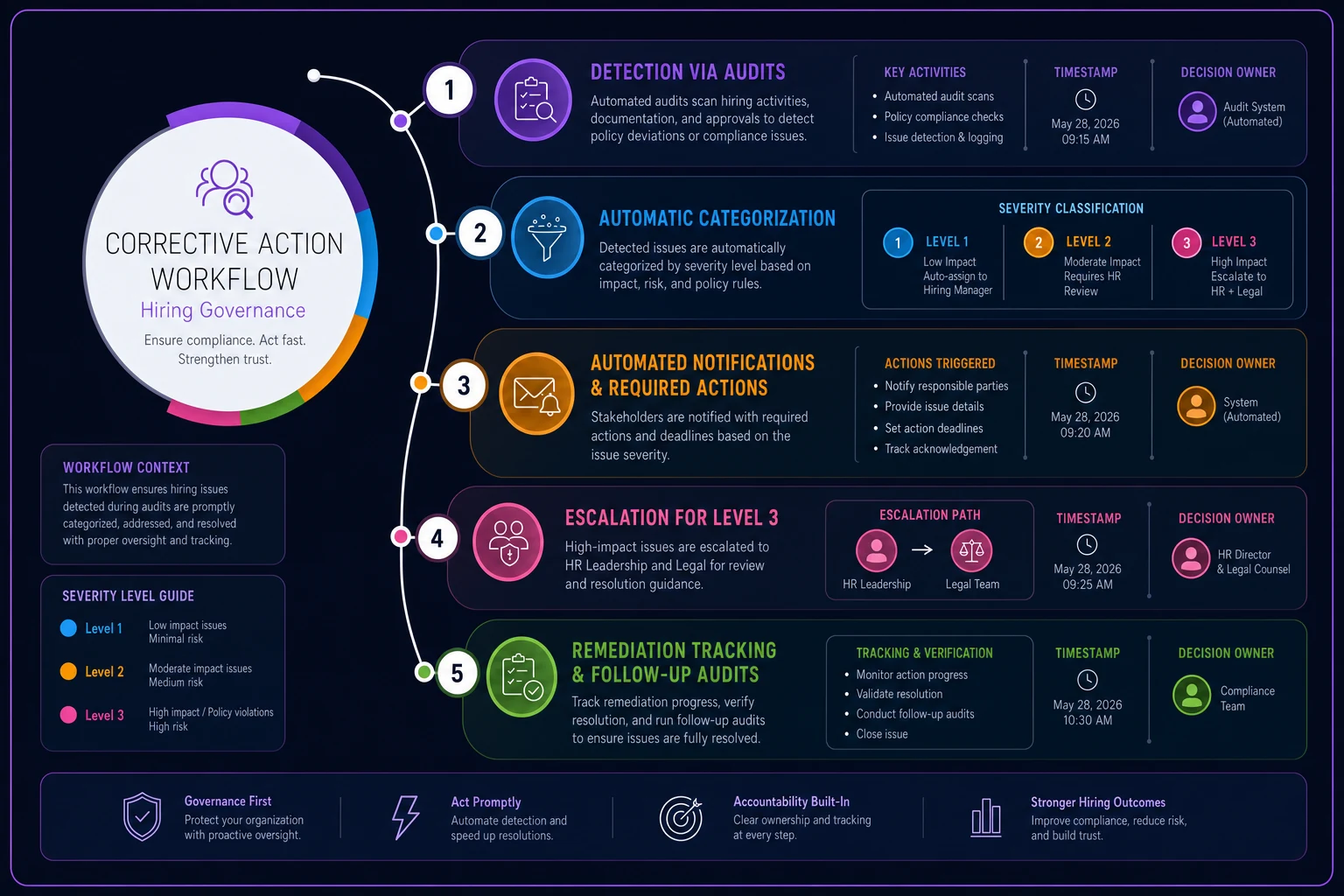
Finding problems means nothing without fixing them. Most organizations discover issues and then scramble through chaotic remediation. You need predetermined workflows that trigger automatically based on what audits find.
Level 1 infractions (documentation gaps, minor inconsistencies) trigger a system-generated notice to the individual, require completion within 48 hours, and log remediation for pattern tracking with no escalation unless it repeats.
Level 2 issues (process violations, quality concerns) send notification to both the individual and their manager, require a review meeting within one week, mandate a corrective action plan, and schedule a follow-up audit in 30 days.
Level 3 problems (potential discrimination, legal exposure) trigger immediate escalation to HR and legal, a hiring freeze for involved parties, external investigation if warranted, and a comprehensive remediation plan.
The key is removing discretion from the initial response. When your audit flags questionable patterns, the workflow activates regardless of who's involved or how inconvenient the timing is.
A financial services firm learned this painfully. Their audits repeatedly flagged one executive's hiring patterns, but "he's too important to confront" kept anyone from acting. Two years later, a class action lawsuit named him specifically — along with evidence the company had known and done nothing. Automated escalation would have forced intervention before legal exposure compounded.
A quick visual of the escalation steps helps.
Your corrective workflows should also address systemic failures, not just individual ones. Training interventions make sense when multiple people show similar gaps. Process redesign is warranted when the system itself enables poor decisions. Technology changes become necessary when manual processes introduce inconsistency. Policy updates are needed when guidelines don't match operational reality.
The DEI reporting connection everyone misses
Companies spend significant money on DEI initiatives and then wonder why hiring diversity doesn't improve. Usually it's because their governance framework doesn't connect to DEI goals at an operational level.
Your hiring decision governance should automatically surface DEI insights — where in the funnel does diversity decrease, which interviewers advance diverse candidates at different rates, what rejection reasons disproportionately affect certain groups, and how "culture fit" assessments correlate with demographics.
Raw data isn't enough, though. You need governance structures that turn insights into action.
If certain job requirements disproportionately screen out diverse candidates without predicting job performance, your framework should flag this and require justification for keeping them. When specific interviewers show consistent demographic patterns, the system should automatically adjust their involvement or require paired evaluations. If your pipeline lacks diversity at the source, governance protocols should mandate diverse slate requirements or alternative sourcing before moving forward.
A technology company discovered through governance audits that their "rapid decision making" cultural value was being interpreted as "aggressive communication style" by interviewers — systematically disadvantaging candidates from cultures that value deliberation and consensus. They didn't abandon the value but refined how they assessed it, and pass rates for international candidates improved almost immediately.
Technology infrastructure you'll actually need
Most recruiting teams are working with a barely-integrated mess of tools that sort of talk to each other through Zapier webhooks and CSV exports. That's not governance infrastructure — that's digital duct tape.
Proper hiring decision governance requires a centralized decision repository where all evaluations, scores, and determinations live in structured formats, not scattered across email threads and Slack messages. It requires workflow automation that enforces governance requirements without recruiters having to mentally track twenty different rules, real-time analytics surfacing patterns while you can still address them, audit trail integrity with tamper-evident logs that would hold up under legal scrutiny, and integration APIs connecting your ATS, assessment platforms, communication tools, and scheduling systems into a coherent framework.
You can't buy governance, though. Even the best platforms fail without operational discipline. The technology just makes good governance possible at scale.
Most teams should start with their existing ATS and add governance layers through configuration and integration. Platforms with AI automation built in can monitor decision patterns, flag anomalies, and enforce documentation compliance without piling hours onto recruiters' workloads. They can automatically compile evidence from multiple sources, standardize decision records, and generate audit reports that would otherwise take weeks to produce manually.
Start with your existing ATS and add governance layers through configuration and integration before buying new systems.
The real shift happens when governance becomes invisible to daily operations — recruiters follow their normal workflow while the system captures, validates, and organizes everything needed for defensibility and DEI reporting in the background.
Real implementation that doesn't break your team
Every recruiting team that hears "governance framework" pictures months of bureaucracy crushing hiring velocity. That's backwards — good governance makes hiring faster by eliminating uncertainty and rework.
Start with your highest-risk decisions. For most organizations, that's final-round rejections and executive hires. Implement required fields and evidence capture just for those. Takes about two weeks to stabilize, then you expand.
Next layer: timestamp automation for all decisions. This is mostly technical configuration, not process change. Your team keeps working normally while the system adds temporal documentation.
Then add spot-check audits. Don't announce them initially — just start pulling random decisions weekly and reviewing documentation quality. Share aggregate findings, not individual callouts. This builds awareness without creating anxiety.
Within 90 days, basic governance can be operating without major disruption.
A professional services firm with around 200 hires per year took this phased approach. Month one was painful as people adjusted to documentation requirements. By month three, average time-to-fill had actually dropped by four days because decisions were clearer and internal disputes disappeared. Six months in, they passed an OFCCP audit with zero findings — the auditor specifically complimented their documentation.
The payoff when governance prevents disaster
Strong hiring decision governance feels like insurance — unnecessary overhead until the moment it saves you. But unlike insurance, governance improves daily operations while protecting against catastrophe.
Immediate operational benefits include faster decisions through clear criteria, reduced internal disputes over candidates, better interviewer calibration and consistency, and improved candidate experience through transparency.
Long-term strategic value shows up as legal defensibility when challenged, DEI progress through measured accountability, quality hire improvements through pattern analysis, and organizational learning from documented decisions.
The real payoff, though, comes from problems that never materialize. The discrimination lawsuits that don't get filed because your documentation is airtight. The EEOC complaints that get dismissed immediately because you have contemporaneous evidence. The internal bias that gets caught and corrected before affecting hundreds of candidates.
One e-commerce company calculated that their governance framework prevented at least three potential lawsuits in its first year, based on issues caught and remediated through audits. At typical settlement costs of $75,000–$200,000 each, plus legal fees and productivity loss, the return was hard to argue with.
Moving from chaos to documented decisions
Your hiring process probably works fine most of the time. But governance isn't about most of the time — it's about the one time something goes wrong and you need to prove your decisions were legitimate, job-related, and defensible.
Start by picking five recent hiring decisions and trying to reconstruct exactly why you made them. Not your general memory — documented evidence of specific factors and rationale. If that exercise makes you uncomfortable, you know where to focus first.
Build governance incrementally. Pick your highest-risk decisions, add structure and documentation requirements, then expand based on what you learn. Don't try to overhaul everything at once.
The companies that implement proper hiring decision governance don't do it because they're paranoid. They do it because documented, systematic decision-making is faster, fairer, and more defensible than the alternative. The question isn't whether you need governance — it's whether you'll implement it proactively or wait until the first crisis forces your hand.
Ready to elevate your hiring process?
Join 1,500+ recruiting teams using Recioly to save time, improve collaboration, and hire smarter.