

The moment a recruiting team crosses from "we all just know what's happening" to "we need to report this to the CFO," something ugly happens. Two people run the same source-of-hire report and get different numbers. The ATS says a hire came from LinkedIn, the referral program swears it was an employee referral, and the recruiter remembers sourcing them directly six months earlier. Nobody's lying. The data just never had an owner, a definition, or a rule for what happens when systems disagree.
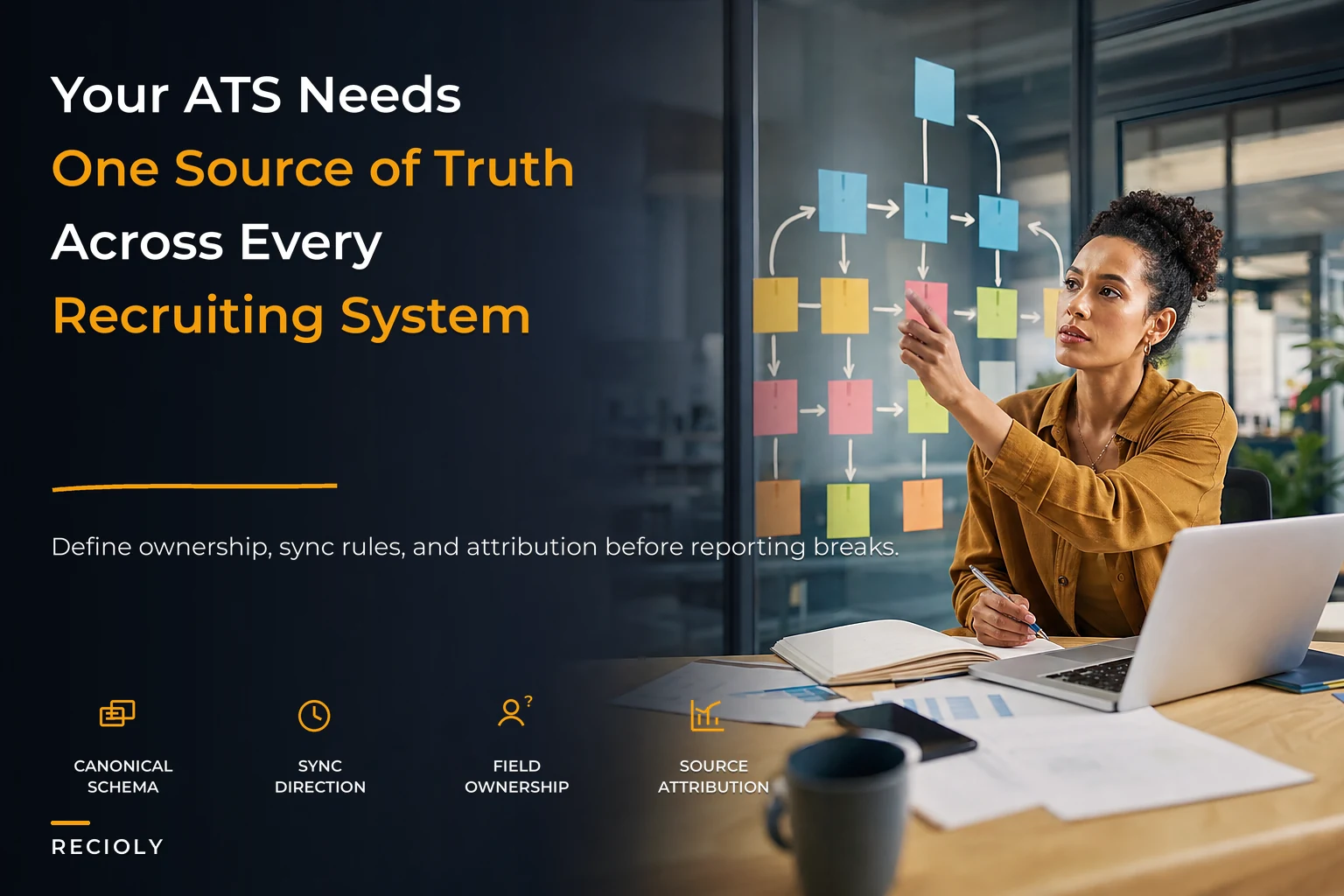
That's the real story of recruiting data ownership. It's not about privacy or retention — that's a different problem. It's about who owns the truth for each field, how that field flows between your ATS, CRM, HRIS, and BI layer, and what happens when they conflict. Most teams never define this until they're already drowning in reconciliation work.
This is the piece that turns a spreadsheet operation into something that can actually support enterprise reporting without a full-time analyst re-keying numbers every Friday.
Where the cracks actually start
Small TA teams don't have a data problem at first. Five recruiters, one ATS, everyone in the same Slack channel. When a number looks wrong, someone just asks the person who entered it. The knowledge lives in people's heads, and that works fine — right up until it doesn't.
The break point is almost always the same: a second system enters the picture. You add a sourcing CRM. The referral program moves into its own tool. Finance wants cost-per-hire, which means blending ATS data with vendor invoices. Suddenly the same candidate exists in three places, each with a slightly different version of the truth, and nobody decided which one wins.
In practice, this usually shows up as a fight about attribution. A candidate applies through a job board, gets tagged by a sourcer who'd already messaged them, and then an employee "refers" them to collect the bonus. Three sources, one hire. Whoever built the report last quarter picked a rule — probably informally — and now the numbers depend on which report you're reading. This is exactly the kind of thing that makes leadership stop trusting recruiting data, and once trust is gone it's very hard to earn back.
The deeper issue is that nobody defined the canonical field — the single authoritative version of "source of hire" that every system defers to. Without that, every integration multiplies the ambiguity instead of resolving it.
Start with the canonical field spec
Before you touch ownership or sync rules, you need agreement on what each field actually means. A canonical field spec is boring, and it's the most valuable document your TA data will ever have. It defines, for every field that matters:
Never lose track of top talent again.
Recioly helps you manage every stage of recruiting efficiently, from application to offer.
- Centralized candidate tracking
- Automated interview scheduling
- Collaborative hiring workflows
No credit card required
-
The field name and a plain-English definition anyone can read
-
The allowed values (a controlled list, not free text)
-
The system of record — which tool holds the authoritative value
-
How it's captured — automatic, recruiter-entered, or derived
-
The rule for conflicts when two systems hold different values
Here's a slimmed-down example of what a real spec looks like for a handful of high-conflict fields:
| Field | Definition | System of Record | Capture Method | Allowed Values |
|---|---|---|---|---|
| Source of Hire | The channel credited for first meaningful candidate contact | ATS | Derived by first-touch rule | Job board / Referral / Sourced / Agency / Inbound |
| Application Date | First submitted application for the specific req | ATS | Automatic | Timestamp |
| Requisition Owner | Recruiter accountable for the req | ATS | Recruiter-entered | Employee ID |
| Offer Amount | Base salary in the extended offer | HRIS | HRIS-entered | Currency value |
| Stage | Current pipeline stage | ATS | Automatic | Controlled stage list |
Notice the "first meaningful contact" definition on source. That single word settles the three-way attribution fight before it starts. If a sourcer touched the candidate before they applied, sourcing wins. If nobody touched them and they applied cold, it's inbound. You write the rule once, everyone follows it, and the report stops depending on who built it.
The mistake most teams make is trying to spec every field at once. You don't need to. Start with the ten or fifteen fields that appear in your executive reports and cause the most arguments. Source, stage, dates, req owner, offer, and hire status get you most of the way there.
Ownership: who actually decides
A field having a "system of record" is a technical fact. A field having an owner is an operational one, and they're not the same thing. The ATS might be the system of record for source of hire, but a person has to own the definition, defend it in meetings, and decide when to change it.
-
Responsible — the person or team that enters or maintains the value day to day
-
Accountable — the single owner who defends the definition and approves changes (only ever one name here)
-
Consulted — people whose work depends on the field, like finance for offer amounts
-
Informed — everyone who needs to know when the definition changes
A RACI model works well here. For each canonical field, you assign:
One name in the Accountable column, always. Shared accountability is the same as no accountability.
A quick example. For Source of Hire, sourcing operations is Responsible, the TA analytics lead is Accountable, finance and hiring managers are Consulted, and the whole recruiting org is Informed. For Offer Amount, HR ops is Responsible, comp is Accountable, TA is Consulted.
The single most common ownership failure is having two accountable owners for a field. It feels collaborative. It's actually paralysis. When source-of-hire numbers get questioned, both owners assume the other will handle it, nobody does, and the definition quietly drifts. One name in the Accountable column, always. Shared accountability is the same as no accountability.
Cross-system sync rules
Once fields have definitions and owners, you have to decide how they move between systems — and this is where teams either build something durable or a spaghetti mess of integrations that break every time a vendor pushes an update.
The core principle: data flows from the system of record, never into it from a downstream system. If the ATS owns source of hire, the CRM can read it but never overwrite it. Sounds obvious. Gets violated constantly, usually by a well-meaning integration someone set up to "keep things in sync" bidirectionally. Bidirectional sync on a field that has a clear owner is how you get silent corruption — the downstream system writes a stale value back and suddenly the source of record is wrong.
A workable sync model in plain terms:
-
The ATS is the hub for pipeline data — stages, sources, dates, req ownership. Everything reads from it.
-
The HRIS owns post-offer data — final comp, start date, employment status — and pushes hire confirmations back to the ATS to close the loop, but only for its own fields.
-
The CRM/sourcing tool owns pre-application touch history and feeds the source-of-hire derivation, but doesn't own the final source value.
-
The BI layer reads from all of them and owns nothing. It's the reporting surface, not a source of truth.
That last point matters more than it looks. When your BI layer starts storing "corrected" values that don't exist in any source system, you've created a fourth version of the truth. Corrections belong in the source, with an audit trail, not buried in a dashboard's transformation logic.
If you're building this from scratch without a BI team, the minimal recruitment analytics foundation guide walks through schema and attribution in a way that fits directly on top of the field spec above.
Where AI automation quietly earns its keep
A simple workflow diagram helps visualize those one-way sync rules.
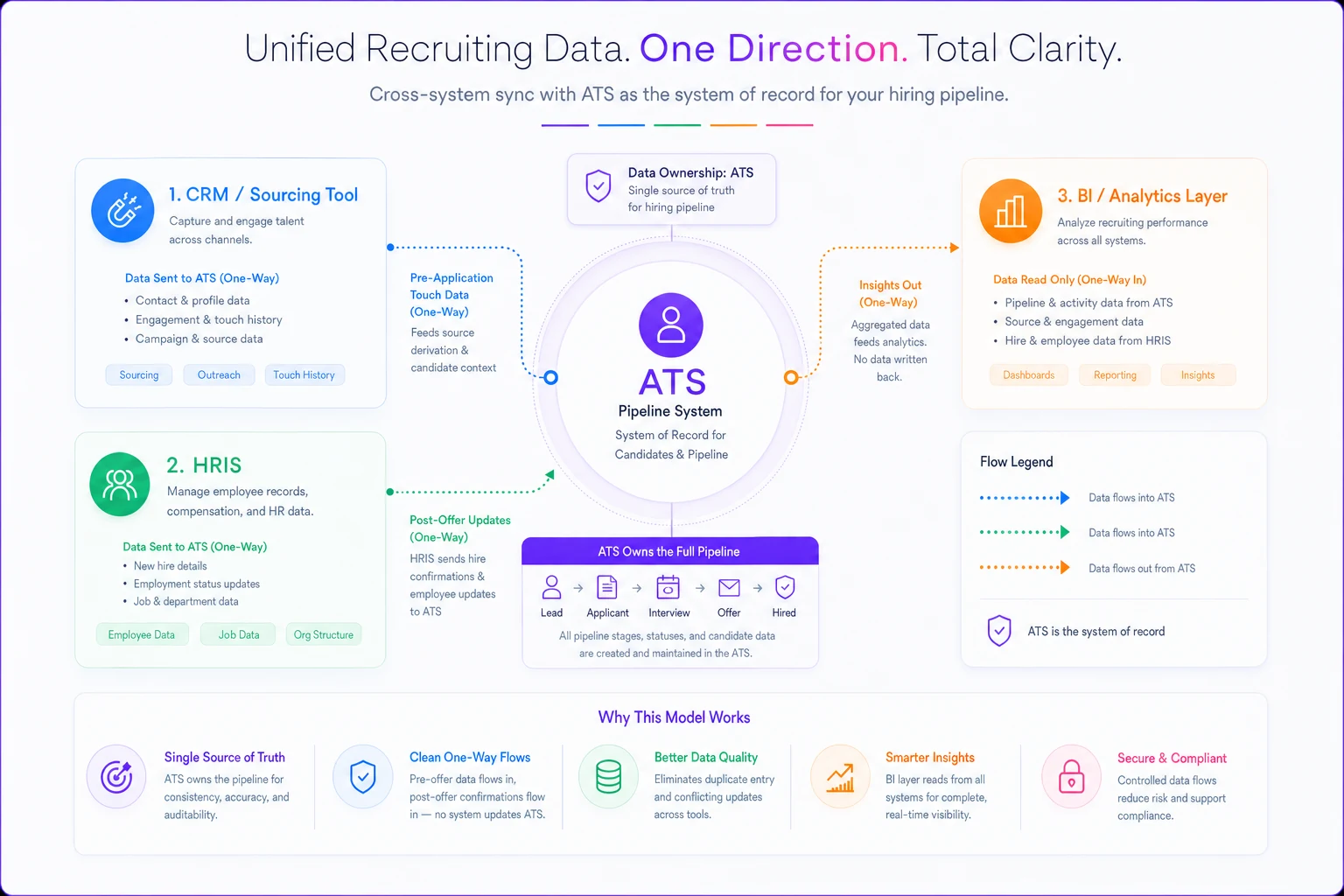
The derivation of source-of-hire — reconciling a sourcer's touch, an application timestamp, and a referral claim against your first-touch rule — is exactly the kind of tedious, rule-based work that eats analyst hours every week. A workflow platform with AI automation can apply the canonical rule consistently across thousands of records, flag genuine conflicts for a human to resolve, and log every decision. You're not replacing judgment; you're removing the manual re-keying and catching the small percentage of records that actually need a person. That's the difference between a data model that scales and one that needs a headcount to babysit it.
The dispute-resolution flow
No matter how clean your spec is, conflicts happen. A recruiter insists a hire was sourced. Finance says the vendor invoice tells a different story. Without a defined path, every dispute becomes a Slack argument that ends when someone gets tired.
-
Flag — anyone can raise a data dispute, but it goes to a single intake (a form or queue), not a DM.
-
Classify — is this a definition problem (the rule is ambiguous) or a data entry problem (someone entered it wrong)? These get handled completely differently.
-
Route to the Accountable owner — the person in the RACI who owns that field decides.
-
Resolve and log — the correction is made in the system of record, with a timestamped note on why.
-
Escalate only if it's a definition change — if resolving it means changing the canonical rule, it goes to a change-review step, because that affects historical reporting.
The classify step is what most teams skip, and it's the one that saves you. A one-off wrong entry is a five-minute fix. Changing what "source of hire" means rewrites every historical report and needs real governance. Treating those two as the same problem is how you either move too slowly on trivial fixes or too fast on decisions that break your trend lines.
What breaks at each stage of growth
The system you need looks different depending on where your team is. The failure isn't usually building the wrong system — it's building the enterprise version too early, or the small-team version too late.
| Stage | Team Size | Primary Risk | What You Actually Need |
|---|---|---|---|
| Early | 1–5 recruiters, single ATS | Knowledge trapped in people's heads | A written field spec for your top 10 fields |
| Growing | 6–20, multiple tools | Attribution conflicts, silent overwrites | Ownership RACI + strict one-way sync rules |
| Scaling | 20+, finance dependencies | Reports diverge, no dispute path | Dispute-resolution flow + change governance |
| Enterprise | Multi-region, audited | Historical restatements, compliance | Full canonical model + versioned definitions |
The pattern is consistent: teams wait until the "Scaling" row's pain is unbearable before doing the "Early" row's work. The field spec that takes a week to write when you have five recruiters takes a quarter to write — and a painful data cleanup — when you have twenty and three systems disagreeing.
An operational rollout plan
If you're wondering where to start without stopping everything, here's a realistic sequence:
-
Weeks 1–2 Inventory every field that appears in an exec report. List which system it lives in and who "sort of" owns it today.
-
Weeks 3–4 Write the canonical spec for the top 10–15 conflict-prone fields. Get the Accountable owners named and signed off.
-
Weeks 5–6 Audit your existing integrations. Kill any bidirectional sync on owned fields. Document the intended one-way flows.
-
Weeks 7–8 Stand up the dispute intake and resolution flow. Even a simple form and a weekly triage is enough to start.
-
Ongoing Run a monthly definition-review so changes to canonical fields go through governance instead of happening quietly.
Once the field model is stable, the reporting layer becomes almost boring to build — which is the goal. If you're designing the metrics and cadences that sit on top of this, the data-driven hiring system framework pairs well here, since defensible KPIs depend entirely on having agreed definitions underneath them.
When this is worth it — and when it isn't
When it makes sense: You have two or more systems holding overlapping candidate data, you're reporting to finance or leadership on cost and source metrics, or you've already had a "why don't these numbers match" meeting. Any of those, and you're past due.
When it's overkill: You're a solo recruiter or a team of three on a single ATS with no external reporting pressure. Writing a full RACI and sync-rule doc for that is process for its own sake. You'd get more value from a clean one-page dashboard — the small-team dashboard specs cover exactly what that looks like without the overhead.
Who should NOT do this yet: Teams in the middle of an ATS migration. Define your canonical model after you know your target system, not during a move, or you'll spec fields against a system you're about to abandon.
A real scenario
A mid-size company — around 40 people in TA across two regions, hiring roughly 300 people a year — kept getting burned in board meetings. Source-of-hire reports from the analytics team and the sourcing team never matched, sometimes off by 15–20% on referral attribution. The root cause was exactly what you'd expect: no canonical definition of source, and a bidirectional sync between their CRM and ATS that was quietly overwriting the ATS source field with stale CRM values.
They didn't buy anything new. They wrote a field spec for their nine most-reported fields, named a single accountable owner for source of hire, killed the bidirectional sync, and set up a weekly dispute triage. Within a couple of months, the referral numbers reconciled to within a few percent, and the "which report is right" question basically stopped coming up in leadership meetings. The analyst who'd been spending most of a day each week reconciling numbers got that time back for actual analysis.
Nothing about that fix was technically fancy. Definitions, ownership, and one-way flow. That's almost always what it comes down to.
The takeaway
Recruiting data ownership isn't a reporting problem you solve at the end — it's a foundation you either lay early or pay to retrofit later. The teams that scale cleanly into enterprise reporting are rarely the ones with the fanciest BI stack. They're the ones where every important field has a definition, one owner, a one-way flow, and a path for resolving disagreements. Build that, and your reports stop being arguments and start being answers.
Ready to elevate your hiring process?
Join 1,500+ recruiting teams using Recioly to save time, improve collaboration, and hire smarter.