

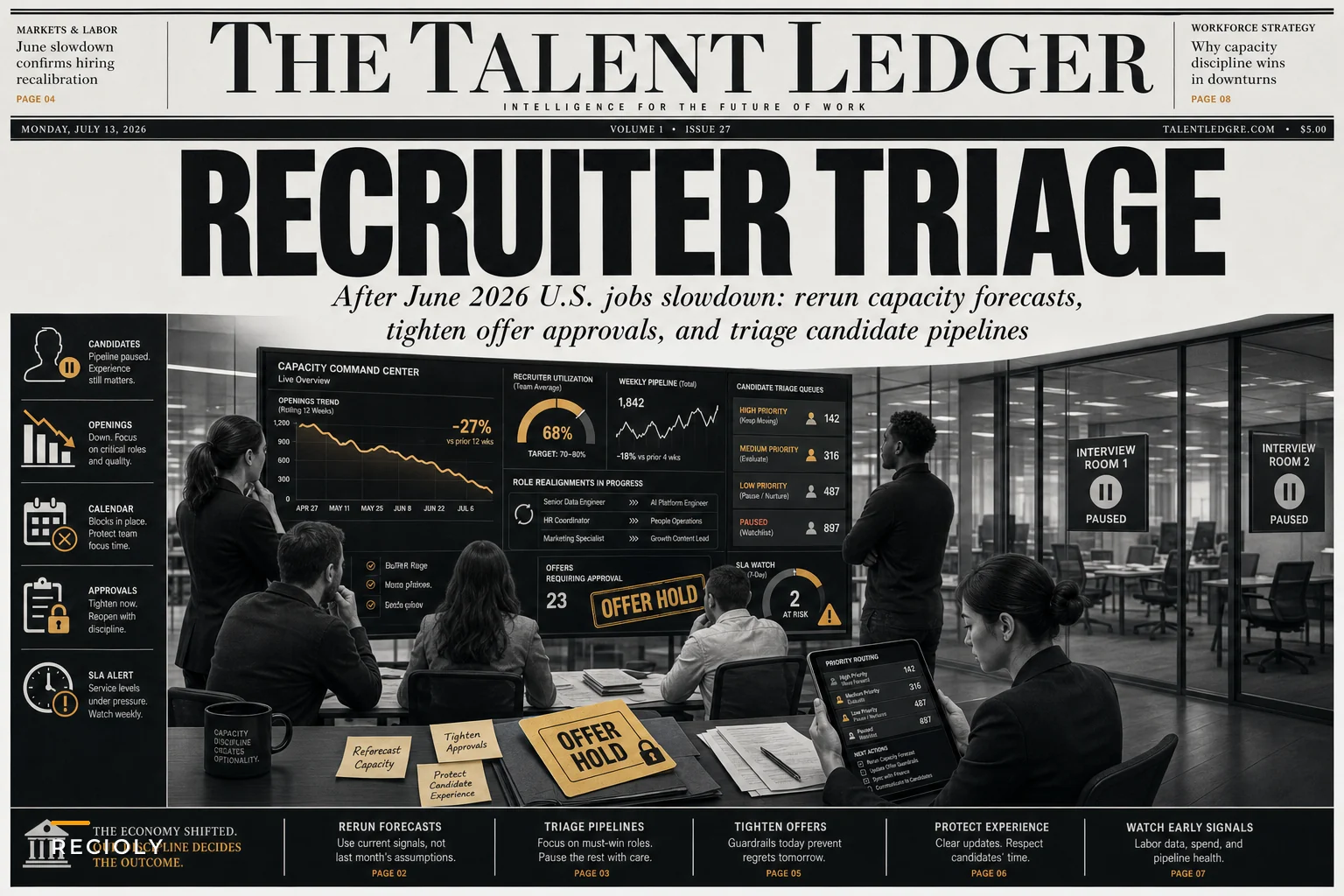

The June jobs report landed like a bucket of cold water on recruiting teams. Only 57,000 nonfarm jobs added — well below the expected 190,000 according to CNBC — and labor force participation dropped to 61.5%. The hiring landscape shifted practically overnight.
For recruiting teams, this isn't background noise. It's an operational gut-punch that requires real adjustments to recruiter capacity forecasting, candidate prioritization, and offer approval processes. Teams that move fast will hold their pipeline health together. Teams that sit on their hands will watch conversion rates drop and time-to-fill creep up in ways that are painful to explain to leadership.
What actually breaks when the labor market cools
A sudden slowdown creates cascading problems most recruiting teams aren't wired for. Recruiters who were managing 25 active requisitions are suddenly sitting on 12. Meanwhile, candidate volume spikes as laid-off workers flood applicant systems — you can end up with triple the screening workload even as hiring contracts.
It's a weird paradox. Less hiring, but more work. Recruiters spend more time on rejections, hiring managers get picky because they can afford to, and offer approval processes that ran fine at 100 hires a month start breaking down at 30.
The immediate hit lands on recruiter capacity forecasting. Most teams built Q3 plans assuming steady growth — some even built them on aggressive Q1 expansion numbers. Those forecasts are now pretty much useless. Without adjustments, you're either burying your team in unqualified applications or watching your best recruiters disengage because there's nothing meaningful to work on.
Recalibrating capacity when demand drops
The common mistake when hiring volumes fall is assuming fewer requisitions means easier workload. It doesn't. The work shifts — it doesn't disappear.
Never lose track of top talent again.
Recioly helps you manage every stage of recruiting efficiently, from application to offer.
- Centralized candidate tracking
- Automated interview scheduling
- Collaborative hiring workflows
No credit card required
Instead of spending 80% of their time sourcing and 20% screening, your recruiters flip that ratio. Each open role takes longer to close because hiring managers have options and use them. A 3-interview process becomes 5. Offer negotiations that wrapped in two days now drag into a week.
-
Fixed recruiter-to-requisition ratios
-
Monthly capacity reviews
-
Static sourcing targets
-
Uniform workload distribution
-
Dynamic role assignment based on pipeline stage
-
Weekly capacity rebalancing
-
Variable sourcing targets by role criticality
-
Specialized teams for high-volume screening vs. strategic hiring
A simple workflow for elastic capacity planning helps make this concrete.
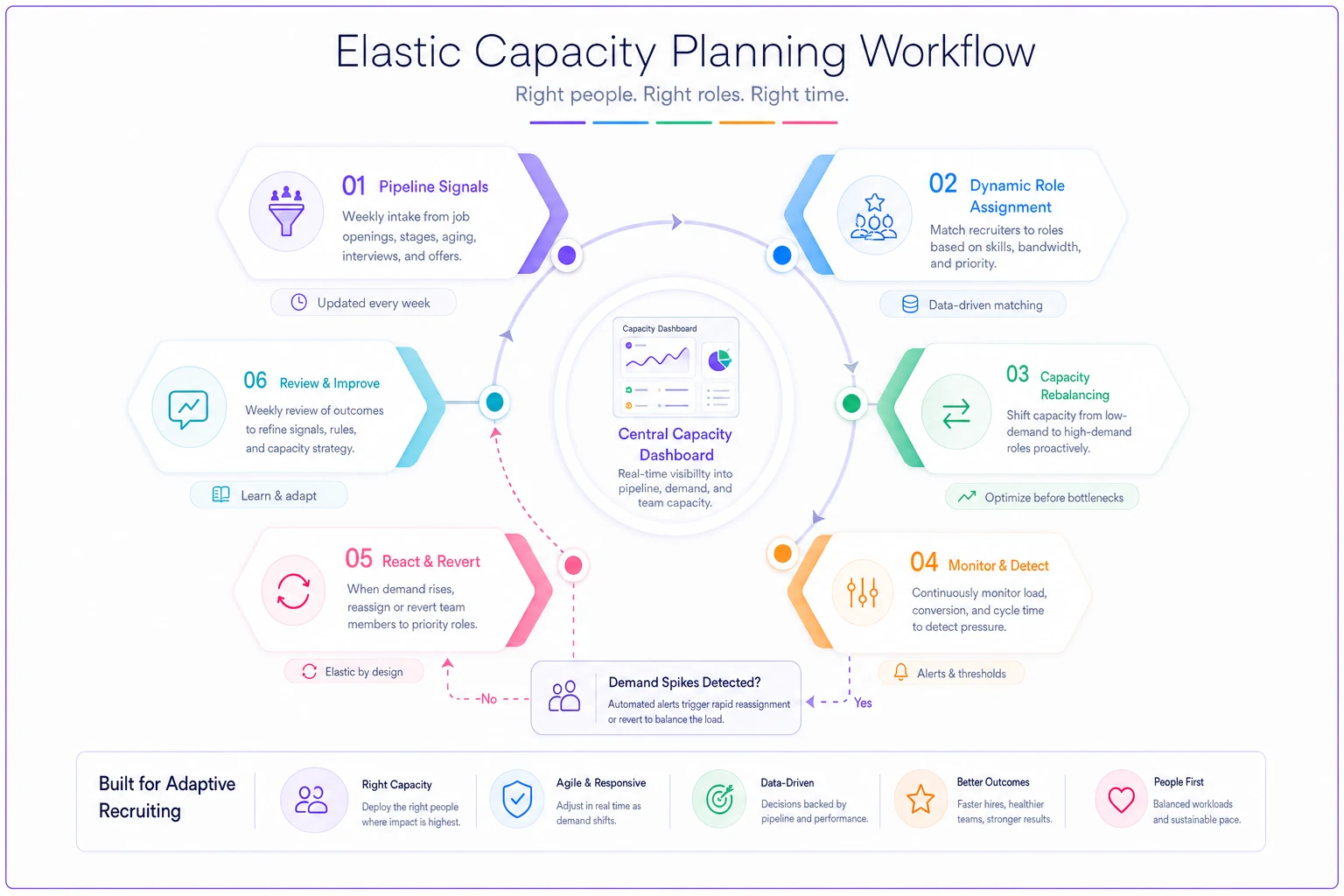
One tech company went through this exact situation when their engineering hiring dropped from 45 per quarter to 12. They kept the same team structure at first. Three recruiters quit from boredom, two burned out managing the inbound flood. After rethinking capacity planning, they moved half the team onto candidate experience and employer branding during the slow stretch — then pivoted back quickly when demand picked up again.
Triage rules that stop pipeline bloat
Market slowdowns create a candidate triage problem fast. An ATS handling 500 applications a week suddenly processes 2,000. Without updated triage rules, the qualified candidates just get buried.
Most teams respond by tightening knockout questions or raising minimum qualifications. That usually backfires. You start rejecting solid candidates on technicalities while your team still manually reviews hundreds of weak applications.
The better approach is a multi-tier triage system with clear escalation paths:
| Triage Level | Volume % | Response Time | Review Depth | Routing |
|---|---|---|---|---|
| Tier 1 - Auto-reject | 60-70% | Instant | None | Automated rejection |
| Tier 2 - Quick scan | 20-25% | 24 hours | 30-second review | Junior recruiter pool |
| Tier 3 - Deep review | 8-12% | 48 hours | 3-minute review | Role-specific recruiter |
| Tier 4 - Fast track | 2-3% | 4 hours | Full review | Senior recruiter + HM alert |
Use ATS tags and automated scoring to route Tier 2 candidates straight to the junior recruiter pool to keep turnaround within 24 hours.
These percentages shift with market conditions. In a hot market, maybe 40% auto-reject. In a slowdown like this one, you push that closer to 70% to keep the volume manageable.
This isn't about becoming more selective — it's about being more efficient with selection. The top few percent still get proper attention. You're just not burning senior recruiter hours on applications that don't meet basic requirements.
Offer workflow gates that prevent compensation drift
One thing that quietly kills recruiting teams during slowdowns is compensation drift. Hiring managers assume they can lowball because candidates have fewer options. Then a strong candidate shows up with competing offers anyway, and the same manager panics and overpays. Neither outcome is good.
During the 2023 tech correction, a mid-size SaaS company burned through most of their Q4 hiring budget on three engineers. Their offer approval process wasn't built for market volatility. Each hiring manager was negotiating independently, which created pay equity problems they were still untangling a year later.
The fix is building market-adjusted offer gates — approval workflows that shift based on what's actually happening in the market:
-
Offers within band
Manager approval only
-
5% above band
Director approval
-
10% above band
VP approval
-
15%+ above band
Executive committee
-
Offers below midpoint
Auto-approved
-
Midpoint to 75th percentile
Manager + compensation team review
-
Above 75th percentile
Director + market analysis required
-
Any equity grants
VP approval with peer comparison
These gates prevent both failure modes. Managers can't lowball freely because anything below midpoint still requires documentation. They also can't panic-spend because offers above the 75th percentile trigger real scrutiny before going out.
Building early warning systems before you need them
The teams that got hurt most after June's report had no warning systems in place. No triggers, no playbooks, no signals that something was shifting. By the time problems showed up in their metrics, the pipeline was already in rough shape.
Good recruiting operations need weekly capacity forecasting dashboards — not monthly reviews, not lag indicators. You need leading indicators that surface problems before they become crises.
-
Application volume changes week-over-week
-
Offer acceptance rate trends on a rolling two-week average
-
Time-to-fill movement
-
Recruiter utilization by pipeline stage
-
Candidate response rates to outreach
When any metric moves more than 20% for two consecutive weeks, that triggers a capacity review. When multiple metrics shift at once — which is exactly what happened in June — you activate your response playbook immediately.
A recruiting ops team in Austin built this kind of system a while back. When local tech layoffs spiked their application volume 150% in a single week, their dashboard caught it fast. Within 48 hours they'd reassigned two sourcers to screening, tightened their auto-reject rules, and adjusted offer bands. They filled the same number of roles without blowing budget or burning out the team.
The hidden upside most teams miss
Counter-intuitive, but slowdowns can actually improve your recruiting operations if you use the space well. While other teams are in reactive mode making hasty decisions, you have a window to fix things that never got fixed during growth.
This is when you build the interviewer training program you've been deferring. When you audit scorecards for bias. When you clean up ATS data and close out broken workflows. When senior recruiters finally document the tribal knowledge they've been carrying around for years.
During two different hiring freezes, using the downtime to implement AI-assisted screening tools cut manual review time significantly. When hiring picked back up, teams could handle roughly twice the volume without adding headcount. The operational improvements from slow periods ended up being real competitive advantages when growth returned.
90-day action plan
Based on June's numbers and what's showing up across recruiting teams right now, here's a realistic 90-day response:
Weeks 1-2: Immediate triage
-
Audit current requisition priorities with hiring managers
-
Tighten auto-rejection rules for high-volume roles
-
Adjust offer bands down 5-10% for non-critical positions
-
Pause any recruiting that isn't revenue-critical or a backfill
Weeks 3-4: Capacity rebalancing
-
Reassign sourcers to screening on high-volume positions
-
Create specialized teams by hiring type
-
Build market-adjusted offer approval workflows
-
Stand up weekly pipeline health monitoring
Weeks 5-8: Process optimization
-
Implement AI-assisted screening for initial application review
-
Build contingency playbooks for further market shifts
-
Document process changes so nothing gets lost
-
Train the team on updated triage and prioritization rules
Weeks 9-12: Strategic positioning
-
Develop employer brand content for future hiring
-
Build talent pools for when the market recovers
-
Optimize recruitment marketing spend for efficiency
-
Create dashboards for ongoing market monitoring
Based on June's numbers and what's showing up across recruiting teams right now, here's a realistic 90-day response:
Tech stack adjustments
The recruiting tech stack that worked during growth becomes a liability in a slowdown. You're paying for sourcing tools you're barely touching while lacking screening capacity for the applicant surge.
Smart teams consolidate around core workflows. Rather than eight different point solutions, integrated platforms that handle the full lifecycle tend to hold up better. AI-powered operational software matters here — not as a magic bullet, but as a force multiplier. Implementing AI-assisted screening doesn't replace recruiters. It means they spend less time reading clearly unqualified resumes and more time engaging people worth engaging. The recruiter who could screen 50 applications a day properly can handle 200 with good pre-filtering, without cutting corners on quality.
Building for the next shift, not just this one
June's slowdown won't be the last market shift your team faces. According to Reuters, job growth missed expectations while unemployment ticked down — a mixed signal that makes planning harder, not easier. The organizations that hold up over time are the ones that build flexibility into their core operations: elastic capacity models, automated triage, offer workflows that respond to market conditions rather than ignoring them.
This isn't about predicting what comes next. It's about building systems that adapt regardless. Your recruiter capacity forecasting should work at 20 hires per month and 200. Your triage rules should adjust automatically based on volume. Your offer workflows should guard against both ends of the compensation problem.
The teams making these adjustments now — while things are uncomfortable but not broken — will be in a much better position when the market flips again. And it will flip.
Pick one area this week. Capacity planning, triage, or offer workflows. Start there, make some changes, see what moves. You don't need a perfect plan to get started — you just need to stop running last quarter's playbook in this quarter's market.
Ready to elevate your hiring process?
Join 1,500+ recruiting teams using Recioly to save time, improve collaboration, and hire smarter.