

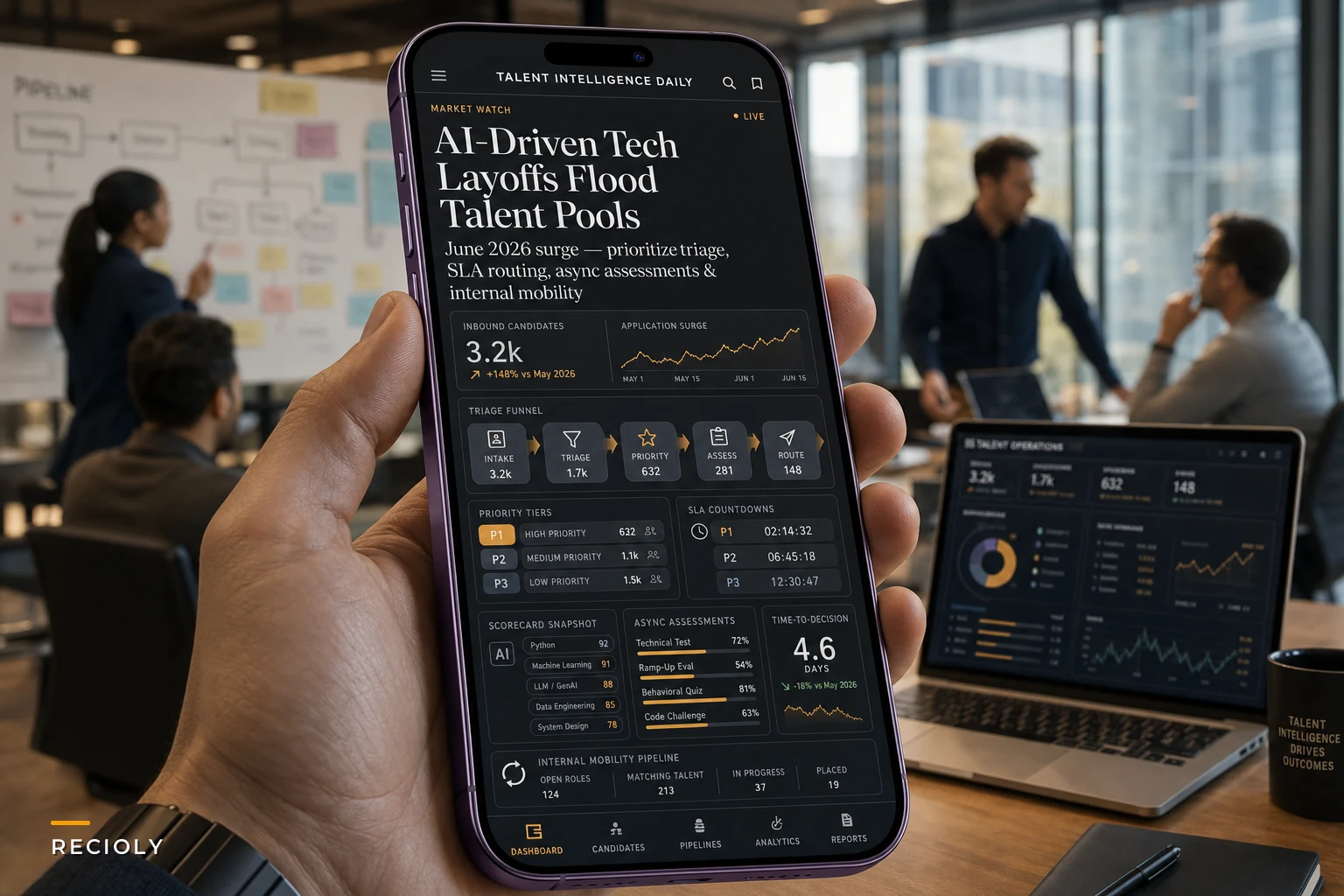

Oracle just cut 21,000 jobs citing AI efficiency gains. Meta, GitLab, Cloudflare, and Intuit followed with their own rounds. Forbes reports these AI-driven layoffs are accelerating, not slowing down.
For recruiting teams, this is an operational mess most ATS platforms and hiring workflows weren't designed for. You're looking at 5x normal application volumes for technical roles, candidates with outdated skill profiles flooding your pipeline, and hiring managers still demanding niche AI expertise that barely existed eighteen months ago.
The cruel irony? While thousands of experienced engineers hit the market, companies are struggling to fill AI and automation roles. It's not a talent shortage — it's a massive mismatch between available skills and what's actually needed right now.
The Volume Spike Will Break Your Current Triage System
Most recruiting teams built their workflows around steady-state hiring. Maybe 40–60 applications per role for senior positions, 100–150 for junior ones. Now you're seeing 400+ applications within 48 hours of posting a senior engineering role.
Recruiters are burning 3–4 hours on initial resume reviews for a single position. That's before screening calls, coordinator handoffs, or interview scheduling. The math stops working fast when each recruiter is managing 8–12 open reqs simultaneously.
What usually happens is corners get cut. Review time drops from 90 seconds per resume to 15. Teams lean harder on keyword filters. Personalized rejections disappear. Good candidates get missed, and your employer brand takes hits on Glassdoor from applicants who never heard back.
The typical response — hire contract recruiters to handle overflow — doesn't really solve it. Contract recruiters need 2–3 weeks to ramp on your processes, another week to understand role requirements, and by then the damage is done. Plus they're expensive when budgets are already tight from the same market forces causing the layoffs in the first place.
Skills Mismatch Creates False Positive Overload
Here's what makes AI-driven layoffs different from previous tech downturns: displaced talent often has the wrong skill mix for open roles. A backend engineer with 15 years of Java and microservices looks great on paper, but if they've never touched PyTorch or worked with LLMs, they probably won't fit your AI engineering requisition.
Never lose track of top talent again.
Recioly helps you manage every stage of recruiting efficiently, from application to offer.
- Centralized candidate tracking
- Automated interview scheduling
- Collaborative hiring workflows
No credit card required
Your screening process now has to evaluate current capabilities and learning potential. Most scorecards are binary — someone either has Python experience or they don't. There's rarely a structured way to assess whether a person with strong fundamentals can realistically ramp up on transformer architectures within 60 days.
This creates a strange dynamic where you're rejecting hundreds of experienced engineers while hunting for the handful with specific AI tool experience. Those rejected engineers could probably learn what you need faster than finding and closing a "perfect" candidate who already has three other offers on the table.
Fixing this isn't straightforward. It means rethinking interview rubrics, building skills assessment matrices that account for adjacency and ramp-up time, and probably restructuring your technical screens entirely.
Budget Constraints Force Uncomfortable Prioritization Decisions
Companies implementing AI automation are simultaneously cutting costs and investing in new capabilities. For recruiting teams, that usually means frozen or reduced budgets while complexity keeps increasing.
You can't pay top-of-market for every AI role when half your engineering org just got restructured. But you also can't lowball candidates who know they're in demand. The result is brutal prioritization — which roles get full recruiting support versus which ones get posted and forgotten.
Some teams are building tier systems. The breakdown typically looks something like this:
| Tier | Support Level | Use Case |
|---|---|---|
| Tier 1 | Full-cycle recruiting, multiple touchpoints | Critical AI/technical roles |
| Tier 2 | Sourcing with limited screening | Important but non-urgent roles |
| Tier 3 | Post-and-hope | Lower-priority backfills |
The problem is this requires clear criteria for tier assignment and constant recalibration as priorities shift. When a critical AI role sits open for four months because it got miscategorized as Tier 2, the business impact cascades. Product roadmaps slip, competitive advantages erode, and suddenly that "nice to have" hire becomes an emergency that better prioritization would have prevented.
Reskilling Programs Become Operational Requirements, Not Nice-to-Haves
Smart companies are realizing it's cheaper to reskill existing employees than compete for scarce AI talent. But most recruiting teams don't have the infrastructure for internal mobility at scale.
Your ATS tracks external candidates. Your LMS tracks course completion. Your HRIS tracks current skills. None of them talk to each other effectively. So when an operations analyst wants to transition into data science, there's no clear path or tracking mechanism in place.
Building internal mobility pipelines requires operational infrastructure that spans recruiting, L&D, and HR. Skills gap assessments, structured learning paths, internal interview processes, success metrics that account for ramp-up time — all of it needs to exist and connect.
The companies getting this right treat internal candidates as a separate recruiting pipeline with their own workflows, scorecards, and SLAs. They're creating apprenticeship-style roles where employees contribute while learning. They're adjusting performance expectations to reflect skill development time rather than penalizing people who are still ramping.
-
Skills gap assessment — identify what the employee has versus what the target role needs
-
Learning path assignment — structured curriculum mapped to the specific gap
-
Milestone checkpoints — regular evaluations at 30, 60, and 90 days
-
Internal interview process — same rigor as external hiring, but with context on the candidate's trajectory
-
Adjusted onboarding — ramp-up expectations set at the start, not retrofitted after a bad first quarter
Most organizations skip steps two and three entirely, then wonder why internal mobility numbers stay flat.
Candidate Experience at Scale Requires Systematic Communication
When application volumes spike 5x, most teams abandon candidate communication entirely. Auto-rejections feel impersonal. No communication feels worse. Either way, you're damaging your employer brand exactly when competition for talent is most intense.
The operational challenge is maintaining meaningful communication when your team is underwater. This isn't about sending more emails — it's about designing communication systems that scale without losing any sense of authenticity.
Stage-based workflows help. Instead of personalized messages for 400 applicants, you create thoughtful templates for each stage: application received, under review, moving forward, not moving forward. The key is making these messages actually useful — not just hollow status updates.
Include real information: "We received 387 applications for this role and are reviewing them in batches of 50. You're in batch 3, which we expect to complete by Thursday." Or: "While we're not moving forward for this role, your background in distributed systems would be a strong fit for our Platform team. Want us to keep you in mind as those open up?"
Systematic transparency like this actually reduces inbound inquiries, saving your team time while improving the overall experience. Building proper triage workflows with clear SLAs and routing rules becomes essential when you're operating at this kind of volume.
Technical Assessment Strategies Need Complete Overhaul
Traditional technical interviews assume you're evaluating existing knowledge. With AI-driven layoffs creating real skills gaps, you need to evaluate learning velocity and foundational understanding just as much.
Take-home projects that mirror actual work become more valuable than algorithm challenges. Instead of asking someone to implement merge sort, give them a simplified version of a real problem your team solved. See how they approach unfamiliar territory. Do they identify the right abstractions? Can they find and integrate relevant documentation? How do they handle ambiguity?
Some teams are experimenting with ramp-up assessments — give candidates access to learning resources for a new technology, then evaluate how quickly they apply it. This better predicts success for career-switchers than traditional screens do.
The operational complexity comes from standardizing these assessments across interviewers. When every hiring manager runs their own pet project, you lose calibration and comparability. Building a library of validated assessments with clear rubrics takes time upfront but pays off when you're evaluating hundreds of candidates.
Compensation Bands Require Dynamic Recalibration
Market-rate data becomes unreliable when the market is moving fast. A recently laid-off principal engineer has different salary expectations than someone currently employed. AI specialists command premiums that vary wildly depending on their specific experience.
Static compensation bands break down fast. A "Senior Software Engineer" role might have a $140k–$180k band, but if the role requires LLM experience, market rate could push well past $200k. If you're hiring someone strong who needs to skill up, maybe $160k works with a clear ramp-up plan attached.
This means building compensation flexibility directly into your operational workflows. Instead of fixed bands, create adjustment factors — something like +20% for specific AI skills, -10% for ramp-up period, +15% for competing offers. Document these decisions for equity and legal compliance.
Your recruiting ops also need clear escalation paths for compensation exceptions. When a recruiter identifies a strong candidate outside the band, what's the approval process? How fast can you move? Every day of delay increases the odds of losing the candidate to someone who already figured this part out.
Internal Partnership Models Must Evolve
The standard recruiter-hiring manager partnership — intake meeting, weekly syncs, candidate feedback — needs restructuring when market conditions are shifting this fast.
Hiring managers need education on market realities. They can't demand five years of LLM experience when the technology has barely existed that long. They need to understand the trade-offs between a perfect skills match and time-to-fill. That means recruiting teams have to operate more like market advisors than candidate suppliers.
Structured market intelligence briefings help. Show hiring managers actual candidate profiles and compensation expectations. Help them think through the real choices: "We can get someone with exact skills in four months at $220k, or someone strong who needs ramp-up in three weeks at $170k." That's a real conversation, not a negotiation about job description wording.
The operational challenge is making this advisory role scalable. Building templates for market briefings, creating skill taxonomy guides, running regular calibration sessions — these things take time to set up but make the partnership much more functional at volume.
Employer Brand Becomes Operational Priority
With hundreds of displaced tech workers comparing opportunities, your employer brand directly affects how fast you can fill roles. Bad Glassdoor reviews or negative Reddit threads mean higher rejection rates and longer time-to-fill.
Brand can't be fixed with marketing campaigns when your operations are broken. Candidates talk. If your interview process is disorganized, communication is inconsistent, or decisions drag on for weeks, that becomes your reputation.
This means treating candidate experience as an operational metric. Track response times at each stage. Measure candidate NPS. Monitor withdrawal rates and the reasons behind them. Build feedback loops that actually change how you operate — not just dashboards that get reviewed once a quarter.
Some teams are creating candidate experience review groups with people from recruiting, coordination, and even past candidates. They look at friction points, test new workflows, and make sure process changes actually improve the experience rather than just internal efficiency numbers.
AI-Powered Recruiting Tools Need Thoughtful Implementation
There's a real irony in AI-driven layoffs pushing recruiting teams toward AI-powered recruiting tools. But implementing these wrong creates more chaos than they solve.
Resume parsing that misjudges experience levels floods your pipeline with poor matches. Chatbots that can't answer basic questions frustrate candidates. Automated scheduling that ignores timezone complexity creates no-shows.
The smarter approach is using AI automation for specific, well-defined tasks rather than trying to automate entire workflows. Use it for initial resume categorization, but have humans review edge cases. Implement chatbots for FAQ responses, but escalate complex questions quickly. Automate scheduling, but build in flexibility for exceptions.
Start with your highest-volume, most repetitive work. If recruiters spend 30% of their time sending follow-up emails, automate that first. If phone screens follow a consistent script, test AI-powered initial screens in a controlled way. Always keep human oversight and clear escalation paths in place — especially in a market this volatile.
Measuring Success Requires New Metrics
Traditional recruiting metrics don't capture what's actually happening in the current market. Time-to-fill means less when you're being strategic about prioritization. Cost-per-hire ignores the hidden costs of bad hires or missed opportunities.
-
Skills coverage percentage — what portion of needed skills the current team actually covers
-
Ramp-up velocity — how quickly new hires reach full productivity
-
Internal mobility rate — percentage of roles filled internally
-
Candidate pipeline health — not just quantity, but quality distribution
-
Competitive offer win rate — when you make an offer against competition, how often do you close
These metrics require more sophisticated tracking but better reflect actual recruiting effectiveness. They also help justify recruiting investments when budgets are under scrutiny. The operational challenge is collecting this data without drowning in administrative work — integrated recruiting operations platforms help here by automatically tracking interactions, assessments, and outcomes rather than relying on manual data entry.
Building Resilient Recruiting Operations
The current wave of AI-driven layoffs won't be the last disruption. Building resilient operations means creating systems that can handle volume spikes, skill shifts, and budget pressure without falling apart.
That requires moving past reactive firefighting toward actual capacity planning. What happens if application volume doubles again? What if AI skills requirements shift toward different frameworks? What if budgets get cut another 20%? Build playbooks for those scenarios before you need them.
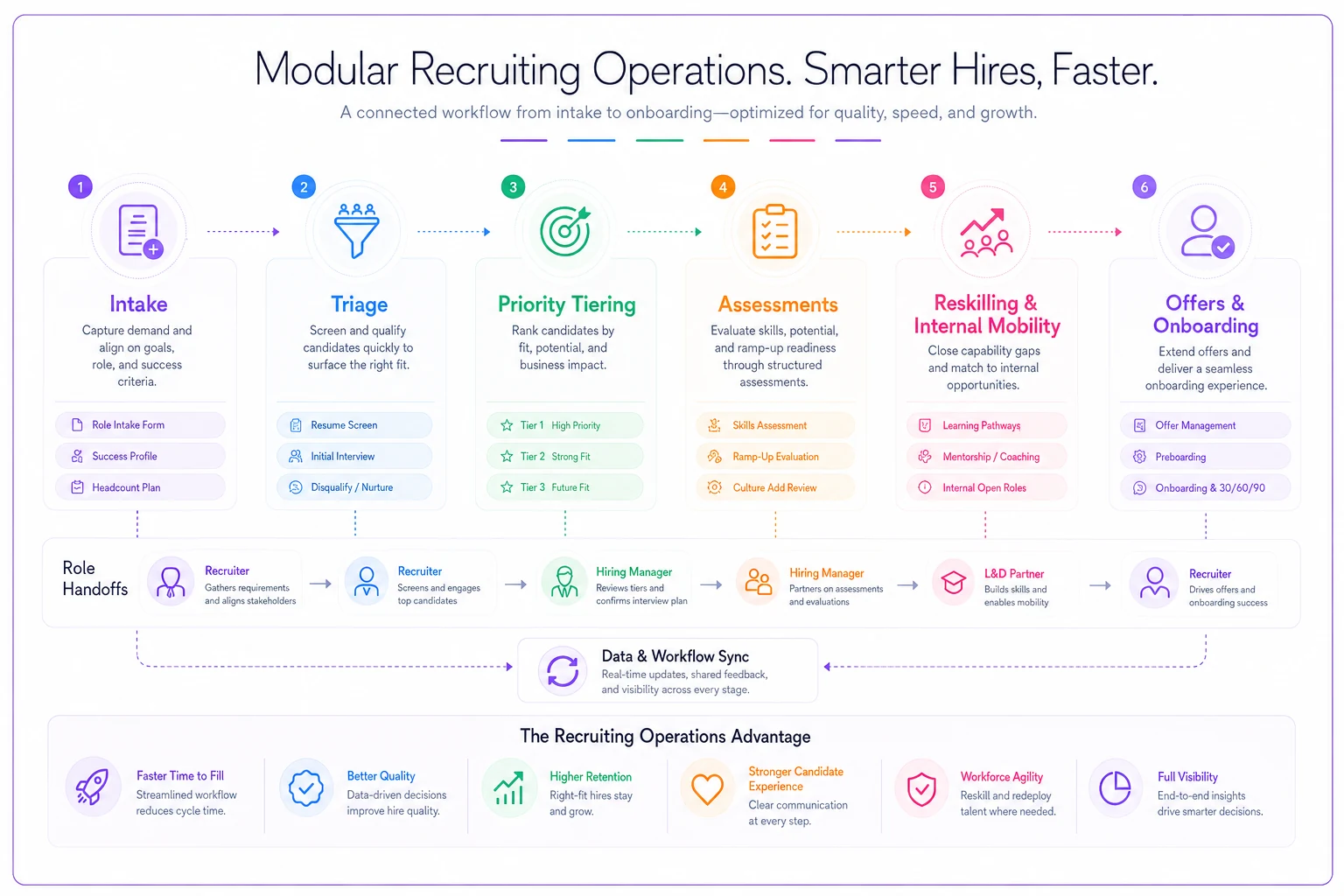
Create modular processes that scale up or down. Instead of fixed workflows, build components that can be assembled based on what a situation actually needs — quick screens for high volume, deep assessments for critical roles, ramp-up paths for career switchers. Document these so any team member can execute them, not just the two people who built them.
Here's a simple visualization of a modular recruiting operations workflow.
Invest in operational infrastructure even when it feels like overhead. Proper documentation, clear templates, and systematic processes pay off massively when things get chaotic. The teams struggling most right now are the ones that relied on tribal knowledge and informal processes that never scaled.
Modular playbooks saved as templates make it easy to spin up the exact combination of screens and assessments needed for different volume or priority scenarios.
Build playbooks for those scenarios before you need them.
The Path Forward
AI-driven layoffs in tech are forcing overdue modernization of recruiting operations. Teams that adapt quickly will build advantages that outlast the current disruption.
This isn't a temporary spike to weather — it's a fundamental shift in how technical talent markets operate. Skills will keep evolving fast. Volume spikes will become more common. Budget pressure isn't going anywhere. Traditional recruiting playbooks won't hold up.
Success requires operational systems built for complexity at scale: better assessment frameworks, dynamic prioritization, systematic communication workflows, and technology that actually connects previously siloed processes.
Most importantly, it requires shifting from reactive recruiting to strategic talent operations. Instead of just filling requisitions, recruiting teams need to understand market dynamics, model different scenarios, and help organizations navigate ongoing disruption — not just respond to it.
The teams that come out strongest won't necessarily have the biggest budgets or the best-known brands. They'll have the most capable operations — able to process high volumes efficiently, evaluate non-traditional candidates without defaulting to checkbox thinking, and adapt quickly as requirements shift. In a disrupted talent pool, that operational foundation is the real competitive advantage.
Ready to elevate your hiring process?
Join 1,500+ recruiting teams using Recioly to save time, improve collaboration, and hire smarter.