



Most offer negotiations don't collapse because the candidate wanted too much money. They collapse in the dead space between the counter and the yes — the three days a recruiter spends waiting on a Slack reply from a VP who's traveling, or the confusion over whether a 6% bump needs finance sign-off or just the hiring manager's nod.
That gap is where good candidates go cold and where recruiters end up freelancing decisions they were never authorized to make.
The fix isn't "negotiate better." It's building a decision matrix that tells a recruiter, the moment a counter lands, exactly three things: who needs to approve this, what to say while approval is pending, and what gets logged. If you can't answer those three questions in under a minute, you don't have an offer negotiation playbook — you have a series of improvised phone calls.
This piece walks through how to build that matrix so counter-offers route themselves, escalate when they stall, and leave a clean audit trail behind.
The real problem: counters arrive faster than your approval chain moves
Here's a pattern that shows up constantly. A recruiter extends an offer at $118k base. Candidate counters at $128k plus a signing bonus. The recruiter thinks the band tops out around $124k but isn't sure, so they say "let me check and get back to you." Then the checking begins.
The hiring manager says yes to $124k but wants leadership to bless the signing bonus. Leadership is in back-to-back meetings. Finance needs to confirm the bonus doesn't blow the quarterly comp budget. By the time everyone's aligned, four business days have passed and the candidate has a competing offer with a same-day yes attached to it.
-
Threshold ambiguity — the recruiter doesn't know if the ask is inside or outside the approved band, so they escalate everything "just to be safe."
-
Routing ambiguity — even when escalation is needed, it's unclear who owns the specific dimension being negotiated (base vs. bonus vs. equity vs. start date).
-
Silence ambiguity — an approver goes quiet and there's no rule for what happens next, so the request just… sits.
Fix those three and the whole thing speeds up dramatically.
Build the counter-offer decision matrix
The matrix is the heart of the playbook. It maps the size and type of a counter to a routing decision. The recruiter reads the counter, finds the row, and knows instantly what to do.
Never lose track of top talent again.
Recioly helps you manage every stage of recruiting efficiently, from application to offer.
- Centralized candidate tracking
- Automated interview scheduling
- Collaborative hiring workflows
No credit card required
Below is a version that works for most mid-market TA teams. Adjust the thresholds to your actual bands.
| Counter delta (above original offer) | Component | Who approves | Target response time | Recruiter authority |
|---|---|---|---|---|
| Up to 3% base | Base salary | No approval — recruiter closes | Immediate | Full |
| 3–8% base | Base salary | Hiring manager | 4 business hours | Verbal soft-yes allowed |
| 8–15% base | Base salary | HM + comp partner | 1 business day | No commitment until sign-off |
| Over 15% base | Base salary | HM + comp + skip-level | 1 business day | No commitment; flag for band review |
| Any signing bonus ≤ $10k | Bonus | Hiring manager | 4 business hours | Verbal soft-yes allowed |
| Signing bonus > $10k | Bonus | Comp partner + finance | 1 business day | No commitment |
| Equity change | Equity | Comp partner | 1 business day | No commitment |
| Start date > 4 weeks out | Timeline | Hiring manager | 4 business hours | Full within reason |
Two things make this matrix actually useful, and they're the parts teams usually skip.
First, the "recruiter authority" column. A small counter — say a 2% base bump — shouldn't touch an approver at all. If your recruiters have to escalate a $2,400 raise on a $120k offer, you've built a bottleneck by design. Give them a pre-approved wiggle band and most counters resolve on the spot.
Visual of how a counter maps to routing and escalation.
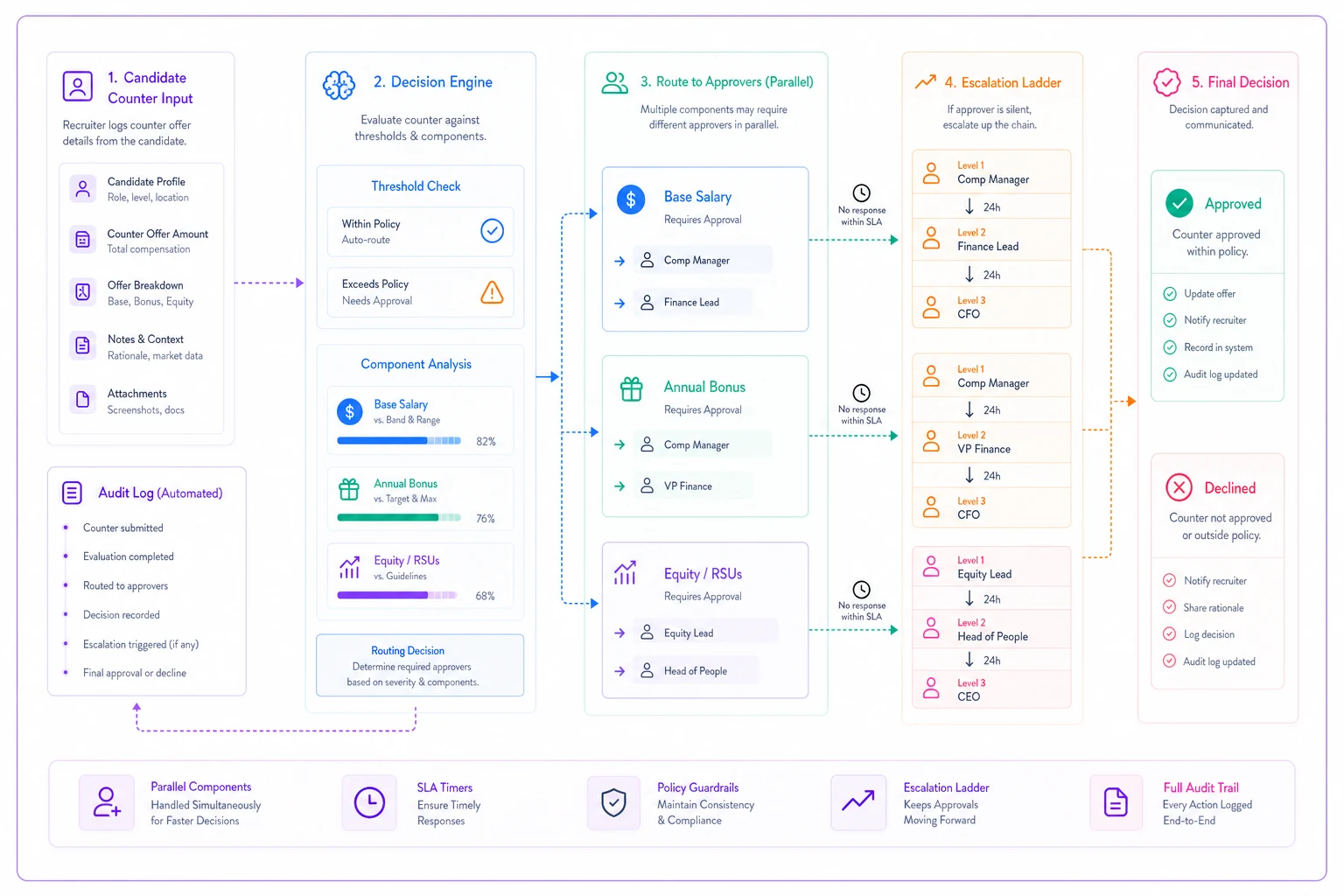
Second, the matrix separates components. A candidate rarely counters on one dimension. They'll ask for more base and a signing bonus and an earlier start. Each of those may route to a different approver with a different clock. Treat the counter as one blob and you wait for the slowest approver on the fastest item. Split them and the base can close while the bonus is still being reviewed.
This matrix pairs well with a broader offer approval workflow for compensation gates — the pre-approvals and routing logic there define your bands upfront, which is exactly what lets counter-offer thresholds resolve without a fresh budget conversation every single time.
Templated negotiation scripts that buy time without lying
The single most damaging thing a recruiter can say during a counter is "let me check and get back to you" with no follow-up structure. It signals uncertainty, sets no expectation, and leaves the candidate free to keep interviewing elsewhere.
Templated scripts give recruiters honest, specific language for each matrix scenario. They're not manipulation — they're just knowing what to say so the pause feels intentional instead of shaky.
When the counter is inside recruiter authority (auto-approve):
> "That works. I can move your base to $121k — let me send the updated offer letter today and we can get this signed by end of week."
No wait, no escalation, no cooling off. This is why the pre-approved band matters.
When the counter needs approval but you can soft-commit:
> "I hear you on the $126k. That's within range I can advocate for, but I want to confirm it with the hiring manager before I put it in writing. I'll have a firm answer to you by tomorrow afternoon — is that timeline okay on your end?"
That does two jobs: it sets a concrete deadline you control, and quietly checks whether they're under time pressure from a competing offer. If they say "I need to know by 5pm today," you've just learned to escalate hard.
When the counter is well outside band:
> "I appreciate you being direct about the $140k. I want to be straight with you — that's above where this role is currently scoped, so I need to have a real conversation internally rather than give you a quick no or a false yes. Can I take 24 hours and come back with either a revised number or a clear explanation?"
This buys legitimate time while preserving trust. Candidates respect a recruiter who won't fake-promise more than they'll respect a fast, disappointing no.
The point of scripting isn't robotic delivery. It's that a recruiter under pressure — who just got hit with a number they didn't expect — has a landing pad instead of ad-libbing something that commits the company to a figure it can't honor.
Auto-escalation: what happens when an approver goes silent
This is the piece almost everyone forgets, and it's where the most offer time bleeds out.
You've routed a 10% counter to the hiring manager and comp partner. But what happens when the hiring manager doesn't respond for a day and a half? Without an escalation rule, the recruiter either nags (awkward, inconsistent) or waits (deadly). Neither is a system.
-
Hour 0 — counter routed to primary approver with the deadline attached.
-
At 75% of target response time — a reminder fires to the primary approver, cc'ing the recruiter, with the words "this offer closes in X hours."
-
At 100% — the request auto-escalates to the approver's backup or manager, and the recruiter is notified that authority has moved up a level.
-
At 150% — it hits the TA lead or director, flagged as an at-risk offer requiring a same-day decision.
This works because it converts a vague social pressure ("should I bug the VP again?") into an impersonal, predefined process. Nobody feels nagged because the system escalated, not the recruiter. And approvers respond faster when they know silence automatically bumps the decision to their boss.
One pattern worth calling out: the biggest escalation delays almost always happen on the second approver, not the first. The hiring manager responds quickly because it's their hire. The comp partner or finance person, who's juggling a dozen reqs at once, is the one who goes dark. Set tighter escalation clocks on the downstream approvers accordingly.
The audit-trail checklist recruiters follow during negotiation
Speed without a paper trail creates a different problem — comp inequity you can't defend and decisions nobody can reconstruct three months later. Every counter-offer that moves a number should leave the same footprint.
-
[ ] Original offer captured — base, bonus, equity, start date, and the approved band it fell within.
-
[ ] Counter logged verbatim — what the candidate actually asked for, on which components, and any stated reason ("competing offer at $130k").
-
[ ] Matrix row identified — which threshold row the counter triggered and the routing it required.
-
[ ] Approver decisions timestamped — who approved what, when, and any conditions attached ("bonus approved contingent on 30-day start").
-
[ ] Escalations recorded — if the counter auto-escalated, note when and to whom.
-
[ ] Final terms + delta from original — the closed numbers and the total dollar movement from the first offer.
-
[ ] Rationale for anything outside band — if you went above the range, one or two sentences on why (scarce skill, retained counter, internal equity check completed).
That last item is what auditors and comp reviews care about most. When a candidate lands 12% above band, "the recruiter felt pressure" is not a defensible reason. "Skill in short supply, two prior candidates declined, approved by skip-level after equity check" is.
This checklist also protects the recruiter. When someone asks six weeks later why this hire came in higher than a peer, the answer isn't a memory exercise — it's a record.
A real scenario: how the matrix changed a stalled pipeline
A roughly 40-person software company was losing around one in four final-stage candidates at the offer stage. Their own recruiters admitted most losses came from slow counter responses rather than the money itself. Average time from counter to final answer was somewhere around five to six business days. In a market where competitors were closing in 48 hours, that gap alone was killing offers.
They didn't change their comp bands. They built the decision matrix, gave recruiters a 3% pre-approved wiggle band, and set auto-escalation clocks on their comp partner — who turned out to be the consistent bottleneck, which surprised no one once they looked at the timestamps.
Within about two months, counter-to-answer time dropped to roughly a day and a half. Offer acceptance climbed noticeably. The interesting part: the amount they paid out in counters barely moved. Faster answers didn't cost them more money. They just stopped hemorrhaging candidates to nothing more than delay.
Most teams assume winning counter-offers means paying more. Often it just means answering faster.
When this level of structure makes sense — and when it doesn't
This matrix is worth building if you're extending more than a handful of offers a month, if multiple people touch comp approval, or if you've lost candidates to slow responses in the last quarter. The overhead of setting it up pays back the first time a $125k candidate closes in a day instead of a week.
When it's overkill: if you're a tiny team extending two or three offers a quarter and the founder approves everything in the same room, a formal routing matrix adds ceremony you don't need. A shared doc with your bands and a simple "text me" rule is enough.
Who should be cautious: teams that build the matrix but skip the audit trail. A decision matrix without logging just moves the improvisation upstream — you'll route faster but still can't defend your comp decisions. If you're only going to build one half, build the audit half. Speed you'll feel immediately; defensibility you'll only miss when it's too late.
Where automation quietly earns its keep
You can run all of this on spreadsheets and calendar reminders, and plenty of small teams do. It works until volume climbs and the manual escalation reminders start slipping — someone forgets to nudge the comp partner, an offer sits an extra day, and you're back to losing candidates to silence.
That's the point where an operational platform with rule-based routing starts paying off. When the thresholds, approver assignments, and escalation clocks live inside a workflow tool rather than a recruiter's head, the routing and reminders fire on their own. The recruiter reads the counter, the system finds the matrix row, the right approver gets pinged, and the escalation ladder runs without anyone babysitting it. The audit trail builds itself as a byproduct instead of being reconstructed after the fact.
The value isn't automation for its own sake — it's that the discipline holds under volume. A matrix you have to manually enforce degrades the exact week you need it most. One that enforces itself doesn't.
Counter-offers don't sink because candidates are greedy. They sink in the coordination gap — ambiguity about who approves what, improvised scripts under pressure, and silence when an approver disappears.
Build the decision matrix so every counter routes itself. Give recruiters a small pre-approved band and honest scripts so they're never stalling blind. Set escalation clocks so silence triggers action instead of delay. Run the audit checklist as you go, not after, so the fast decisions stay defensible.
Do that, and the negotiation stops being a series of nervous phone calls and becomes something your recruiters can actually run — quickly, consistently, and with a record they can stand behind.
Ready to elevate your hiring process?
Join 1,500+ recruiting teams using Recioly to save time, improve collaboration, and hire smarter.