
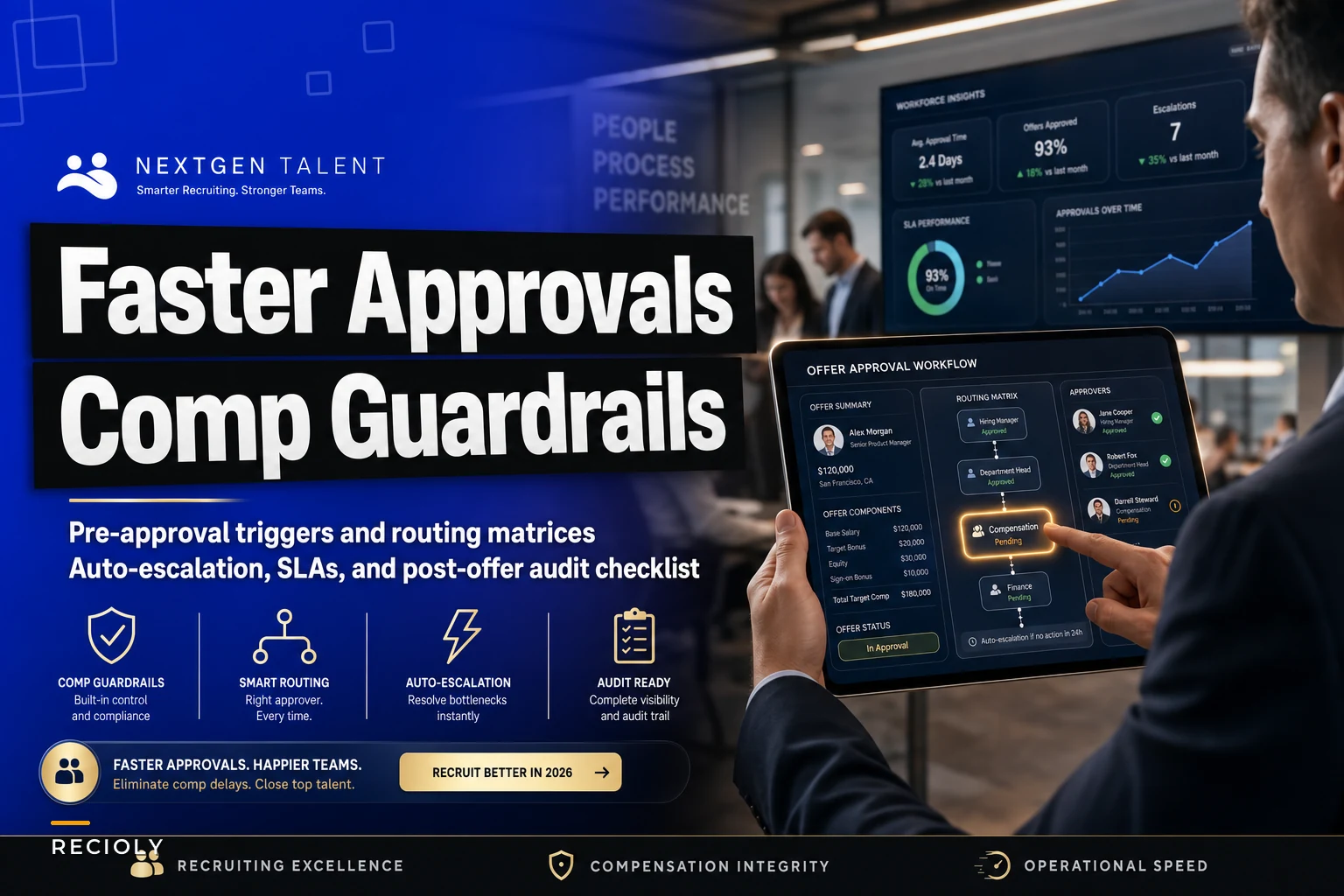

Three weeks ago a tech recruiter friend texted me at 11pm. They'd lost another senior engineer to a competitor — not because of comp or role fit, but because their offer sat in approval limbo for eight days while the candidate had a 72-hour exploding offer from another company.
This happens constantly. You find the right candidate, negotiate comp, get verbal acceptance, then watch everything fall apart because your approval process moves at the speed of government bureaucracy. The candidate gets nervous. Other companies swoop in. The hiring manager starts panicking. And by the time legal and finance finally approve that extra $8k in base, your candidate has already signed elsewhere.
The real problem isn't that approvals take time — it's that most companies build their offer approval workflow backwards. They design for the most complex scenario (executive hires needing board sign-off), then force every single offer through that same process. A junior analyst ends up needing the same five signatures as a VP of Engineering.
Why traditional approval chains create artificial bottlenecks
Most recruiting teams inherit an offer approval workflow that looks reasonable on paper. Recruiter creates offer → manager approves → HR reviews → compensation team validates → finance signs off → legal checks → executive approves. Seven steps, maybe 2-3 days if everyone's responsive.
Except that's never how it actually works.
The comp team is buried during quarterly planning. Your VP of Finance is traveling for a board meeting. Legal has questions about the equity vesting schedule. The hiring manager forgot to check their queue. Meanwhile, your candidate just got called by a recruiter offering 20% more with a one-week deadline.
What makes this worse is that probably 80% of your offers fall within standard compensation bands. They don't actually need executive review. They don't need special finance approval. But because your system treats every offer the same, that junior designer role gets stuck behind three director-level approvals that are legitimately complex and slow for good reason.
The compensation gates themselves become the problem. Not because they're unnecessary — you absolutely need controls around comp — but because they're applied uniformly regardless of context. A $65k analyst role in Dallas shouldn't route through the same chain as a $400k principal engineer in San Francisco.
Building pre-approval triggers that actually speed up offers
What works: pre-approved compensation zones based on role level, location, and experience band.
Never lose track of top talent again.
Recioly helps you manage every stage of recruiting efficiently, from application to offer.
- Centralized candidate tracking
- Automated interview scheduling
- Collaborative hiring workflows
No credit card required
Start with your existing compensation philosophy. Most companies already have salary bands for each level. L3 engineers in Seattle might range from $140k to $180k base. L5 product managers in Austin might range from $165k to $210k. These aren't secrets — they're documented ranges that compensation teams have already validated.
Now create pre-approval triggers within those bands. Any offer that falls within roughly 80% of the range gets automatic approval from comp and finance. No waiting, no escalation. The recruiter can move straight to generating the offer letter.
For example:
-
L3 Software Engineer, Seattle
$140k–$180k band
-
Pre-approved zone
$140k–$165k (roughly 80% of range)
-
Offers in this zone
Skip comp review, skip finance approval
-
Offers above $165k
Standard comp review required
This immediately cuts approval delays for your most common offers. That junior analyst at $67k? Pre-approved. The mid-level marketing manager at $95k? Pre-approved. Your approval queue shrinks significantly, almost overnight.
But pre-approvals need guardrails. You can't just let recruiters approve anything under a certain number. Build specific triggers:
Location-based adjustments: A $150k offer in San Francisco is a completely different thing from $150k in Phoenix. Your pre-approval zones should adjust automatically based on location multipliers.
Experience band requirements: That L3 engineer role might be pre-approved at $155k for someone with five years of experience, but require approval at the same salary for someone with two years.
Equity considerations: Base salary might be pre-approved, but equity grants above certain thresholds still need review. $160k base with standard equity might be automatic; $160k base with double equity needs escalation.
Tie pre-approval zones to live ATS market data so thresholds update automatically.
This immediately cuts approval delays for your most common offers. That junior analyst at $67k? Pre-approved. The mid-level marketing manager at $95k? Pre-approved. Your approval queue shrinks significantly, almost overnight.
Role-based compensation guardrails that prevent expensive mistakes
Pre-approvals speed things up, but guardrails prevent costly errors. Not every recruiter understands comp philosophy deeply. Not every hiring manager knows current market rates.
Build role-specific guardrails directly into your workflow:
Hard stops vs. soft warnings: Some violations should completely block an offer. Others should just flag for review. Offering 40% above band maximum? Hard stop. Offering 5% above the pre-approved zone? Soft warning with an optional override.
Cross-functional equity: Engineering and sales often have entirely different comp structures. A salesperson might have a 60/40 base/variable split while an engineer is 90/10. Your guardrails need to understand these differences. An account executive at 50% base might be normal. An engineer at 50% base is probably an error.
Title-level mismatches: Sometimes recruiters accidentally select the wrong level. Your guardrails should catch when someone tries to offer L5 compensation for an L3 role. Sounds obvious, but it happens more than you'd think — usually because of confusing internal job codes.
Real example from a 200-person startup: their recruiters kept making offers that finance rejected. Turned out, the ATS had salary bands from 2021. Recruiters thought they were within range, but compensation had adjusted bands upward by 15% for inflation. Every offer needed manual review because the system data was stale.
The fix: auto-sync compensation bands between your HRIS and ATS each quarter. Add a "last updated" flag that warns recruiters when bands are more than 90 days old. Build in automatic cost-of-living adjustments that update monthly.
The routing matrix that eliminates confusion about who approves what
Most approval confusion comes from ambiguous routing rules. "Senior roles need VP approval" — but what counts as senior? "High comp needs finance review" — but what's the threshold? "Special circumstances need legal" — but who decides what's special?
| Scenario | Level | Base Salary | Total Comp | Required Approvers | SLA |
|---|---|---|---|---|---|
| Standard Junior | L1–L2 | <$80k | <$100k | Manager only | 4 hours |
| Standard Mid | L3–L4 | $80–150k | $100–200k | Manager + HR | 8 hours |
| Standard Senior | L5–L6 | $150–250k | $200–400k | Manager + HR + Comp | 24 hours |
| Above-band Junior | L1–L2 | >$80k | >$100k | Manager + HR + Comp | 24 hours |
| Above-band Senior | L5–L6 | >$250k | >$400k | Manager + HR + Comp + VP | 48 hours |
| Executive | L7+ | Any | Any | CEO + Board Comp Committee | 72 hours |
| International | Any | Any | Any | Standard + Legal + Finance | 48 hours |
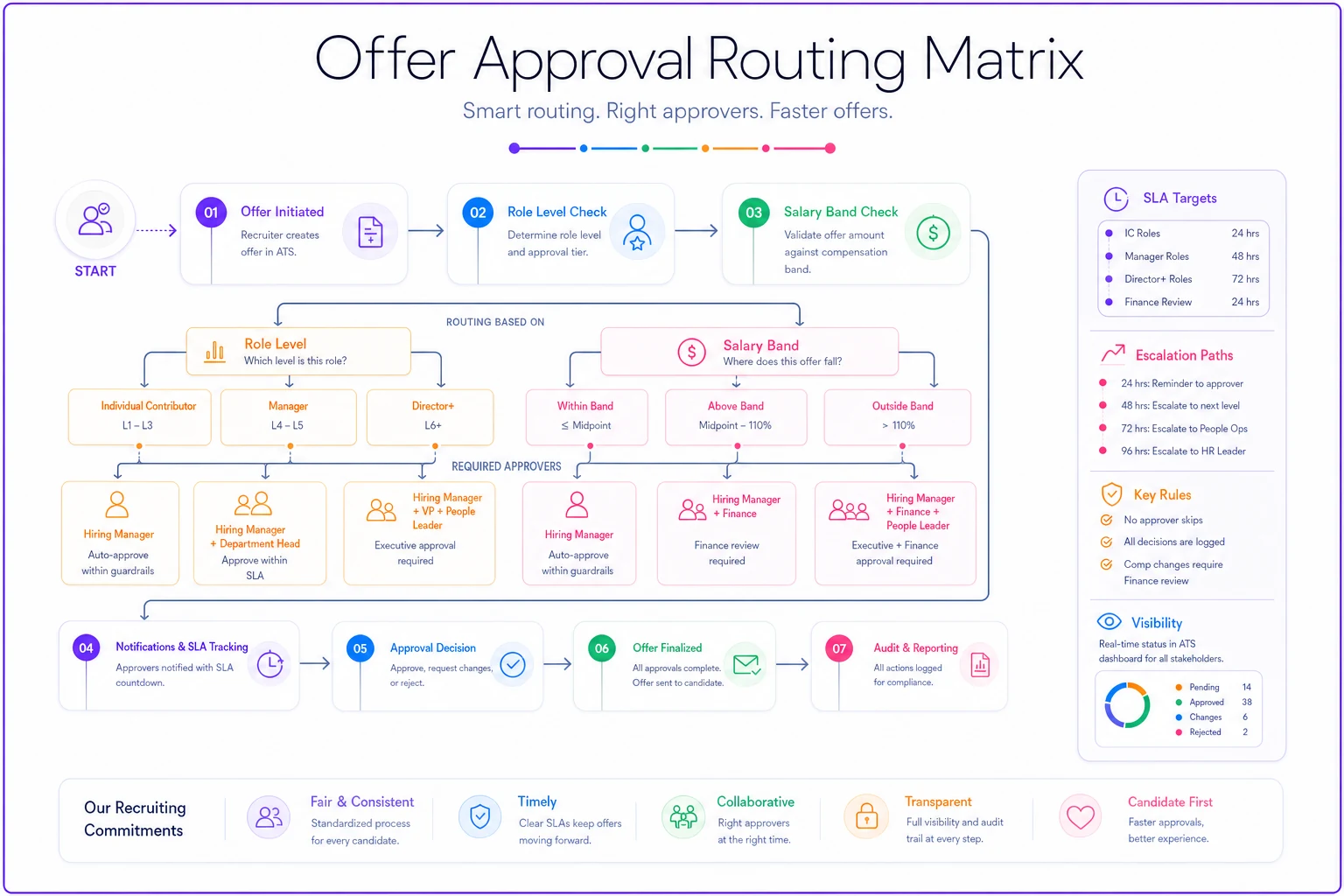
Notice the SLAs. Every approval tier has a deadline. Miss it? Automatic escalation.
Skip-level approvals: If the hiring manager is also the VP, don't route to them twice. The system should recognize the overlap and consolidate.
Out-of-office handling: When an approver is on PTO, automatically route to their backup. Don't let offers sit in someone's inbox while they're on a beach somewhere.
Parallel vs. sequential routing: Some approvals can happen at the same time (HR and Comp can review simultaneously). Others must be sequential (need comp approval before the VP even looks at it). Your matrix should specify which is which.
Auto-escalation rules that keep offers moving
Static approval chains fail because humans are unreliable. Even the most responsive executive occasionally misses a notification. That's why you need auto-escalation.
Simple version: if someone doesn't approve within their SLA, escalate to their manager.
Better version: smart escalation based on urgency and context.
Candidate-driven urgency: If a candidate has a competing offer deadline, flag the approval as urgent and cut SLAs in half. Normal 24-hour approval becomes 12. Miss it? Immediate escalation.
Cascading notifications: First ping at 50% of SLA. Second at 75%. Third at 90%. Escalation at 100%. Don't wait until the deadline to remind people.
Progressive escalation paths:
-
Hour 1–4
Original approver
-
Hour 4–8
Original approver + their backup
-
Hour 8–12
Skip-level manager
-
Hour 12+
VP of department
Weekend and holiday handling: Auto-escalate immediately if an approval lands on a weekend or company holiday. Don't let offers sit idle for three days because of a long weekend.
A marketing agency I worked with had a simple but effective rule: any offer pending more than 48 hours automatically copied the CEO on all communications. Not for approval — just visibility. Amazing how quickly people move when they know the CEO can see the timestamp.
Post-offer audit checklist with clear handoff points
Getting the offer approved is only half the battle. You need a clean handoff from recruiting to HR to onboarding. Most offer workflows fall apart here — the offer gets signed but nobody tells IT to order the laptop, nobody tells facilities about the desk, nobody tells payroll about the start date.
Immediate triggers (within 2 hours):
-
Send signed offer to HR for filing
-
Update ATS status to "Offer Accepted"
-
Notify hiring manager of acceptance
-
Trigger background check if not already started
-
Send welcome email to candidate
Day 1 triggers (within 24 hours):
-
Create employee record in HRIS
-
Submit new hire packet to payroll
-
Order equipment through IT
-
Reserve desk space/parking
-
Schedule Day 1 orientation
-
Assign onboarding buddy
Week 1 triggers (within 7 days):
-
Mail welcome package
-
Set up email and system accounts
-
Add to team meetings/calendars
-
Schedule first 1
1 with manager
-
Enroll in benefits orientation
Each item needs a clear owner and deadline. "Someone should probably tell IT" doesn't work. "IT Service Desk must receive equipment request within 24 hours of offer acceptance" does work.
The checklist should also be role-specific. Engineers need GitHub access and dev machines. Salespeople need CRM licenses and territory assignments. A generic 50-item checklist for everyone creates noise. Build checklists that adapt to the role.
Candidate communication SLAs that maintain momentum
Silence kills deals.
During the approval process:
-
Day 0
"We're excited to move forward with an offer. I'm working with our team on approvals and will have something to you by [specific date]."
-
Day 1
"Quick update — your offer is currently with [specific team]. Still on track for [deadline]."
-
Day 2
"We've cleared HR and comp review. Just waiting on final sign-off from [specific person]. Should have everything wrapped up by [time]."
-
Day 3+
"I know this is taking longer than expected. Here's exactly where we are…"
The key is specific updates, not generic holding patterns. "We're still working on it" creates anxiety. "Your offer is with our VP of Finance, who reviews Tuesday mornings — we'll have approval by Tuesday at noon" actually builds confidence.
After offer extended:
-
Every 48 hours until response
-
Acknowledge candidate questions within 2 hours
-
Provide written responses within 24 hours
After verbal acceptance:
-
Send written offer within 4 hours
-
If delayed, explain exactly why and when
After signed offer:
-
Confirmation within 1 hour
-
Welcome packet within 24 hours
-
Weekly check-ins until start date
Build these SLAs into your triage workflow. Just like you have SLAs for initial candidate response, you need them for offer communication — and they're even more critical here because you've already invested significant time and the candidate is actively making a decision.
Common routing mistakes that create unnecessary delays
Even with solid routing rules, teams make the same predictable mistakes:
The Friday afternoon trap: Recruiting teams love extending offers on Friday. Feels like ending the week on a high. Except now your approval chain has the entire weekend to lose momentum. That VP who needs to approve isn't checking email until Monday. Better to extend offers Tuesday through Thursday when you have maximum weekday coverage.
The committee bottleneck: Some companies require full hiring committee consensus for offers above certain levels. Sounds thorough. In practice, scheduling six executives for an approval meeting takes at least a week. Either use asynchronous approval workflows or set a clear rule: if quorum can't meet within 48 hours, the senior-most member approves unilaterally.
The perfect comp trap: Comp teams sometimes hold up offers trying to optimize the package — modeling out five equity scenarios, validating against market data one more time. Meanwhile, your candidate is getting antsy. Set a clear standard: if comp is within pre-approved bands, no additional modeling needed. Perfect is the enemy of done.
The surprise stakeholder: Nothing worse than getting through five approvals only to discover Legal needs to weigh in because the candidate has a non-compete. Or Finance needs to review because it's end of quarter. Map out every possible stakeholder upfront. Better to over-communicate at the start than discover surprise approvers at the last minute.
Using operational software to enforce approval discipline
Manual approval workflows always break down eventually. Someone forgets to click approve. Someone's out sick and nobody knows who their backup is. The tracking spreadsheet is three days stale.
This is where AI-powered operational software makes a real difference — not by replacing human judgment, but by enforcing the process discipline that humans consistently skip.
The software handles routing offers based on your matrix rules, triggering escalations when SLAs expire, sending scheduled candidate updates, maintaining audit logs for compliance, syncing compensation bands across systems, and tracking approval patterns to surface bottlenecks. More importantly, it prevents the manual errors that quietly kill deals. No more offers sitting unread in an inbox. No more forgetting to update the candidate. No more confusion about who's supposed to approve what.
A 400-person tech company reduced their average offer approval time from around six days to under two, just by automating their routing matrix. They didn't change their approval requirements — they just made sure the process actually followed their documented rules. The automation handles the routing, the reminders, the escalations, and the candidate communications. Their recruiting team focuses on selling the opportunity instead of chasing signatures.
The real measure: offer acceptance rate and time-to-decision
Your offer approval workflow succeeds or fails based on two metrics:
Offer acceptance rate: What percentage of extended offers get accepted? If this drops below 80%, your process is too slow. Candidates are accepting other offers while waiting for yours.
Time-to-decision: How long from "we want to hire this person" to "offer in the candidate's hands"? Every day beyond 48 hours chips away at your acceptance rate — roughly 10% per day, based on patterns I've seen across multiple recruiting teams. A five-day approval process means you're starting with maybe a 70% chance of acceptance, regardless of how strong the offer is.
Track these metrics by role level, department, approval path, and individual approver. When you identify bottlenecks, fix them. If your VP of Engineering consistently takes three days to approve, either change the routing or have a direct conversation about SLAs. If international offers always stall in legal, create pre-approved templates for your most common countries.
The goal isn't to eliminate approvals — it's to make them invisible to the candidate. They experience a smooth, fast, confident offer process while your backend handles all the complexity.
Your competition is making offers in 24 hours. If you're taking a week, you're not competing for top talent. Fix the approval workflow, and you'll see acceptance rates climb while time-to-fill drops. The operational discipline pays off immediately in better hires and fewer candidates lost to avoidable delays.
Ready to elevate your hiring process?
Join 1,500+ recruiting teams using Recioly to save time, improve collaboration, and hire smarter.