

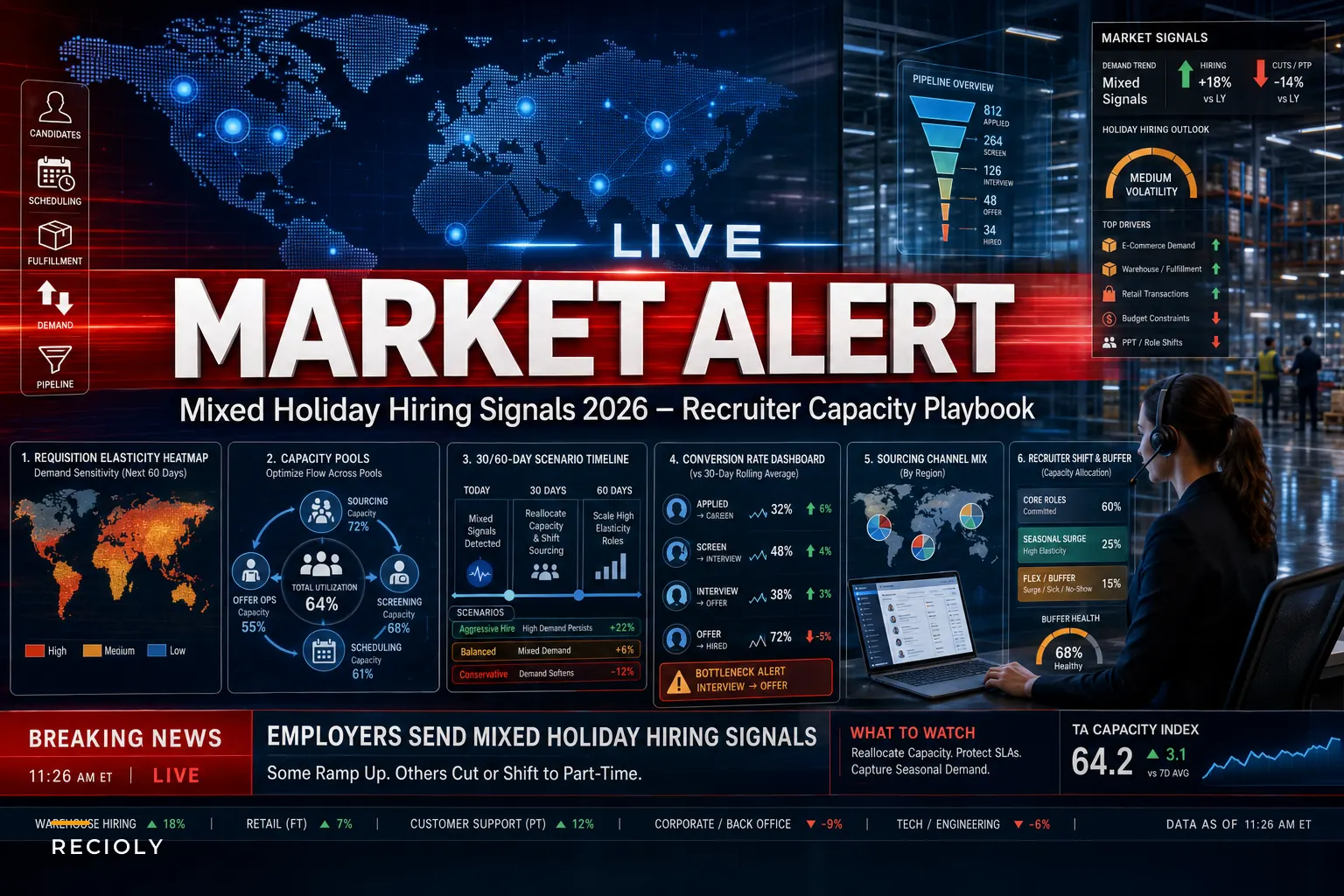

The headline numbers this season don't agree with each other, and that's the whole problem. Amazon is going after 300,000+ seasonal workers while UPS is trimming its seasonal headcount. According to a recent CNBC piece on the 2026 holiday hiring picture, labor experts are calling these "mixed signals" — some big employers scaling aggressively, others pulling back. Meanwhile, Indeed Hiring Lab reported that seasonal postings are up roughly 10%, with a clear tilt toward warehouse and fulfillment work and a surprising amount of part-time-to-permanent framing.
For anyone running TA ops, the mixed signal isn't just an interesting data point — it's an operational trap. Read the market as "hot" and you overstaff recruiting for retail-style volume that may never show. Read it as "cooling" and you're flat-footed when fulfillment reqs flood in with two-week fill expectations. Most teams will guess wrong on at least one role family. The real question is whether your plan can absorb being wrong without the whole pipeline locking up.
This post isn't about predicting the season. It's about building a capacity model that works regardless of which direction things actually break.
The real exposure: role-mix volatility, not volume
Everyone prepares for volume spikes. Volume is the easy variable — you add recruiters, add sourcers, extend hours. What actually breaks teams is role-mix shift, and that's exactly what this season is throwing at people.
A volume spike means more of the same work. A role-mix shift means the type of work changed, so your existing recruiter skills, sourcing channels, and screening steps are suddenly pointed at the wrong target. You can have plenty of raw capacity and still miss fill dates because that capacity is specialized in the wrong direction.
Picture this: a retailer's TA team built its seasonal muscle around store-associate hiring — walk-in applications, group interviews, fast in-person offers. Then corporate shifts the seasonal bet toward fulfillment centers. Now the same team needs high-volume warehouse sourcing, shift-based scheduling, background-screening throughput, and a candidate pool that behaves nothing like retail applicants. Recruiters are busy, reqs are open, and nothing closes on time because the shape of the work changed underneath them.
The mistake is treating recruiter capacity as a single number — "we can run 40 open reqs." In reality you have several distinct capacity pools, and they're not interchangeable:
| Capacity Pool | What It Handles | Breaks When… |
|---|---|---|
| High-volume sourcing | Warehouse, fulfillment, driver roles | Channel mix shifts away from job boards it's tuned for |
| Scheduling/coordination | Interview loops, shift assignments | Volume spikes faster than schedulers can absorb |
| Screening throughput | Background checks, basic quals | Role mix moves to roles with heavier compliance steps |
| Specialized recruiting | Supervisory, skilled seasonal | Demand shifts toward niche roles with thin pipelines |
| Offer/onboarding ops | Approvals, I-9s, start-date logistics | Rapid-hire roles need same-day turnaround |
When signals are mixed, you don't know which pool gets stressed. So you plan for all of them to flex — which means you need the model, not the guess.
Why mixed signals specifically wreck planning
A clear "up" or "down" season is actually manageable. You commit resources in one direction and ride it. Mixed signals remove that certainty, and uncertainty has a cost that most capacity plans never account for.
Never lose track of top talent again.
Recioly helps you manage every stage of recruiting efficiently, from application to offer.
- Centralized candidate tracking
- Automated interview scheduling
- Collaborative hiring workflows
No credit card required
The core issue is that most TA capacity forecasts assume a known demand shape. You take last year's seasonal numbers, adjust by the business forecast, and staff to it. That works when the forecast is confident. This year it's split — fulfillment leadership wants aggressive hiring, retail leadership is cautious, and the overall posting data shows a shift toward part-time and permanent conversions rather than pure temp volume.
What this exposes is that a lot of teams have never built a capacity model that handles branching demand. They've built models for one projection. When reality forks, the model has no answer, and the team defaults to reacting — which is the most expensive way to run a seasonal spike.
-
Over-commitment to the loud signal. One business unit announces big hiring, so TA pre-allocates recruiters there. Volume arrives slower than expected, and those recruiters sit on half-full pipelines while a quieter req family quietly misses its dates.
-
Sourcing channels tuned for last year's mix. The team keeps spending on channels that worked for retail roles, even as actual demand moves toward warehouse pools that live on different boards and respond to different outreach timing.
-
Scheduler capacity ignored until it's the bottleneck. Everyone forecasts recruiters. Almost nobody forecasts coordinators. When fulfillment volume hits, scheduling becomes the constraint and offers stall at the interview-logistics step.
When fulfillment volume hits, scheduling becomes the constraint and offers stall at the interview-logistics step.
Building a capacity model that survives being wrong
The goal isn't a perfect forecast. It's a model that degrades gracefully when demand breaks in an unexpected direction.
-
Split your demand into committed vs. conditional reqs. Committed reqs are confirmed — fulfillment center openings with signed-off headcount. Conditional reqs are the "if the season breaks hot" roles. Forecast capacity against committed demand first, and hold a labeled buffer for conditional demand rather than treating it as firm.
-
Map each req family to its specific capacity pool. Don't forecast "recruiter hours." Forecast sourcing hours, scheduling hours, screening throughput, and offer-ops throughput separately. This is where mixed signals get exposed early — you'll see which pool runs out first under each scenario.
-
Build two or three demand scenarios, not one. A fulfillment-heavy scenario, a balanced one, and maybe a softer-than-expected one. For each, calculate which capacity pool becomes the constraint. You're not predicting which scenario happens — you're pre-deciding how you'd reallocate.
-
Pre-assign cross-training moves. Identify which recruiters can shift from retail-style to high-volume fulfillment hiring with a day of ramp, and which can't. When the mix shifts, you move trained people instead of scrambling to hire more recruiters mid-season.
-
Set reallocation triggers, not reactions. Decide in advance
"If fulfillment conversion rate stays above X by week two while retail stays below Y, we move two recruiters over." Triggers turn a judgment call into an automatic move, which saves you the days of debate that usually kill seasonal fills.
This scenario-based approach builds on standard recruiter capacity forecasting with shift plans, buffers, and early-warning dashboards — the difference here is that you're forecasting multiple demand shapes and pre-wiring the switch between them.
Pro-tip: Tag conditional reqs in your ATS so they can be activated quickly without manual re-entry.
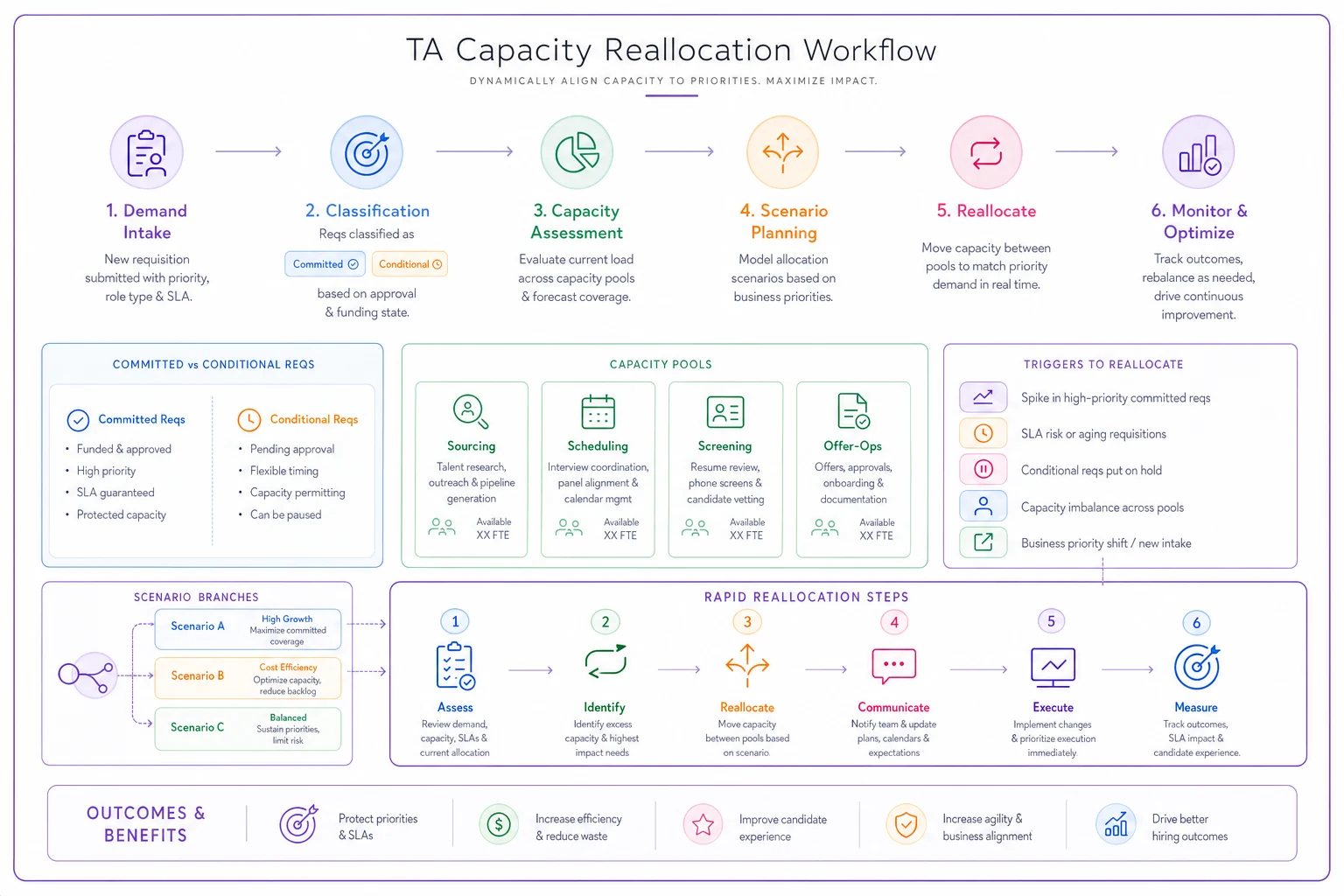
A simple visual like this helps teams move from debate to execution when the mix shifts.
The early-warning signals that tell you which way it's breaking
By the time your fill rate drops, you're already two weeks behind on a seasonal timeline. You need to detect the actual direction before it shows up in lagging metrics.
-
Application-to-screen velocity by role family. If fulfillment applications are coming in 2–3x the rate of retail, the mix is confirming itself early — reallocate before the offer stage clogs.
-
Source channel yield shifts. When the channels that drove retail hires go quiet while warehouse-focused boards spike, the mix is moving. That's not a random week.
-
Scheduler queue depth. If coordinators are sitting on a growing backlog of interview requests, scheduling is about to become your constraint regardless of recruiter capacity.
-
Offer-to-start drop-off on rapid-hire roles. Seasonal candidates ghost between offer and start at high rates. A rising drop-off tells you your onboarding ops can't keep pace with hire velocity.
-
Conditional req activation rate. How many of your "if hot" reqs are getting formally opened? This is your clearest read on which scenario you're actually in.
Teams that win mixed-signal seasons watch leading signals and act on triggers. Teams that struggle are still staring at fill rate, wondering why it's dropping.
A realistic scenario
A regional distribution-and-retail operator ran two seasonal lanes — store associates and warehouse pickers. Last season they staffed TA assuming a retail-heavy mix, roughly 60/40 in favor of stores. This year, corporate leaned hard into fulfillment, and the actual mix landed closer to 70/30 the other way.
Their original plan had five recruiters weighted toward retail sourcing and two coordinators handling all scheduling. Once warehouse reqs started flooding in, those two coordinators became the bottleneck inside about ten days — interview loops were booked out five or six days, and seasonal candidates were taking other offers while they waited.
The fix wasn't dramatic. They'd already identified two retail recruiters who could run high-volume fulfillment sourcing with minimal ramp, and they pulled one of them to help with scheduling during the peak weeks. Time-to-schedule dropped back under two days. They still missed a handful of early fill dates, but they recovered the season instead of losing it.
The lesson wasn't "they needed more people." They had the people. What saved them was having pre-decided the reallocation, so they could execute in two days instead of arguing about it for two weeks.
When aggressive seasonal ramping makes sense — and when it doesn't
Ramp aggressively when your committed reqs are confirmed with signed headcount, your channels for that role family are proven, and you have onboarding ops that can absorb fast starts. Confirmed demand plus proven throughput is the only combination that justifies going all-in early.
Be cautious when the demand is still conditional, the role mix is unfamiliar to your recruiters, or your scheduling and onboarding pools are already near capacity. Pouring sourcing effort into a pipeline that can't be scheduled or onboarded just creates a backlog that frustrates candidates and damages your employer brand.
Who should not over-index on seasonal volume at all: teams whose permanent-hiring pipeline is already behind. Seasonal spikes have a way of cannibalizing recruiter attention, and the Indeed data's shift toward part-time-to-permanent conversions means some of your best permanent candidates are sitting inside the seasonal pool. You don't want to lose them to a disorganized temp process.
Bottom line for the 2026 season
The mixed signals aren't a forecasting problem to solve — they're the actual condition you have to operate inside. The teams that handle this well won't be the ones who guessed the market correctly.
They'll be the ones whose capacity model split demand into committed vs. conditional, forecasted each capacity pool separately, and pre-wired reallocation triggers so a mid-season mix shift becomes a two-day move instead of a two-week crisis.
Build the model that survives being wrong, watch leading signals instead of lagging ones, and decide your reallocation moves before you need them. That's the difference between a season you recover and one you spend explaining.
Ready to elevate your hiring process?
Join 1,500+ recruiting teams using Recioly to save time, improve collaboration, and hire smarter.