


When a regional shock lands, the problem isn't that you lack a plan — it's that your existing plan assumed a stable baseline that no longer exists. A chip fab pauses expansion. A regional bank gets acquired and consolidates. A port strike freezes logistics hiring across three counties. Suddenly your req load, your time-to-fill assumptions, and your approval chain are all running on numbers that were true last quarter and useless today.
This playbook is narrow on purpose. It covers exactly three moves, in order: reforecast recruiter capacity after a regional economic shock, triage open roles so you stop treating every req as equal, and bolt on temporary offer/approval guardrails so you don't lose your critical hires while leadership figures out the budget. Everything else — employer brand, long-term workforce planning, DEI program design — waits. In the first 30 days, those are distractions.
If you've already read our breakdown on how to reforecast recruiter capacity after the June jobs slowdown, think of this as the regional-shock version: same discipline, tighter timeline, and a sharper focus on protecting the handful of roles that actually matter when hiring demand gets chaotic in both directions at once.
Why a regional shock breaks your capacity model specifically
National slowdowns are gradual. You see them in two or three weeks of softening metrics and you adjust. A regional shock is different because it hits your supply and your demand at the same time, usually in opposite directions.
Here's the pattern that trips teams up. When a large regional employer announces cuts, candidate supply spikes — applications per req can double or triple within ten days for roles that match the displaced workforce. At the exact same moment, your own leadership often freezes or slows internal hiring out of caution, so your req count drops or stalls. So you've got recruiters drowning in inbound volume for roles that may no longer be approved, while a few genuinely critical reqs sit unattended because the whole team is firefighting.
The second thing that breaks: your time-to-fill assumptions invert. Roles that used to take 60 days now get 400 applicants in a week, but screening capacity hasn't changed. A recruiter who could comfortably run 8 active reqs is now effectively running the inbound equivalent of 20 because every posting is a firehose. Capacity math built on "active reqs" becomes meaningless. You have to re-anchor on screening hours and decision throughput, not req count.
The third: approval authority gets murky. Nobody's sure who can sign off on an offer anymore. The VP who used to rubber-stamp things is now in daily budget meetings. Offers sit for a week waiting on approvals that used to take an hour, and your best candidates — who now have options because other employers are hunting the same displaced talent pool — walk.
Step 1: Reforecast recruiter capacity on hours, not reqs
Throw out req-count-based capacity for the duration of the shock. During a regional event, the only unit that holds up is recruiter hours allocated against decision-weighted work.
Never lose track of top talent again.
Recioly helps you manage every stage of recruiting efficiently, from application to offer.
- Centralized candidate tracking
- Automated interview scheduling
- Collaborative hiring workflows
No credit card required
Build the reforecast like this:
-
Pull actual hours per activity from the last two weeks, pre-shock. You want a baseline: how long does one phone screen take, one intake meeting, one offer workup, one sourcing hour? Most teams never measure this and guess wildly.
-
Recalculate inbound screening load using current application velocity. If a req now pulls 300 applicants where it used to pull 60, and your recruiters spend roughly 4 minutes on a first-pass resume review, that's 20 hours of screening on a single role that used to take 4. Multiply across live reqs.
-
Subtract fixed obligations. Intake meetings, debriefs, offer stage work, admin. These don't shrink during a shock — they often grow.
-
What's left is your true available sourcing and advancing capacity. It will be far smaller than you expect. That gap is your reforecast.
-
Convert the gap into a decision. Either you reduce inbound volume (tighter postings, knockout questions, closing reqs), add temporary screening help, or you explicitly accept slower throughput on lower-priority roles. There's no fourth option.
Log actual resume-screening time across a sample of recent reqs to ground your per-activity hours in reality, not guesswork.
A concrete example: a 4-recruiter team covering a mid-size manufacturer near a plant that announced around 1,200 layoffs. Pre-shock they handled roughly 30 active reqs without much strain. Post-shock, application volume per req jumped 3–4x. On paper they still had 30 reqs. In reality their screening backlog represented close to 120 hours of work a week against maybe 60 hours of available screening time. The reqs hadn't changed. The work had doubled. Nobody noticed for nine days because the dashboard still said "30 open."
The insight most teams miss: during a regional shock, your bottleneck moves from sourcing to screening and decisioning almost overnight. If you keep optimizing top-of-funnel, you make the problem worse. The whole game becomes reducing the number of decisions your team has to make, not increasing the number of candidates they see.
> Downloadable: Recruiter Capacity Calculator — inputs for application velocity, per-activity hours, fixed obligations, and a gap-to-decision output. Use it weekly during the shock window, not quarterly.
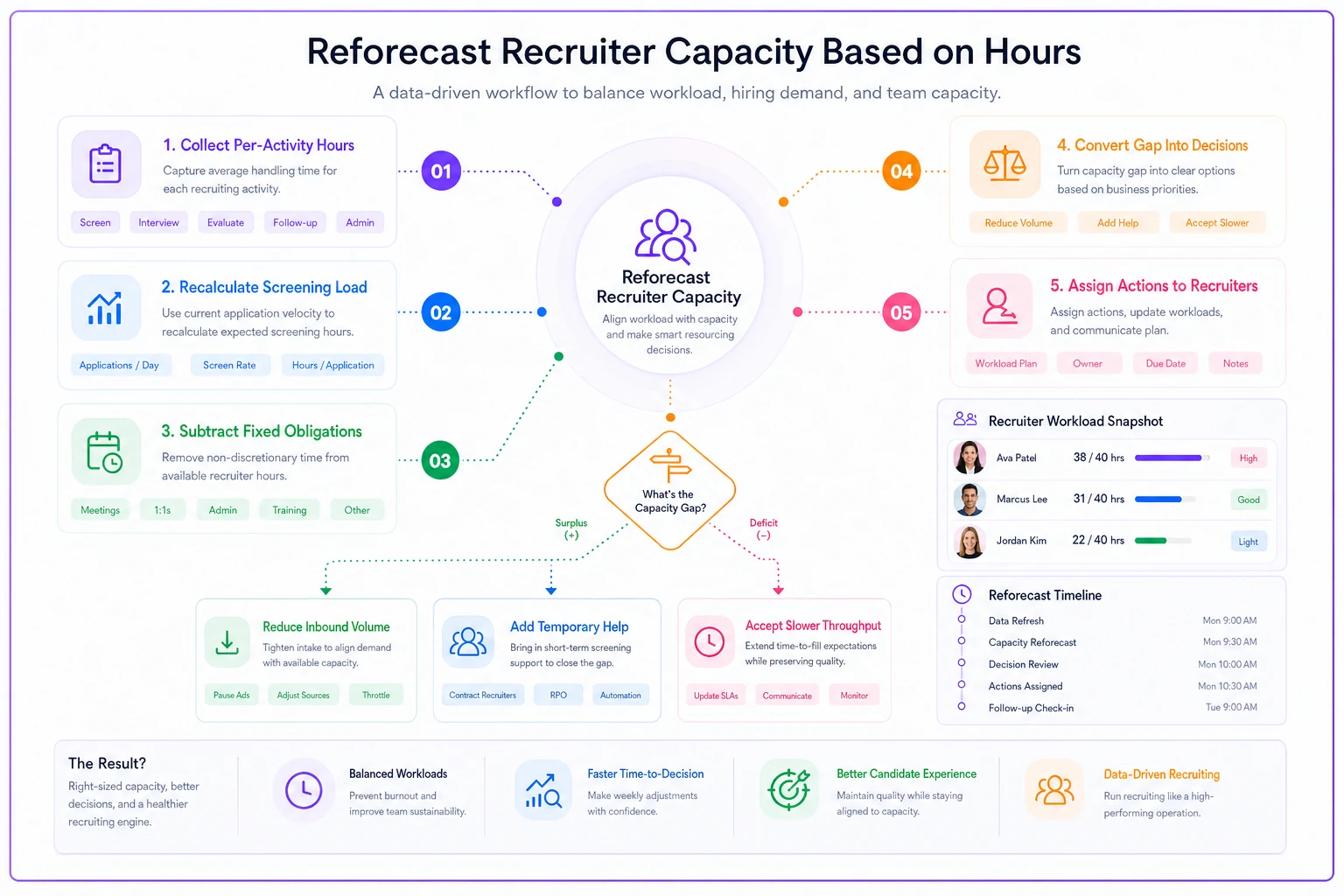
This visual shows the reforecast steps and decision points.
Step 2: Triage open roles with an impact / urgency / replaceability matrix
Not every req deserves attention during a shock, and the usual "critical vs. nice-to-have" label is too blunt. You need three independent axes, because a role can be high-impact but easily replaceable, or low-impact but genuinely urgent.
Impact — what breaks if this seat stays empty for 90 days? Revenue, compliance, a shipping deadline, a single-point-of-failure person leaving.
Urgency — is the clock external (a contract, a go-live, a visa window) or internal (someone wants it filled)? Externally-driven urgency is real. Internal preference is negotiable.
Replaceability — can this role be filled quickly from the current market, including newly-displaced talent? Ironically, some roles become more replaceable during a regional shock because the talent just hit the market. A role that was a 90-day search last month might be a 3-week search now.
Score each open req 1–3 on all three axes. Then prioritize using the combination, not the sum:
| Priority tier | Pattern | Action |
|---|---|---|
| Protect | High impact + high urgency (any replaceability) | Full capacity, guardrails ON, daily attention |
| Opportunistic | High impact + newly high replaceability | Accelerate — the talent is on the market now, grab it before competitors do |
| Hold | Low impact + low urgency | Pause or soft-close; stop screening inbound |
| Drain | Low impact + high inbound volume | Close the posting immediately — it's eating screening hours for no reason |
The counterintuitive move is the Opportunistic tier. Most teams, in a defensive crouch, freeze everything. But a regional shock dumps experienced, pre-vetted talent into your market for a short window. If you have a high-impact role that's suddenly easy to fill because a few hundred skilled people just became available, that's not the time to pause — that's the time to move faster than everyone else who's panicking. The window closes in weeks as those candidates get absorbed.
The most common triage mistake: teams score once, at the start, and never revisit. Replaceability changes weekly during a shock as the displaced pool gets hired away. Re-score every Monday.
> Downloadable: Role-Triage Worksheet — one row per req, three scored columns, auto-assigned tier, and a "last re-scored" date so nothing goes stale.
Step 3: Temporary offer and approval guardrails
This is the part teams skip, and it's the part that loses hires. During a shock, two failure modes run simultaneously: approvals slow down because leadership is cautious, and offers go out wrong because recruiters trying to move fast on opportunistic hires overshoot comp bands or skip steps.
Guardrails solve both. The word "temporary" matters — these are shock-duration rules with a defined sunset, not permanent process changes.
What to put in place for the duration:
-
A pre-approved comp ceiling per triage tier. Protect and Opportunistic roles get a standing band the recruiter can offer within, no sign-off needed. This removes the week-long approval delay that kills your best candidates. Anything above the band escalates.
-
A single named approver with a backup. During a shock, the usual approver is in meetings. Name one person and one backup who can approve offers within 4 business hours. Ambiguity about who signs causes most offer-stage delays mid-crisis.
-
A hard escalation threshold. Any offer for a Hold-tier role requires explicit director sign-off — because if someone's trying to fill a deprioritized role during a shock, leadership should know and confirm.
-
A 24-hour offer SLA for Protect and Opportunistic tiers. Verbal offer within 24 hours of final debrief. In a market flooded with displaced talent, your competitors are moving on the same people.
-
A freeze-and-exception log. If leadership freezes a category of hiring, you need a documented, fast exception path for genuinely critical roles — otherwise everything stops indiscriminately and you lose the one hire you couldn't afford to lose.
The guardrail that pays for itself fastest is the standing comp band tied to triage tier. A regional bank's TA team, mid-consolidation, lost two high-impact risk-and-compliance hires in a single month because offers sat eight and six days waiting on an approver consumed by the merger. After putting in a standing band and a named approver with a 4-hour turnaround, their offer-to-acceptance time on protected roles dropped from over a week to under two days. Same candidates, same budget — just a decision chain that could actually make a decision.
> Downloadable: Temporary Offer Approval Policy — a one-page template with tier-based comp bands, named-approver fields, SLA commitments, and a mandatory sunset date.
Communication: the part that prevents the chaos from spreading
A reforecast and a triage matrix are useless if hiring managers don't understand why their req just got moved to Hold, or why a role they didn't prioritize is suddenly being filled fast. Mid-shock, silence gets filled with anxiety, and anxious managers go around your process.
The hiring-manager script explains in plain terms: here's what the shock means for hiring, here's how we're triaging, here's which tier your role landed in and why, and here's what you can expect. The key move is giving managers a mechanism to contest the tier with evidence — "if you believe this role is higher-impact than we scored it, here's the one question to answer: what breaks in 90 days if it stays empty?" That single question kills most low-value escalations and surfaces the legitimate ones.
The recruiter script sets internal expectations: we're measuring capacity in hours now, not reqs; Hold-tier inbound is not getting screened and that's a deliberate decision, not a backlog you're failing to clear; here are your guardrails for moving fast on Protect and Opportunistic roles. Recruiters need explicit permission to not do work, or they'll burn out trying to screen a firehose they were never supposed to touch.
> Downloadable: Manager & Recruiter Communication Scripts — editable templates for the initial announcement, weekly tier updates, and the "your role moved tiers" conversation.
When this playbook makes sense — and when it doesn't
Run it when: a discrete regional event hits — a major employer layoff, a plant or facility closure, a sector-specific regulatory change, a local acquisition causing consolidation. The signature is a sudden shift in both candidate supply and internal hiring appetite within your geography.
Don't run the full version when: you're facing a slow national cooldown with no supply spike. That's a gentler reforecast — you don't need opportunistic acceleration or a flooded-pool strategy because the pool isn't flooding. The triage discipline still helps, but the guardrails can be lighter.
Who should skip the Opportunistic tier entirely: teams under a genuine, enforced hiring freeze with zero exception budget. If you truly cannot make any hire, don't tease the matrix with an acceleration lane you can't use — it just frustrates everyone. Stick to triage-to-pause and protect your sunset dates.
The 30-day operational checklist
Days 1–3 (Stabilize):
-
[ ] Pull pre-shock per-activity hour baselines
-
[ ] Run the capacity reforecast on current application velocity
-
[ ] Score every open req on the triage matrix
-
[ ] Close all Drain-tier postings immediately
-
[ ] Name the offer approver and backup
Days 4–10 (Guardrail + communicate):
-
[ ] Publish temporary offer/approval policy with tier-based comp bands and sunset date
-
[ ] Send hiring-manager and recruiter communication scripts
-
[ ] Stand up the freeze exception log
-
[ ] Set the 24-hour offer SLA for Protect/Opportunistic tiers
Days 11–30 (Operate + re-score):
-
[ ] Re-score the triage matrix every Monday
-
[ ] Re-run the capacity reforecast weekly
-
[ ] Review the exception log weekly with leadership
-
[ ] Confirm the policy sunset date is still right as the shock stabilizes
Daily and weekly KPIs with escalation thresholds
| Metric | Cadence | Escalate when |
|---|---|---|
| Screening backlog (hours) | Daily | Backlog exceeds available screening hours for 2+ days |
| Protect-tier offer SLA (time to verbal) | Daily | Any Protect offer exceeds 24 hours |
| Approval turnaround | Daily | Any approval exceeds 4 business hours |
| Application velocity per Protect req | Weekly | Velocity drops below pre-shock (pool is drying up — act now) |
| Capacity gap (hours needed vs. available) | Weekly | Gap exceeds 25% for 2 consecutive weeks |
| Opportunistic-tier fill rate | Weekly | Window closing — competitors absorbing the displaced pool |
The velocity-drop threshold is the one teams forget to watch. When application volume on your opportunistic roles starts falling back toward normal, that's your signal the displaced talent is getting hired elsewhere. That's not a time to relax — it's your last call to close the hires you flagged in week one.
Running this with tooling vs. spreadsheets
You can run every piece of this in spreadsheets, and plenty of teams do — the templates above are built to work that way. The friction shows up in the re-scoring. Pulling fresh application velocity, recalculating capacity gaps, and re-tiering reqs every Monday by hand is exactly the kind of manual work that gets skipped by week three, right when the shock is still live and the data is shifting fastest.
A workflow platform that can refresh application velocity, flag SLA breaches, and surface stale triage scores automatically earns its keep here — not as a replacement for judgment, but as a way to make sure the weekly discipline actually happens when your team is stretched thin. The decisions stay human. The reminders, the threshold alerts, and the "this req hasn't been re-scored in 9 days" nudges don't need to be.
Whatever you run it on, the point is the same: a regional shock punishes teams that keep using pre-shock assumptions. Re-anchor capacity on hours, triage on three axes instead of one, protect your critical offers with temporary guardrails, and re-score weekly until the shock settles. The teams that lose their best hires during a downturn usually aren't the ones without budget — they're the ones whose process couldn't move as fast as the market did.
Ready to elevate your hiring process?
Join 1,500+ recruiting teams using Recioly to save time, improve collaboration, and hire smarter.