



Boomerang hires are some of the cheapest, fastest, lowest-risk placements a recruiting team can make. Someone already knows the systems, already fit the culture, already has a manager who'd vouch for them. And yet most teams handle them badly — not because they don't want the rehires, but because their ATS treats a returning alum exactly like a cold applicant who came in off a job board.
That mismatch is where the damage starts. A returning senior engineer shows up in your sourcing reports as a "LinkedIn InMail conversion." A former marketing manager who reached out on her own gets attributed to an agency because a recruiter forgot to flag the record. Multiply that across a year and your channel ROI numbers are lying to you, your cost-per-hire is inflated in the wrong buckets, and nobody trusts the sourcing dashboard anymore.
This post is about the plumbing that fixes that: eligibility rules, ATS tagging and expiration logic, reseeding cadences, and attribution filters that keep your rehire alumni pipeline fast and keep it from polluting the metrics you use to make budget decisions.
Why the metrics break in the first place
The core problem is that a rehire is two things at once. It's a pipeline event (someone entered a req and got hired) and a relationship event (this person already existed in your world). Standard ATS attribution only understands the first one.
So when a former employee applies, the system grabs whatever source field is in front of it — the last touch, the referring URL, the recruiter's manual dropdown selection — and stamps it on the hire. If the alum clicked a paid ad on the way back, your paid channel just "converted" a hire it had nothing to do with earning.
-
Reactivation gets counted as acquisition. A dormant candidate record gets touched by a nurture email or a sourcer's re-outreach, and the reactivation is scored as brand-new sourcing.
-
Duplicate records fragment history. The alum applies with a personal email this time instead of their old work address, creates a fresh candidate profile, and their entire prior tenure and interview history is invisible to the recruiter.
-
Manual source fields get fudged. Recruiters know the "real" source was "she used to work here," but the dropdown doesn't have that option, so they pick something plausible and move on.
None of these are exotic. They're the default behavior of almost every configuration until someone deliberately builds rules to stop it.
The eligibility matrix comes first (before any tracking)
Before you worry about attribution, you need to answer a blunt question: who is even allowed to be rehired, and on what terms? Skip this and recruiters make ad-hoc calls, hiring managers lobby for favorites, and legal finds out later that you rehired someone who left under a settlement.
Never lose track of top talent again.
Recioly helps you manage every stage of recruiting efficiently, from application to offer.
- Centralized candidate tracking
- Automated interview scheduling
- Collaborative hiring workflows
No credit card required
| Departure reason | Rehire eligible? | Cooling-off period | Approval required |
|---|---|---|---|
| Voluntary — better opportunity | Yes | None | Recruiter + hiring manager |
| Voluntary — relocation / life event | Yes | None | Recruiter |
| Reduction in force / layoff | Yes, priority | None | Recruiter (fast-track) |
| Performance-managed exit | Case-by-case | 12 months | HRBP + skip-level |
| Terminated for policy violation | No | N/A | — |
| Left during PIP, before completion | Case-by-case | 6–12 months | HRBP |
| Retired | Yes | Varies by plan | Recruiter + benefits check |
The exact rows will differ by company, but two things matter more than the specifics. First, layoff alumni should almost always be on a priority path, not a neutral one — they left through no fault of their own and they're your highest-yield pool. Second, the "case-by-case" rows need a named owner, because "case-by-case" with no owner just means whoever argues loudest wins.
One quiet failure mode worth naming: teams build the matrix, then bury it in a wiki nobody reads. It needs to live where the rehire decision actually happens — inside the ATS record or the intake step — or it won't get used.
ATS tagging and expiration rules
Once eligibility is settled, tagging is what makes rehires findable and measurable. The mistake most teams make is treating tags as static labels. A tag like alumni that never expires becomes useless within eighteen months, because half those people have moved on, gone stale, or become ineligible.
Good tagging has three layers:
-
Identity tags — permanent facts.
former-employee,prior-req-[id],original-hire-date. These never expire because they're historical truth. -
Status tags — current state, with expiration.
rehire-eligible,alumni-active,nurture-hold. These need a review date attached or they rot. -
Attribution tags — the ones that protect your metrics.
boomerang-source,reactivation,alumni-referral. More on these below.
The expiration logic is where discipline pays off. A reasonable default: rehire-eligible gets re-validated every 12 months against the eligibility matrix, and alumni-active expires after 9–12 months of no contact and drops to alumni-dormant. Dormant isn't dead — it just changes how the record is treated in reporting and outreach.
A typical example of why this matters: a company tagged around 400 alumni as "active pipeline" during a growth year, never expired the tags, and two years later the sourcing team was reporting a 400-person warm pool to leadership. When someone finally ran outreach against it, maybe 60 were still reachable and interested. The pipeline was mostly a ghost, and every capacity plan built on that number was wrong.
Reseeding cadence: keeping the pool warm without spamming it
Reseeding is the deliberate schedule for re-touching alumni so the pool stays real. Do it too rarely and eligibility data goes stale. Do it too often and you annoy people into unsubscribing — which is a genuinely expensive mistake because alumni goodwill doesn't regenerate quickly.
-
30 days post-departure — a clean, no-ask goodbye touch. Confirm preferred personal contact info. This single step prevents most of the duplicate-record problem later.
-
Quarter 1 after exit — light company update, no role pitch. Maintaining warmth, not selling.
-
Every 6 months — a genuinely relevant touch
a role that fits their profile, a team update, or an alumni event. Relevance is the whole game here.
-
Trigger-based reseed — when a req opens that matches an alum's prior role family, the record surfaces automatically for the recruiter to evaluate. This is the one that actually converts.
-
Annual eligibility re-validation — quietly re-check the matrix status and refresh or expire status tags.
Prioritize trigger-based reseeds over calendar-based touches because they consistently drive higher conversion from alumni.
The pattern that separates good alumni programs from decorative ones: the trigger-based reseed matters far more than the calendar-based one. Sending a newsletter every quarter feels productive but converts almost nothing. Pinging a former backend engineer the week a backend req opens converts at a rate cold sourcing can't touch. When deciding where to spend recruiter attention, the same capacity logic applies here as anywhere else — worth reading alongside recruiter capacity forecasting to keep pipelines steady, because reseeding is real recruiter work that needs to be budgeted as such, not treated as a free background task.
Attribution filters: the part that actually protects your data
This is the section most teams skip, and it's the one that decides whether your sourcing metrics survive.
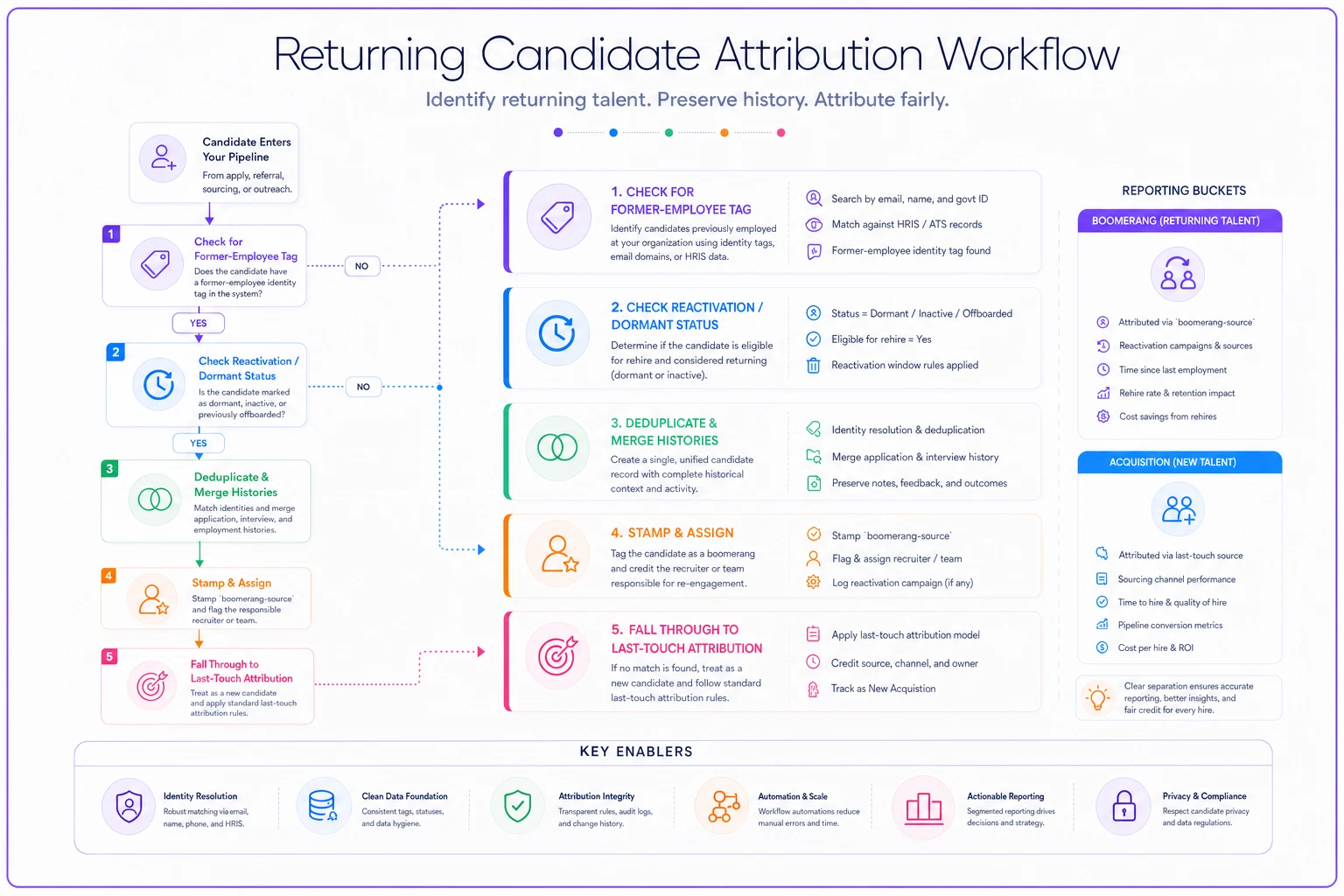
The rule is simple to state and annoying to enforce: rehires and alumni reactivations must be excluded from net-new sourcing metrics and reported in their own category. They don't count as agency wins. They don't count as paid conversions. They don't count as inbound. They are their own channel — boomerang or alumni, full stop.
-
Check for
former-employeeidentity tag first. If it's present, source resolves toboomerangregardless of last-touch, click path, or referral. Prior tenure overrides everything. -
Check for reactivation next. If the record existed before this req and was dormant, tag
reactivationand route it to the alumni/nurture channel — not to whatever email or ad touched it last. -
Only then fall through to normal last-touch attribution for genuinely new candidates.
In plain terms, a workflow that holds up looks like this: when a candidate enters a req, the system checks whether a matching record already exists (by name, personal email, phone, or prior employee ID). If it finds a former employee, it merges the histories, stamps boomerang-source, and flags the recruiter that this is a rehire so nobody manually overrides the source field. The rehire still flows through the req normally — same interviews, same scorecards — but in every report it lives in the boomerang bucket, separated from your acquisition spend.
Here's a quick visual of that order of operations.
This is also where deduplication becomes non-negotiable. If your matching is weak and the alum's new personal email creates a fresh record, none of the above fires and you're back to square one. The merge logic is the load-bearing wall of the whole system.
A quick checklist for auditing your current setup
Run through this against your live ATS, not your documentation. The gap between the two is usually the problem.
-
[ ] Do former employees create a merged record, or a duplicate?
-
[ ] Is there a
former-employeeidentity tag that persists permanently? -
[ ] Do status tags like
rehire-eligiblehave expiration or review dates? -
[ ] Does source attribution check for prior tenure before last-touch?
-
[ ] Are boomerangs excluded from paid, agency, and inbound conversion counts?
-
[ ] Is there a dedicated
boomerang/alumnichannel in your sourcing reports? -
[ ] Does the eligibility matrix have a named owner for case-by-case rows?
-
[ ] Can recruiters see prior tenure and interview history at a glance on the record?
-
[ ] Is reseeding scheduled and trigger-based, or just a quarterly newsletter?
If you can't check off the attribution items, your sourcing ROI numbers are currently telling you a story that isn't true — and you may be about to pour more budget into a channel that doesn't deserve it.
When this level of rigor makes sense — and when it doesn't
You don't need all of this on day one. If you hire fifteen people a year and rehire one, a spreadsheet and a manual note is fine. The overhead of expiration logic and attribution filters would cost more than the mess it prevents.
-
You're rehiring often enough that boomerangs are a real percentage of annual hires — north of 5–8%.
-
You've been through a layoff and have a large, warm, high-quality alumni pool you actually intend to re-engage.
-
Leadership uses sourcing ROI to allocate budget, so polluted channel data has real financial consequences.
It's a bad idea when your ATS can't reliably deduplicate. Building attribution rules on top of a system that spawns duplicate records just gives you confidently wrong reports instead of obviously messy ones. Fix the matching first.
And it's genuinely overkill for very small teams with informal hiring — the governance overhead will slow you down more than the metric pollution ever hurt you.
A short real scenario
A mid-size software company — around 600 employees, hiring roughly 120 roles a year — went through a reorg and lost a chunk of good people, many to the usual "better title elsewhere" reasons. Over the next year they rehired about 14 of them.
The problem surfaced in the budget review. Their paid sourcing channel was showing an unusually strong cost-per-hire, and finance wanted to double the spend. When someone finally dug in, nearly half those "paid" hires were boomerangs who happened to click a retargeting ad on their way back to a company they already knew. Paid had earned almost none of that credit.
After they rebuilt the attribution logic — identity tag first, boomerangs in their own bucket, dedup on personal email — the picture changed. Paid's real cost-per-hire was noticeably higher than it had looked, the boomerang channel showed up as by far the cheapest and fastest path (time-to-fill on rehires was running roughly half their average), and the budget conversation flipped entirely. Instead of doubling paid, they funded a proper alumni reseeding cadence. The following year, boomerangs quietly became one of their most efficient sources — and this time the dashboard actually said so.
The takeaway
Boomerang hiring isn't hard because the candidates are hard. It's hard because your systems weren't built to understand someone who's both new to the req and old to the company at the same time. Get the eligibility matrix down so decisions are consistent, tag with expiration so the pool stays real, reseed on triggers instead of just calendars, and — most importantly — filter attribution so returning employees never get counted as sourcing wins they didn't earn.
Do that, and you get the best of both: fast, cheap, high-fit rehires and clean metrics you can actually make budget decisions with. The two aren't in tension. They just require the plumbing to be built on purpose.
Ready to elevate your hiring process?
Join 1,500+ recruiting teams using Recioly to save time, improve collaboration, and hire smarter.