

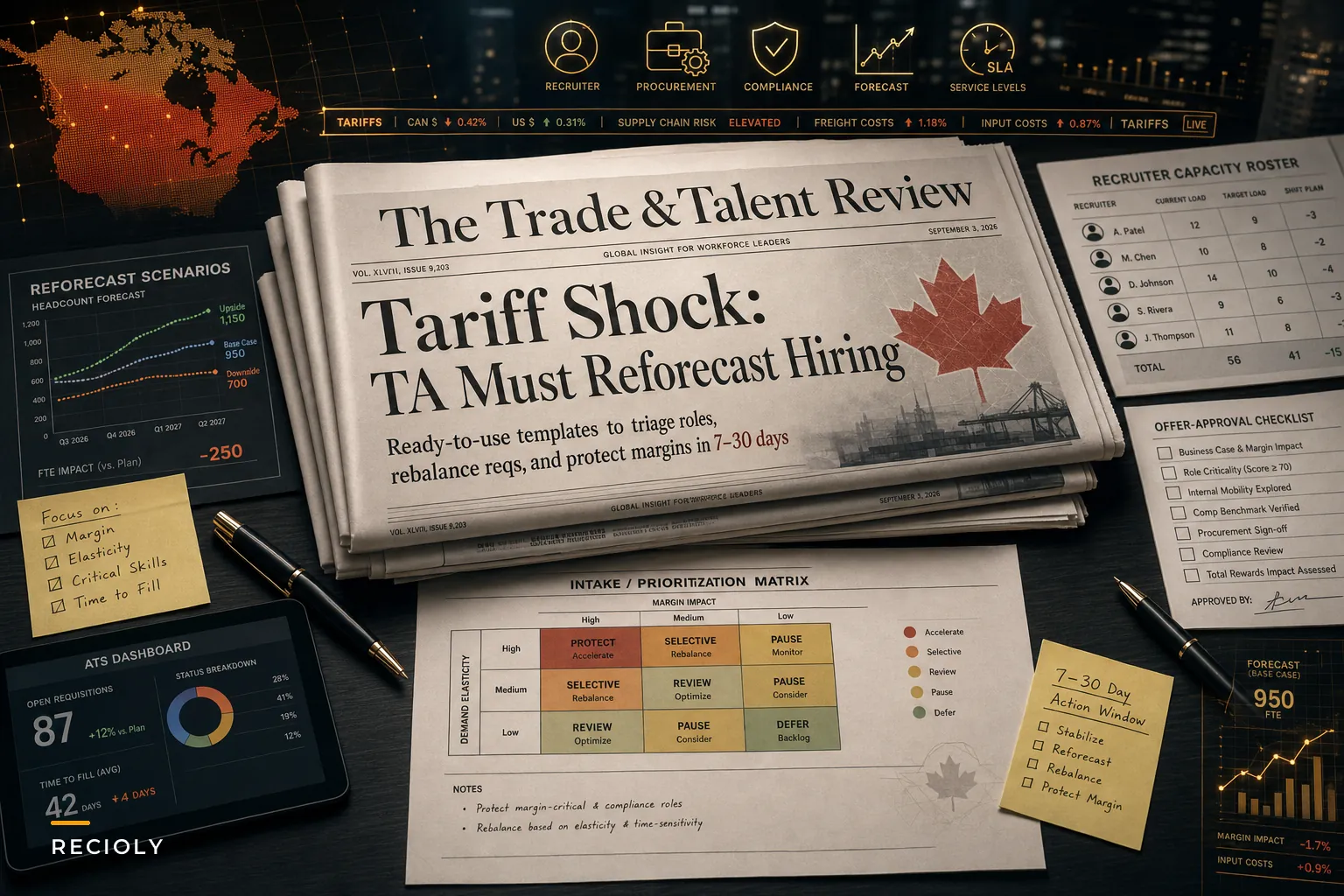

On August 25, Canada announced retaliatory tariffs on roughly C$27.6 billion of U.S. goods — matching recent U.S. duties dollar-for-dollar with levies of 15%, 25%, and up to 50% across industrial and consumer products, according to Reuters. The measures take effect September 8, 2026.
If you run TA at a manufacturer, distributor, or any company with input costs tied to cross-border flows, finance already has this on a spreadsheet somewhere. What most TA leaders miss is that a tariff shock hits recruiting on a delay — and the teams that wait for the reorg memo to land are the ones scrambling three months from now.
This isn't a piece about trade policy. It's about what happens to your req list when your CFO reruns the margin model, and how to move before someone else decides your headcount for you.
The delay problem nobody plans for
A tariff's impact on hiring almost never shows up as a clean "hiring freeze" email. It shows up as ambiguity.
What actually plays out is a sequence that takes somewhere between six and ten weeks. Finance re-forecasts landed costs on affected SKUs. Procurement starts renegotiating or re-sourcing. Some product lines get quietly deprioritized. And around week five, a business unit leader tells you three of your open reqs are "on hold for now" — with zero clarity on whether that means paused, canceled, or reprioritized.
By the time that hits your pipeline, you've already burned recruiter hours, agency spend, and interviewer capacity on roles that were dead on arrival. That's the real cost. Not the freeze itself — the work you kept doing after the freeze became inevitable but before anyone said anything.
The teams that handle this well don't wait for direction. They build a fast internal read on which reqs are exposed and get ahead of the conversation.
Sorting your req list by demand elasticity, not headcount priority
When cost pressure hits, the instinct is to rank open roles by importance. That's the wrong axis. A role can feel critical and still be directly tied to a revenue stream that's about to compress.
Never lose track of top talent again.
Recioly helps you manage every stage of recruiting efficiently, from application to offer.
- Centralized candidate tracking
- Automated interview scheduling
- Collaborative hiring workflows
No credit card required
The better lens is demand elasticity — how tightly is this role's justification tied to volume or margin on affected product lines?
A rough way to bucket your open reqs:
| Req category | Exposure to tariff shock | Typical action |
|---|---|---|
| Roles supporting affected product lines (sales, production for tariffed SKUs) | High | Pause or slow; reconfirm demand assumptions |
| Backfills on affected units | High–Medium | Hold; reassess if role is truly load-bearing |
| Cross-functional / shared services | Medium | Continue but monitor |
| Risk-mitigation roles (procurement, logistics, trade compliance) | Inverse — demand rises | Accelerate and prioritize |
| Roles tied to unaffected or countercyclical lines | Low | Continue as normal |
The insight most teams miss is that bottom-right row. A tariff shock doesn't just reduce hiring — it reshapes it. When landed costs jump 15–50% on a category of inputs, the roles that become urgent are the ones finding alternative suppliers, renegotiating terms, rerouting logistics, and keeping the company out of a compliance mess on new duty classifications.
So while half your req list cools down, another slice heats up fast. If you treat this purely as a "slow down hiring" event, you'll be understaffed on exactly the roles that determine how much the tariffs actually hurt.
The roles that get more urgent, not less
Worth being specific, because "prioritize critical roles" means nothing without naming them.
-
Procurement / strategic sourcing — someone has to find and qualify alternative suppliers, and quickly. A single strong sourcing hire can offset a meaningful chunk of the cost increase.
-
Trade compliance / customs — new duty schedules mean reclassification work, tariff engineering, and audit exposure. Under-resourcing this is how companies eat penalties on top of the tariffs themselves.
-
Logistics and supply-chain analysts — rerouting, mode shifts, inventory rebalancing. These roles pay for themselves in freight and carrying-cost savings.
-
FP&A / cost analysts embedded in ops — because the whole scenario runs on someone modeling landed cost correctly.
Think about a mid-size industrial parts distributor with around $180M in revenue seeing duties climb on a category that makes up roughly a fifth of its purchased volume. The obvious move is to freeze hiring. The smarter move is to freeze most hiring while pulling forward a senior procurement hire and a trade-compliance specialist — two roles that, staffed well, might claw back more in cost avoidance than their combined comp several times over.
That reframing — from "cut headcount" to "reallocate headcount toward resilience" — is the difference between a TA team that's seen as a cost center during a shock and one that's seen as part of the response.
Reforecasting recruiter capacity when the mix shifts
When your req list rebalances like this, your recruiter allocation is now wrong. You probably have sourcers loaded onto the exact reqs going on hold, and thin coverage on the procurement and compliance roles that just jumped in priority.
The workflow to fix it, roughly in order:
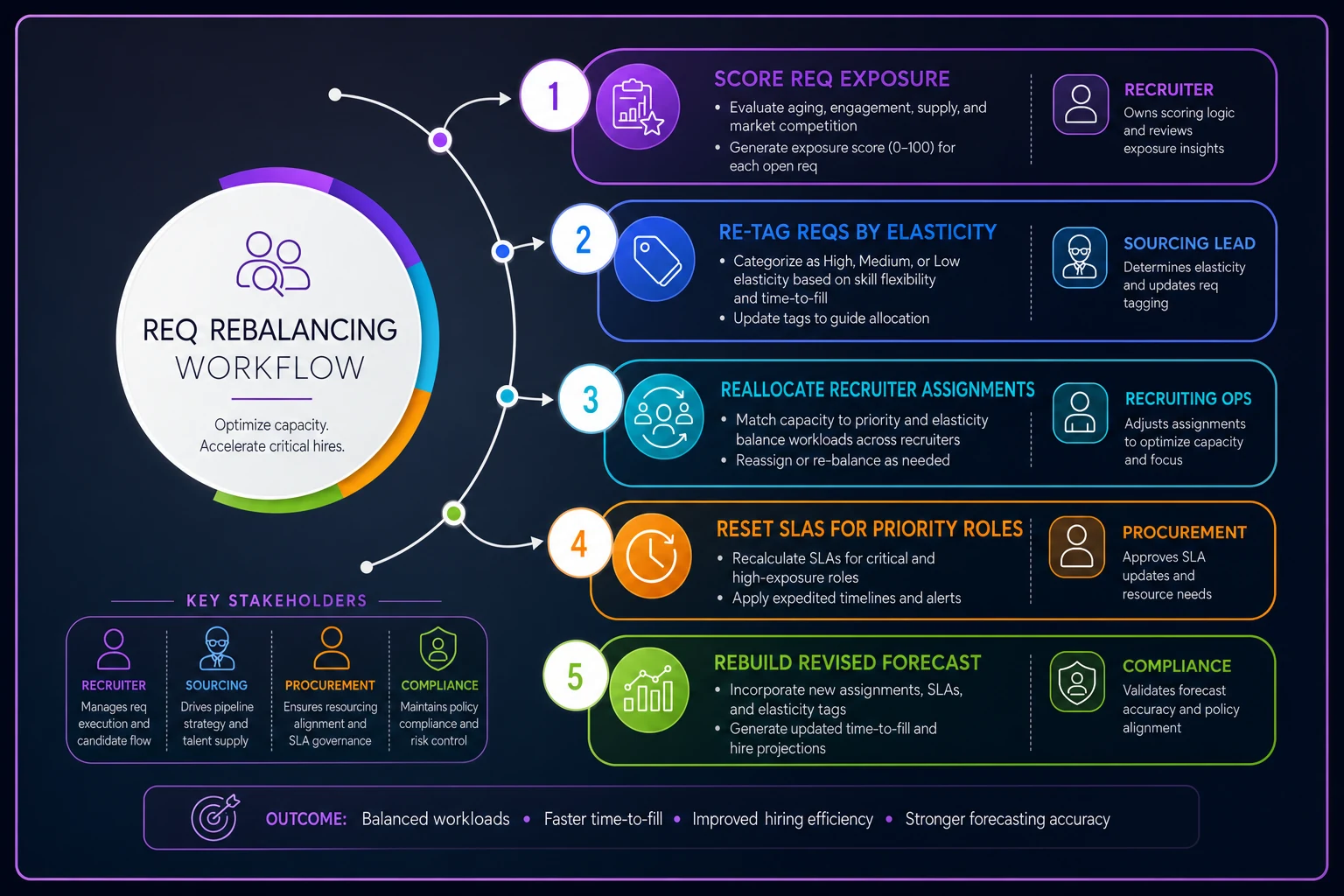
Use this workflow to reassign recruiters and rebuild your forecast quickly.
-
Freeze intake for a week. Stop new reqs from entering until you've re-scored the existing list against exposure.
-
Re-tag every open req by the elasticity buckets above. This is a half-day exercise if your intake data is clean — a painful week if it isn't.
-
Reallocate recruiter load off held reqs and onto the accelerating ones. The people who were sourcing for a paused production role can pivot to procurement pipelines.
-
Reset SLAs on the priority roles. Trade compliance and senior sourcing talent is thin and moves quickly. Treat these like mission-critical hires, not standard reqs.
-
Rebuild the forecast with a clear split
which roles are you actively working, which are held, and what's your revised time-to-fill on the accelerated ones.
The part teams consistently underestimate is step two. If you can't quickly see which reqs map to which business units and product exposures, you can't reforecast at all — you're just guessing. This is exactly where having a structured workforce-planning hiring architecture with intake templates and prioritization matrices pays off. Teams that already have that in place can re-sort their entire req list in an afternoon. Everyone else spends a week in meetings.
If your intake data is clean, re-tagging open reqs can be completed in a half-day.
Everyone else spends a week in meetings.
Tightening offer and comp gates without stalling the roles that matter
There's a real tension here. You want to slow spend, but you also can't afford to lose a strong procurement or compliance candidate to a slow approval loop — those are the hires actually reducing your exposure.
-
High-exposure / held reqs add an approval gate. Any offer needs re-confirmation that the role is still funded given the revised forecast.
-
Risk-mitigation roles remove friction entirely. Pre-approve comp bands, give recruiters a clear ceiling, and let these move at full speed. A three-day approval delay on a scarce trade-compliance candidate is how you lose them.
-
Everything else normal process.
The mistake to avoid is applying a blanket "extra approval on all offers" policy during a cost scare. It feels responsible, but it slows down the exact hires you're trying to accelerate. Differentiated gating beats uniform caution every time.
Differentiated gating also gives you something to show leadership — a clear signal that you're not just spending freely, but you're also not applying a blunt instrument that kills your best hires in the pipeline.
Adjusting what you screen for
Your scorecards should move too, and this one's easy to overlook.
-
Experience navigating supplier disruption and re-sourcing under time pressure
-
A track record of measurable cost savings, not just process management
-
Comfort with ambiguity and cross-border complexity
-
For compliance roles specifically — real depth on customs classification and duty exposure, not general regulatory familiarity
The pattern to watch for: interviewers who default to their old rubric and score a candidate down for "not enough big-company polish" when what the business actually needs right now is someone who's rerouted a supply chain under pressure. Recalibrate the panel on what "good" means for these roles, right now, in this environment.
When to move — and when to wait
Not every company exposed to this needs to act immediately. A rough decision guide:
Move now if:
-
A meaningful share of your input costs or revenue ties to affected categories
-
You already have reqs open on those exposed business units
-
Procurement or compliance is currently under-resourced
Wait and monitor if:
-
Your exposure is genuinely marginal and finance hasn't flagged a material margin hit
-
Your open reqs sit mostly in unaffected or countercyclical lines
-
You'd be reorganizing pipelines on speculation rather than a real forecast change
The point isn't to panic-reforecast every time trade policy shifts. It's to have the exposure map ready so that when finance reruns the numbers, you can respond in days instead of reacting after the reorg lands on your desk.
Closing thought
A tariff shock like this one tests whether your TA function can read a business signal and reshape its work before being told to. The teams that struggle are treating their req list as a static queue — working every role at the same priority until someone above them intervenes.
The teams that come out ahead treat their open reqs as a live portfolio: re-sortable against real business exposure, with recruiter capacity that flows toward the roles that actually matter as conditions shift. That capability isn't something you build in the two weeks after tariffs hit. It's something you either already have, or wish you did, when the forecast changes underneath you.
Ready to elevate your hiring process?
Join 1,500+ recruiting teams using Recioly to save time, improve collaboration, and hire smarter.