


Most hiring plans die in the gap between what finance approved and what the recruiting team can actually deliver. Finance signs off on 40 new roles for the year. Hiring managers assume all 40 are equally urgent starting in Q1. The TA team, meanwhile, has four recruiters who can realistically carry maybe 8–10 open reqs each before quality craters. Nobody did the math on whether those two numbers actually agree.
That's the core problem a real workforce planning hiring architecture solves. Not headcount forecasting on its own, not recruiter capacity on its own — but the connective tissue that forces those two worlds to reconcile before the year starts, and keeps reconciling them monthly as reality drifts.
This isn't a template you fill out once. It's a running system with three moving parts: the intake that translates a business need into a hireable req, the prioritization logic that decides what gets worked first when everything can't happen at once, and the capacity math that tells you honestly whether your team can carry the load. When any one of those breaks, the whole thing degrades — usually silently, until a critical role has been open 90 days and a VP starts asking questions.
Why the plan and the pipeline stop agreeing
The disconnect almost always starts with how headcount gets approved. Finance thinks in annual budgets and cost centers. Hiring managers think in "I need this person now." TA thinks in weekly throughput. These three groups rarely sit in the same planning conversation, so each one builds a mental model that assumes the other two will just flex around it.
A typical example: a mid-size company approves 24 roles for the year. On paper that's two hires a month — totally manageable. But the roles aren't evenly spread. Twelve of them are for a new product line leadership wants staffed by end of Q2. So the real ask is twelve hires in roughly five months, layered on top of normal backfill churn and whatever attrition surprises show up. The annual number said "fine." The actual timing said "impossible." Nobody caught it because nobody laid the timing against capacity.
What tends to happen on scaling teams is that the failure isn't a lack of planning — it's that each function plans in its own unit of measure. Finance in dollars per year, managers in urgency level, TA in reqs per recruiter per week. Until everyone converts into a shared unit — hires-per-month against deliverable-capacity-per-month — you're not really planning together. You're three teams making three separate bets and hoping they line up.
The intake template: where a business need becomes a real req
Intake is where most of the downstream mess originates. A vague intake produces a vague search, and a vague search burns recruiter hours that were already scarce. If you want capacity planning to mean anything, the intake has to capture the variables that actually drive workload — not just the job title and a rough headcount number.
Never lose track of top talent again.
Recioly helps you manage every stage of recruiting efficiently, from application to offer.
- Centralized candidate tracking
- Automated interview scheduling
- Collaborative hiring workflows
No credit card required
A good intake template forces the hiring manager to declare things that affect difficulty and priority up front:
-
Business trigger — is this backfill, growth, or a bet on a new initiative? Backfill and net-new have very different urgency profiles.
-
Revenue or delivery dependency — does something downstream stall if this seat stays empty? Be specific about what.
-
Target start date — and whether that date is a hard constraint or a preference.
-
Difficulty signals — niche skill set, narrow location, comp band vs. market, security clearance, anything that inflates time-to-fill.
-
Approved comp range — the actual approved number, not the aspirational one.
-
Backup plan — is there an internal candidate, a contractor bridge, or does it have to be a full external search?
The part most teams miss: intake is your first prioritization filter, not just a data-collection form. When a manager can't answer "what breaks if this stays open for another month," that req probably isn't as urgent as claimed — and it shouldn't jump the queue ahead of something with a clear revenue dependency. A disciplined intake quietly kills the "everything is P1" problem before it ever reaches the recruiters.
Prioritization: deciding what gets worked when you can't work everything
Once intake is clean, you need a way to rank reqs that doesn't come down to whoever emailed the recruiter last or which VP is loudest that week. A simple scoring matrix holds up better than any political process because it makes trade-offs visible and defensible.
Score each req on a few weighted dimensions. Here's a version that works in practice:
| Dimension | Weight | What high scores mean |
|---|---|---|
| Revenue / delivery impact | 35% | Empty seat directly blocks revenue or a shipping commitment |
| Time sensitivity | 25% | Hard start date, ramp season, or a dependency with a real deadline |
| Fill difficulty | 20% | Rare skills, tight market, or narrow comp band that will eat recruiter hours |
| Strategic weight | 15% | Ties to a leadership bet or a capability the org lacks entirely |
| Replaceability | 5% | No internal or contractor bridge available |
The output isn't a perfect ranking — it's a conversation starter grounded in something other than volume of complaints. When two reqs tie, you talk it through. When one clearly outscores another, the debate wraps up faster.
Separate fill difficulty from priority in the matrix so recruiters don't chase interesting but non-urgent searches at the expense of blockers.
One thing worth flagging: fill difficulty and priority are not the same thing, and treating them as one wrecks pipelines. A hard-to-fill role that nobody's actually waiting on can sit in the background. An easy-to-fill role blocking a launch should be worked now. Recruiters naturally drift toward interesting hard searches and away from the boring urgent ones. The matrix pulls them back toward what the business actually needs.
Capacity-to-deliver: the math nobody wants to do
Here's the formula that ties it together. It's not complicated, but most teams never actually run it.
Deliverable capacity = (recruiters × reqs each can carry × monthly fill rate) − ramp and attrition drag
Walk through it with real numbers. Say you have four recruiters. Each can carry around 9 active reqs at healthy quality — that's 36 concurrent reqs. But concurrent capacity isn't the same as monthly output. If average time-to-fill is around 45 days and each recruiter closes roughly 2–3 hires a month across their load, realistic throughput lands somewhere near 8–11 hires a month. Call it 10.
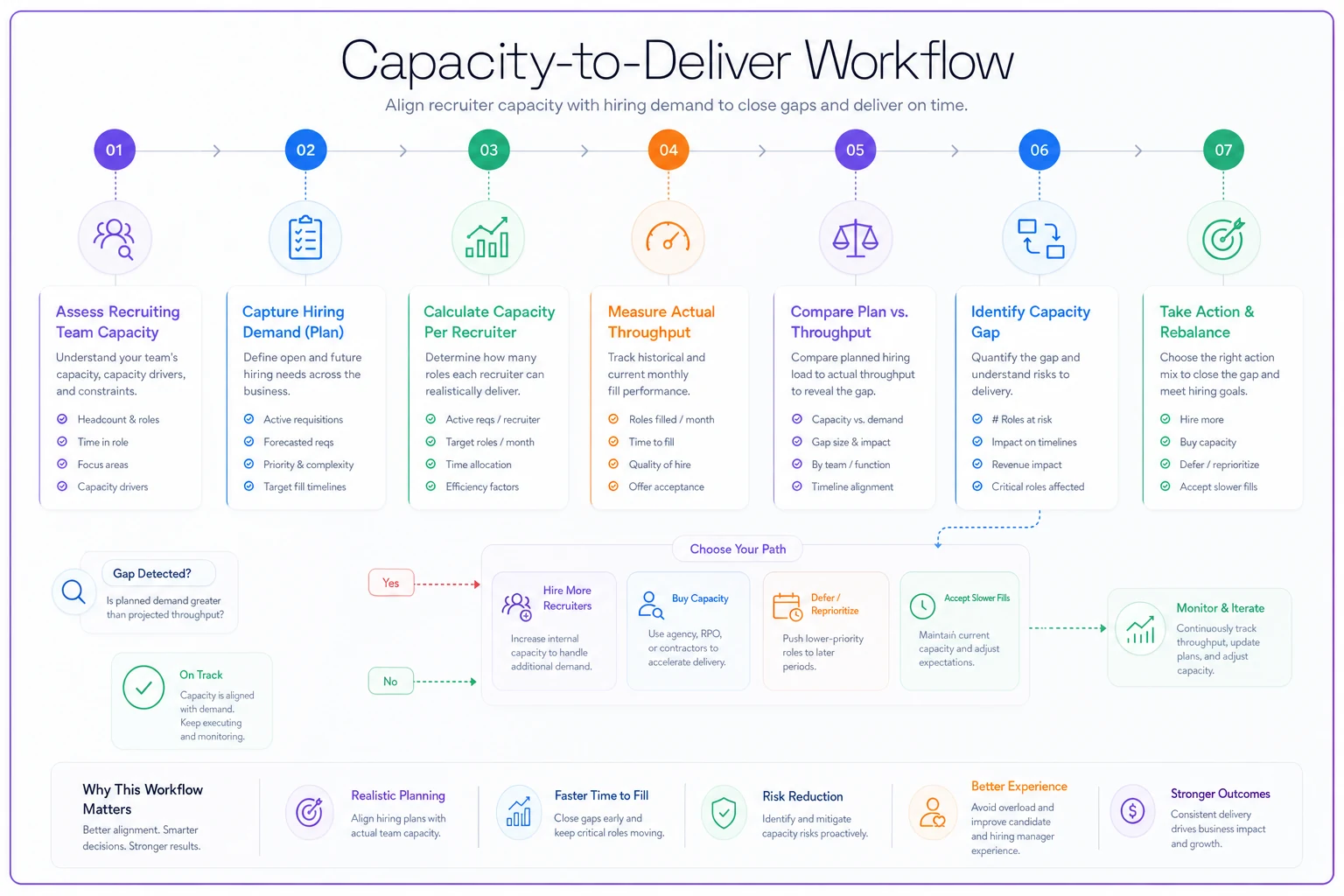
Now lay that against the plan. If the annual plan front-loads 12 hires into a single quarter on top of four or so monthly backfills, you're asking for 16 hires a month against a team that delivers 10. That's not a stretch goal — that's a 60% overload that shows up as blown SLAs, rushed screens, and declined offers.
The point of the formula isn't precision. It's to expose the gap before the quarter starts, when you still have options: bring on another recruiter, engage an agency for overflow, push non-critical reqs out a quarter, or tell finance the timeline isn't real. All four are reasonable choices. Discovering the gap in month two of the quarter is not.
Where scale changes everything
At small scale — one or two recruiters, maybe 15 hires a year — you can run all of this in your head and a spreadsheet. The coordination cost is low because everyone's in the same room.
What breaks as you grow is coordination, not the math. Add more hiring managers and each one optimizes for their own reqs, so "priority" inflates across the board. Add more recruiters and load balancing stops being obvious — one drowns in six hard searches while another has slack. Add more functions and the monthly planning conversation, if it happens at all, turns into a status meeting instead of an actual re-planning session.
-
Intake quality drifts because nobody enforces it, so difficult reqs enter the pipeline looking easy and blow up time-to-fill later.
-
Priority calls get made ad hoc in Slack threads instead of against the matrix, and the loudest manager wins.
-
Capacity gets tracked as headcount, not throughput — "we have four recruiters" tells you nothing about how many hires land next month.
-
Candidates fall through the seams between an overloaded pipeline and inconsistent follow-up. If you don't have a disciplined process for this, a proper recruiter triage workflow with SLAs, tags, and priority routing is what keeps the top of funnel from leaking while the plan sorts itself out.
Everything that worked informally at small scale needs to become explicit at larger scale. Not more bureaucratic — just written down, shared, and revisited on a cadence.
The monthly planning cadence that keeps it honest
An annual plan is a snapshot that's wrong by February. The cadence is what keeps the architecture alive. The goal is a short recurring session where finance, hiring managers, and TA reconcile the plan against reality using the same numbers.
-
Days 1–2 TA refreshes actuals — hires closed last month, current active req count per recruiter, updated time-to-fill by role family.
-
Mid-month Hiring managers submit new intakes and re-confirm priorities on existing reqs. Anything that can't answer "what breaks if this waits" gets deprioritized.
-
Monthly session (60–75 min) All three functions in the room. Run capacity-to-deliver against the re-prioritized queue. Name the gap. Decide the lever — hire, buy, defer, or accept slower fills.
-
Output An updated ranked req list with owners, plus a documented capacity gap and the agreed response. That's it. No 40-slide deck.
The SLA piece matters here too. TA commits to specific turnaround on new intakes — say, sourcing live within 3 business days for anything scored above a priority threshold. Hiring managers commit to their side: feedback within 48 hours, interview slots held in advance. When both sides have SLAs and the monthly session reviews whether they were met, the "recruiting is slow" versus "managers ghost candidates" argument mostly goes away because the data shows where the delay actually lived.
A real scenario
A B2B software company, roughly 220 people, planned to grow to about 290 over a year — around 70 net-new plus normal backfill. Three recruiters. No shared prioritization; reqs got worked in whatever order managers pushed hardest. Average time-to-fill sat close to 60 days, and two engineering leaders were furious that critical roles had been open over three months while "easier" marketing roles kept closing.
When they laid the plan against actual throughput, the gap was obvious: they were staffed to deliver maybe 6–7 hires a month and the plan implicitly needed 9–10, weighted heavily toward hard-to-fill engineering roles the team kept deferring.
The fix wasn't dramatic. They tightened intake so difficulty and revenue dependency had to be declared up front, adopted a weighted priority matrix, and started a monthly reconciliation with finance and hiring managers in the same room. They also brought on one agency for engineering overflow instead of pretending three recruiters could absorb it.
Six-ish months later, time-to-fill on the priority engineering roles dropped to the low 40s in days, the "everything is urgent" noise died down because the matrix settled most disputes before they escalated, and finance stopped being surprised by mid-quarter agency spend because the capacity gap was named in advance. Nothing exotic — just the three parts of the system finally talking in the same units.
When this architecture makes sense — and when it's overkill
When it's worth building: You're hiring more than roughly 30 people a year, you have multiple hiring managers competing for the same recruiter time, or finance and TA keep discovering they were planning against different assumptions. If a critical role has ever sat open for a quarter while easier roles closed, that's the signal.
When it's overkill: A single recruiter and a founder hiring 8–10 people a year don't need a weighted matrix and a monthly cadence. The coordination cost outweighs the benefit at that size. A shared spreadsheet and a weekly 15-minute check-in gets the job done. Build the architecture when informal coordination starts failing, not before.
Who should be careful: Teams that adopt the matrix but never enforce the intake. Garbage in, garbage ranked. The scoring is only as good as the honesty of the inputs, and a manager who inflates every dimension defeats the whole point. The monthly session has to actually challenge inflated scores, or the system just becomes theater.
Bringing it back to the seams
The reason this architecture works isn't the templates or the formula in isolation. It's that it forces the three functions that normally plan in different languages — finance, hiring managers, and TA — to reconcile on a schedule, in shared units, with the gap made visible early enough to actually do something about it.
Everything downstream depends on those seams holding. A clean intake makes prioritization meaningful. Honest prioritization makes capacity math useful. Capacity math makes the monthly cadence a real decision instead of a status update. And when the load exceeds what the team can carry, the same downstream workflows — from candidate triage to how you structure interview loops, including whether asynchronous interviews scored with a review-panel rubric can absorb some of the volume — are what let you flex without breaking quality.
Plans don't fail because the forecast was wrong. They fail because nobody kept checking whether the pipeline could actually carry the plan. Build the connective tissue, revisit it monthly, and the gap stops being a surprise.
Ready to elevate your hiring process?
Join 1,500+ recruiting teams using Recioly to save time, improve collaboration, and hire smarter.