


Most recruiting teams have quietly accepted a hard truth: the process only works as well as the least-committed hiring manager in the loop. You can build defensible scorecards, tight SLAs, and clean dashboards, and one senior director who "goes with their gut" can unravel all of it in a single interview loop.
The frustrating part is that this isn't a training problem. It's an enforcement problem. Managers get a 45-minute onboarding session, nod along, sign nothing binding, and then default to their old habits within two weeks. The playbook lives in a Confluence page nobody opens again.
So instead of writing another "how to train hiring managers" guide, this is about the actual system that makes manager behavior predictable — one with mandatory adoption rules, a clear map of who owns which decisions, escalation gates that fire automatically, and calibration rituals tied to real SLAs. Not suggestions. Rules with teeth.
Why manager enablement usually fails (and why it's not the managers' fault)
There's a pattern that shows up across almost every scaling recruiting org: the recruiting team owns process but has no authority over managers. TA can define how a scorecard should be filled out, but they can't make a VP of Engineering actually fill it out. So enablement becomes a polite request, and polite requests lose to a manager's calendar every single time.
Enablement also tends to get treated as a one-time event. A manager gets "onboarded" when they first start hiring, and then never again — even as scorecards change, roles evolve, and the manager's own scoring slowly drifts.
The second breakdown: there's no cost to non-compliance. If a manager submits a two-word interview note ("strong hire") and faces zero consequence, the two-word note becomes the norm. Enablement without accountability is just a suggestion in a nicer font.
And the third reason, which is subtle but real — nobody has defined which decisions actually belong to the hiring manager versus the recruiter versus the panel. So every debatable call becomes a negotiation, and the loudest or most senior person wins. That's not a system. That's politics.
The four pillars of an enforceable playbook
A manager-onboarding playbook that actually changes behavior rests on four connected pieces. Miss one and the whole thing sags.
Never lose track of top talent again.
Recioly helps you manage every stage of recruiting efficiently, from application to offer.
- Centralized candidate tracking
- Automated interview scheduling
- Collaborative hiring workflows
No credit card required
-
Mandatory scorecard adoption rules — non-negotiable standards for how evaluation happens, with completion gates.
-
A decision-accountability matrix — a clear map of who decides what, so debatable calls have a pre-assigned owner.
-
Escalation gates — automatic triggers that stop a hire from moving forward when the process isn't followed.
-
Recurring calibration and debrief rituals — ongoing tune-ups tied to SLAs, not annual training.
These aren't independent. The accountability matrix tells you who owns a decision; the escalation gates enforce it; the scorecard rules feed the data; and the calibration rituals correct drift before it compounds. Pull them apart and you're back to polite requests.
Pillar 1: Mandatory scorecard adoption rules
The scorecard is where most of the leverage lives, and it's also where most of the sloppiness hides. If you've read our breakdown of common scorecard mistakes that wreck hiring decisions, you already know a well-designed rubric is the foundation. But a good scorecard nobody fills out properly is worthless.
-
No verbal-only feedback. If it isn't in the scorecard, it didn't happen. Hallway conversations and Slack DMs about candidates don't count toward a decision.
-
Submission before the debrief, not during. Scores must be locked in before the panel discusses anything, to prevent the most senior voice from anchoring everyone else.
-
A minimum evidence threshold per competency. A rating with no supporting note gets flagged as incomplete. "7/10, good communicator" is not evidence. "Walked through how they de-escalated a client churn situation, gave specifics on the metrics" is.
-
A hard completion window. Scorecards due within 24 hours of the interview. After that, the score is considered less reliable — memory decays fast.
Configure your ATS to block stage progression until scorecards pass the completeness check.
The interesting thing about the 24-hour window: teams that enforce it see far fewer copy-paste "great candidate, strong yes" submissions, because managers can't batch a week of interviews into one rushed Friday afternoon session.
In practice, enforcement happens through the applicant tracking system. A candidate can't advance to the next stage until every required scorecard is submitted and passes the completeness check. No exceptions carved out for senior people — that's the part everyone wants to skip, and it's the part that makes it work.
Pillar 2: The decision-accountability matrix
This is the piece most teams have never formally built, and it quietly causes half the friction in a hiring loop. When responsibilities are fuzzy, every disagreement turns into a standoff.
| Decision | Owner | Advises | Can override |
|---|---|---|---|
| Whether to open the req | Hiring Manager | Recruiter, Finance | Dept Head |
| Interview panel composition | Recruiter | Hiring Manager | TA Lead |
| Advance/reject at screen | Recruiter | — | Hiring Manager |
| Advance/reject after loop | Hiring Manager | Panel | Dept Head |
| Final scorecard interpretation | Hiring Manager | Panel | — |
| Comp band exceptions | TA Lead / Finance | Hiring Manager | VP |
| Bar-raiser veto | Bar Raiser | Panel | Cannot be overridden by HM |
The bottom row generates the most debate, and it's the most important. If a designated bar-raiser can be overruled by a hiring manager who really wants their candidate, the bar-raiser role is theater. The matrix has to protect certain decisions from seniority pressure, or you've just documented the existing power dynamics with fancier labels.
Something worth noticing: the moment you write this matrix down, arguments get shorter. Not because people suddenly agree, but because there's no longer anything to argue about ownership. The conversation shifts from "who gets to decide" to "what does the evidence say," which is exactly where it should be.
One caution — resist the urge to make everything a shared decision to keep the peace. Shared accountability is no accountability. If two roles own a call, neither will feel responsible when it goes wrong.
Pillar 3: Escalation gates
Escalation gates are the automated conscience of the system. They're the checkpoints that stop a hire from moving forward when something's off — before the mistake becomes an offer.
-
Score divergence gate. When panel scores on the same competency span more than a set range (say, one person gives a 2 and another gives a 9), the loop can't close until the panel reconciles. Wide divergence usually means people interviewed for different things.
-
Incomplete evidence gate. Any scorecard flagged as below the evidence threshold blocks advancement until it's fixed.
-
Single-strong-voice gate. If a hire recommendation rests almost entirely on one enthusiastic interviewer while the rest are lukewarm, it routes to the TA Lead for a second look.
-
SLA-breach gate. When a scorecard is overdue past the window, an automatic reminder fires, then an escalation to the manager's manager if it's still missing after 48 hours.
-
Override gate. Any time a decision-owner overrides the recommendation the scores point toward, they have to log a written justification. Not to block the override — sometimes overrides are right — but to create a record.
That last one is quietly powerful. Managers behave differently when they know an override requires them to write down why in a place other people will read. Most of the time, the requirement to justify makes people reconsider whether the override was actually warranted.
The override log also connects directly to your defensibility posture. Every documented override becomes a data point you can review later: which managers override often, whether their overrides pan out, and where your scorecards might be missing something real that managers keep catching.
Pillar 4: Calibration and debrief rituals tied to SLAs
A one-time onboarding session guarantees drift. Managers start aligned and slowly diverge — one becomes a soft grader, another develops a pet competency they over-weight, a third starts scoring on "culture fit" they can't define. Without recurring calibration, your scorecard data slowly turns into noise.
The post-loop debrief happens after every hiring decision, and it's short — 15 to 20 minutes. It's not a re-litigation of the hire. It's a quick check: did the scorecards predict what the panel felt? Where did evidence and scores diverge? Any gate get triggered, and why? Over time, these debriefs surface systemic issues — like a competency everyone struggles to assess consistently.
The recurring calibration session happens on a fixed cadence, usually monthly or quarterly depending on hiring volume. Managers score the same anonymized sample interview and compare results. When one manager consistently scores two points higher than the group, that's not a personality quirk to tolerate — it's a calibration gap to close.
-
Post-loop debrief
within 3 business days of decision
-
Manager calibration
monthly for high-volume orgs, quarterly for lower volume
-
Override-log review
quarterly, at the TA leadership level
-
Full playbook re-certification for managers
annually, or whenever scorecards materially change
The cadence only works if attendance carries real consequences. A calibration session that managers can skip without anything happening is just a calendar event nobody attends.
What breaks at scale
At five hiring managers, you can run all of this informally. Someone remembers who owns what, the recruiter chases missing scorecards personally, and calibration happens because everyone's in the same three Slack channels.
-
Nobody can track who's out of calibration. Drift is invisible until a hiring outcome goes badly, and by then you've made a dozen more decisions on the same drifted scale.
-
Escalation depends on someone noticing. A recruiter juggling 20 reqs won't catch that a scorecard came in with no evidence. The gate has to fire automatically or it doesn't fire at all.
-
The accountability matrix gets ignored across department lines. A hiring manager in one org has no idea what the bar-raiser role even means in another, so cross-functional loops turn into chaos.
-
Onboarding new managers becomes a bottleneck. You're hiring managers faster than you can enable them, so a growing share of your interviews are being run by people who never went through the playbook.
The core issue at scale is that enforcement can't rely on human vigilance. When your process depends on a recruiter remembering to check something, it works until the day they're overloaded — which, in a scaling org, is basically every day. The gates and completion rules need to live inside the system that manages the workflow, so they apply automatically regardless of who's paying attention.
Where tooling fits (without overcomplicating it)
You don't need a giant platform to start. Most of pillar one and two can be enforced with configuration inside a decent applicant tracking system — required fields, stage gates, and permission settings that reflect the accountability matrix.
Where it gets harder is the automated escalation and drift-detection work: flagging score divergence, catching overdue scorecards, routing single-voice recommendations for review, and surfacing which managers are consistently miscalibrated. That's the layer where operational software with built-in automation earns its place — not to replace judgment, but to make sure the rules fire consistently instead of depending on an overworked person to remember them.
A simple workflow diagram helps visualize the handoff from rules to automation.
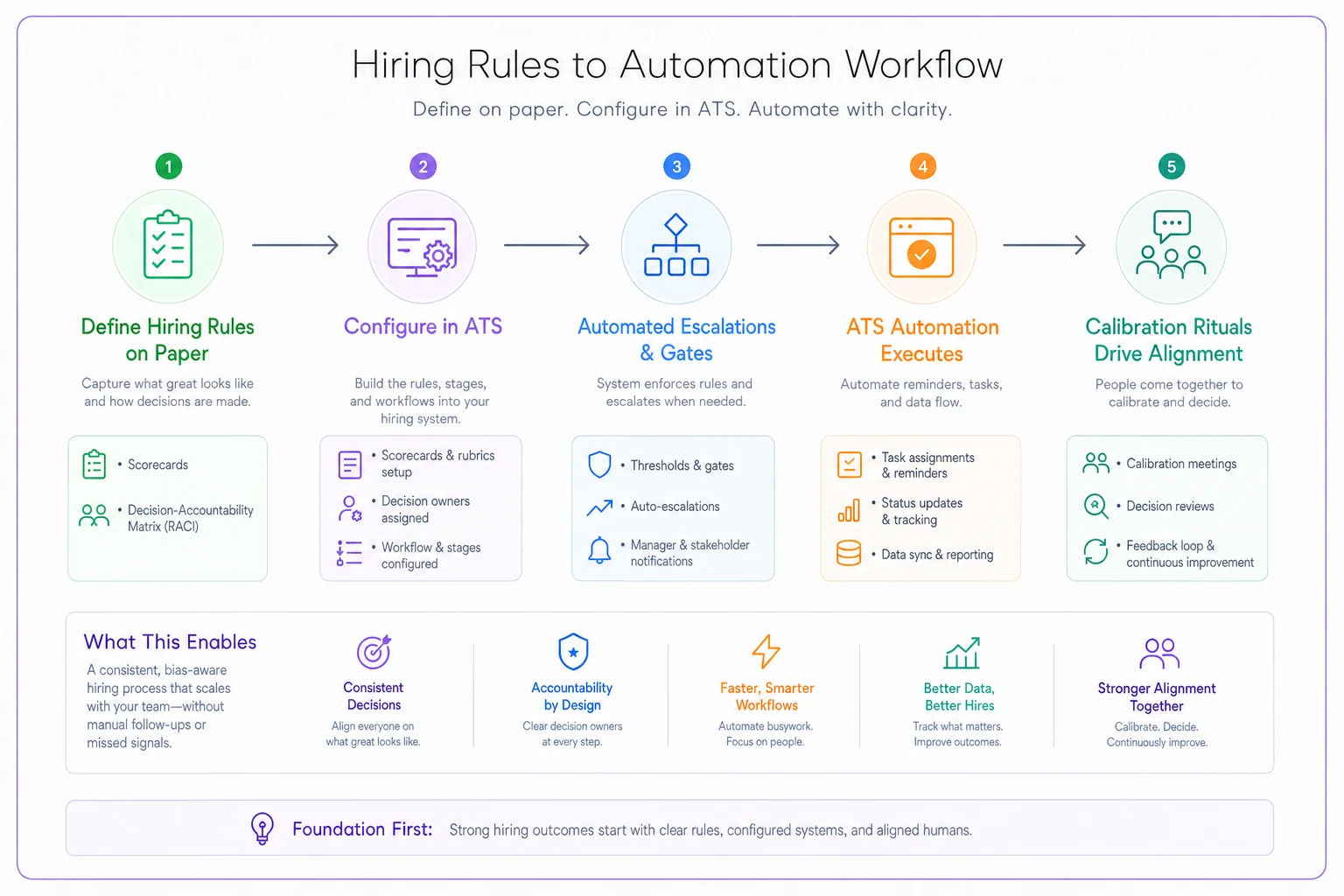
The mistake teams make here is buying the tool first and defining the rules never. The tool enforces whatever rules you give it. If your accountability matrix is vague, the software just automates the vagueness. Design the system on paper first, then automate the enforcement.
When this level of rigor actually makes sense
Be honest about your stage before implementing all of this.
This makes sense when: you have more than roughly 10–15 active hiring managers, you're making enough hires that drift is costing you real money, you've had at least one bad hire trace back to a sloppy process, or you're in a regulated or high-scrutiny environment where defensibility matters.
This is overkill when: you're a small team making a handful of hires a quarter with two or three managers who all talk daily. Forcing formal escalation gates and monthly calibration on a five-person startup will create friction that outweighs the benefit. Start with the scorecard adoption rules and a simple accountability matrix; add the rest as you grow.
Who should not roll this out cold: any team without executive backing. If leadership won't enforce consequences for skipping calibration or ignoring the matrix, don't launch it. A playbook that everyone knows carries no consequences does more harm than no playbook — it teaches your team that the rules are optional.
A real scenario
A mid-sized SaaS company — around 300 employees, scaling their sales and engineering orgs — was hiring across roughly 25 active reqs with about 18 hiring managers involved at any given time. Their scorecard "process" existed on paper but adoption was maybe half. Managers submitted feedback whenever they got to it, senior people routinely overruled panels, and there was no calibration at all.
The symptoms were predictable: loops dragging out because scorecards trickled in over a week or more, a couple of regretted senior hires that traced back to one loud interviewer's enthusiasm, and constant friction between recruiters and managers about who actually got to make the call.
They rolled out the four pillars over about a quarter. Scorecard completion became a hard stage gate. They built the accountability matrix and, crucially, protected the bar-raiser veto. Escalation gates fired automatically on divergence and overdue submissions. Monthly calibration started with tracked attendance.
The changes weren't instant. Within roughly two quarters, scorecard completion before debrief went from around half to nearly full, and the time from final interview to decision tightened noticeably — the week-long scorecard wait mostly disappeared. Score divergence in loops dropped as managers re-anchored in calibration. The most telling shift was qualitative: debrief conversations stopped being about who outranked whom and started being about what the evidence actually showed.
Bringing it together
Manager enablement fails when it's treated as training. It works when it's treated as an operating agreement — one with defined ownership, enforced through gates that don't depend on anyone remembering, and kept honest through rituals that catch drift before it compounds.
The four pillars reinforce each other. Adoption rules generate clean data. The accountability matrix removes the politics from decisions. Escalation gates enforce the rules without relying on human vigilance. Calibration keeps the whole thing from slowly rotting. Take any one out and the others weaken.
Start where the pain is sharpest — usually scorecard adoption and the accountability matrix — get executive backing to make consequences real, and layer in the escalation and calibration machinery as your hiring volume outgrows your ability to manage it by hand. The goal isn't more process for its own sake. It's making manager behavior predictable enough that the rest of your carefully built recruiting system can actually do its job.
Manager enablement fails when it's treated as training. It works when it's treated as an operating agreement — one with defined ownership, enforced through gates that don't depend on anyone remembering, and kept honest through rituals that catch drift before it compounds.
The four pillars reinforce each other. Adoption rules generate clean data. The accountability matrix removes the politics from decisions. Escalation gates enforce the rules without relying on human vigilance. Calibration keeps the whole thing from slowly rotting. Take any one out and the others weaken.
Start where the pain is sharpest — usually scorecard adoption and the accountability matrix — get executive backing to make consequences real, and layer in the escalation and calibration machinery as your hiring volume outgrows your ability to manage it by hand. The goal isn't more process for its own sake. It's making manager behavior predictable enough that the rest of your carefully built recruiting system can actually do its job.
Ready to elevate your hiring process?
Join 1,500+ recruiting teams using Recioly to save time, improve collaboration, and hire smarter.