

Most recruiting teams don't actually manage their vendors. They accumulate them. An agency gets added during a hiring spike, a niche sourcing tool gets bought because one recruiter loved the demo, an RPO shows up for a big EMEA push and never fully leaves. Two years later you've got 14 vendors, nobody knows the combined spend, and half of them are billing against renewals that auto-triggered while everyone was busy.
The problem isn't that any single vendor is bad. It's that there's no architecture holding them together. Each contract was signed in isolation, evaluated in isolation, and now gets renewed in isolation. That's how a TA vendor portfolio quietly turns into a leaky, overlapping, ungoverned mess that costs 20–30% more than it should and delivers less than it promises.
This is a systems problem. Once you look at it as a portfolio — with tiers, spend bands, scorecards, and a governance rhythm — the whole thing gets a lot easier to run and cheaper to operate.
Why vendor sprawl happens (and why it's nobody's "fault")
Vendor sprawl isn't the result of bad decisions. It's the result of reasonable decisions made at different times by different people under different pressures.
A hiring manager screaming for a senior data engineer gets a contingency agency approved in a day. That's the right call in the moment. But nobody circles back to ask whether that agency should stay on the roster, whether the 22% fee is competitive, or whether it overlaps with the RPO you already pay a retainer to. The urgency that justified the vendor is also what prevents anyone from governing it afterward.
-
Procurement owns the contract but not the performance.
-
Recruiting owns the performance but not the contract.
-
Finance sees the spend but has no context for whether it's good spend.
So the vendor exists in a gap between three functions — and gaps don't get managed. This is exactly why teams end up renewing an agency that hasn't delivered a hire in eight months. Nobody who noticed the underperformance had the authority or the calendar reminder to actually do something about it.
Step one: classify every vendor as strategic or tactical
Before you can govern a portfolio, you have to accept that not every vendor deserves the same attention. Trying to manage a $400k RPO relationship and a $9k/year sourcing extension with the same process is a waste of everyone's time.
Never lose track of top talent again.
Recioly helps you manage every stage of recruiting efficiently, from application to offer.
- Centralized candidate tracking
- Automated interview scheduling
- Collaborative hiring workflows
No credit card required
The cleanest first cut is strategic vs. tactical.
Strategic vendors are the ones where switching is painful, spend is significant, and performance directly affects your hiring outcomes. Think your primary RPO, your executive search partner for leadership roles, your core assessment platform. These need real relationship management, quarterly business reviews, and multi-quarter planning.
Tactical vendors are interchangeable, lower-spend, and easy to swap. A contingency agency you use twice a year, a job board, a background-check provider you could replace in a week. These need monitoring, not management — light scorecard, "prove it or lose it" posture.
| Dimension | Strategic vendor | Tactical vendor |
|---|---|---|
| Annual spend | High (often 6 figures) | Low to moderate |
| Switching cost | High — integration, ramp, data | Low — days or weeks |
| Impact on outcomes | Direct and broad | Narrow or occasional |
| Governance cadence | Quarterly QBRs + monthly check-ins | Quarterly scorecard, light touch |
| Relationship owner | Named senior TA leader | Recruiting ops coordinator |
| Renewal approach | Negotiated, planned 90+ days out | Competitive, easy to churn |
The mistake teams make here is over-classifying. Everyone wants to call their vendors "strategic" because it feels more important. In practice, if you're labeling more than 20–30% of your roster as strategic, you've diluted the whole point. Strategic status should be scarce — it's a budget of your attention, and attention is what you're actually short on.
Step two: put everyone in spend bands
Classification tells you how to manage a vendor. Spend bands tell you how hard. They also set your approval and procurement thresholds automatically, so you're not making up rules case by case.
-
Band A — low spend (roughly under $25k/year) Recruiting ops can approve and renew. Light quarterly scorecard. No formal RFP required to switch.
-
Band B — mid spend (roughly $25k–$100k/year) Requires a named owner, a real scorecard, and a competitive check at renewal. TA leadership sign-off needed.
-
Band C — high spend (roughly $100k+/year) Full procurement governance. Quarterly business reviews, documented performance history, formal RFP or renegotiation on a fixed cadence.
The bands make governance proportional. Nobody's running a 40-page RFP for a $12k tool, and nobody's rubber-stamping a $300k renewal because the account manager is friendly. The band decides the process before emotions get involved.
One thing worth watching — vendors will sometimes price suspiciously close to your band ceiling. You'll see "$24k" contracts often when your Band A threshold is $25k. That's not coincidence. Watch for creeping usage fees and add-ons that push actual spend into the next band without triggering the governance that comes with it.
Step three: quarterly scorecards that actually change behavior
Most vendor scorecards fail because they measure activity instead of outcomes, and because nobody does anything with the score once it's filled in.
A scorecard is only useful if it feeds a decision. The score should map to an action — keep, watch, or remediate. If every vendor scores "3 out of 5, meets expectations" quarter after quarter, you're not measuring anything. It's just a ritual.
-
Delivery — Did they hit volume, quality, and timeline commitments? (submits-to-interview ratio, quality of shortlists, fill rate against agreed SLAs)
-
Speed — Time to first qualified submission, time to fill, responsiveness on active reqs.
-
Cost efficiency — Effective cost per hire, fee competitiveness, hidden charges.
-
Partnership — Communication quality, proactive problem-solving, how they handle a miss.
Weight these differently based on classification. For a strategic RPO, partnership and delivery carry more weight because you're planning together long-term. For a tactical contingency agency, delivery and cost efficiency are basically the whole story — you don't need them to be a great partner, you need them to send good candidates quickly.
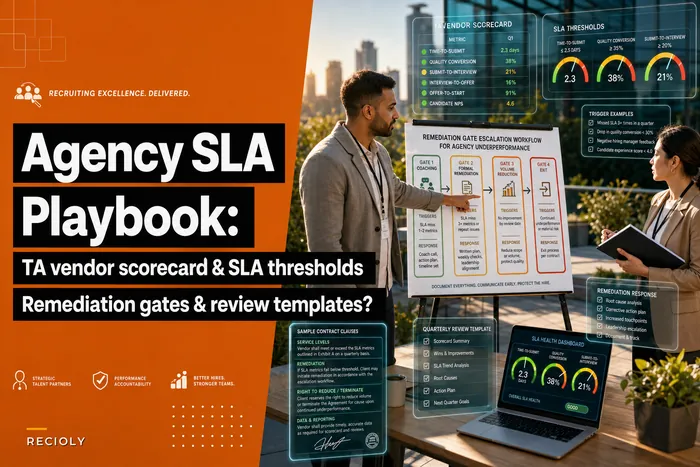
For a deeper build-out of scoring mechanics and SLA thresholds specifically for agencies, When agencies underdeliver: a TA vendor scorecard, SLA thresholds, and remediation playbook goes into the detail. The portfolio view here sits one level above that — the scorecard is the instrument; the portfolio is the system it plugs into.
Step four: remediation ladders, not surprise breakups
A lot of teams tolerate underperformance for months, then suddenly drop a vendor after one specific painful miss. The vendor is blindsided, the relationship ends badly, and institutional knowledge disappears with no replacement lined up.
-
Rung 1 — Flag (one bad quarter) Documented feedback in the scorecard review. Specific gaps, specific expectations for next quarter. No penalty yet.
-
Rung 2 — Formal watch (two consecutive misses) Written improvement plan with measurable targets and a 60–90 day window. Volume may be reduced or paused on new reqs.
-
Rung 3 — Wind-down (failed improvement plan) No new reqs assigned. Existing work completes. Replacement sourcing starts in parallel.
-
Rung 4 — Exit Contract not renewed or terminated per terms. Knowledge transfer and data handoff executed.
The value of the ladder isn't the exit — it's that most vendors respond to Rung 1. A clear, documented flag with real numbers behind it does more to fix behavior than any angry email. Vendors underperform partly because they can't see the scoreboard. Show them the scoreboard, and a surprising number of them course-correct on their own.
One exception worth calling out: if a vendor commits an actual breach — a compliance failure, data mishandling, a candidate-experience disaster that damages your employer brand — that's not a remediation situation. That's an immediate exit. Don't ladder your way through a fireable offense.
Step five: RFP cadence so renewals stop being autopilot
The single biggest source of overspend in a TA vendor portfolio is the auto-renewal nobody looked at. A three-year-old contract priced for a hot market is still billing at that rate in a soft one, because the renewal happened silently.
Fixing this doesn't mean RFP-ing everything constantly. It means a cadence tied to classification and spend band:
-
Band C / strategic Formal RFP or structured renegotiation every 24–36 months, with a competitive benchmark pulled annually regardless. You're not necessarily switching — you're making sure your incumbent knows they can be benchmarked.
-
Band B / mid Competitive check at every renewal. Doesn't have to be a full RFP; two or three comparison quotes is enough to keep pricing honest.
-
Band A / tactical Spot-check pricing annually. Switch freely when a better option shows up.
The goal isn't churn. It's removing the silence that lets bad economics persist. When your incumbent knows a benchmark is coming, their renewal quote tends to get a lot more reasonable on its own.
One thing procurement people know that recruiting people often don't: the best time to negotiate is before you're desperate. RFP-ing an RPO the same quarter you're drowning in reqs means you have no leverage. Cadence-based reviews happen on your calendar, not during a crisis — that's the whole point.
How the pieces connect (the part most teams miss)
Individually, each of these — classification, bands, scorecards, ladders, cadence — is useful. The value comes from how they chain together.
Classify vendor ↓ Assign spend band → sets approval + RFP thresholds ↓ Quarterly scorecard → generates performance score ↓ Score triggers remediation rung (if needed) ↓ Ladder activity feeds RFP decision at renewal ↓ RFP outcome updates classification + band for next cycle
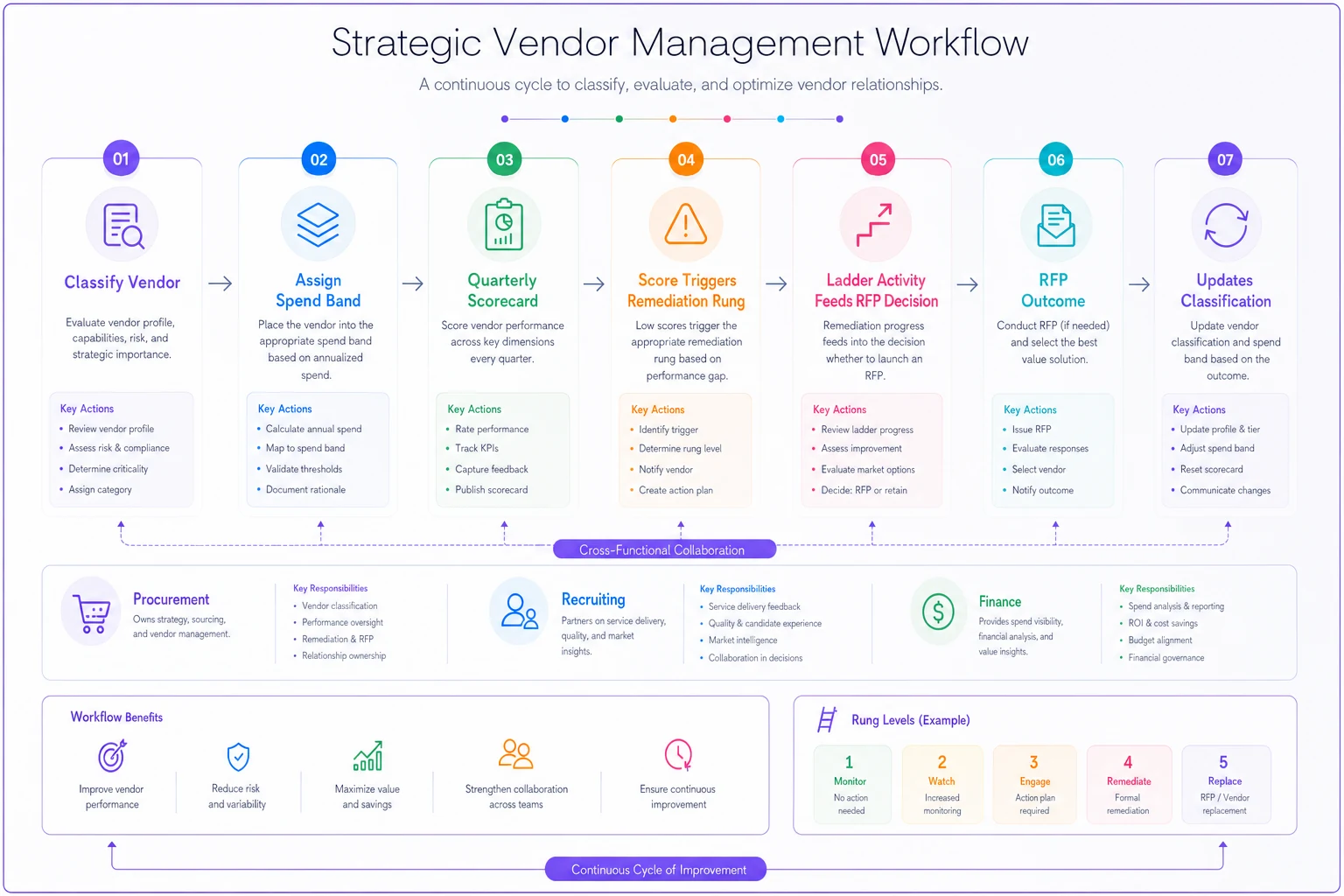
That's a closed system. Nothing falls through the gap between procurement, recruiting, and finance, because the process is the shared language between them. Finance sees spend bands. Procurement sees RFP cadence. Recruiting sees scorecards. Same data, three views.
Centralize vendor renewal dates and scorecard data in the same system to make cadence reviews routine.
Where this breaks in practice is data fragmentation. The scorecard lives in one recruiter's spreadsheet, the contract terms live in procurement's system, and the actual performance data — submits, fills, time-to-fill by vendor — lives in the ATS. When those three don't talk, governance becomes a manual reconciliation project nobody has time for, and the whole thing collapses back into autopilot renewals.
Centralizing the operational data is where things actually click. When vendor performance metrics flow automatically out of your ATS into a single scorecard view, and renewal dates and spend bands sit in the same place, the quarterly review stops being an archaeology dig. Scorecards populate themselves, renewal reminders fire before the auto-renew window closes, and the remediation ladder becomes a status field instead of a debate. The system doesn't replace judgment — it just removes the manual data-wrangling that makes teams skip governance entirely.
A real scenario
A mid-market SaaS company — around 600 employees, hiring roughly 120–150 people a year — had accumulated 11 active TA vendors over about three years. Nobody had a single view of the whole roster. Combined annual vendor spend was somewhere in the $600k–$700k range, split across two agencies, an RPO, a background-check provider, an assessment tool, a couple of sourcing platforms, and a few niche point tools.
When they finally mapped it into a portfolio, two things jumped out fast. First, two sourcing tools did basically the same job — a clear overlap nobody had noticed because different recruiters had bought them independently. Second, one contingency agency hadn't produced a hire in over half a year but was still on an arrangement that kept billing.
They classified everyone (only the RPO and the assessment platform ended up as strategic), set three spend bands, and built a simple quarterly scorecard fed from ATS data. The underperforming agency went straight to Rung 2, failed its improvement window, and got wound down. The duplicate tool was cut. At the next RPO renewal, a benchmark quote gave them the leverage to negotiate about 12% off.
Net effect after roughly two quarters: annual vendor spend came down somewhere in the $90k–$120k range, and — this part they didn't expect — quality of submissions actually improved. Reqs got concentrated with vendors who were performing instead of scattered across everyone. Fewer vendors, better managed, cheaper, and better output. That's the whole argument for a portfolio approach in one story.
When this is worth it — and when it isn't
This makes sense when you've got more than a handful of vendors, combined spend that finance is starting to ask questions about, and no single person who can tell you off the top of their head which vendors are actually delivering. If renewals happen silently and scorecards live in scattered spreadsheets, the portfolio structure pays for itself quickly.
This is overkill when you've got two or three vendors and a clear owner who talks to all of them regularly. Don't build a procurement-grade governance stack for a portfolio that fits on a sticky note. The overhead of the system should never exceed the spend it governs.
Who should not do this: a very early-stage team hiring fewer than 20–30 people a year with one or two agencies. At that scale, a lightweight vendor scorecard and a calendar reminder before renewals covers most of the value. Save the full portfolio architecture for when the sprawl is real.
Vendor sprawl isn't a discipline problem or a people problem — it's the natural result of managing contracts one at a time instead of as a system. The teams that get this right aren't smarter negotiators. They just stopped treating every vendor decision as isolated and started running the whole roster as a portfolio: classified by importance, banded by spend, scored on a rhythm, laddered when they slip, and reviewed on a cadence they control. If you're also rethinking how you invest upstream in sourcing itself, the same portfolio logic applies to channels. There's more on that in Turn sourcing into a measurable investment: a strategic sourcing framework for channel mix, cadence, and ROI. Vendors and channels are two halves of the same spend question. Manage them like a portfolio and both get cheaper, cleaner, and easier to defend when finance comes knocking.
Ready to elevate your hiring process?
Join 1,500+ recruiting teams using Recioly to save time, improve collaboration, and hire smarter.