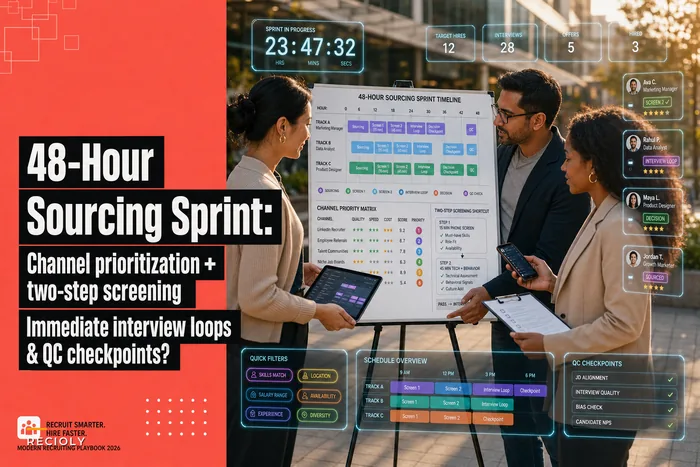



The engineering team needs 12 backend developers by Q2. Marketing wants three growth specialists yesterday. Sales is screaming for SDRs. Your sourcing team splits effort across LinkedIn, job boards, referrals, and agencies with no real sense of which channel actually delivers quality hires at a reasonable cost.
Sound familiar? Building operational software for recruiting teams ranging from 5-person startups to 300-person talent acquisition departments, I've watched this pattern quietly destroy recruiting efficiency over and over.
The teams that consistently hit hiring targets without blowing through budget treat sourcing like an investment portfolio. They know which channels deliver for which roles, when to double down, and when to cut losses. They run quarterly reviews that drive actual decisions — not just reports nobody reads.
Why sourcing strategy falls apart (and stays broken)
Most recruiting operations start simple. Post on LinkedIn, maybe Indeed, ask for referrals. Works fine when you're hiring three people a quarter.
Then volume increases. Different roles need different approaches. That backend developer pipeline that worked great six months ago dries up. The agency that sent great sales candidates now sends duds. Nobody tracks what changed or why.
The real killer is that teams keep throwing resources at broken channels because they don't have visibility into actual performance. One recruiting team I worked with spent $48,000 on a premium job board subscription that produced two hires in six months. They renewed it anyway because "that's where we've always posted engineering roles."
Meanwhile, their employee referral program — which cost almost nothing to run — generated 40% of their technical hires. Nobody noticed because channel-specific metrics stopped at "applications received."
This isn't a data problem. It's a strategic sourcing framework problem.
Building your channel investment matrix
Think of each sourcing channel as an investment with four key metrics: Cost per qualified candidate (not just cost per application) Time to qualified candidate (from channel activation to first qualified profile) Quality score (conversion rate through your hiring funnel) Volume capacity (how many qualified candidates the channel can realistically deliver)
Never lose track of top talent again.
Recioly helps you manage every stage of recruiting efficiently, from application to offer.
- Centralized candidate tracking
- Automated interview scheduling
- Collaborative hiring workflows
No credit card required
Here's what an actual channel matrix looks like for a 50-person SaaS company:
| Channel | Monthly Cost | Qualified Candidates/Month | Cost per Qualified | Avg Days to Qualified | Interview Conversion | Hire Rate | Volume Cap |
|---|---|---|---|---|---|---|---|
| LinkedIn Recruiter | $1,200 | 28 | $43 | 3 | 62% | 18% | 40-45 |
| Indeed Sponsored | $800 | 45 | $18 | 5 | 31% | 8% | 60-70 |
| Employee Referrals | $500 (avg bonus) | 12 | $42 | 8 | 78% | 34% | 15-20 |
| AngelList | $350 | 8 | $44 | 4 | 55% | 22% | 10-12 |
| Agency (Technical) | $0 upfront | 6 | $0 upfront* | 2 | 71% | 28% | 8-10 |
| University Programs | $200 | 15 | $13 | 14 | 44% | 15% | 20 (seasonal) |
*Agency cost hits on placement at roughly $15k per hire
Three things jumped out immediately from this data:
-
Indeed generated volume but quality was poor (8% hire rate)
-
Employee referrals had the best ROI despite higher upfront cost per candidate
-
The agency channel performed well but couldn't scale beyond 8-10 candidates monthly
The agency channel performed well but couldn't scale beyond 8-10 candidates monthly
Channel mix optimization by role family
Different roles need different channel strategies. Your sourcing framework should segment channels by role family — not dump everything into one bucket.
Technical roles typically break down like this:
-
40% from LinkedIn direct outreach
-
25% from specialized job boards (AngelList, Stack Overflow)
-
20% from employee referrals
-
15% from agencies for senior positions
Sales and customer success roles:
-
35% from Indeed/ZipRecruiter (higher volume tolerance)
-
30% from LinkedIn
-
25% from referrals
-
10% from sales-specific communities
Executive and leadership positions:
-
60% from executive search firms
-
30% from direct network outreach
-
10% from selective job postings
Where most teams go wrong is applying these percentages without considering their actual market. A fintech startup in NYC has completely different channel dynamics than a healthcare SaaS in Austin. Test, measure, and adjust based on your own results — not industry benchmarks.
Replenishment cadence and pipeline health
The biggest operational failure? Teams only activate sourcing channels when pipelines are empty. That's like waiting until you're out of gas to start looking for a station.
Pipeline depth targets: For every open role, maintain 8-12 qualified candidates at various stages. When it drops below 6, activate additional channels.
Lead time buffers: Engineering roles average around 47 days to fill. Start sourcing 60 days before anticipated need, not when the req opens.
Seasonal adjustments: University recruiting delivers in May and December. Agency capacity drops in August. Plan channel activation around these realities.
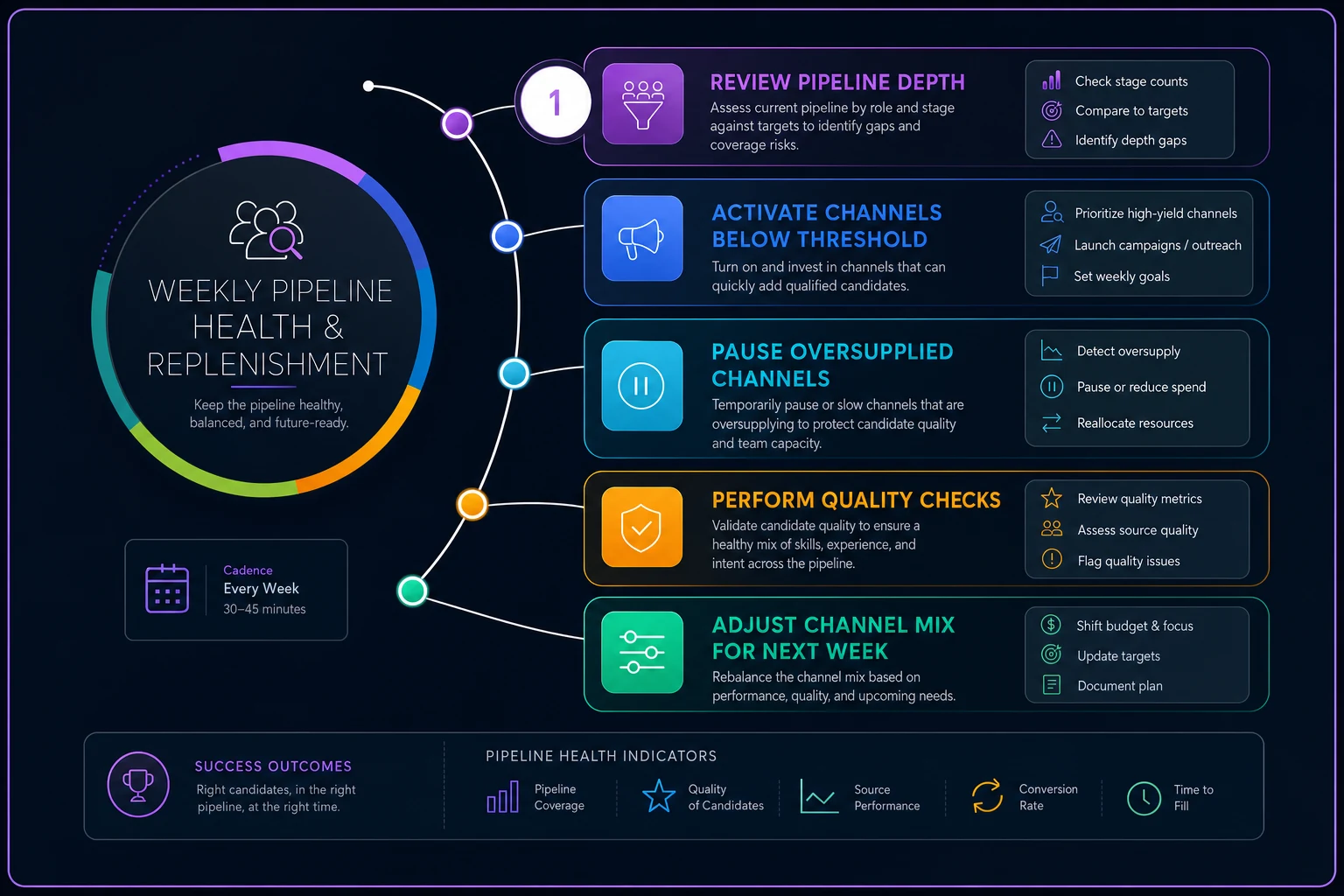
One team I worked with implemented weekly pipeline health checks:
-
Monday
Review pipeline depth by role
-
Tuesday
Activate channels falling below threshold
-
Wednesday
Pause oversupplied channels
-
Thursday
Quality check recent channel outputs
-
Friday
Adjust next week's channel mix
Here's a visual of the weekly pipeline health and replenishment workflow.
It replaced their previous panic-mode sourcing with something predictable and measurable.
The retire/scale decision matrix
Scale triggers:
-
Cost per hire below company average for 2+ quarters
-
Quality score (interview to offer ratio) above 40%
-
Can deliver 20%+ more volume without degrading quality
-
Time to fill faster than department average
Retirement triggers:
-
Cost per hire 2x above company average for 2 consecutive quarters
-
Quality score below 20% after optimization attempts
-
Channel requires more management time than value delivered
-
Better alternative channel identified and validated
One recruiting team burned $72,000 annually on a diversity job board that sounded great in theory but delivered three hires over 18 months. They kept renewing because "diversity is important to us."
Diversity absolutely matters. But that same budget could have funded targeted outreach programs, partnerships with diverse professional organizations, or scholarship pipelines that actually worked. The framework forced them to confront actual ROI instead of just good intentions.
Quarterly review templates that drive decisions
A quarterly review structure that actually works:
Section 1: Channel Performance Ranking
-
Rank all active channels by cost per quality hire
-
Identify top 3 performers and bottom 3
-
Calculate quarter-over-quarter change
Section 2: Investment Reallocation
-
Propose specific budget shifts from bottom to top performers
-
Required
Move at least 15% of budget each quarter
-
Document reasoning for any channel maintaining the same investment
Section 3: New Channel Tests
-
Identify 1-2 new channels to test next quarter
-
Define success metrics before launch
-
Set maximum test budget (usually 10% of total sourcing budget)
Section 4: Channel Sunset Decisions
-
List channels meeting retirement criteria
-
Set specific sunset dates
-
Document migration plan for active candidates
Make decisions mandatory. Every channel either gets more investment, less investment, or gets retired. No "let's wait and see."
Operational coordination across your recruiting stack
When you're moving fast on critical hires, your channel strategy determines whether you can actually deliver candidates in 48 hours. LinkedIn Recruiter gives you immediate access to profiles, but agency partners often deliver pre-screened candidates faster when speed matters more than cost.
The framework also feeds your analytics foundation. Building even a minimal recruitment analytics system becomes far more valuable when you have clean channel attribution data. You can finally answer "what's our actual ROI on LinkedIn Recruiter?" instead of estimating.
Common framework failures and fixes
Failure: Tracking applications instead of quality Teams celebrate channels that deliver 500 applications while ignoring that 490 are unqualified. Track candidates who pass the initial screen, not raw volume.
Failure: Ignoring total cost of channel management That "free" job board posting requiring 3 hours weekly to manage isn't free. Factor in recruiter time at roughly $50-75/hour when calculating true channel cost.
Failure: Over-relying on single channels When LinkedIn delivers 70% of your hires, you're one algorithm change away from a crisis. No channel should exceed 40% of successful placements unless you're comfortable with that concentration risk.
Failure: Not accounting for channel interaction effects Candidates often touch multiple channels. That LinkedIn hire might have started with an Indeed posting. Build attribution models that recognize multi-touch journeys, even simple ones.
The compound effect of systematic sourcing
A strategic sourcing framework isn't about finding one perfect channel. It's about building a systematic approach that compounds over time.
Quarter 1: You identify that technical referrals convert at 3x the rate of cold outreach. Quarter 2: You shift budget to referral bonuses and see 20% more technical hires. Quarter 3: You optimize referral messaging and boost participation by 30%. Quarter 4: Your cost per technical hire drops 40% year-over-year.
None of that happens without treating sourcing as a measurable investment portfolio.
Teams using this kind of framework consistently report a 30-40% reduction in cost per hire within six months, faster time to fill on critical roles, and significantly less time spent reviewing unqualified candidates. The dependency on expensive agencies tends to drop too — not because agencies are bad, but because you have better alternatives generating results.
More importantly, you build institutional knowledge about what actually works for your specific hiring context. That compounds into a real competitive advantage as you scale.
Making the framework stick
The best framework means nothing if your team doesn't use it.
Start with just three channels. Don't try to optimize everything at once. Pick your highest-volume channels and build the process around those. Add more once the habit is established.
Set up short weekly channel reviews — 15 minutes, focused on specific metrics. Not a strategy session. An operational check-in.
Create channel owners. Each recruiter owns 1-2 channels and becomes the expert responsible for optimization, testing, and reporting.
Build the review into existing recruiting operations, not as a separate add-on. Integrate channel metrics into pipeline reviews and planning sessions that are already happening.
And celebrate the wins. When a channel retirement saves $5,000 monthly, make sure the team knows. When a new channel test fails, document why and share the learning so someone else doesn't repeat it.
Start with just three channels.
The teams that get real value from this treat it like any other operational system — with clear processes, defined ownership, and regular improvement cycles. It stops being an analysis project and starts being how recruiting actually operates.
Your sourcing channels are investments. Start treating them that way.
Ready to elevate your hiring process?
Join 1,500+ recruiting teams using Recioly to save time, improve collaboration, and hire smarter.