

You get the call at 2pm Monday. The VP of Engineering just quit. The board wants three viable candidates by end of week. Your regular sourcing process takes 14 days minimum just to build pipeline.
This is when you pull out the rapid sourcing playbook — the operational framework that compresses weeks of recruiting work into 48 intense hours. Not for every role, not for volume hiring, but for those mission-critical positions where waiting means losing deals, missing product launches, or watching teams fall apart.
Regular sourcing and rapid sourcing aren't just different in pace. They require different tradeoffs entirely. You screen wider but shallower. You activate channels that cost more but respond faster. You run parallel processes that normally happen in sequence.
Most recruiting teams never document their emergency playbooks. They scramble each time, reinvent the same shortcuts, make the same mistakes. After watching dozens of teams handle urgent fills, the patterns become pretty clear — the ones that consistently deliver in 48-hour sprints follow remarkably similar operational frameworks, even when they've never compared notes.
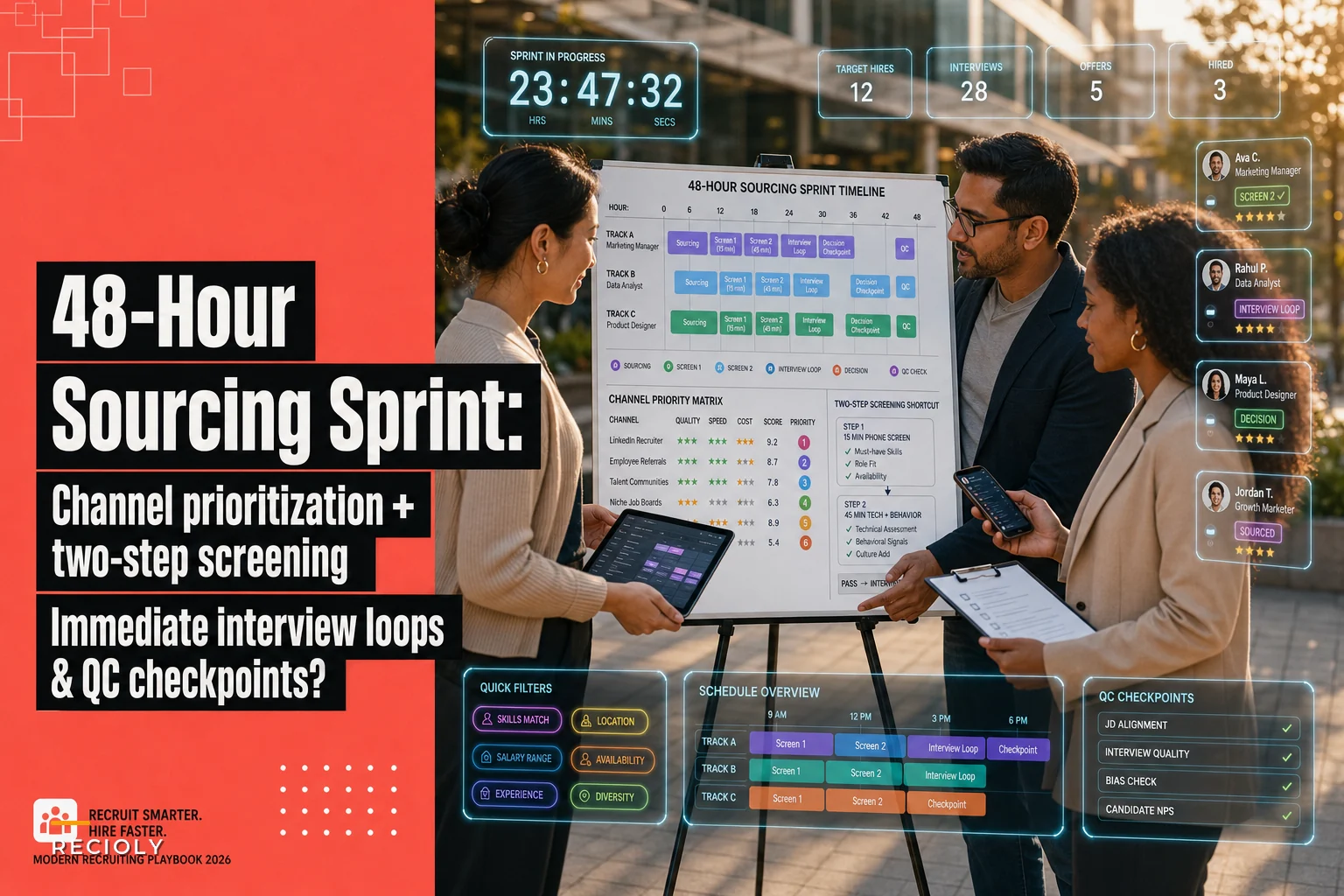
Channel prioritization matrix for speed hiring
Not all sourcing channels are built for speed. LinkedIn InMail might have a 12% response rate over seven days, but only around 3% respond within 24 hours. Employee referrals convert at 40% but take an average of nine days to materialize. When you have 48 hours, channel selection determines everything.
The fastest channels aren't always the best channels. They're just the ones that respond immediately.
Tier 1: Immediate response (0–4 hours)
-
Warm pipeline candidates already engaged
-
Previous silver medalists from recent searches
-
Contract recruiters with ready networks
-
Executive search firms with active candidates
Tier 2: Same-day response (4–12 hours)
-
Direct phone outreach to passive candidates
-
Text messaging to previous applicants
-
Slack communities and Discord servers
-
WhatsApp groups for specific industries
Tier 3: Next-day response (12–24 hours)
-
Premium job board postings with boost features
-
Targeted social media ads with urgency messaging
-
University alumni networks
-
Professional association member directories
The math changes completely in rapid sourcing. A channel with 50% lower quality but 10x faster response becomes your primary weapon. You'd never use text messaging for normal executive search, but when you need responses in hours not days, that 71% open rate within the first hour suddenly matters more than professional decorum.
One biotech startup needed a Chief Medical Officer after their incumbent had a family emergency. They activated all Tier 1 channels simultaneously — three executive search firms, their warm pipeline from a CMO search six months earlier, and direct outreach to five physicians who'd previously expressed interest in startup roles. Within four hours, they had seven candidates willing to interview immediately. Not all were right for the role, but three were strong enough to present to the board.
Two-step screening shortcut
Traditional screening involves resume review, recruiter phone screen, hiring manager screen, then technical assessment. That's a minimum five-day process with scheduling delays alone. The two-step rapid screen compresses this into two high-signal interactions that happen within hours.
Never lose track of top talent again.
Recioly helps you manage every stage of recruiting efficiently, from application to offer.
- Centralized candidate tracking
- Automated interview scheduling
- Collaborative hiring workflows
No credit card required
Step 1: The Knockout Questionnaire (2 hours)
-
Can you start within [specific timeframe]?
-
Do you have [absolute must-have qualification]?
-
Are you authorized to work without sponsorship?
-
Is your expected compensation within [range]?
-
Can you relocate/work from [location] if needed?
These aren't the questions you'd ask in a thoughtful hiring process. They're blunt filters designed to rapidly identify who can actually take the job. Every question should eliminate at least 20% of respondents. If everyone passes, your questions are too soft.
Step 2: The 15-Minute Video Screen (4 hours)
-
Why are you open to moving right now? (Shows availability and motivation)
-
Tell me about [specific relevant project/experience]? (Shows capability)
-
What would you need to accept an offer this week? (Shows seriousness)
Record every call. You don't have time for multiple screening rounds, so these recordings become your reference material. Share them with hiring managers who can review asynchronously while you're still working through the next batch.
A marketing agency lost their Creative Director three days before a major client pitch. They sent the knockout questionnaire to 47 candidates from various sources. 19 responded within two hours. 11 passed all five questions. They scheduled video screens for that afternoon, completed nine calls — two no-shows — and identified four strong candidates by 6pm the same day.
Quality wasn't as high as their normal process. They later admitted one hire from this batch wouldn't have made it through regular screening. But they had a Creative Director in place for the pitch, which saved a $2M account.
Immediate interview loop templates
The traditional interview loop — multiple rounds, panel interviews, take-home assignments — assumes you have weeks to evaluate candidates. In a 48-hour sprint, you need interview templates that extract maximum signal in minimum time.
The Compressed Loop Structure:
-
Hour 0–4
Initial outreach and responses
-
Hour 4–8
Knockout questionnaire and video screens
-
Hour 8–24
Sleep/candidate processing time
-
Hour 24–32
Intensive interview rounds
-
Hour 32–40
References and decision making
-
Hour 40–48
Offer preparation and delivery
The actual interviews happen in an 8-hour block on day two. The critical part: you run them in parallel, not series. While Candidate A is meeting with the hiring manager, Candidate B is with the technical team, and Candidate C is doing a case study presentation.
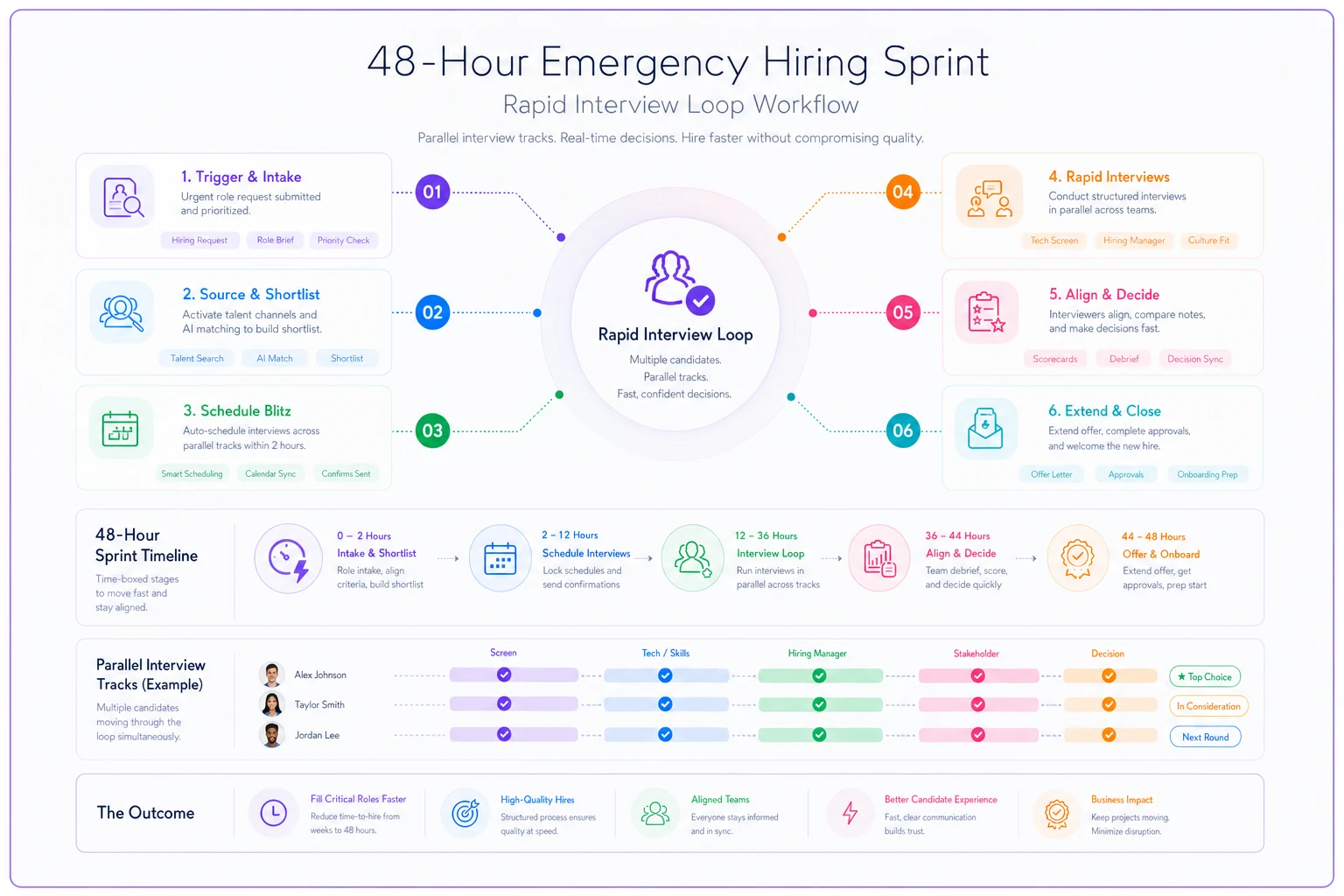
Here's a quick visual of how parallel interviews, screening, and decision points overlap during the 48-hour sprint.
Interview Template 1: The Behavioral Sprint (45 minutes)
-
10 minutes
Role expectations and urgent timeline explanation
-
25 minutes
Five behavioral questions mapped to critical competencies
-
10 minutes
Candidate questions and next steps
Interview Template 2: The Technical Verification (60 minutes)
-
15 minutes
Review of specific technical claims from resume
-
30 minutes
Live problem-solving relevant to immediate needs
-
15 minutes
Technical Q&A with team members
Interview Template 3: The Culture Fit Speed Round (30 minutes)
-
Multiple 5-minute conversations with potential teammates
-
Focus on work style, communication preferences, conflict resolution
-
Immediate thumbs up/down from each interviewer
These aren't comprehensive evaluations. They're targeted probes designed to surface major red flags and confirm basic competency. You're not trying to find the perfect candidate — you're trying to avoid a disaster hire while moving fast enough to solve the urgent problem.
Quality control checkpoints that don't slow you down
Speed hiring without quality control leads to expensive mistakes. Traditional quality measures — multiple interview rounds, extensive references, background checks — take weeks. The rapid sourcing playbook needs lightweight checkpoints that catch major issues without killing momentum.
Checkpoint 1: The Overlap Analysis (Hour 20)
While candidates are processing overnight, compare all screening notes for patterns. Do multiple candidates mention the same concerns about the role? Are you seeing consistent experience gaps across the pool? Have any candidates given contradictory information between touchpoints?
Takes about 30 minutes but catches screening mistakes before you waste interview time. One fintech company discovered three of their five "qualified" candidates had misunderstood the role as remote when it required office presence. They corrected this before interview day and saved themselves eight hours of pointless conversations.
Checkpoint 2: The Reference Spot Check (Hour 30)
-
Call their most recent direct manager
-
Three questions only
Would you rehire? What's their biggest weakness? Can they handle [specific challenge]?
-
10-minute maximum
If you can't reach that reference immediately, try their second most recent manager. If neither responds within two hours, check LinkedIn for mutual connections who might provide informal insight.
Checkpoint 3: The Offer Pre-Check (Hour 36)
-
LinkedIn profile matches resume claims
-
Google search reveals no obvious red flags
-
Salary expectations haven't shifted since initial screen
One e-commerce company caught a candidate claiming to be "VP of Marketing at Amazon" when LinkedIn showed "Marketing Manager at Amazon Marketplace Seller." That 10-minute check saved them from a bad hire and a lot of embarrassment.
These checkpoints aren't foolproof. You'll miss things a thorough process would catch. But they prevent the most egregious mistakes while keeping you inside the 48-hour window.
When to deploy (and when to resist) rapid sourcing
The rapid sourcing playbook is powerful but dangerous. Like performing surgery in a field hospital — sometimes it's necessary, but it should never be your first choice.
Deploy rapid sourcing when:
-
Business continuity depends on immediate replacement
-
You're losing more than $50k per week without the role filled
-
A critical project or client relationship is at risk
-
Regulatory or compliance requirements demand immediate coverage
-
You've already tried normal sourcing for 30+ days without results
Resist rapid sourcing when:
-
The urgency is artificial (arbitrary deadlines, impatient executives)
-
You're hiring for culture-sensitive or long-term strategic roles
-
The role requires rare, specialized skills with a small talent pool
-
You haven't defined what "good enough" actually looks like
-
The hiring manager isn't available for compressed interview schedules
The failure rate for rapid sourcing hires runs roughly 2x higher than normal process hires. Around 35% leave or get terminated within six months, compared to about 18% for standard recruiting. But sometimes a 65% success rate in 48 hours beats an 82% success rate in six weeks.
A logistics company faced this tradeoff when their Head of Operations had a heart attack. Every day without leadership cost them around $30k in delayed shipments and overtime. They activated the rapid sourcing playbook, hired a "good enough" candidate in 48 hours, and kept operations running. Six months later, they replaced that person with a stronger long-term hire through normal recruiting. The interim solution wasn't perfect, but it prevented a complete operational meltdown.
Building your own rapid response capability
Most recruiting teams discover they need rapid sourcing capability during a crisis. That's like learning to swim while drowning. The teams that execute 48-hour fills successfully have already built the infrastructure before they need it.
Start with the boring but critical foundation: maintain warm pipelines for critical roles even when you're not actively hiring. Keep silver medalists engaged with quarterly check-ins. Build relationships with search firms before you need them. Document institutional knowledge about where to find specific talent quickly.
Create pre-approved interview loops for emergency hires. Get budget pre-approval for premium sourcing channels. Train interviewers on compressed evaluation techniques. This isn't paranoid over-preparation — it's operational readiness for inevitable surprises.
The technology stack matters too. Your normal ATS might take 20 minutes to create a new requisition. In rapid sourcing, you need systems that move at the speed of crisis. Some teams maintain a separate lightweight tracking system just for emergency hires — even a shared spreadsheet beats waiting for IT approvals.
Maintain a pre-approved vendor and budget list so procurement doesn't block emergency sourcing.
This infrastructure investment pays off when the 2pm Monday call comes and you need to move immediately.
Pattern recognition from failed sprints
Not every rapid sourcing sprint succeeds. The failures teach more than the successes. Three patterns show up repeatedly in failed 48-hour attempts.
First, scope creep kills speed. The hiring manager who insists on "just one more candidate" or "let's also consider remote options" doesn't understand the tradeoffs. Every scope expansion adds 12–24 hours minimum. Define the target precisely and reject all scope changes during the sprint.
Second, parallel processing breaks down when one person becomes a bottleneck. Usually it's the hiring manager who insists on personally screening every candidate before interviews proceed. Build redundancy into every step or accept that some decisions will happen without full consensus.
Third, candidates sense desperation and either withdraw or negotiate aggressively. The tone should be "urgent but selective," not "desperate and willing to compromise." One failed sprint saw three candidates — who happened to know each other — coordinate to collectively demand 40% above market rate, knowing the company had no real alternatives.
A software company learned this lesson expensively. They lost their Chief Revenue Officer two weeks before end of quarter. The sprint started well — strong candidate pool, fast screening, immediate interviews. Then the CEO insisted on personally interviewing all five finalists, then traveled unexpectedly, adding three days to the process. By the time they made an offer, their top choice had accepted elsewhere and their backup demanded a $100k signing bonus. They ended up with their third choice at premium compensation.
The handoff to normal operations
The rapid sourcing playbook gets someone in the door, but the real work starts after the crisis ends. These accelerated hires need different onboarding, different expectations, and different success metrics.
Document what was skipped during the rushed process. Maybe you didn't check references thoroughly, or skipped the culture fit assessment, or didn't verify all technical claims. Plan to evaluate these within the first 30 days — not to find reasons to fire someone, but to identify support needs early.
Set explicit 30-60-90 day checkpoints with higher touch than normal hires. Weekly one-on-ones instead of biweekly. Assign a buddy in addition to their manager. Provide extra context about company culture and process that normally emerges during longer interview cycles.
Most importantly, separate emergency performance from long-term fit. Someone who can step into a crisis and deliver immediate value might not be the right person for the role once things stabilize. That's okay. Sometimes you need a battlefield medic, not a surgeon. Plan for a possible transition once the dust settles.
Real numbers from the field
A 200-person SaaS company tracked their rapid sourcing metrics across seven emergency hires over the course of a year:
| Metric | Result |
|---|---|
| Average time to offer | 52 hours (target was 48) |
| Candidates screened per hire | 31 |
| Interview hours per hire | 12 |
| Cost per hire | $18,000 (vs $8,000 normal) |
| 90-day retention | 71% |
| 6-month performance rating | 3.1/5 (vs 3.7/5 for normal hires) |
These aren't numbers to celebrate. They're numbers to accept when the alternative is operational failure. The rapid sourcing playbook isn't about excellence — it's about speed with acceptable quality when time matters more than perfection.
Integrating operational software for rapid sourcing
The manual coordination required for 48-hour hiring sprints breaks most recruiting teams. Tracking candidates across multiple channels, coordinating parallel interviews, managing rapid feedback loops — technically possible with spreadsheets and email, but barely.
This is where AI-powered operational software starts to earn its place. Instead of manually tracking which candidates responded to which outreach, automated systems pull responses across all channels into a single view. Rather than playing calendar Tetris to schedule parallel interviews, intelligent scheduling finds available slots and sends invites without someone manually chasing availability.
The real acceleration comes from eliminating coordination overhead. When five interviewers need to share feedback immediately, AI-assisted triage systems centralize notes and surface patterns without waiting for everyone to submit scorecards. Automated reference checks can run in parallel while interviews are still happening. Even simple automation like templated messages for each stage saves hours when every minute counts.
One recruiting team cut their emergency hire time from 72 to 38 hours after implementing operational software that automated candidate tracking, interview scheduling, and feedback collection. The system didn't make decisions — it eliminated the administrative friction that usually kills speed. They still ran the same two-step screening, still conducted intensive interviews, still made all the judgment calls themselves. But without manual coordination overhead, they could focus on evaluation rather than logistics.
The software particularly helps during the parallel processing phase. While one recruiter screens candidates, another reviews automated reference checks, and a third coordinates interviews — all working from the same real-time data. No confusion about candidate status, no duplicate outreach, no missed handoffs. For teams also considering asynchronous video screening, the right platform makes it significantly easier to score and compare candidates quickly without adding scheduling complexity.
For teams running rapid sourcing more than twice a year, the infrastructure investment pays for itself in the first crisis. Burning out recruiters with manual coordination marathons isn't sustainable, even when it occasionally works.
Speed as a capability, not a panic response
The rapid sourcing playbook isn't about lowering standards or accepting mediocrity. It's about building operational capability to respond when business continuity demands speed over process perfection.
Teams that execute 48-hour sprints successfully don't treat them as exceptions to their recruiting process — they treat them as a different process entirely, with different rules, metrics, and expectations. They practice the muscle movements before the crisis hits. They maintain the infrastructure between emergencies. They document what worked and what broke for the next time.
Because there's always a next time. The executive who quits without notice. The specialist who gets poached by a competitor. The critical role that suddenly becomes urgent when a major customer threatens to walk. These aren't planning failures — they're operational realities that require operational responses.
The rapid sourcing playbook provides that response. Not perfect, not pretty, but functional when speed matters most. Build the capability before you need it, and when that 2pm Monday call comes, you'll be ready to deliver by Wednesday close of business.
Some roles deserve months of careful sourcing and evaluation. But when the building's on fire, you don't interview multiple contractors — you call the one who can show up immediately with the right equipment. Keep the playbook maintained, practiced, and ready to deploy. Your future crisis-mode self will thank you.
Ready to elevate your hiring process?
Join 1,500+ recruiting teams using Recioly to save time, improve collaboration, and hire smarter.