

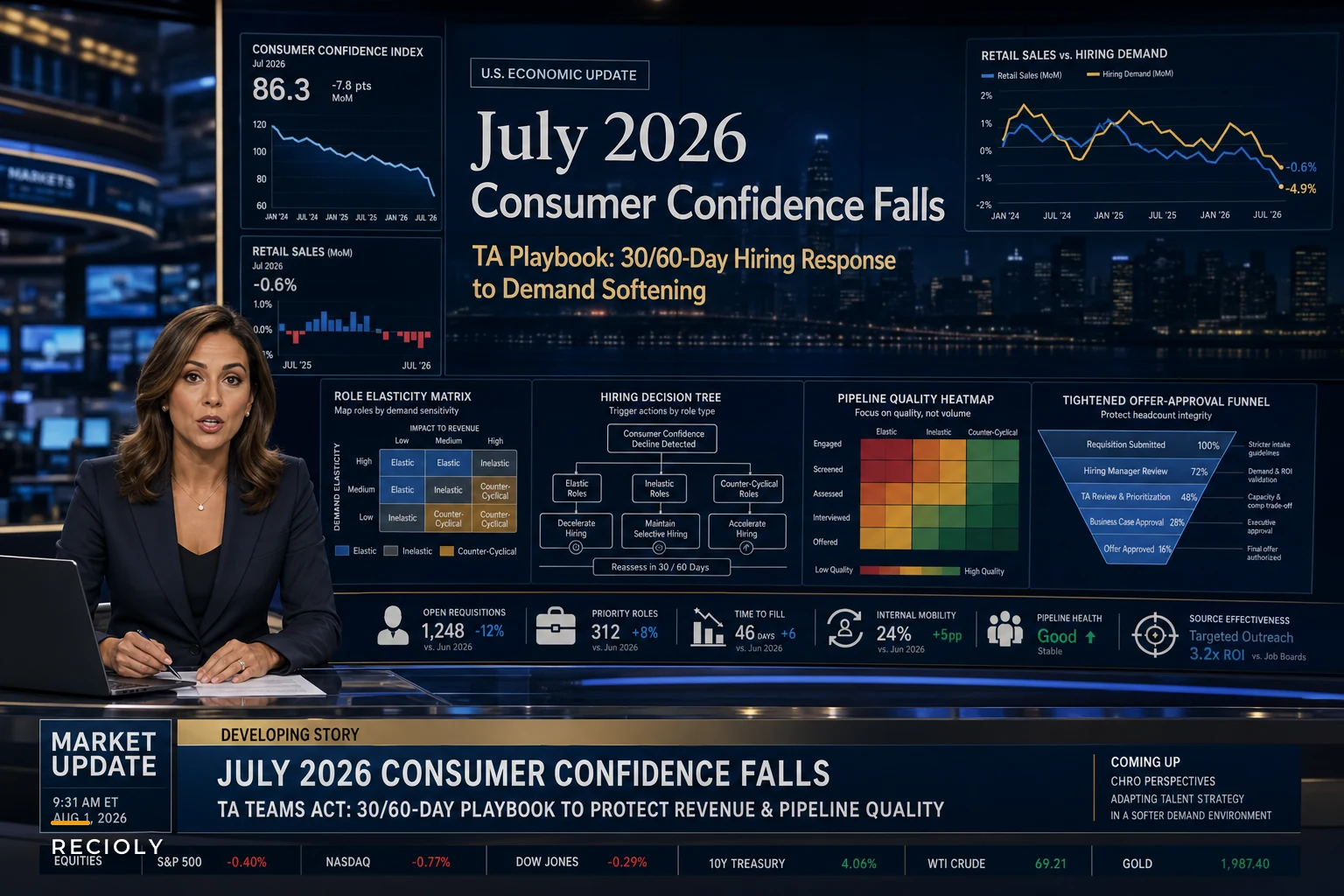

The latest consumer confidence numbers are out, and they're not great. Reuters reported this week that U.S. consumer confidence eased in July, with households showing weaker perceptions of the labor market. For recruiting teams at consumer-facing companies—retail, hospitality, subscription services, discretionary goods—this signals something specific: your hiring landscape is about to shift, and probably not in your favor.
When consumer confidence drops, the ripple effects hit recruiting operations fast. Marketing slashes ad spend. Sales projections get revised down. CFOs start asking uncomfortable questions about headcount. Meanwhile, you're sitting on 47 open requisitions, three offers pending acceptance, and a sourcing pipeline you've spent months building.
The knee-jerk response? Freeze everything. Cancel requisitions. Tell recruiters to pause activity. Then six weeks later when demand picks back up slightly, everyone scrambles to restart cold pipelines—and now you're paying agency fees to fill roles you could've hired for directly if you'd just maintained some momentum.
The elasticity trap most TA teams fall into
When consumer confidence hiring patterns shift, companies with consumer spending exposure face this weird duality: some roles become immediately less critical (that third retail associate for the new location), while others become more critical (the data analyst who can optimize inventory during demand uncertainty). But most TA teams treat all requisitions the same during slowdowns.
A mid-size e-commerce company made this exact mistake. Consumer spending softened in their category, so they froze all hiring—including a supply chain analyst role that could have saved them around $400K in inventory carrying costs, and a customer retention specialist who probably could have cut churn by 12%. They saved maybe $180K in salaries over three months while bleeding close to $800K in operational inefficiency.
The real problem isn't that hiring slows during consumer confidence dips. It's that TA teams don't have a framework for selective slowdowns. They don't categorize roles by demand elasticity. They don't have pre-built decision trees for which roles to accelerate versus decelerate. They operate in binary mode: hire everything or hire nothing.
Building your demand-elastic hiring framework
Start by mapping your open requisitions into three buckets based on their relationship to consumer demand volatility:
Never lose track of top talent again.
Recioly helps you manage every stage of recruiting efficiently, from application to offer.
- Centralized candidate tracking
- Automated interview scheduling
- Collaborative hiring workflows
No credit card required
Demand-elastic roles (scale with consumer activity):
-
Front-line sales positions
-
Customer service expansion roles
-
Retail operations staff
-
Marketing campaign managers
-
Seasonal or surge capacity
Demand-inelastic roles (critical regardless of consumer patterns):
-
Core engineering and product
-
Finance and accounting
-
Legal and compliance
-
Security and infrastructure
-
Key leadership positions
Counter-cyclical roles (become more valuable during downturns):
-
Cost optimization analysts
-
Process improvement specialists
-
Retention and loyalty managers
-
Pricing strategy roles
-
Efficiency automation positions
Most companies discover their requisition mix is roughly 40% elastic, 35% inelastic, and 25% counter-cyclical. Yours will vary based on industry and business model, but the pattern holds surprisingly well across consumer-exposed sectors.
Once you have this categorization, you can build differentiated playbooks for each bucket. Elastic roles get extended timelines, tighter salary bands, and higher quality bars. Inelastic roles maintain pace but with tighter cost controls. Counter-cyclical roles actually accelerate—these hires pay for themselves through efficiency gains.
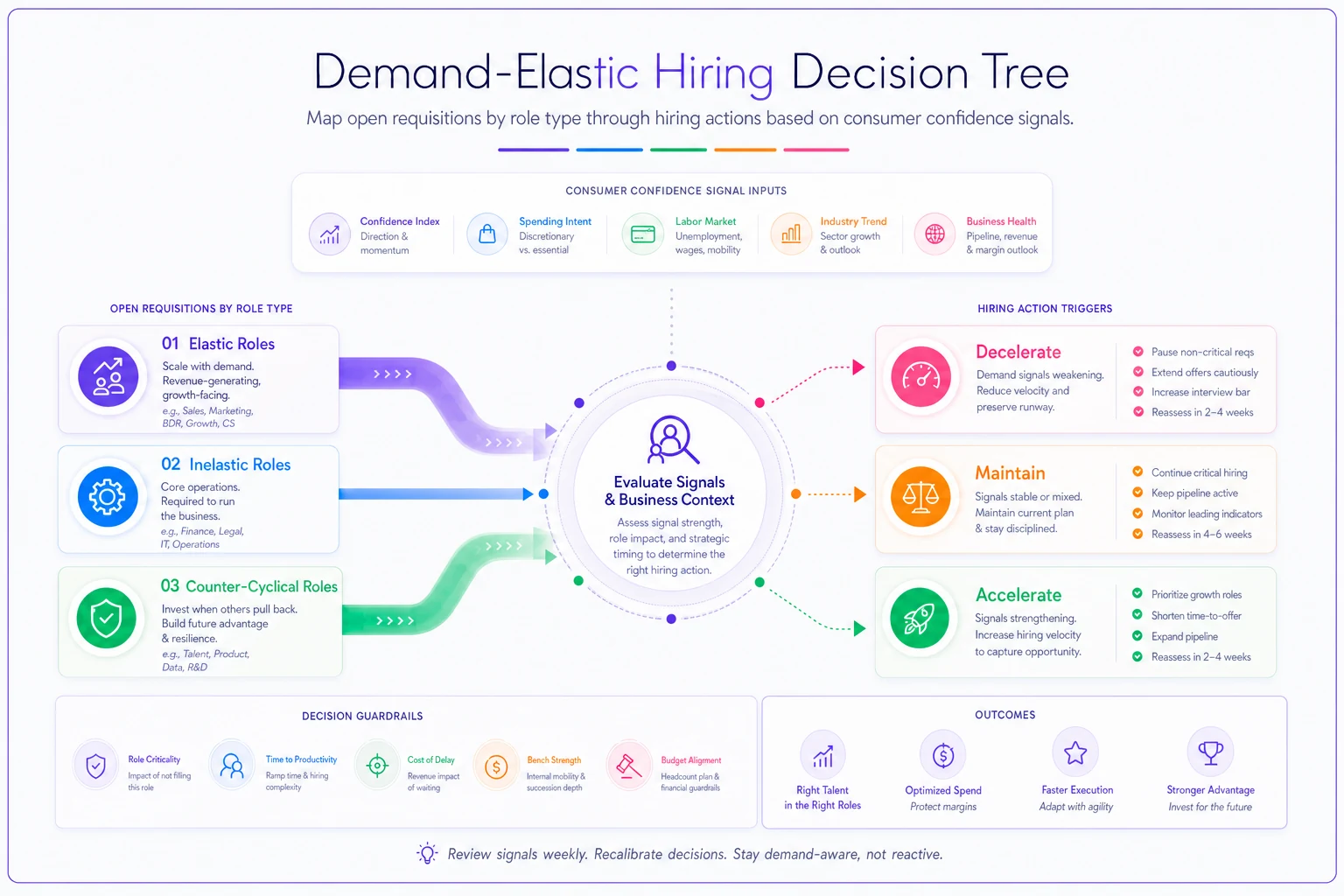
[WORKFLOW GRAPH PLACEHOLDER — Demand-Elastic Hiring Decision Tree: Maps open requisitions by role type (Elastic / Inelastic / Counter-Cyclical) through hiring action triggers (Decelerate / Maintain / Accelerate) based on consumer confidence signal inputs]
The quality paradox during slowdowns
Something counterintuitive happens during consumer confidence dips: your candidate quality can actually improve, but only if you adjust your sourcing and evaluation approach correctly.
When consumer spending weakens, risk-averse candidates who normally wouldn't consider moves start exploring options. The senior operations manager at a struggling retailer. The head of customer success at an overextended D2C brand. The data scientist at a venture-backed marketplace burning through runway. These candidates suddenly become available—but they're also more selective about stability and long-term prospects.
Your sourcing message needs to shift. Instead of "join our rocket ship," it becomes "help us build sustainable operations through any market cycle." Instead of emphasizing equity upside, you lean into base compensation stability and benefits quality. Companies that miss this shift wonder why their response rates crater during slowdowns. They're still sending hypergrowth messaging while candidates are quietly evaluating which companies survive a recession.
Evaluation criteria should shift too. During expansion, you prioritize candidates who can scale fast, take risks, build from scratch. During uncertainty, you want operators who've managed through cycles—people who understand cost discipline and can optimize existing systems rather than just build new ones.
Restructuring your pipeline velocity for preservation mode
Normal recruiting metrics assume consistent demand and budget availability. Time-to-fill, cost-per-hire, offer acceptance rate—these all presume you're optimizing for speed and volume. During consumer confidence shifts, you need different metrics that reflect preservation of quality and budget flexibility.
Replace time-to-fill with "time-to-quality-fill"—how long to find someone who exceeds the bar rather than just meets it. Track "pipeline preservation rate"—what percentage of strong candidates remain engaged even if hiring slows. Monitor "budget efficiency score"—actual comp versus budgeted comp for accepted offers.
The operational workflow changes too. Instead of pushing every candidate through as fast as possible, you build holding patterns. Phone screens might extend from 30 to 45 minutes to gather more signal. You might add an async assessment between rounds. Not to create artificial delays, but to make sure you're only advancing candidates who are genuinely strong fits.
Some teams worry this damages candidate experience, but done right it actually improves it. Candidates appreciate thoroughness during uncertain times. They want to know you're evaluating seriously, not just rushing to fill seats.
Channel optimization when budgets tighten
Sourcing channel ROI becomes critical during consumer confidence hiring shifts. That LinkedIn Recruiter seat costing $8K annually needs to justify itself. Job board posts at $400 each need to demonstrate value. The employee referral program with $3K bonuses needs scrutiny.
| Channel | Recommended Action | Why It Works During Downturns |
|---|---|---|
| Employee referrals | Double down (adjust bonus to ~$1,500) | Better retention, lower comp demands, culture fit signal |
| Passive sourcing via recruiter networks | Increase activity | Access to candidates who weren't previously open to moves |
| University partnerships | Maintain for early-career roles | Cost-effective, long-term pipeline value |
| Internal mobility programs | Accelerate | Near-zero sourcing cost, zero culture risk |
| Organic employer branding | Continue investing | Builds brand without paid spend |
| Premium job board postings | Scale back for non-critical roles | Poor efficiency during low-application-volume periods |
| Agency partnerships | Limit to niche or urgent roles | High cost-per-hire rarely justified in slow markets |
| Sponsored social media campaigns | Reduce significantly | Weak ROI when candidate pool is already moving |
| Programmatic advertising (broad) | Pause or minimize | Volume-focused channel in a quality-focused moment |
The shift toward relationship-based channels makes sense during uncertainty. Referrals and network hires tend to have better retention, faster ramp times, and lower comp demands. They also give you better signal on culture fit when you can't afford mis-hires.
Our analysis of sourcing channel performance during the last several market cycles shows referral and internal mobility consistently outperform during downturns, while job boards and agencies see 30–40% efficiency drops.
Creating budget flexibility without freezing operations
Rigid hiring freezes are blunt instruments. They damage culture, slow recovery, and often cost more than they save. Build flexible budget controls that allow smart tradeoffs instead.
Start with comp band flexibility. Instead of fixed salaries for each level, create wider bands with clear triggers for when to use different points. Market rate for inelastic roles, 85–90% of market for elastic roles, 95–105% for counter-cyclical roles. That gives you roughly 15–20% budget flexibility without touching headcount.
Build approval escalation that matches risk levels. Elastic roles under 90% of budget might need director approval. Inelastic roles at market rate need VP approval. Counter-cyclical roles above market need CHRO sign-off. Natural speed bumps without full stops.
Consider spreading hiring bonuses over 12 months to reduce upfront budget pressure while keeping offers attractive.
Consider alternative compensation structures—more equity and less cash for certain roles, hiring bonuses spread over 12 months instead of upfront, performance bonuses tied to company metrics rather than guaranteed. These aren't about being cheap. They're about aligning compensation with business reality. A candidate who gets $95K base plus meaningful equity might choose you over someone offering $105K base with minimal equity, especially when stability and upside both matter.
Internal mobility as your secret budget weapon
The companies that navigated demand cycles best were the ones treating internal mobility as a core channel, not an afterthought. Internal moves are essentially free from a sourcing perspective—no recruiter fees, no job board costs, no sourcing time. Internal candidates carry zero culture risk and minimal ramp time. And they improve retention of existing talent by creating growth paths when external hiring slows.
Most companies don't have the operational infrastructure to execute this well, though. No skills inventories. No clear internal posting processes. No manager agreements about talent sharing. So when external hiring slows, internal mobility doesn't naturally accelerate to compensate.
Build the infrastructure before you need it. Here's a straightforward process to get this off the ground:
-
Create a skills database—even a spreadsheet works for companies under 500 people.
-
Establish a policy that all roles get posted internally for 72 hours before going external.
-
Set up quarterly talent reviews where managers identify employees ready for moves.
-
Track internal mobility monthly alongside external hiring so it stays visible.
Build the infrastructure before you need it. Here's a straightforward process to get this off the ground:
Communication patterns that preserve candidate quality
How you communicate during confidence downturns determines whether you maintain access to quality talent when things improve. Too many companies go dark on candidates when hiring slows, then wonder why those same candidates won't respond when hiring resumes.
Set up a cadence communication system. Every candidate in your pipeline should hear from you at least every three weeks, even if there's no update. A simple "Hi Sarah, no update on the role yet but wanted to check in on your timeline and let you know we're still interested" maintains engagement without creating false urgency.
Be transparent about market conditions without being alarmist. "We're being thoughtful about timing given market dynamics" beats radio silence. For high-value candidates you can't hire immediately, create informal pipeline programs—monthly coffee chats with a hiring manager, invitations to company events or webinars, light advisory relationships. These cost almost nothing but keep strong candidates warm for when budget opens.
Using operational software to maintain quality at lower velocity
When hiring slows but quality standards rise, your operational burden actually increases. Each candidate needs more thorough evaluation. Each decision needs better documentation. Each pipeline stage needs tighter management. Doing this manually means recruiters spend even more time on administrative work at exactly the moment you need them focused on sourcing and evaluation.
This is where AI-powered operational software becomes genuinely useful for managing consumer confidence hiring cycles—not the "AI will screen your candidates" pitch, but actual operational automation that reduces manual burden on quality processes.
Take reference checking during a slowdown. You want more thorough references because each hire matters more, but you have less recruiter capacity because of budget constraints. AI-assisted platforms can automate reference scheduling, send follow-ups, compile responses, and flag concerns—turning a 3-hour manual process into a 30-minute review. Or interview scheduling when you're being more selective: you might need five rounds instead of three, across more stakeholders, with tighter availability windows. Manual scheduling becomes a nightmare. Automated scheduling with intelligent conflict resolution means candidates move through smoothly despite the added complexity.
Documentation requirements during slowdowns are brutal too. Every rejection needs clear rationale. Every offer needs market justification. Every pipeline decision needs an audit trail. Workflow automation can capture this documentation in the natural flow of work rather than requiring separate administrative tasks piled on top of everything else.
Measuring what matters during uncertainty
Your recruiting metrics dashboard needs to shift during consumer confidence changes. Volume metrics become less relevant. Quality and efficiency metrics become critical.
Track quality score per hire—some combination of interview scores, reference ratings, and hiring manager satisfaction. Monitor budget variance per hire—how much over or under budget was each offer? Measure pipeline preservation—what percentage of silver medalist candidates would accept an offer if one emerged?
Build weekly early warning systems. If quality scores drop below threshold, you're moving too fast. If budget variance trends negative, you're overpaying. If pipeline preservation falls, you're losing future options.
The goal isn't to hire less during consumer confidence dips. It's to hire smarter—to use a constrained environment to build better evaluation processes, stronger pipelines, and more efficient operations that hold up regardless of market conditions.
The recovery advantage
Companies that maintain disciplined hiring through consumer confidence cycles come out ahead when things stabilize. Pre-vetted candidate pipelines. Refined evaluation processes. Stronger employer brands built on stability during uncertainty. Recruiters who've learned to operate in any environment.
Companies that freeze and restart lose all of that. They're rebuilding pipelines from scratch, rushing to hire just as competition heats up, paying premium prices for talent everyone wants, and making compromised quality decisions because they're behind on headcount.
The consumer confidence numbers will bounce around for months—some weeks up, some weeks down. Companies that build systematic responses rather than reactive ones will come out with better talent, lower costs, and stronger operations. The question isn't whether consumer confidence affects your hiring. It's whether you're building the operational capability to thrive regardless of where confidence goes next.
The consumer confidence numbers will bounce around for months—some weeks up, some weeks down. Companies that build systematic responses rather than reactive ones will come out with better talent, lower costs, and stronger operations. The question isn't whether consumer confidence affects your hiring. It's whether you're building the operational capability to thrive regardless of where confidence goes next.
Ready to elevate your hiring process?
Join 1,500+ recruiting teams using Recioly to save time, improve collaboration, and hire smarter.