
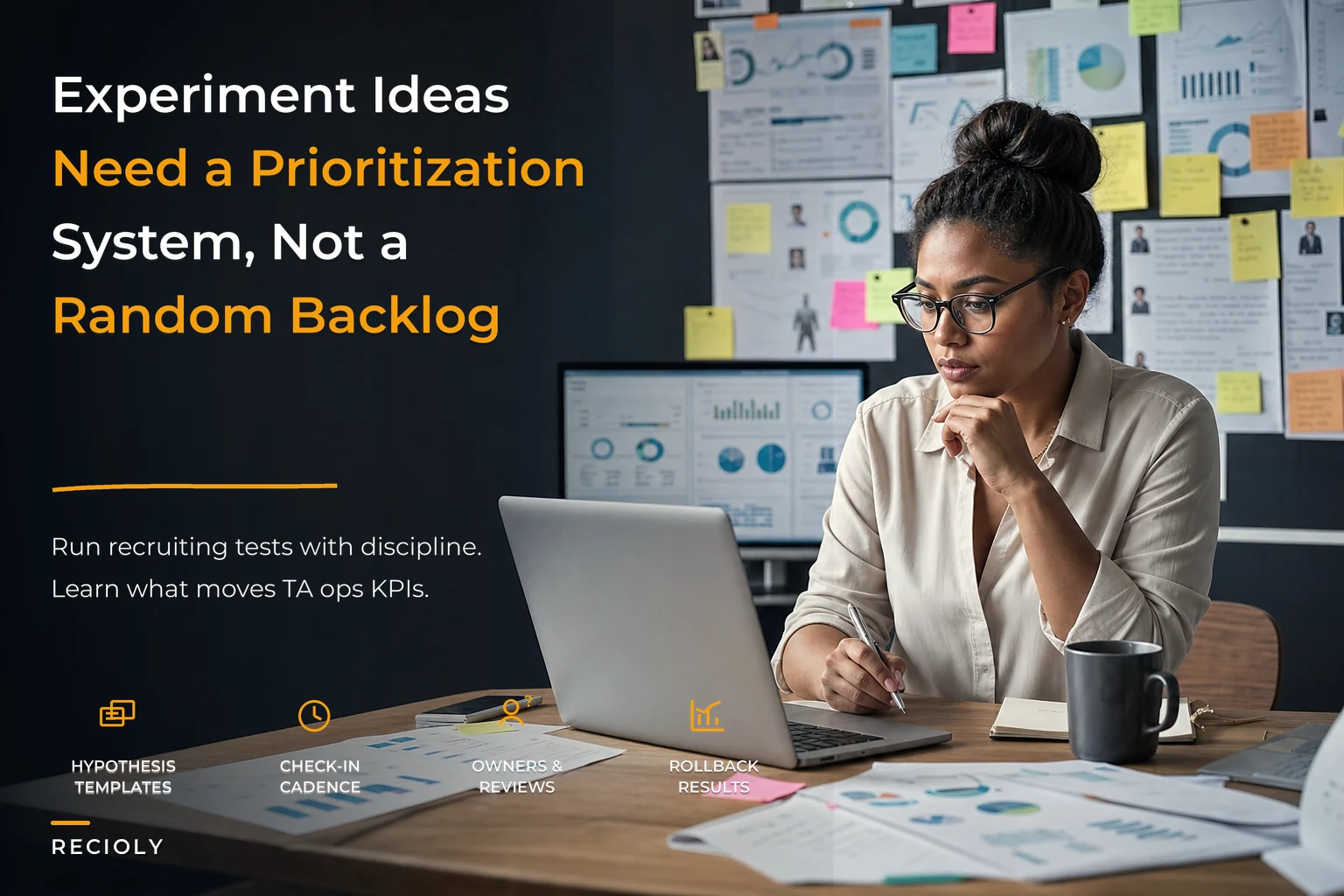

Most recruiting teams treat process changes like throwing darts blindfolded. Someone suggests trying LinkedIn Recruiter Lite instead of the full version, the budget holder agrees, six months later nobody remembers if it actually helped. Or a recruiter starts texting candidates instead of calling, seems to work better, but there's no way to prove it wasn't just a good quarter.
This pattern quietly destroys recruiting operations. Teams implement a dozen changes at once, can't isolate what's working, and eventually revert to old processes out of frustration. The real tragedy is they were probably sitting on two or three genuinely useful improvements the whole time — they just couldn't separate signal from noise.
Building a proper recruiting experimentation system isn't about becoming a data scientist. It's about creating just enough structure to learn systematically while still moving fast enough to actually fill roles.
The missing infrastructure that makes most recruiting experiments worthless
Recruiting teams fail at experimentation for structural reasons, not lack of effort. They run "tests" without baselines, change multiple variables at once, and measure success through gut feel.
The first problem hits immediately: no documented hypothesis. A team decides to "try video screening" without defining what success looks like. Time-to-fill? Quality of hire? Candidate experience scores? Without a clear hypothesis linking action to outcome, you're just changing things and hoping something improves.
The second issue is measurement infrastructure. Most ATS platforms make it surprisingly hard to track experiment-specific metrics. You roll out a new sourcing channel but can't easily flag which candidates came through the experimental path versus the control group. Your analytics foundation might track overall metrics, but experiment-level attribution disappears into the noise.
Then there's the rollback problem. A team tries structured behavioral interviews for engineering roles. Three weeks in, senior engineers complain it takes too long. The team abandons the whole thing instead of adjusting parameters. No learning captured, nothing modified and retested — just a binary outcome of worked or didn't.
The coordination overhead makes everything worse. Different recruiters run different experiments on different roles with no shared tracking. The same failed experiment gets repeated 18 months later when people turn over.
Building hypothesis templates that actually drive learning
A functional recruiting experimentation system starts with forcing some discipline around hypothesis formation. Not academic research-grade rigor — just enough structure to make experiments measurable.
Never lose track of top talent again.
Recioly helps you manage every stage of recruiting efficiently, from application to offer.
- Centralized candidate tracking
- Automated interview scheduling
- Collaborative hiring workflows
No credit card required
The template needs three things: the specific change, the expected impact, and how you'll measure it. Something like: "We believe that adding a technical screening quiz before phone screens will reduce engineering phone screen time by 30% while maintaining offer acceptance rates above 85%."
That hypothesis tells you exactly what to track, what success looks like, and what would constitute failure. Specific enough to test, flexible enough to iterate on.
When hiring volumes are small, run experiments across role families or extend timelines to collect enough data.
Most teams make hypotheses too broad. "Improve candidate experience" isn't testable. "Reduce candidate drop-off between application and first interview from 68% to 55% by sending personalized video messages within 2 hours of application" gives you something real to work with.
The measurement piece also needs to account for recruiting's inherent variability. If you're only hiring three data scientists per quarter, you don't have statistical significance. So you design experiments that run across role families or extend timelines to collect enough data — neither of which feels natural when you're trying to move fast.
Some teams build hypothesis banks organized by impact area — sourcing effectiveness, interview efficiency, offer acceptance, quality of hire — with pre-validated metrics and measurement approaches for each. When someone proposes an experiment, they pull from existing templates rather than starting from scratch every time.
The prioritization matrix that stops random experimentation
Without prioritization, recruiting teams end up testing whatever seemed interesting that week — usually something a vendor pitched or another company wrote about.
-
Potential impact on key recruiting metrics (time-to-fill, quality, cost-per-hire)
-
Implementation complexity (systems changes, training required, process disruption)
-
Risk to candidate experience or legal compliance
-
Data collection feasibility
High-impact, low-complexity experiments go first. Testing a new outreach email template? Low risk, easy to implement, clear metrics. Restructuring your entire interview process? High potential impact but significant complexity — that one needs more runway and more buy-in before you start.
The scoring method matters less than having one. Some teams use high/medium/low ratings. Others score 1–10 on each dimension. The point is consistency so you're comparing experiments on the same terms rather than whoever argues loudest in the planning meeting.
One approach that works well: quarterly experiment planning sessions where the team proposes and scores potential experiments together. This prevents the failure mode where individual recruiters run shadow experiments nobody knows about.
Rollout templates that prevent chaos while preserving learning
The difference between a useful experiment and chaos often comes down to how structured the rollout is. Teams need templates that define exactly how experiments launch, expand, or get shut down.
Start contained. Never test a new interview format across all roles at once. Pick one role family, one geography, or one seniority level. Run it long enough to gather meaningful data but not so long that a failing approach gets embedded in the process.
| Rollout template items |
|---|
| Pilot scope (which roles, locations, or recruiters) |
| Success criteria for expansion |
| Minimum data requirements before evaluation |
| Rollback triggers |
| Documentation requirements |
A software engineering team might test async coding assessments for junior roles only. If pass-through rates stay above 60% and hiring manager satisfaction exceeds baseline after 20 candidates, they expand to mid-level roles. If pass-through drops below 45%, they revert immediately.
Rollback triggers need to be defined upfront — not vague concerns like "if it's not working" but specific thresholds: "If offer acceptance rate drops below 75% for two consecutive weeks" or "If average time-to-fill exceeds 55 days."
Documentation during rollout matters too. Weekly notes on what's working, what's breaking, and what surprised you. These observations often end up being more useful than the quantitative metrics when you're trying to figure out why something failed.
Learning reviews that actually change behavior
Most recruiting teams skip the learning review. The experiment ends, everyone moves on, six months later someone suggests trying the same thing again.
A proper experimentation system needs scheduled learning reviews tied to quarterly OKRs. Not just "did it work?" but structured analysis of what happened and why.
-
Original hypothesis versus actual results
-
Unexpected findings (positive and negative)
-
Confounding variables that affected results
-
Modifications worth testing
-
Broader implications for other processes
Real learning often comes from failed experiments. A team tests mandatory reference checks before extending offers, expecting to reduce bad hires. Instead, they lose three strong candidates to competitors while waiting on references. The lesson: reference checks need to run parallel to final interviews, not after. That's a useful thing to know — but only if the review process captures it.
The review process also needs to produce artifacts that persist beyond the current team. Experiment summaries in a searchable knowledge base, decision logs that explain why certain approaches were rejected. This is what prevents the institutional memory loss that hits recruiting teams with high turnover.
Some teams link learning reviews directly to OKR planning. If the quarter's goal is reducing time-to-fill by 20%, the review examines which experiments moved that metric and which ones didn't.
Change governance without bureaucracy
Recruiting experimentation needs just enough governance to prevent chaos without slowing everything down. The challenge is oversight that doesn't make an already-slow function even slower.
The governance model should specify who can initiate experiments, who must approve them, and who needs to be notified. A junior recruiter testing a new LinkedIn message template? No approval needed, just documentation. Changing the entire technical interview process? That needs hiring manager sign-off and likely legal review.
-
Individual recruiter discretion
messaging templates, scheduling approaches, sourcing channels
-
Team lead approval
interview format changes, assessment modifications, scorecard updates
-
Leadership approval
compensation philosophy tests, major process overhauls, vendor changes
The governance framework also needs to specify documentation requirements. Every experiment needs a simple brief: hypothesis, timeline, success metrics, stakeholders affected. This prevents the scenario where three recruiters are unknowingly running conflicting experiments on the same candidate population.
Governance should also enforce basic experiment hygiene. No running multiple experiments on the same population simultaneously. No changing parameters mid-flight without documentation. No extending experiments indefinitely without a formal review checkpoint.
The operational layer that makes experimentation sustainable
Most recruiting experimentation systems eventually fall apart because the overhead becomes unsustainable. Tracking experiments, collecting data, scheduling reviews, managing documentation — it's a significant operational lift that nobody really has bandwidth for.
This is where AI-powered operational software changes things practically. Instead of manually tracking which candidates went through experimental versus control processes, the system automatically tags and segments them. Instead of hoping people remember to document observations, it prompts for input at natural points in the workflow.
Here's a simple workflow visualization.
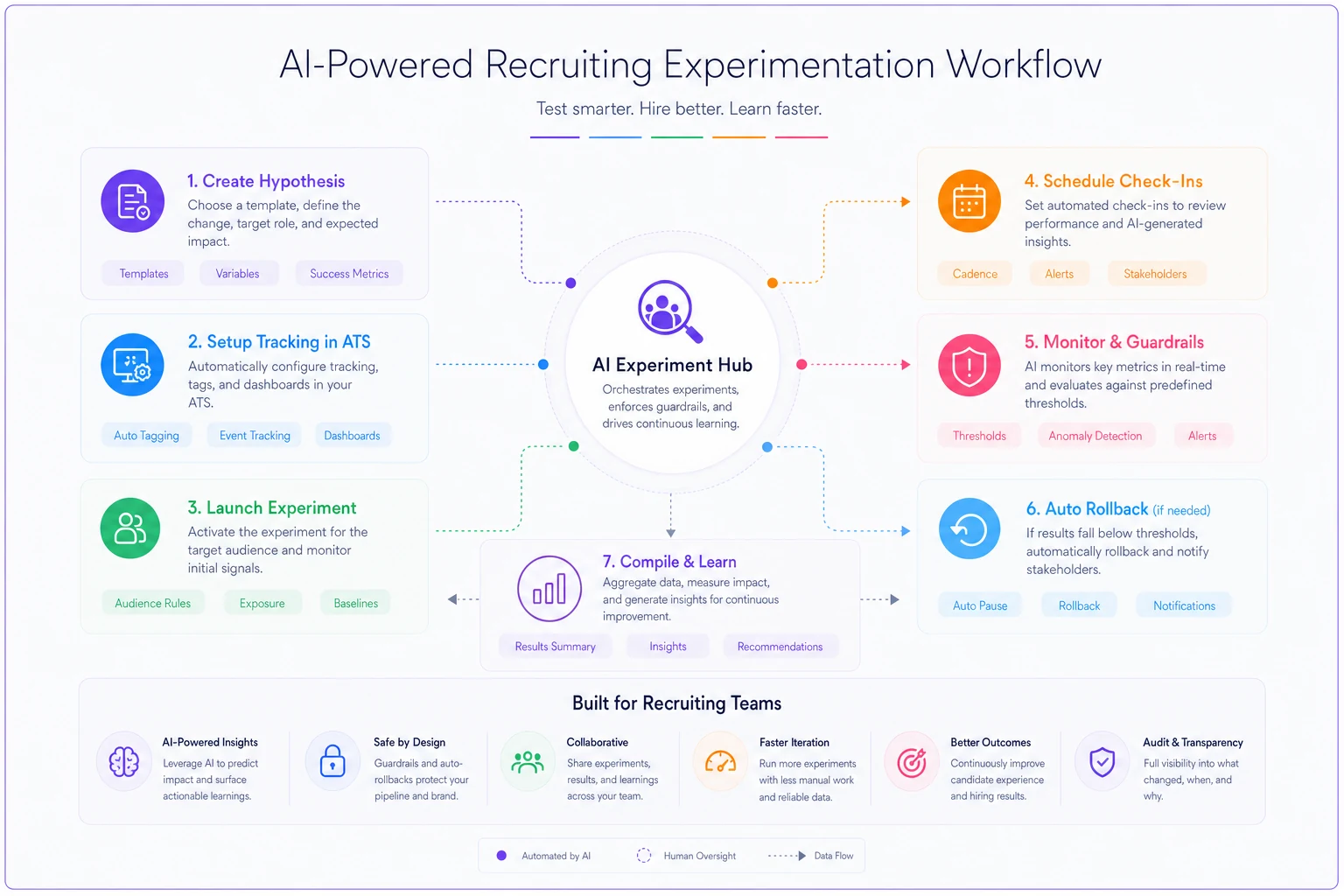
When someone proposes testing a new technical assessment, the platform can automatically create the hypothesis from a template, set up tracking parameters in the ATS, schedule check-in points, trigger rollback if thresholds are breached, and compile data for the learning review. The mechanics get handled so recruiters can focus on the actual insights rather than the administrative scaffolding.
This isn't about replacing human judgment. A recruiter notices that video interviews seem to work better for certain roles. Instead of trying to remember to manually track that observation, they flag it in the system, which starts collecting supporting data automatically.
The platform can also surface patterns that wouldn't be obvious otherwise. Maybe experiments involving a specific engineering manager consistently fail, which suggests change resistance in that team. Or experiments run in Q4 show inflated positive results because candidates are more motivated around year-end. Those patterns only emerge when there's a system capturing the data consistently.
AI automation can also monitor experiments for statistical significance — alerting the team when they actually have enough data to make a decision rather than running experiments for arbitrary timeframes or cutting them short too early.
Real-world example: How a 50-person startup built learning velocity
A fintech startup with around 50 employees was struggling to scale their engineering team. They were trying everything — new job boards, agencies, referral bonuses — but couldn't figure out what was actually working.
They built a basic experimentation system over about 8 weeks. Nothing sophisticated: hypothesis templates, a simple prioritization matrix, and monthly learning reviews.
First experiment: would including salary ranges in job postings increase quality applications? Hypothesis was a 40% increase in applications while maintaining quality. They ran it on half their engineering roles for 6 weeks.
Result: 55% increase in applications, and quality actually improved — fewer unqualified candidates wasting time on both sides. They rolled it to all roles.
Second experiment: async technical screens before phone interviews. Hypothesis was cutting recruiter phone screen time by roughly half while maintaining pass-through rates.
Result: mixed. Saved around 8 hours per week of recruiter time, but senior candidates refused to do the assessment. They adjusted — async screens for junior and mid-level roles only, direct to phone screen for senior hires.
Six months in, they'd run 12 experiments. Seven succeeded, three failed, two got modified and retried. Time-to-fill dropped from 67 days to 43 days. More importantly, they knew exactly which changes drove that improvement.
The learning compounds in ways you don't fully anticipate going in. Each experiment tells them something not just about that specific change but about their candidate pool, their market, their own operations. They figured out their candidates strongly prefer text over phone calls — something they'd never have known without structured testing.
The compound effect of systematic learning
A recruiting experimentation system isn't about finding one silver bullet. It's about building learning velocity that compounds over time.
Teams that run disciplined experiments consistently outperform those that rely on intuition and borrowed industry best practices. Not because they're smarter, but because they're learning what works for their specific context rather than copying playbooks built for different companies with different hiring profiles.
The infrastructure requirements aren't that heavy — hypothesis templates, a prioritization matrix, rollout procedures, learning reviews, and some automation to reduce overhead. Most recruiting teams won't build this because it feels like extra work without immediate payoff.
The ones that do build something real: methodical, accumulated knowledge about what actually moves their metrics. That knowledge survives team turnover. It informs future experiments. It narrows the gap between trying things randomly and actually understanding cause and effect in your recruiting operation.
The gap between teams that experiment systematically and those that change things randomly only widens over time. One builds institutional knowledge. The other stays stuck in a cycle of trying things, forgetting what they learned, and trying them again.
The ones that do build something real: methodical, accumulated knowledge about what actually moves their metrics. That knowledge survives team turnover. It informs future experiments. It narrows the gap between trying things randomly and actually understanding cause and effect in your recruiting operation.
The gap between teams that experiment systematically and those that change things randomly only widens over time. One builds institutional knowledge. The other stays stuck in a cycle of trying things, forgetting what they learned, and trying them again.
Ready to elevate your hiring process?
Join 1,500+ recruiting teams using Recioly to save time, improve collaboration, and hire smarter.