

Most assessment fairness problems don't show up until a rejected candidate's lawyer sends an email. By then you're trying to reconstruct what happened in a proctoring session eight months ago — and the vendor who ran it has a 400-page terms doc, no session logs you can actually read, and a support rep who keeps saying "the AI flagged it."
That's the real risk with proctored and vendor-run assessments. Not that they're inherently unfair, but that when someone challenges a decision, you have nothing to show. No record of what accommodations were offered. No documentation of why a flag became a disqualification. No way to prove the scoring rubric was applied consistently across 300 candidates.
This piece is about closing that gap before it becomes a problem — a working checklist for vetting vendors, the accommodation rules you need pinned down in writing, the scoring transparency you should demand, and the specific contract clauses that give you an audit trail you can actually defend.
The thing that usually breaks first: you can't see inside the vendor's black box
Here's the pattern that burns teams. You sign with a proctoring or assessment vendor. The demo looks great — flags, dashboards, a nice candidate completion rate. Then a candidate with ADHD requests extra time, gets it, finishes the test, and gets auto-flagged for "excessive off-screen glances." A recruiter, trying to move fast, treats the flag as a signal and passes on them.
Six weeks later the candidate files a complaint. Now you need to answer three questions:
-
What exactly triggered the flag?
-
Was the accommodation correctly applied in the system?
-
Who reviewed the flag before the rejection decision, and what did they see?
In a lot of vendor setups, you can't answer any of these. The flag logic is proprietary. The accommodation was applied manually and not logged. The "review" was a recruiter glancing at a red icon. That's not a fairness problem you can argue your way out of — it's a documentation vacuum.
The vendors aren't usually trying to hide anything. Proctoring tools are built to produce outputs — scores, flags, risk ratings — not defensible records. Those are different products. One tells you a result. The other lets you prove why the result was fair. You need the second one, and you almost always have to demand it contractually because it won't come standard.
Vendor vetting checklist: what to actually ask before signing
Skip the generic "do you comply with GDPR" checkbox questions — every vendor says yes. The questions that separate a defensible vendor from a liability are specific and a little uncomfortable. Here's what to run through.
Never lose track of top talent again.
Recioly helps you manage every stage of recruiting efficiently, from application to offer.
- Centralized candidate tracking
- Automated interview scheduling
- Collaborative hiring workflows
No credit card required
On flagging and scoring logic:
-
Can you give us a plain-language description of what each flag type measures, and the threshold that triggers it?
-
Are flags advisory or disqualifying by default? Can we configure that?
-
Do you have published false-positive rates for your flag categories, broken out by anything (device type, lighting, etc.)?
-
Has the flagging model been tested for disparate impact across demographic groups? Can we see the methodology?
On accommodations:
-
How are accommodations (extra time, breaks, screen readers, separate rooms) applied in the system — automatically, or manual override?
-
Does an applied accommodation suppress related flags? Extra time shouldn't trigger a "took too long" flag.
-
Is the accommodation logged as part of the candidate record, or stored separately where a reviewer won't see it?
On records and access:
-
Can we export the full session record — flags, timestamps, reviewer actions, raw video retention status — in a format we can read without your dashboard?
-
How long is session data retained, and can we set that ourselves?
-
When a candidate requests their data, what exactly do you provide, and in what timeframe?
On the human review layer:
-
Does a human review flags before any adverse action, or does the system allow auto-rejection on flags?
-
Can we require a review step and log who performed it?
Here's a quick visual of the vetting workflow.
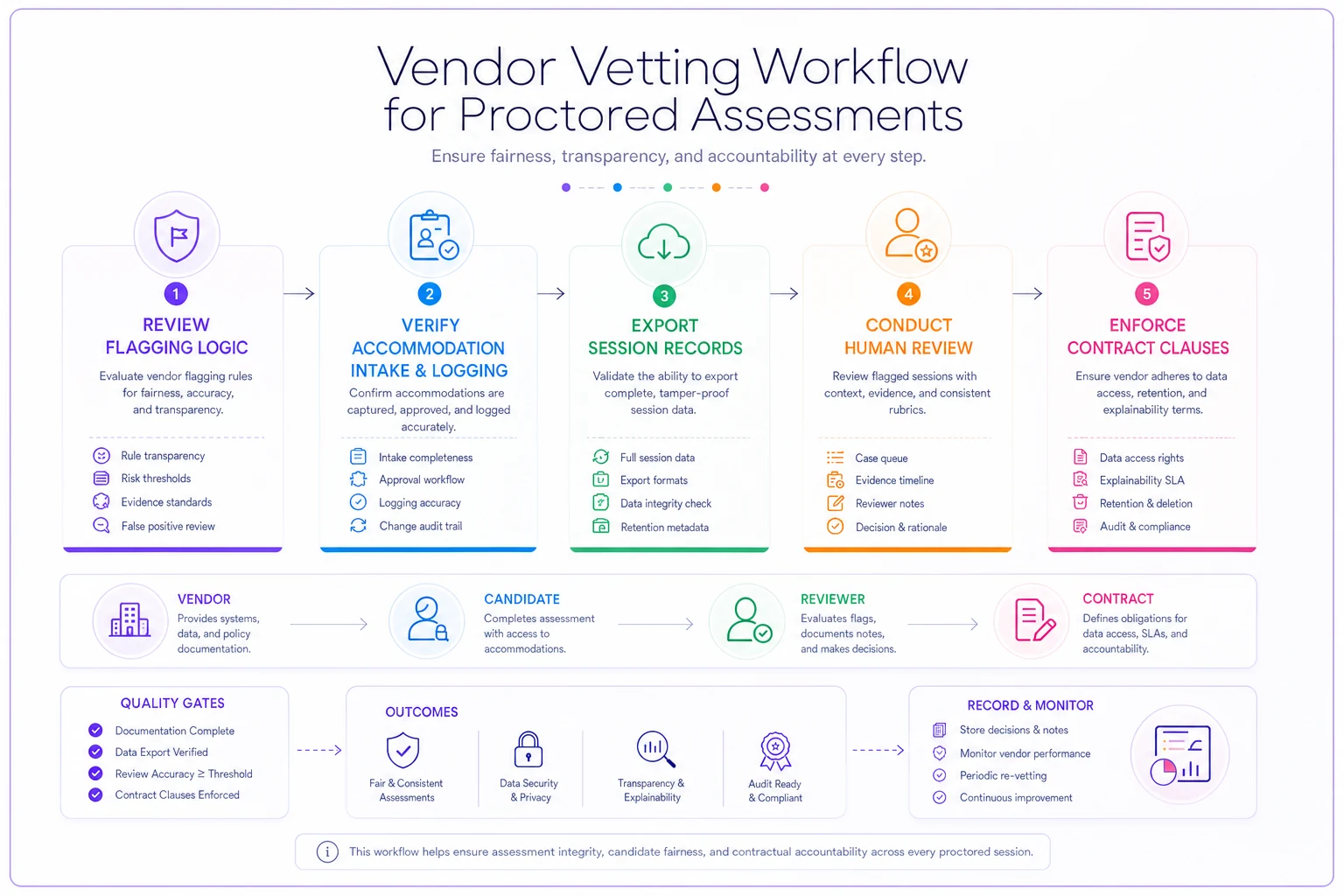
If a vendor can't answer the flagging-logic questions, that's not an automatic dealbreaker — but it means you now own the burden of proving fairness, because they won't help you do it. Price that into the decision.
The accommodation rules nobody writes down (until they're sued)
Accommodations are where fairness quietly collapses, because they're usually handled as one-off exceptions rather than a defined process. A recruiter emails the vendor, "Can we add 30 minutes for this candidate," someone says yes, and nothing about that exchange ends up in the candidate's assessment record.
-
Accommodation requests have one intake path. Not recruiter email, not "mention it to the hiring manager." One form, one owner, timestamped.
-
Approval criteria are written before anyone asks. Decide in advance what extra time, breaks, and assistive tech you'll grant for which assessment types, so nothing gets decided ad hoc under pressure.
-
Applied accommodations are logged in the assessment record itself — not a side spreadsheet. If a flag is later reviewed, the reviewer needs to see "this candidate had approved extra time" right there.
-
Flags affected by the accommodation are automatically contextualized or suppressed. Extra time should never produce a duration-based flag. If your vendor can't suppress these, reviewers need a visible note at minimum.
-
Don't ask for medical documentation you don't need. Overcollecting here creates its own liability. Keep the request narrow and storage controlled — the principles in a solid candidate data governance runbook apply directly to accommodation records, which often touch health-adjacent data.
Log the accommodation decision in the candidate's assessment file immediately; don't rely on email chains or side spreadsheets.
The part that consistently fails isn't the grant — it's the record of it. A granted accommodation that leaves no trace in the assessment file is almost as dangerous as a denied one, because when the flag gets reviewed later, it just looks like the candidate behaved abnormally.
Scoring transparency: the three things you need to reconstruct any decision
Scoring transparency isn't about publishing your rubric to candidates (though sometimes you should). It's about being able to reconstruct, months later, exactly how a specific candidate's result was produced. Three records make that possible.
The one people consistently forget is the scoring definition snapshot. Teams tweak passing thresholds as they calibrate. Then a candidate rejected in March challenges the decision in September, and you pull up the current rubric — which has a different cut score. Now you can't even demonstrate what standard you applied to that person. Versioning the rubric and tying each candidate record to the version in force at test time removes that entire category of problem.
| Record | What it captures | Why it matters in a dispute |
|---|---|---|
| Scoring definition snapshot | The exact rubric, weights, and passing thresholds in effect on the date the candidate tested | Rubrics change. You need the version applied to this candidate, not today's version |
| Applied-score trail | Each sub-score, who or what assigned it, and any manual overrides | Proves the rubric was actually applied, not improvised |
| Flag-to-decision chain | Each flag, the reviewer who assessed it, their note, and the resulting action | Shows a human judged the flag in context before any adverse outcome |
That's also why many teams run anonymized screening alongside rolling outcome checks on their assessment data — catching an unfair pattern early is far easier than defending one later. If you haven't set that up yet, the approach in operationalizing inclusive hiring with audit controls pairs well with everything here.
Sample contract clauses that create an actual audit trail
Vendor contracts default to protecting the vendor. The standard template gives them broad flag-logic secrecy, short data access windows, and no obligation to explain adverse outcomes. You have to write the fairness protections back in. These are clause concepts worth getting into the agreement — run exact wording past counsel, but the substance is what matters.
Session record export clause. The vendor will provide, on request and within a defined window (10 business days is a reasonable ask), a complete machine-readable export of any candidate's session including all flags, timestamps, applied accommodations, reviewer actions, and retention status — without requiring access to the vendor's live dashboard.
Flag explainability clause. For any flag type used in the engagement, the vendor will provide a plain-language description of what it measures and its trigger threshold, and will notify you in advance of material changes to flag logic or scoring models.
No automated adverse action clause. No candidate will be rejected, downranked, or disqualified solely on the basis of an automated flag or score without a documented human review. This protects you under several emerging AI-in-hiring laws, not just fairness optics.
Accommodation integrity clause. Approved accommodations will be recorded within the candidate's assessment record and will not independently generate flags tied to the accommodation itself.
Bias testing disclosure clause. The vendor will disclose, at least annually, the methodology and results of any disparate-impact or adverse-impact testing on its scoring and flagging systems.
Data retention and deletion control clause. You, not the vendor, set retention periods. The vendor will delete session data on your defined schedule and on validated candidate request.
The clause people skip and regret is the export clause. Without it, every record you'd need in a dispute is trapped behind a UI the vendor controls and can change or deprecate at any time. You want the raw record in your own hands, on your timeline.
When heavy proctoring makes sense — and when it's a liability you're inviting
Not every role justifies invasive proctoring, and over-proctoring is itself a fairness risk because it generates more false flags against candidates with atypical setups, disabilities, or noisy home environments.
When strict proctoring is reasonable: licensing-adjacent assessments, roles with real integrity-critical certification requirements, or high-volume screens where identity fraud is a demonstrated problem. Here the audit-trail investment clearly pays off.
When it's a bad idea: early-stage screens for roles where a short work sample would tell you more, or any context where the flag false-positive rate is high relative to the actual signal you need. If you're flagging 18% of candidates and manually clearing 15% of them, the proctoring is generating noise and legal exposure, not value.
Who should avoid this entirely: small teams running a handful of hires a quarter with nobody assigned to review flags. If nobody owns the human-review step, automated proctoring will quietly make unreviewed rejections in your name. That's the worst possible position — you've bought the liability without the safeguard.
A realistic before/after
A mid-sized fintech ran technical and situational-judgment assessments through a proctoring vendor for roughly 250–300 candidates a quarter. Their setup: flags surfaced in a dashboard, recruiters used them to triage, accommodations handled over email. When two rejected candidates raised fairness concerns within the same month, the team spent close to three weeks trying to reconstruct the sessions — and couldn't fully, because accommodations were never logged and the flag logic was opaque.
They reworked it over about a quarter. Added an export clause and a no-automated-adverse-action clause at contract renewal. Moved accommodation intake to a single logged workflow. Snapshotted the scoring rubric by version and tied each candidate to the version in force at test time. Required a reviewer note on every flag before any adverse decision.
The visible change wasn't speed — it was that the next challenge took under a day to answer, with a clean record showing the accommodation applied, the flag reviewed in context, and the exact rubric used. Flag-driven rejections also dropped noticeably once reviewers had to write down why a flag mattered, because a lot of flags turned out not to justify anything once someone actually had to defend them in writing.
Fairness in proctored and vendor assessments isn't mostly about having better intentions or a stricter rubric. It's about whether you can reconstruct and defend any individual decision after the fact. Vendors won't give you that capability by default — you have to vet for it, write it into the contract, and build the accommodation and scoring records that let a human judgment survive scrutiny months later.
Start with the two things that close the biggest holes: the session-record export clause, and a single logged accommodation intake path. Everything else on this checklist builds the rest of the trail — so that the next time someone questions a result, you're pulling up a clean record instead of trying to remember what got flagged in a session nobody can see anymore.
Ready to elevate your hiring process?
Join 1,500+ recruiting teams using Recioly to save time, improve collaboration, and hire smarter.