

The moment a background check comes back with something on it, the whole hiring process slows to a crawl. A recruiter forwards the report to their manager. The manager isn't sure what to do with a 6-year-old misdemeanor, so they loop in HR. HR isn't sure either, so they ask legal. Legal asks for context nobody collected. Meanwhile the candidate is sitting there for four days wondering if their offer just evaporated.
That gap — between "the report has a flag" and "we made a decision" — is where most background screening programs fall apart. Not because teams are careless, but because there's no shared logic for what counts as serious, what counts as noise, and who's allowed to make the call.
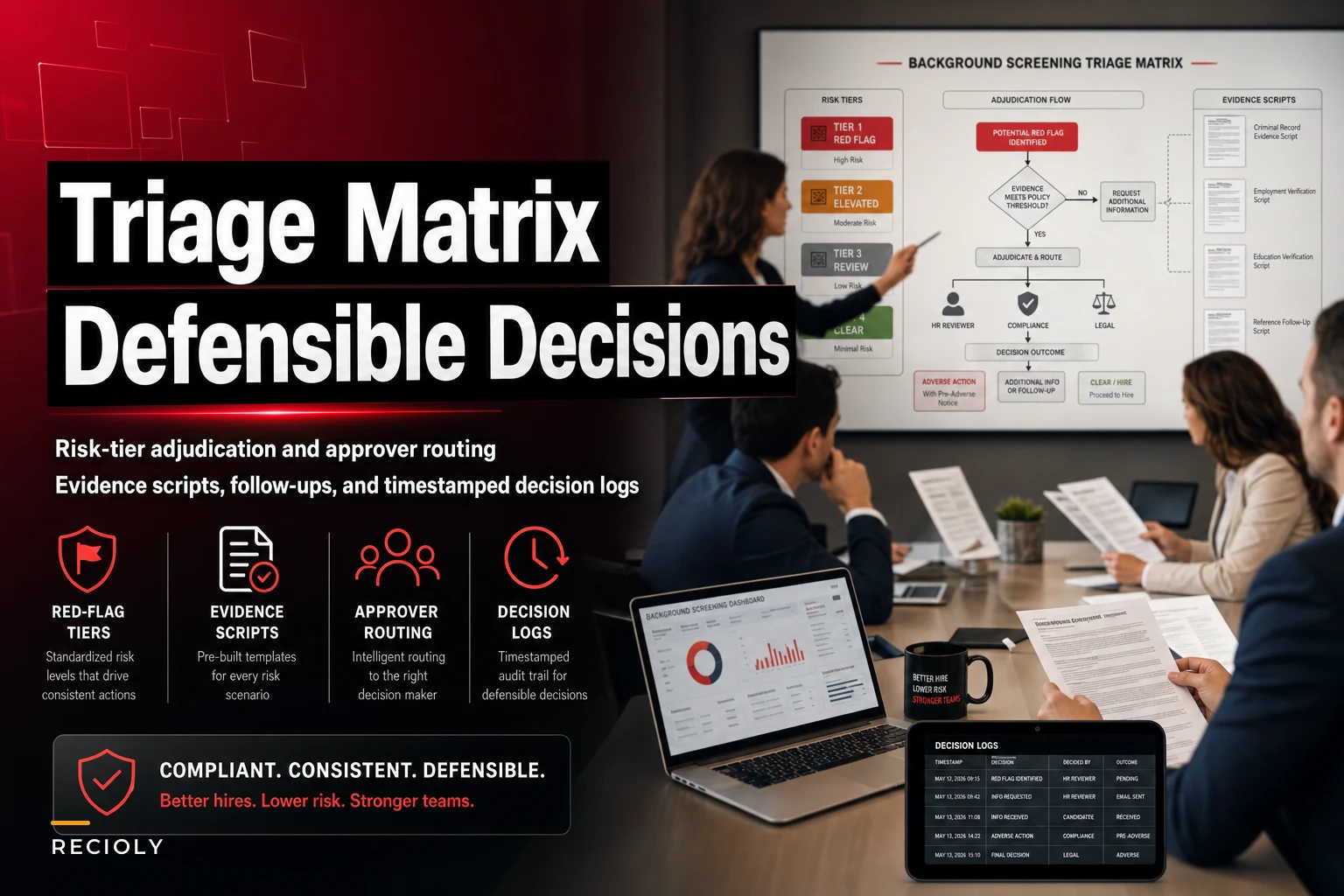
A background screening triage matrix fixes the ambiguity. It's a risk-tier system that classifies findings into low, medium, and high, attaches a specific evidence-collection script to each, defines the follow-ups you're allowed to ask for, and routes the decision to the right approver. Done well, it turns a five-day scramble into a same-day decision that you can actually defend if someone challenges it later.
Why background check flags cause chaos (even in mature teams)
The problem almost never shows up on clean reports. It shows up on the ambiguous ones — the report that's neither obviously fine nor obviously disqualifying.
Think about what a typical mid-sized recruiting team actually receives. Out of 100 completed checks, maybe 70 come back completely clean. Around 20 have something minor: an address mismatch, a name variation, a county record that turned out to be someone else. And roughly 8–10 have a genuine adjudication question — a criminal record, a discrepancy in employment dates, a credential that didn't verify.
Those last ten are where every team improvises. And improvisation is the enemy of defensibility. What you get instead:
-
The same type of finding gets treated differently depending on who reviews it
-
Some hiring managers see the raw report (a data privacy problem waiting to happen)
-
Decisions get made in Slack threads and hallway conversations with no record
-
Nobody ran an individualized assessment, which is exactly what the EEOC expects for criminal history
The inconsistency is the real exposure. If a rejected candidate ever asks why they were denied and a hired candidate had a comparable record, you need to show your reasoning was applied evenly. Scattered decisions can't do that.
The three-tier structure
The whole point of tiering is to answer two questions before anyone touches a decision: how serious is this, and who owns the call. Below is a working structure that holds up across most non-regulated roles. (Regulated industries — finance, childcare, transportation, healthcare — have statutory disqualifiers that override this, so build those in as a separate hard-stop layer.)
Never lose track of top talent again.
Recioly helps you manage every stage of recruiting efficiently, from application to offer.
- Centralized candidate tracking
- Automated interview scheduling
- Collaborative hiring workflows
No credit card required
| Tier | Typical findings | Default action | Approver | Target turnaround |
|---|---|---|---|---|
| Low | Address history gaps, name/DOB mismatches, resolved traffic violations, single minor misdemeanor older than 5–7 years | Note and proceed; recruiter clears | Recruiter (self-serve) | Same day |
| Medium | Employment date discrepancies, credential/license unverified, recent single misdemeanor, financial record for a non-fiduciary role | Evidence collection + individualized review | HR partner + hiring manager | 24–48 hours |
| High | Felony relevant to role, pattern of related offenses, falsified credentials, undisclosed history the candidate denied | Formal adjudication + pre-adverse action process | HR lead + legal review | 3–5 days |
Two things people get wrong here.
First, they over-tier. A resolved parking ticket does not need a legal review. When low-risk items get pushed up the chain "just to be safe," you train your approvers to rubber-stamp everything, and the tier system loses meaning. Low tier should genuinely mean the recruiter closes it and moves on.
Second, they treat tier as fixed to the offense rather than the role. A financial discrepancy is medium for a warehouse associate and high for a controller. The matrix should let the same finding land in different tiers based on job relevance — that's the individualized assessment logic baked right into the structure.
Evidence collection scripts (this is the part everyone skips)
Most triage systems quietly fail here. Teams build the tiers, then leave the actual conversation with the candidate to improvise. The recruiter calls, says something vague like "we found something on your background check," and the candidate panics, gets defensive, or over-explains. Now you have an emotional conversation and still no usable evidence.
For a medium-tier employment discrepancy, the script looks something like:
> "Part of our process is confirming employment details. Our records show your role at [Company] listed as [dates/title], but the verification came back with [different dates/title]. I want to make sure we have this right before we finish — can you walk me through what the accurate details are, and is there any documentation you could share, like a pay stub or offer letter?"
Notice what that does. It's non-accusatory. It assumes a possible error rather than deception. And it asks for a specific artifact you can attach to the file.
For a medium/high-tier criminal record, the script needs to invite context without demanding it:
> "We received a background check result that we review as part of our standard process. Before we make any decision, we give candidates the chance to share context. There's no obligation to, but if there's anything you'd like us to consider — the circumstances, how long ago, anything that's changed since — we'd like to hear it."
The candidate's response goes into the file verbatim, with a timestamp and the recruiter's name. That's your individualized assessment evidence. Without a script, half your recruiters won't ask the context question at all, and you'll have candidates denied without ever getting the chance to explain — which is precisely the scenario adverse-action rules exist to prevent.
One pattern worth flagging: recruiters who are uncomfortable with these conversations tend to soften the language so much that the candidate doesn't realize a decision is pending. Then the adverse action letter blindsides them. The script has to be gentle and clear that a review is underway.
Recommended follow-ups per tier
Once you've got the candidate's response, each tier has a defined set of follow-ups so nobody's guessing what "enough investigation" looks like.
Low tier — usually no follow-up. The recruiter confirms the identity match (was this record actually the candidate's?) and closes it. The only documentation needed is a note: finding reviewed, identity confirmed as non-match / minor and role-irrelevant, cleared.
-
Confirm the finding is accurately reported (dispute rate on background checks is higher than people assume — reporting errors are real)
-
Request supporting documentation from the candidate where relevant
-
Run the role-relevance test
does this finding relate to the actual duties and risks of this job?
-
Document the candidate's explanation
-
Route to the HR partner and hiring manager for a joint yes/no with written rationale
High tier — everything above, plus:
-
Formal individualized assessment covering nature of the offense, time elapsed, and relevance to the role
-
Legal review of adverse-action compliance (pre-adverse notice, waiting period, final notice)
-
Consistency check — pull prior decisions on comparable findings to confirm you're treating this candidate the same way you treated others
-
Documented final decision with named approver and date
That consistency check in step 3 is the one teams forget, and it's the one that matters most in a dispute. If you approved a candidate with a similar record last quarter and reject this one, you need a documented reason for the difference — role relevance, recency, whatever — or you've created a fairness problem.
The approver flow, mapped
The routing is what keeps the whole thing fast. Each tier has exactly one owner who can move it forward, so nothing sits in a "waiting for someone to decide who decides" limbo.
Here's a simple visualization of that routing and decision handoffs.
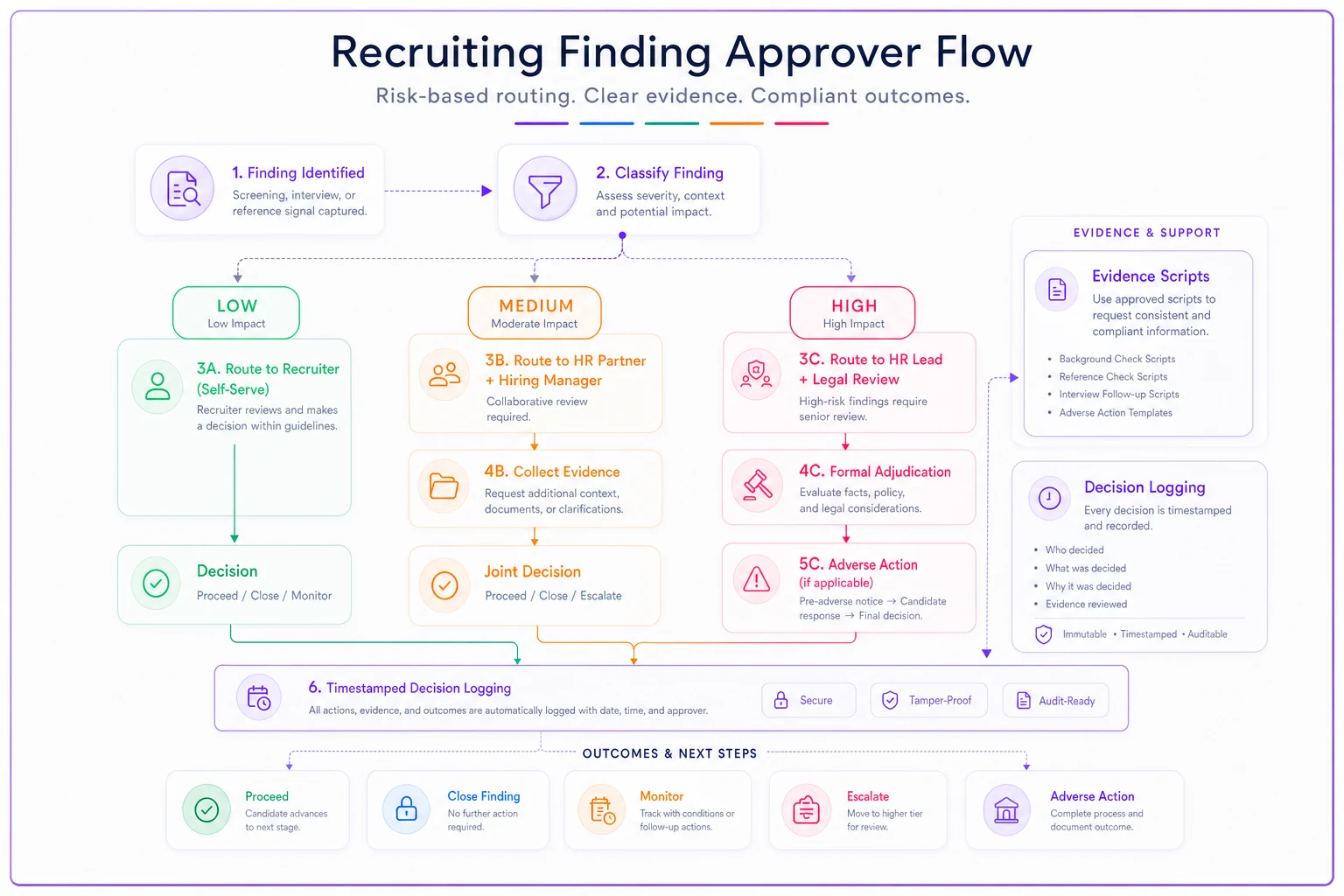
In plain terms: a finding comes in and gets classified by tier — ideally the moment the report lands, not three emails later. Low goes straight to the recruiter, who clears it and logs the note. Medium triggers the evidence script, then routes to the HR partner and hiring manager who make a joint call; if they disagree, it escalates to high. High goes to the HR lead, runs through legal review, and only then produces a final decision with the adverse-action sequence if needed.
What makes this work operationally is that classification happens before anyone reads the full report emotionally. When a hiring manager sees "felony" in a raw report, they react. When they see "Tier 2 — employment discrepancy, individualized review requested," they respond to a process. Tiering strips the emotion and replaces it with a task.
This is also where reference-check timing overlaps. If you're running background checks in parallel with references — and you should be — a medium-tier flag shouldn't stall the whole pipeline. The same escalation discipline that keeps reference checks from delaying offers applies here: define the threshold that pauses an offer versus the one that just requires a note.
A real scenario
A regional logistics company — around 400 employees, hiring 20–30 warehouse and driver roles a month — kept losing candidates during background adjudication. Their average time from "flag received" to "decision made" was close to six days. In a market where drivers had multiple offers, they were losing roughly one in four flagged candidates to faster competitors simply because the review dragged.
The bigger issue surfaced when they audited their own decisions. Over about eight months, they found two candidates with nearly identical driving records — same type of violation, similar recency — where one was hired and one was rejected. No documented reason for the difference. That's the kind of inconsistency that turns into a complaint.
They built a three-tier matrix specifically for their roles: driving-related offenses weighted heavily for driver positions, weighted low for warehouse positions. Evidence scripts for the two most common findings. Clear approver routing.
The turnaround on flagged checks dropped to under two days for medium-tier cases. Candidate loss during adjudication fell noticeably — not to zero, but enough that hiring managers stopped complaining about it. And every flagged decision now had a timestamped record with the reasoning attached, which mattered more than anyone expected when a rejected candidate later asked for an explanation and got a clear, consistent one.
When this makes sense — and when it's overkill
Build the full matrix if: you're running more than a handful of background checks a month, you hire across multiple role types with different risk profiles, or you operate in a state with strict fair-chance / ban-the-box laws. The volume and legal exposure justify the structure.
Keep it lightweight if: you hire fewer than five people a quarter and mostly for one role type. You still want the evidence scripts and a consistency habit, but a full three-tier routing model is probably more machinery than you need. A simple documented "here's how we handle a flag" one-pager will do.
This is a bad idea if you use it to hard-code automatic disqualifiers that skip individualized assessment. The matrix is a triage and routing tool, not a rejection filter. The moment it starts auto-rejecting candidates on category alone, you've built the exact liability you were trying to avoid.
Keeping the records defensible
None of this protects you unless the decisions are logged the way they were actually made — timestamped, attributed, with the reasoning captured at the moment of decision rather than reconstructed later. A tier matrix generates a clean evidence trail almost as a byproduct, but only if you enforce the logging step. Teams that treat documentation as an afterthought end up with the tiers but not the records, which is the worst of both worlds — process overhead with no defensibility payoff.
Capture the candidate's explanation verbatim with a timestamp and the reviewer's name to make individualized assessments defensible.
For the broader framework on what to log and how often to audit it, the approach for closing defensibility gaps with required logs and timestamped decision records pairs directly with this. The triage matrix decides what happens; the governance layer proves it happened the way you say it did.
The takeaway
Background adjudication goes wrong when there's no shared logic for how serious a finding is or who gets to decide. A triage matrix replaces that improvisation with three things: a tier that sets the seriousness, a script that produces consistent evidence, and a routing rule that puts the decision in one clear pair of hands. The candidate gets a faster answer, the recruiter stops guessing, and you end up with a decision you can actually stand behind if anyone ever asks.
Start with your ten hardest past cases. Sort them into tiers. Write the script for whatever finding you see most often. That's a working system by the end of the week — and it'll save you the next six-day scramble.
Ready to elevate your hiring process?
Join 1,500+ recruiting teams using Recioly to save time, improve collaboration, and hire smarter.