
Most campus recruiting programs are measured on the wrong thing. Teams brag about badge scans and business cards collected, then act surprised in March when the actual hire count from those events barely cracks single digits. The gap between "we talked to 400 students" and "we hired 6 of them" is where the entire operation quietly leaks money.
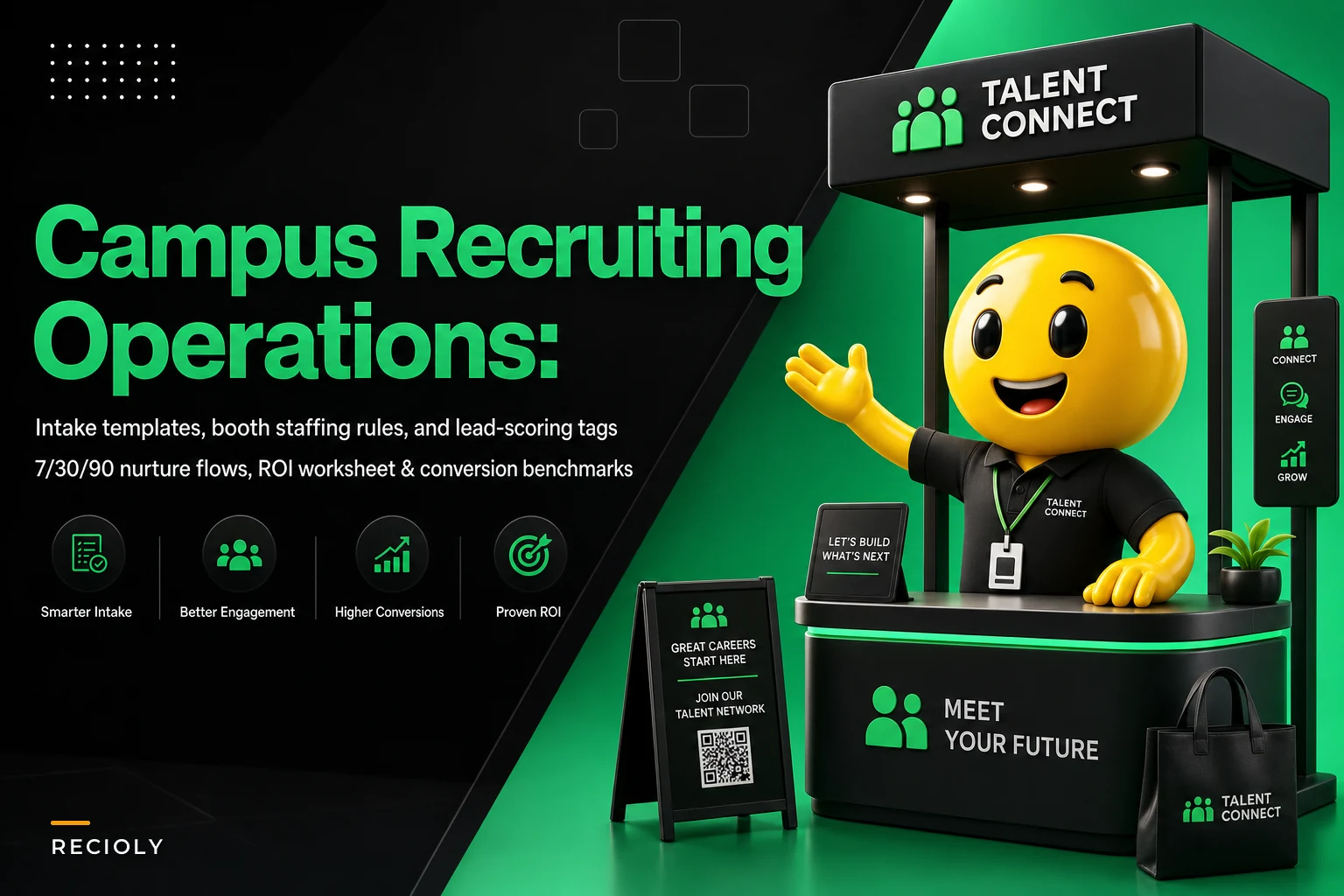
This piece is narrow on purpose. It's about the operational machinery between the event and the hire—the intake templates, the booth rules, the tagging discipline, the nurture cadence, and the benchmarks that tell you whether any of it is working. Not employer branding. Not booth design. The unglamorous conversion plumbing that almost nobody sets up properly.
Where campus recruiting operations actually fall apart
The failure rarely happens at the event. It happens in the 72 hours after, and then again around week three when nobody follows up.
The pattern plays out constantly. A team of four recruiters and eight rotating engineers works a two-day career fair at a big state school. They scan around 380 badges. Everyone's exhausted, they fly home, and the lead data sits in a spreadsheet nobody owns. By the time someone exports the badge scans and cross-references them with resumes, it's ten days later. The strongest candidates—the ones with three competing offers already—have moved on. What's left in the funnel is the students who weren't in demand enough to get pulled elsewhere quickly.
So the funnel gets adversely selected by your own slowness. You didn't lose the top students because your comp was low. You lost them because your intake process took ten days and theirs took two.
The second failure is quality blindness. A badge scan tells you a name and a major. It tells you nothing about whether that person is actually a fit, actually interested, or actually available for the role you're hiring. Without a structured capture at the booth, every lead looks identical in the spreadsheet, and the team ends up nurturing 380 people equally—which means nurturing all of them badly.
Fix #1: The event intake template that captures fit at the booth
Badge scans are lazy data. The fix is a lightweight intake template your booth staff fills out in 30–45 seconds per real conversation. Not for every person who grabs a pen—only for anyone who has an actual exchange worth remembering.
Never lose track of top talent again.
Recioly helps you manage every stage of recruiting efficiently, from application to offer.
- Centralized candidate tracking
- Automated interview scheduling
- Collaborative hiring workflows
No credit card required
-
Name + school email (personal email as backup—students lose access to school email fast)
-
Graduation term (this alone kills half your bad-fit leads)
-
Role interest (specific, not "engineering")
-
Work authorization status if relevant to the role
-
Booth staffer's gut rating (a simple 1–3
strong, maybe, courtesy scan)
-
One memory hook — a specific detail from the conversation ("built a weather API in a hackathon," "asked about our infra team")
That memory hook is the single most underrated field. Six weeks later when you send a follow-up, "Loved hearing about your weather API project" converts at a completely different rate than "Thanks for stopping by our booth." Students can smell a mail-merge. The hook makes it personal without any real effort.
Keep the memory hook to a single short phrase so it's quick to capture and easy to reuse in follow-ups.
Keep the template on phones or tablets, not paper. Paper intake forms get transcribed days later, badly, with half the handwriting illegible. A shared digital form that dumps straight into your ATS or a structured sheet removes the transcription lag entirely.
Fix #2: Booth staffing rules that stop the quality drop-off
The dirty secret of campus events is that your booth quality collapses in predictable windows. Hour one is sharp. By hour four, your engineers are tired, hungry, and giving one-word answers, and your strongest potential leads walk up to a booth that looks checked-out.
-
Rotate every 90 minutes. Nobody stays "on" longer than that at a loud, high-energy booth. Build a rotation schedule before the event, not on the fly.
-
Always staff one recruiter + one practitioner. Students want to talk to someone doing the actual job. A booth with only recruiters converts worse because the technical students disengage.
-
Assign a "scanner" and a "closer." The scanner handles quick badge scans and light chat; the closer goes deep with the one or two promising students in the queue. Mixing these roles means your closer gets interrupted mid-conversation and the strong lead drifts away.
-
Cap the courtesy-scan pile. Not every scan needs a nurture sequence. Rating them at the booth (that 1–3 field) prevents your follow-up list from ballooning to 380 people you'll never realistically contact.
One thing that consistently gets missed: brief your practitioners on what "good" looks like for this specific req. Engineers left to their own devices will rate students on whether they'd personally enjoy working with them, which is not the same as role fit. A 90-second pre-event huddle on the actual scorecard closes that gap.
Fix #3: Lead-scoring tags that make the follow-up sortable
Once the event ends, you need to be able to slice your leads instantly. This is where tagging discipline pays off. The booth rating is your raw signal; the tags turn it into routing logic.
| Tag | Meaning | Follow-up priority |
|---|---|---|
A-fit-grad-soon | Strong rating, graduating within the hiring window | Contact within 48h, fast-track to interview |
A-fit-early | Strong rating, graduating 12–24 months out | Long nurture, internship pipeline |
B-interested | Solid conversation, unclear fit | Standard nurture, screen before advancing |
C-courtesy | Badge scan only, minimal signal | Bulk newsletter only, no 1:1 effort |
role-mismatch | Good student, wrong role for you now | Referral ask, keep warm |
The A-fit-early tag is the one most teams skip, and it's where the compounding returns live. A sophomore you tag and nurture becomes a warm intern lead next year and a full-time conversion the year after. Teams that only chase graduating seniors rebuild their pipeline from scratch every single fall. Teams that tag underclassmen build a multi-year funnel that gets cheaper every cycle.
If your recruiters are already using a structured triage approach for inbound candidates, this is the same muscle applied earlier. The recruiter triage and priority routing logic that governs your channel investment should feed the same tagging vocabulary so campus leads don't live in a disconnected silo.
Fix #4: The 7/30/90 nurture sequence
After the event, strong leads get one email—maybe—and then nothing until the team panics about pipeline in December. Meanwhile the student got seven personalized touches from a competitor.
A quick visual of the 7/30/90 flow helps show the timing and routing for each tag.
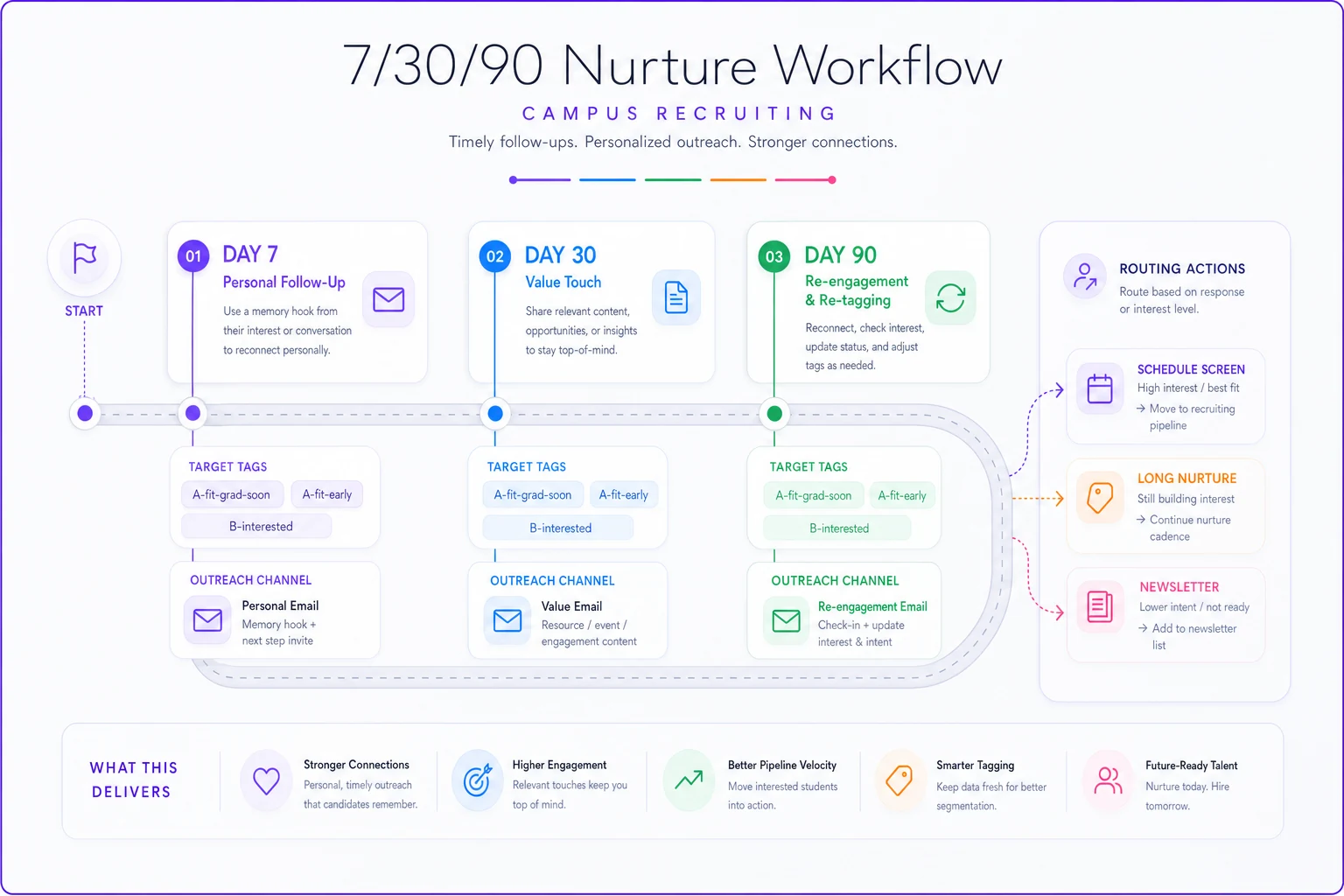
Day 7 — the personal follow-up.
This goes only to A and B tags. It uses the memory hook. For A-fit-grad-soon, it includes a direct next step: a link to schedule a screen, or a specific role to apply to. No "we'll keep you in mind." Give them an action. The whole point of moving in 7 days is beating competitors who move in 21.
Day 30 — the value touch. Not a job pitch. Something the student actually wants: an invite to an engineering talk, a "day in the life" piece from a recent grad, an office-hours slot with the practitioner they met. This is where you separate from companies that only ever email when they want something.
Day 90 — the re-engagement and re-tag. By now the situation has changed. Seniors are deep in the season; underclassmen are thinking about next summer. This touch asks a light qualifying question ("Still targeting a summer 2026 internship?") and lets you re-tag based on the reply. Anyone who engages moves up; anyone who's gone silent drops to the newsletter tier.
The reason 7/30/90 works is that it matches how student decision-making actually unfolds—fast for graduating seniors, slow and seasonal for everyone else. A single blast can't do both. Managing three staggered sequences across a few hundred leads by hand is where things fall apart, so this is worth building into whatever workflow tool tracks your cadences rather than living in someone's memory and a snoozed inbox.
The ROI worksheet: what these events actually cost you
Most teams have never calculated the true cost-per-hire of a campus event, so they can't tell a great school from a money pit. Here's the worksheet skeleton.
Costs to total up per event:
-
Booth fee / registration
-
Travel + lodging for the team
-
Fully-loaded hours of everyone attending (recruiters and practitioners—engineer time is expensive)
-
Swag and materials
-
Prep and post-event processing hours
Then divide against outcomes:
-
Qualified applications generated (
A+Btags who applied) -
Interviews conducted from the event
-
Offers extended
-
Hires closed
A realistic example: a team spends roughly $18k–$22k all-in on a two-day fair once you fully load the engineers' time. They get around 380 scans, maybe 55 tagged A/B, about 20 applications, 9 interviews, and 3 hires. That's somewhere around $6k–$7k cost-per-hire from that event—which might be great or terrible depending on the role. The point isn't the exact number; it's that you now have a number, per school, that you can compare year over year.
Teams that track this consistently start cutting two or three schools every year and doubling down on the ones that actually convert. The ones that don't keep going to the same fifteen campuses out of habit, spreading a thin team across too many low-yield events.
Conversion benchmarks to measure against
Rough benchmarks worth tracking, event to event. These aren't laws—they're the ranges healthy campus programs tend to land in once the operation above is running:
-
Scan → tagged (A/B) ~12–18% of total scans. Below that, your booth conversations are too shallow or your rating discipline is loose.
-
Tagged → applied ~30–45%. Below 30% usually means your Day-7 follow-up is weak or late.
-
Applied → interview ~40–55%. Low here often means your booth ratings are too generous—people getting through who shouldn't.
-
Interview → offer ~25–35%.
-
Offer → accept (campus) ~55–70%. Students accept at higher rates than experienced hires when the nurture was strong.
The single most diagnostic metric is time-from-event-to-first-contact. Every day past 48 hours, your accept rate on strong leads erodes noticeably. If that number is sitting at ten days, fixing it will do more than any booth redesign ever will.
A quick real scenario
A mid-sized software company was running eleven campus events a fall with a four-person team and converting somewhere around 8–10 hires total—decent on paper, but the cost per hire was ugly and the recruiting team was exhausted because everything felt like scramble.
They didn't add events. They cut to seven schools, built the 30-second intake template, enforced the 90-minute booth rotation, and set up the 7/30/90 sequence with real tagging. First-contact time dropped from about nine days to under two. The following fall, from fewer events, they closed roughly 14 hires, and their A-fit-early underclassman list gave them a warm pipeline heading into the next cycle they'd never had before.
Nothing about that was clever branding. It was operational discipline applied to the part everyone ignores.
Where to start
If you only fix one thing this season, fix the 48-hour first-contact window—it moves the needle the most. Then build the intake template so your data is sortable. Then the tags. Then the sequence. Trying to install all of it at once, mid-season, usually collapses under event fatigue.
And if you're bringing on recruiters specifically to own campus, get them running these motions early rather than learning by osmosis—the same principle behind a structured recruiter onboarding checklist that accelerates 90-day productivity applies here. A campus recruiter who understands the tagging and cadence system on day one is worth far more in September than one still figuring out where the leads went.
Campus recruiting rewards teams that treat it as a conversion process with real benchmarks, not a branding road trip. The badge scans were never the product. The hires are—and the machinery between the two is entirely under your control.
Ready to elevate your hiring process?
Join 1,500+ recruiting teams using Recioly to save time, improve collaboration, and hire smarter.