

Most recruiting teams don't have a compensation problem. They have a compensation governance problem. The bands technically exist somewhere in a spreadsheet, someone in Total Rewards owns them in theory, and everyone assumes the guardrails are working — right up until an offer stalls for four days because nobody can figure out who signs off on a 12% above-midpoint request.
That gap — between "we have pay bands" and "our pay bands actually govern decisions in real time" — is where offers die, candidates ghost, and hiring managers start freelancing comp promises they shouldn't be making. This post covers the whole lifecycle: how bands get refreshed, who owns what, what triggers a pre-approval, how you audit approvals after the fact, and how exceptions get handled without turning into chaos.
The real problem isn't the bands — it's that they go stale silently
Comp bands don't fail loudly. They fail quietly. A band set in Q1 is still being quoted in Q4 while the market moved 8-11% underneath it, and nobody flagged it because refreshing bands is nobody's Tuesday priority.
Band decay follows a pretty predictable pattern across hiring orgs. Engineering and sales bands rot fastest — those markets move constantly. Ops, finance, and admin bands can hold for a year without much drift. But teams treat them all the same: one annual refresh, usually tied to the merit cycle, and then radio silence for eleven months.
The result is a recruiter working from numbers that were roughly accurate in February and dangerously low by September. They don't know the band is stale. The hiring manager doesn't know. So the offer goes out, the candidate declines (politely), and now you're doing an emergency comp escalation on a role you could have priced correctly if the band had been refreshed on the right cadence.
The insight most teams miss: band-refresh cadence should not be uniform. It should be tiered by market volatility. Some role families need a quarterly look; others are fine annually. Treating everything as one cycle is why you're always either over-refreshing calm roles or under-refreshing hot ones.
Band-refresh cadence: tier it, don't blanket it
A workable refresh model looks less like a calendar event and more like a maintenance schedule with different intervals per system.
Never lose track of top talent again.
Recioly helps you manage every stage of recruiting efficiently, from application to offer.
- Centralized candidate tracking
- Automated interview scheduling
- Collaborative hiring workflows
No credit card required
| Role family | Market volatility | Refresh cadence | Trigger for off-cycle review |
|---|---|---|---|
| Software/ML engineering | High | Quarterly | 3+ counteroffers lost in a month |
| Sales / GTM | High | Quarterly | Comp-related decline rate above ~15% |
| Product / Design | Medium-high | Semi-annual | Two escalations in same level |
| Finance / Ops | Medium | Annual | Spot survey signals >7% move |
| Admin / Support | Low | Annual | Minimum-wage or legislative change |
The off-cycle trigger column is the part people skip, and it's the part that actually saves you. Cadence tells you when to look on schedule. Triggers tell you when the market forced your hand early. If you're losing three engineers in a month to counteroffers, you don't wait for the quarterly refresh — that's the market telling you the band is wrong now.
A pattern worth naming: teams that only refresh on a calendar tend to over-correct when they finally do it. Eleven months of pent-up drift gets absorbed in one giant jump, which blows up internal equity and makes existing employees furious when they find out new hires came in higher. Frequent, smaller refreshes on volatile role families avoid that whiplash entirely.
Owner RACI: the part that's usually a mess
Ask five people "who owns comp bands?" and you'll get five different answers. Total Rewards says they set them. Finance says they approve the budget envelope. The hiring manager says they know their market. TA says they're the ones actually quoting numbers to candidates. And exactly nobody is accountable when a band turns out to be wrong.
That ambiguity is the single biggest source of offer delay — not the approval routing itself, but the confusion about who's actually allowed to approve what.
A clean RACI for compensation governance usually breaks down like this:
-
Responsible (does the work) Total Rewards / Comp analyst — builds and updates bands, runs benchmarking.
-
Accountable (owns the outcome) Head of Total Rewards or VP People — one name, one throat to choke when bands are stale.
-
Consulted (has input before decisions) Finance (budget envelope), hiring managers (market reality), TA leadership (candidate-facing friction).
-
Informed (told after) Recruiters, hiring managers, HRBPs — they get the refreshed bands and the change log.
The mistake is making too many people Accountable. When comp, finance, and the hiring VP all think they own the final call, every non-standard offer becomes a negotiation between departments instead of a decision. One accountable owner, clearly named, ends more offer delays than any tool ever will.
One accountable owner, clearly named, ends more offer delays than any tool ever will.
There's a related pattern worth flagging: recruiters are almost always left as Informed when they should sometimes be Consulted. They see counteroffers and declines before anyone else does. If they're not feeding that signal into refresh decisions, your comp team is benchmarking off stale surveys while recruiters are watching the real market play out in real time.
Pre-approval triggers: catch exceptions before they become emergencies
The whole point of pre-approval triggers is moving the comp conversation earlier — before an offer is drafted, not after a candidate has already been verbally promised a number.
In practice, offer delays almost never happen inside the normal band. Nobody escalates a clean, midpoint, standard offer. Delays happen at the edges — the above-band request, the equity refresh, the sign-on bonus, the geo-differential exception. So your triggers should fire specifically at those edges.
-
Offer position above ~90th percentile of band → routes to comp before verbal.
-
Any sign-on bonus over a set threshold (say, above one month's salary) → finance sign-off required.
-
Equity grant outside the standard level band → comp + finance.
-
Two or more candidates in the same requisition needing above-band → signals a band problem, not a candidate problem; flags for off-cycle refresh.
-
Any cash component the hiring manager verbally floated before approval → hard stop, mandatory review.
That fourth trigger is underused and genuinely valuable. When multiple candidates for the same role all need exceptions, the exception isn't the exception — the band is broken. Most teams handle each one individually and never connect the dots. A good governance model treats a cluster of exceptions as a diagnostic signal about the band itself.
For the mechanics of how that routing and auto-escalation actually gets built, the offer approval workflow for compensation gates post goes deep on the plumbing. This post is the governance layer that sits above it.
Approval-audit rules: what you check after the offer goes out
Pre-approval stops bad offers from going out. Approval-audit catches the ones that slipped through — and tells you whether your governance is actually working or just theater.
A monthly or quarterly audit should answer a few blunt questions:
-
What percent of offers went out within band without escalation? (Under ~70% and your bands are probably too tight.)
-
How many offers were approved by someone not in the approval matrix? (This is your governance leak. Should be near zero.)
-
What was the median time from "offer requested" to "offer approved"? Where did it stall?
-
Which triggers fired most often — does that point to a specific stale band?
-
How many exceptions were granted, and did any recur for the same manager? (Repeat exception-requesters usually reveal a training gap or a real band problem.)
A subtle one people get wrong: they audit whether the approval happened but not whether the reasoning was captured. An approved above-band offer with no documented justification is a defensibility hole. When pay-equity questions come up — and they will — "we approved it" isn't an answer. "We approved it because the candidate had a competing offer at X and the band midpoint was below market per the March survey" is.
Every exception approval should carry a timestamped reason code. Not a paragraph — a code plus one line. That's the difference between an audit trail you can defend and a pile of yes-clicks.
Exception handling: a lane, not a free-for-all
Exceptions are inevitable. The failure isn't having them — it's handling each one as a bespoke crisis. What breaks at scale is that every above-band request becomes a fresh Slack thread, a fresh set of side conversations, and a fresh delay, because there's no defined lane for exceptions to travel through.
The fix is boring and it works: a standing exception lane with a fixed SLA.
Exception workflow: Recruiter hits a trigger during offer prep → logs the exception request with candidate context, competing offer if any, and requested number → request lands with the single accountable comp owner (not a committee) → comp owner has a fixed window, say 24 hours, to approve, counter, or decline → decision plus reason code is logged → recruiter proceeds. If comp needs finance input, finance is consulted in parallel, not sequentially, so the clock doesn't reset.
Here's a simple visual of that lane-based exception workflow.
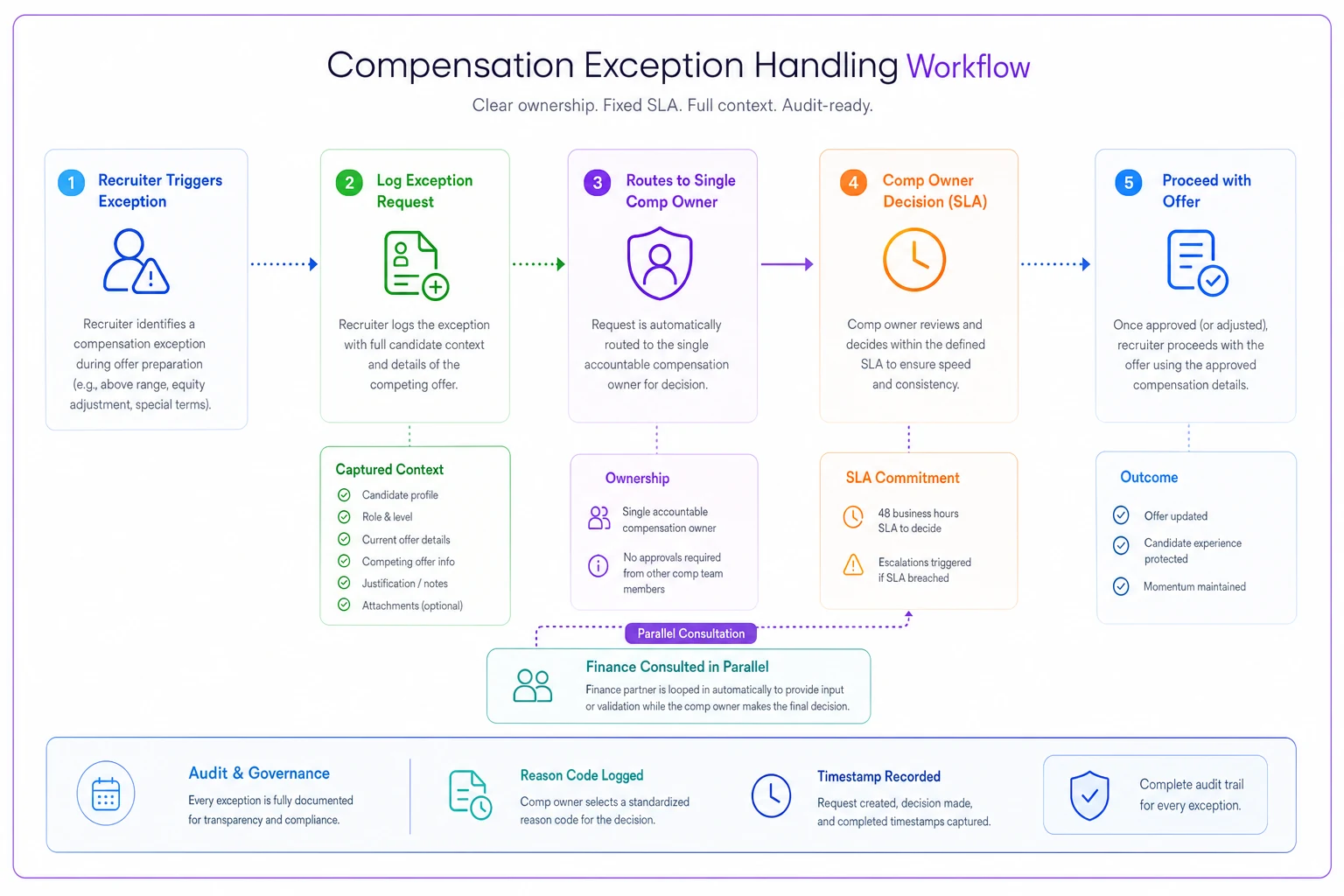
The parallel-vs-sequential detail matters more than it sounds. Sequential routing — comp reviews, then hands to finance, then back to comp — is how a 24-hour exception becomes a five-day one. Same approvers, wildly different candidate experience, purely because of routing order.
There also needs to be a real ceiling. Above a certain threshold, exceptions stop being a comp decision and become a leadership decision. Draw that line explicitly. Otherwise your comp analyst is quietly making calls that belong to a VP, or worse, escalating everything upward until the VP becomes the bottleneck for the entire org.
Artifacts recruiters can actually use to prevent delays
Governance that lives only in policy docs doesn't prevent offer delays. Governance that shows up as usable artifacts in the recruiter's hands does. These are the pieces that turn a policy into something that actually works at 5pm on a Friday when a candidate needs a number.
-
A current band sheet with a visible "last refreshed" date — so recruiters know if they're quoting fresh or stale numbers.
-
A one-page trigger cheat sheet — "these five situations require comp sign-off before you say a number out loud."
-
A pre-filled exception request template — candidate, level, requested number, band position, competing offer, justification. Fillable in two minutes.
-
The RACI on one page — literally "who to ping for what," so nobody wastes a day figuring out who approves.
-
A decline-reason log the recruiter contributes to — because comp-driven declines are the earliest signal a band is going stale.
That last artifact matters more than it looks. If you're tracking why offers get declined, comp-related declines are the smoke that tells you a band is on fire before the whole requisition burns. The offer-acceptance analytics playbook covers how to instrument that signal properly — pair it with your band-refresh triggers and you've got a feedback loop instead of a guessing game.
The centralization piece is where operational software earns its place, quietly. When bands, triggers, approval routing, and reason codes all live in scattered spreadsheets and inboxes, governance is only as good as whoever remembers to check. Pulling those artifacts into one platform — where the band sheet shows its refresh date, triggers fire automatically during offer prep, and exceptions route to the right owner with the reason code attached — mostly removes the manual coordination that causes delay. Not because the software is clever, but because nobody has to remember to enforce the rules by hand.
A real scenario: when the band was the problem all along
A mid-size B2B software company, roughly 400 employees, kept losing senior backend engineers at the offer stage. Their comp bands were on a single annual refresh tied to the April merit cycle. By fall hiring season, the top of their engineering band sat around 9-12% under where competing offers were actually landing.
What made it worse: every above-band request was handled one-off. A recruiter would hit a wall, escalate to comp, comp would loop in finance sequentially, and the whole thing took four to six business days. In a market where strong senior engineers had two other offers in hand, that timeline alone cost them candidates — several dropped out before an answer even came back.
The pattern that finally got noticed was the cluster. Over about two months, seven separate offers for the same role family all needed above-band exceptions. Seven exceptions for one role isn't seven exceptions — it's one broken band. Once they tiered engineering to a quarterly refresh, named a single accountable comp owner, and moved finance review to run in parallel, exception turnaround dropped from that four-to-six day range to under a day for most cases. Comp-related declines on that role family fell noticeably over the next quarter. Nothing exotic happened — they just stopped treating a band problem as a series of candidate problems.
When tight governance makes sense — and when it's overkill
Not every org needs the full apparatus. Bolting heavy governance onto a 20-person startup will just slow you down.
This makes sense when: you're hiring at enough volume that exceptions are frequent, you operate across multiple geos or levels, you have real pay-equity exposure, or offer delays are already costing you candidates. At scale, the coordination cost of not having governance exceeds the overhead of having it.
This is overkill when: you're small enough that one People leader can hold every comp decision in their head, your bands cover a handful of roles, and exceptions are rare. Formal RACI and audit cadences for a team making a dozen offers a year is process for its own sake.
Who should not rush this: teams that don't yet have bands at all. Governance sits on top of bands. If your pay ranges are guesswork, fix the benchmarking first — governing numbers you don't trust just adds ceremony to a shaky foundation.
Pulling it together
Compensation governance isn't a document you write once. It's a lifecycle: bands get refreshed on cadences that match how fast each market moves, one clearly accountable owner keeps them honest, triggers catch exceptions early, audits confirm the rules actually held, and exceptions travel down a defined lane instead of erupting as crises. When those pieces connect, offers stop stalling at the comp gate — not because you got faster at firefighting, but because you built something that didn't start the fire.
The teams that get this right aren't the ones with the fanciest tooling. They're the ones who figured out that a stale band, an unclear owner, and a sequential approval chain are all the same problem wearing different masks — a coordination failure. Fix the coordination, and the offer delays mostly take care of themselves.
Compensation governance isn't a document you write once. It's a lifecycle: bands get refreshed on cadences that match how fast each market moves, one clearly accountable owner keeps them honest, triggers catch exceptions early, audits confirm the rules actually held, and exceptions travel down a defined lane instead of erupting as crises. When those pieces connect, offers stop stalling at the comp gate — not because you got faster at firefighting, but because you built something that didn't start the fire.
The teams that get this right aren't the ones with the fanciest tooling. They're the ones who figured out that a stale band, an unclear owner, and a sequential approval chain are all the same problem wearing different masks — a coordination failure. Fix the coordination, and the offer delays mostly take care of themselves.
Ready to elevate your hiring process?
Join 1,500+ recruiting teams using Recioly to save time, improve collaboration, and hire smarter.