

Most teams treat a declined offer like weather. It happened, it's a shame, maybe comp was low, maybe they had a competing offer, maybe the timing was bad. You log a reason code, close the req, and move on. Then the same pattern repeats three months later and nobody can say for sure what's driving it.
The problem isn't that declines happen. The problem is that almost nobody instruments the offer stage well enough to separate the three things that actually cause declines: price (comp and total package), speed (how long the candidate waited and how the momentum felt), and touch (how the offer was delivered, negotiated, and closed). When you can't split those apart, every fix is a guess — and you end up throwing money at problems that were actually about timing.
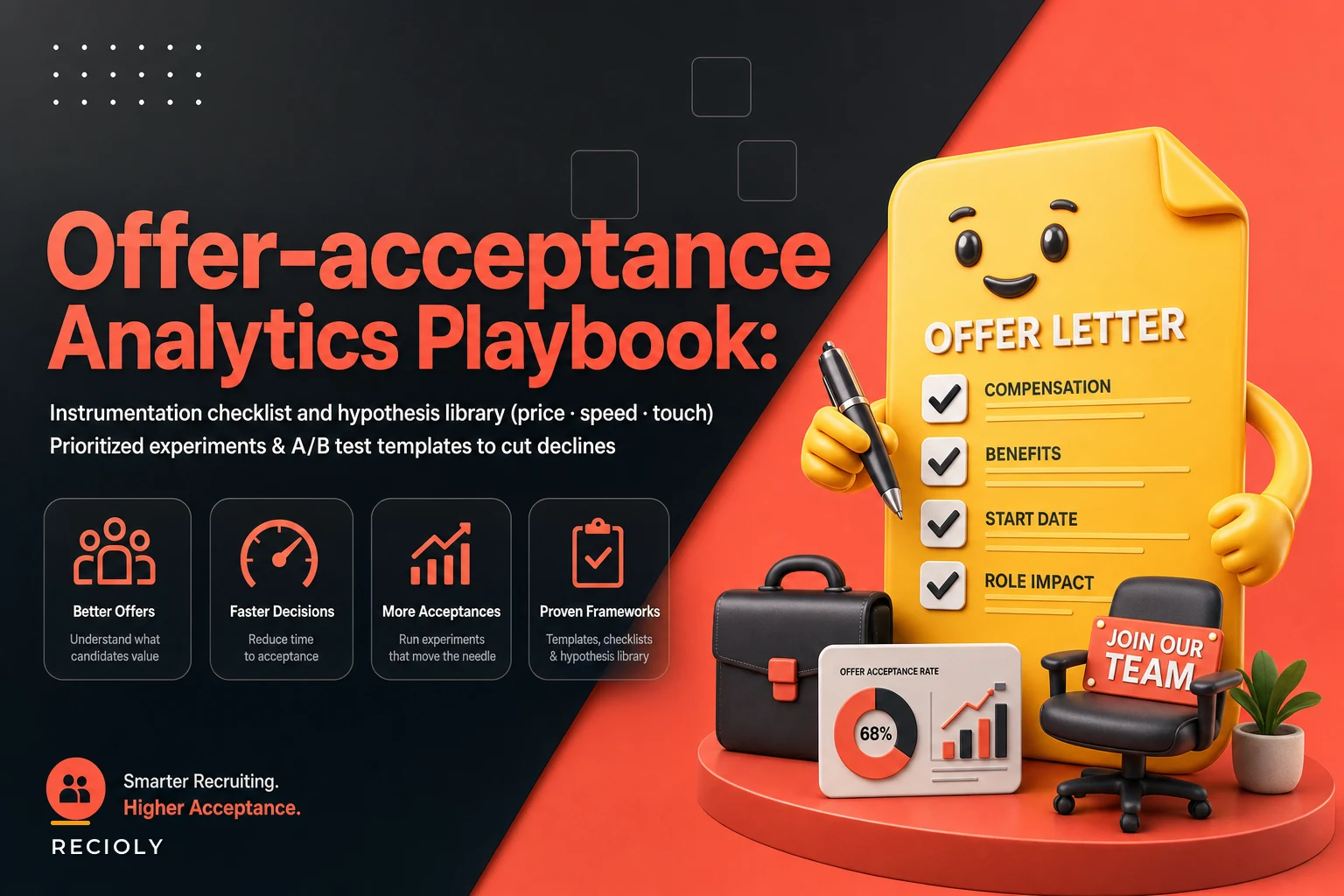
This is a playbook for building real offer-acceptance analytics: the instrumentation you need, the experiments worth running first, and the A/B templates that tell you which lever actually moved the number. It's narrow on purpose. This is only about the window between "we decided to extend" and "they signed or walked."
Why decline reasons in your ATS are basically useless
The reason code your recruiter picks after a decline is one of the least reliable data points in your whole funnel.
A candidate who declines rarely tells you the real reason. They say "the timing wasn't right" when they mean the process dragged and they cooled off. They say "I got a better offer" when the truth is your offer took nine days and the competitor's took two, so the money never even got a fair comparison. Recruiters, wanting to look good, tend to code declines as comp problems — because "they wanted more money" is nobody's fault. It's the market's fault.
What this produces is a dashboard where 70-something percent of declines look like comp issues, leadership approves budget for higher offers, and acceptance rate barely moves. Because the actual driver was speed and handoff friction, not price.
The fix starts by refusing to trust a single self-reported reason code. Instead you instrument the behaviors and timestamps around the offer, then triangulate. A candidate who declined after a 12-day offer turnaround and two rescheduled closing calls is telling you something very different from a candidate who declined in four hours with a written competing offer attached.
The instrumentation checklist: what you must capture before you can diagnose anything
You cannot run offer-acceptance analytics on data you never collected. Before touching experiments, make sure every offer generates these data points automatically. If your team has to remember to log them, they won't — and your dataset will have holes exactly where it matters most.
Never lose track of top talent again.
Recioly helps you manage every stage of recruiting efficiently, from application to offer.
- Centralized candidate tracking
- Automated interview scheduling
- Collaborative hiring workflows
No credit card required
Capture the "decision to offer" timestamp at the hiring manager approval step in your ATS so you measure the true internal-to-candidate gap.
Timing and speed signals
-
Timestamp of internal "decision to offer" (not when the paperwork was ready — when the hiring manager said yes)
-
Timestamp of first verbal offer to candidate
-
Timestamp of written offer delivered
-
Timestamp of candidate response (accept / decline / counter)
-
Number of business days across each of the above gaps
-
Any approval delays inside the process (comp sign-off waiting on someone)
Price signals
-
Offered base vs. the candidate's stated expectation captured earlier in the process
-
Total comp vs. your internal band midpoint for the role
-
Whether a counter was made, and the delta between counter and offer
-
Whether the final number required an exception approval
Touch signals
-
Who delivered the offer (recruiter, hiring manager, or both)
-
Verbal-before-written, or written cold with no call
-
Number of touchpoints between offer and decision
-
Whether a closing conversation happened at all
-
Whether the candidate was given a named point of contact for questions
Context signals
-
Known competing process (yes/no/unknown)
-
Seniority level and role family
-
Source channel of the candidate
Here's a simple diagram showing where to capture each timestamp in the offer-to-sign flow.
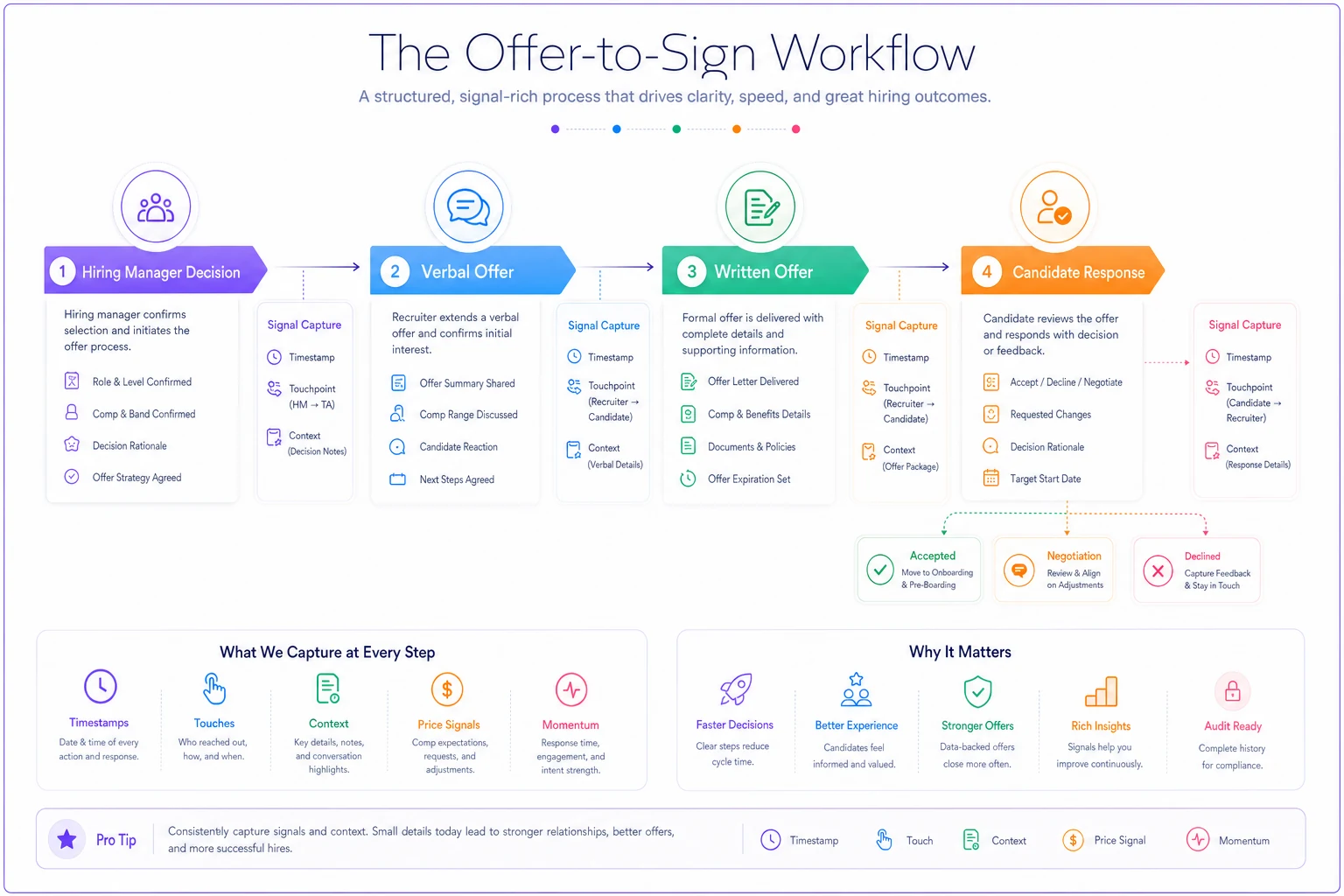
A note on the "decision to offer" timestamp — most teams don't capture it, and it's probably the single most valuable field on this list. Without it, you can only measure how fast HR moved paperwork. With it, you can see the gap between "we wanted them" and "we told them," which is where a large share of avoidable declines actually live. If comp sign-off is a recurring source of that gap, tightening the offer approval workflow with pre-approvals and routing matrices usually buys back more days than any comp increase.
Splitting declines into price, speed, and touch
Once you have the fields above, you can classify each decline into a primary suspected driver instead of a guessed reason code. Here's the logic most teams can apply right away.
| Signal pattern | Likely primary driver | What it usually is NOT |
|---|---|---|
| Offer within band, fast turnaround, candidate still declined with competing offer | Price (or fit) | Not speed |
| Offer competitive, but 8+ business days from decision to written offer | Speed | Not comp |
| Offer delivered cold in writing, no closing call, candidate ghosted | Touch | Not price |
| Counter made, small delta, then decline after slow response to counter | Speed + touch | Not the counter amount itself |
| Below-band offer, candidate stated higher expectation early | Price | Genuinely comp |
The value here isn't precision on any single case — it's the distribution. When you tag 60 declines this way over a quarter, you stop seeing "candidates want more money" and start seeing something more like: 40% speed, 30% touch, 30% price. That split is what tells you which experiment to run first.
One pattern worth calling out: speed and touch problems often masquerade as price problems because a candidate who felt neglected will happily accept more money elsewhere and describe it as a comp decision. The money was the tiebreaker, not the cause.
The prioritized experiment library
Not every experiment is worth running. You want the ones with high impact, low cost, and a clean way to measure. Here's roughly the order that pays off fastest, from cheapest-to-test to most expensive.
1. Verbal-before-written (touch)
Cheapest experiment in the whole library. Half your offers get a live verbal call from the recruiter or hiring manager before the written offer lands. The other half get the written offer first. Measure acceptance rate and time-to-decision.
A warm verbal offer before the paperwork tends to lift acceptance noticeably, especially for mid-level roles where the candidate is weighing two comparable options. The call is where you handle hesitation you'd never see in an email.
2. Compress decision-to-written-offer time (speed)
Set a hard target — written offer out within 48 hours of the internal yes — for the test group, versus your normal cadence for the control. This one often collides with approval bottlenecks, so you may need to fix routing before you can even run the experiment cleanly.
Reference checks are a common hidden source of this delay. If offers are waiting on references, a tightened 48–72 hour reference-check workflow removes the excuse to stall the written offer.
3. Named closer + scheduled decision call (touch)
Test group gets a specific person assigned as their point of contact and a pre-scheduled follow-up call two days after the offer. Control group gets the standard "let us know if you have questions." The scheduled call creates a natural moment to surface objections instead of letting the candidate drift toward a decision in silence.
4. Structured expectation capture earlier (price)
This one's about preventing price declines rather than curing them. Test group has comp expectations explicitly confirmed at the screening stage and again before final interviews. Control uses your normal process. You're measuring how many offers land within the candidate's stated range on the first try — because re-negotiating a lowball offer burns days and momentum.
5. Small targeted comp adjustments (price)
Save this for last. It's the expensive lever and the one everyone reaches for first. Only run it once you've isolated genuine price declines from the noise. Test whether a modest bump to band midpoint for a specific role family measurably changes acceptance — often it doesn't, which is exactly the finding that saves budget.
A/B test templates that don't lie to you
The most common way these experiments go wrong is contamination. A recruiter likes the verbal-offer approach, so they quietly do it for the control group too, and now your test shows no difference. Or the sample is 11 offers and someone declares victory.
A clean template needs four things locked before you start:
-
A single variable. Change verbal-vs-written OR speed target, never both at once. If you change two things and acceptance goes up, you've learned nothing about which one did it.
-
Random or alternating assignment. Assign by offer number (odd/even) or by a rule that doesn't let recruiters cherry-pick who gets the "good" treatment.
-
A pre-declared sample size and stop date. Decide up front you'll run it across the next 40–60 offers or eight weeks, whichever comes first. No peeking-and-stopping the moment it looks good.
-
A primary metric and one guardrail. Primary is usually acceptance rate. Guardrail might be time-to-decision or offer count, so you don't win on acceptance while quietly slowing everything else down.
Write the hypothesis as a sentence before you run anything: "Delivering a verbal offer before the written offer will increase acceptance rate for mid-level engineering roles, measured across the next 50 offers, without extending time-to-decision by more than one day." If you can't write that sentence, you're not ready to run the test.
A real scenario
A mid-size B2B software company — roughly 40 hires a quarter — had an offer-acceptance rate sitting around 74% and a leadership team convinced they were losing people on comp. They'd already pushed a couple of band increases with no real change.
When they finally added the "decision-to-written-offer" timestamp and tagged a quarter's worth of declines by driver, the picture looked different. Comp was genuinely the issue in maybe a third of declines. The larger chunk was speed — the median gap between the hiring manager's yes and the written offer was around seven business days, mostly lost to approval routing and a reference-check step that ran serially instead of in parallel.
They ran two experiments. A hard 48-hour target on written offers for the test group, which meant fixing approval routing so comp sign-off wasn't waiting on one busy VP. And a mandatory verbal offer call before paperwork. Over the following two quarters, acceptance moved from roughly 74% into the low 80s, and the "better offer elsewhere" reason codes dropped — not because they paid more, but because candidates weren't sitting in silence long enough for a competitor to close them first. The budget earmarked for another across-the-board comp bump went unspent.
When this level of analytics makes sense — and when it doesn't
Worth building if you're extending more than about 30–40 offers a quarter and your acceptance rate has real room to move. Below that volume, experiments take forever to reach a readable sample, and you're better off just doing verbal offers, fast turnarounds, and a scheduled closing call for everyone — the practices are cheap enough that you don't need statistical proof.
It's also the wrong move if your instrumentation is a mess and you're not willing to fix the timestamp capture first. Running experiments on dirty data produces confident wrong answers, which is worse than no answer at all. Get the "decision to offer" timestamp and driver tagging sorted before you run a single A/B test.
And if your declines are genuinely, verifiably about comp — you're consistently offering below band because budget is capped — no amount of touch or speed optimization fixes that. That's a compensation strategy conversation, not an analytics one. The whole point of this exercise is figuring out whether that's actually your problem, or just the story everyone's been telling themselves.
The one habit that matters most
Stop trusting the reason code and start trusting the timestamps and behaviors around the offer. Decline reasons are what people say. The gap between decision and delivery, the presence or absence of a real conversation, the number of days a candidate spent waiting — those are what people did. When the two disagree, believe the behavior.
Build the instrumentation, tag the declines by price/speed/touch, run the cheap experiments before the expensive ones, and let the distribution tell you where candidates are actually falling off. Most teams discover they were paying to fix a problem they didn't have, while the real one — a slow, quiet, impersonal offer stage — sat there costing them their best candidates.
Build the instrumentation, tag the declines by price/speed/touch, run the cheap experiments before the expensive ones, and let the distribution tell you where candidates are actually falling off. Most teams discover they were paying to fix a problem they didn't have, while the real one — a slow, quiet, impersonal offer stage — sat there costing them their best candidates.
Ready to elevate your hiring process?
Join 1,500+ recruiting teams using Recioly to save time, improve collaboration, and hire smarter.