

Your Singapore engineering candidate just declined because they couldn't get a morning interview slot. Your London sales lead waited nine days for scheduling confirmation. Your Mexico City designer got three conflicting interview times.
Running distributed hiring without clear scheduling infrastructure creates this exact mess every single week. Not because recruiters aren't trying — but because most companies treat distributed scheduling like it's just regular scheduling with different clocks.
The compound scheduling problem nobody talks about
What actually happens when you scale beyond two timezones: your recruiting coordinator in New York is scheduling interviews for candidates across APAC, EMEA, and LATAM. Each hiring manager has different availability patterns. Some block mornings, others protect evenings. Nobody documents their actual availability windows.
So the coordinator sends calendar invites based on what looks open. Candidates in Sydney get 6am slots. Managers in California get surprise 9pm interviews. Everyone complains about unfair treatment.
Meanwhile, your candidate experience metrics tank. Response times stretch from hours to days. Top candidates withdraw citing "communication issues." Hiring velocity drops somewhere in the 35-40% range compared to single-location recruiting.
This isn't a calendar tool problem. The gap is operational — you're missing a framework that makes distributed scheduling actually work.
Why standard scheduling breaks at scale
Traditional recruiting treats scheduling like a bilateral negotiation. Recruiter checks manager calendar, proposes times to candidate, goes back and forth until something sticks. Works fine when everyone's within two or three timezones.
Never lose track of top talent again.
Recioly helps you manage every stage of recruiting efficiently, from application to offer.
- Centralized candidate tracking
- Automated interview scheduling
- Collaborative hiring workflows
No credit card required
Add five more regions and watch this process collapse.
Your London recruiter scheduling for a Tokyo candidate and San Francisco hiring manager faces an impossible puzzle. Tokyo's morning is SF's previous evening. London overlaps with neither during standard business hours. The recruiter burns 90 minutes just figuring out theoretically possible slots before even contacting anyone.
Multiply this by 20 open roles across 8 timezones. Each recruiter now spends 12-15 hours weekly just on scheduling logistics — not screening, not sourcing, not building relationships. Just calendar Tetris.
The hidden damage goes beyond wasted time. Candidates in "inconvenient" timezones consistently get worse slots. APAC candidates end up with early morning or late evening interviews while US candidates get prime mid-day times. Your diversity goals quietly suffer because geographic bias creeps into the process through scheduling friction — not through intent, but through infrastructure gaps.
Building timezone equity into your scheduling framework
Real distributed hiring candidate experience starts with explicit timezone policies, not good intentions. Here's the framework that actually works:
Regional scheduling windows by role type
-
Engineering roles
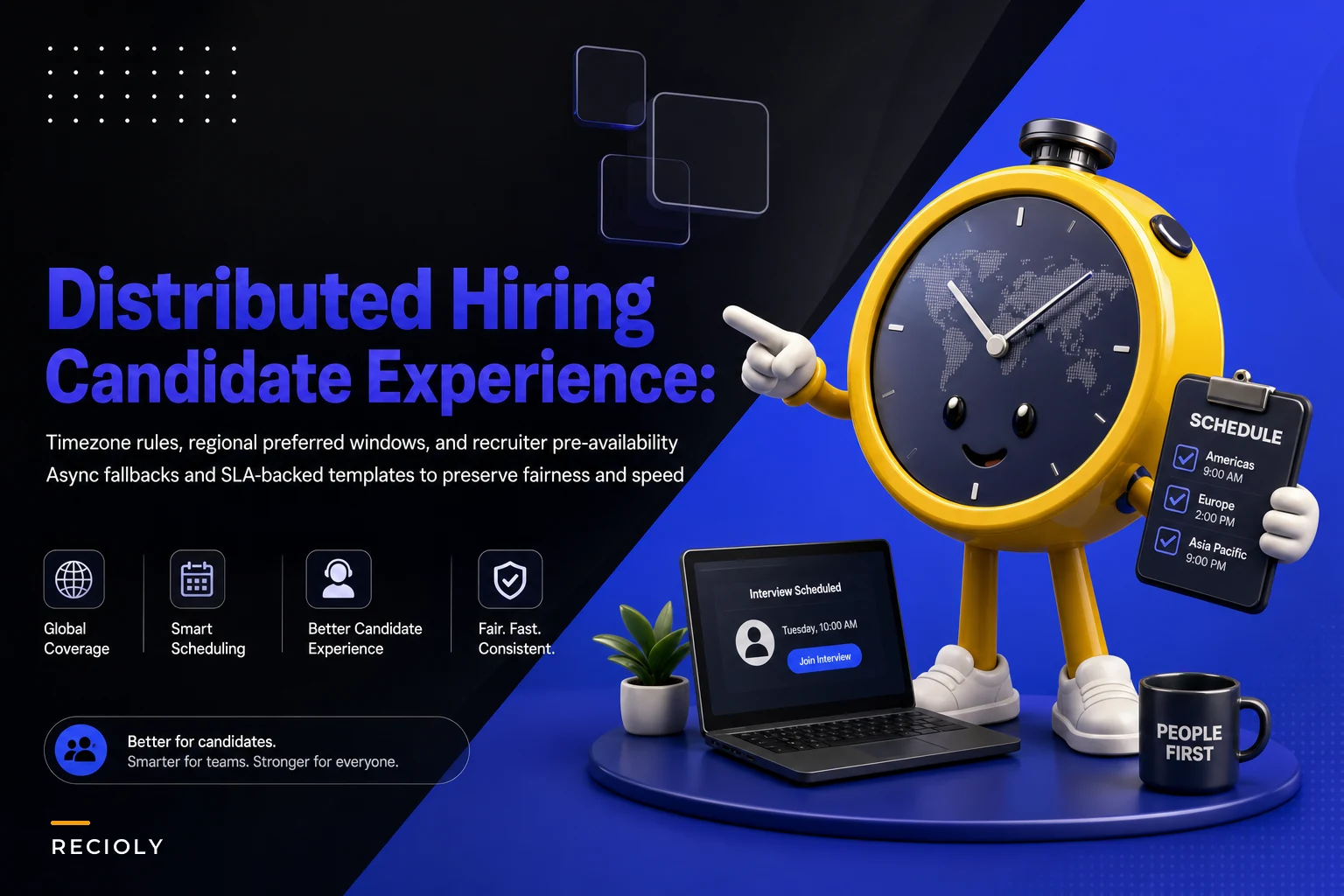
- APAC primary window: 9am-12pm local time - EMEA primary window: 2pm-5pm local time - Americas primary window: 10am-1pm local time
-
Sales/customer-facing roles
- Match customer timezone distribution - Example: If 60% of customers are in EMEA, prioritize EMEA-friendly slots
Pre-availability submission requirements
Every hiring manager submits recurring availability blocks for their region before a role gets posted. Not "generally available afternoons" — specific slots like "Tuesday/Thursday 2-4pm PT recurring."
This goes into a central availability database. When a candidate from Singapore applies, the system already knows which managers have APAC-compatible slots. No back-and-forth required.
Some managers push back on this initially. "What if something comes up?" That's exactly where async fallbacks help. But without baseline availability documented upfront, you're starting from zero every single time.
The async interview fallback that preserves momentum
Not every interview needs to be live. When timezone overlap genuinely doesn't exist, async interviews become your pressure release valve — but only with real structure behind them.
When async makes sense:
Technical screenings: Candidate records a screen-share solving a problem. Reviewer watches within 24 hours and provides structured feedback.
Culture fit interviews: Pre-recorded questions about work style, team preferences, conflict resolution. Multiple team members review independently.
Portfolio reviews: Designer or PM candidate walks through past projects. Hiring team reviews and prepares targeted follow-up questions for a live discussion.
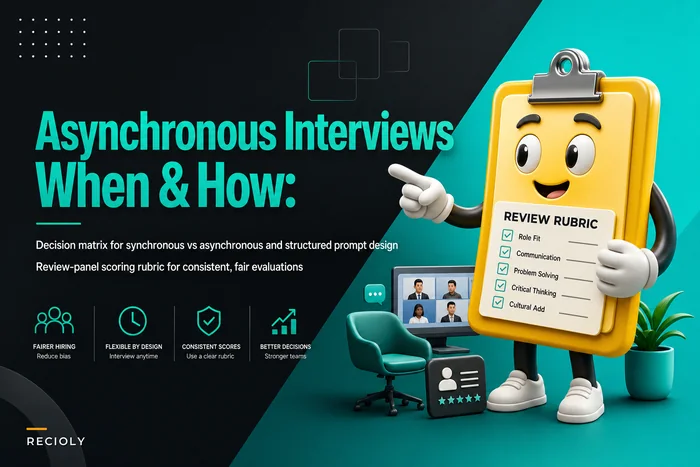
The part most companies miss: async doesn't mean unstructured. Every async interview needs a clear evaluation rubric, a maximum 48-hour review SLA, a feedback template, and an escalation path when reviewers miss that window.
Every async interview needs a clear evaluation rubric, a maximum 48-hour review SLA, a feedback template, and an escalation path when reviewers miss that window.
Without those guardrails, async interviews become black holes. Candidates wait days with no update, assume they've been ghosted, and withdraw.
SLA commitments that actually mean something
Publishing SLAs means nothing if you don't operationalize them. "We respond within 48 hours" becomes a lie when your Tokyo candidate waits five days for interview confirmation.
Real SLA implementation:
| Stage | SLA | Escalation Trigger | Fallback Action |
|---|---|---|---|
| Initial application response | 48 hours | 36 hours | Auto-acknowledge with timeline |
| Interview scheduling | 72 hours | 48 hours | Offer async alternative |
| Post-interview feedback | 5 business days | 4 days | Recruiter provides status update |
| Final decision | 10 business days | 8 days | Hiring manager must provide update |
The escalation trigger matters more than the SLA itself. At 36 hours without response, the system alerts the recruiter's manager. At 48 hours, the candidate gets an automatic status update. No manual tracking required.
Track SLAs by candidate timezone, not just in aggregate. You'll quickly spot if APAC candidates consistently hit escalation triggers while US candidates get rapid responses. That's operational bias showing up in your data — not attitude, not intent, just broken infrastructure.
Templates that balance speed with humanity
Automation helps you hit SLAs, but robotic messages destroy candidate experience. The goal is templates that feel personal while staying consistent.
Bad template: "Dear [CANDIDATE_NAME], Thank you for your interest in [ROLE]. We will review your application and respond within 48-72 hours."
Better template: "Hi Sarah, Thanks for applying to the Senior Engineer role from Singapore! Given the timezone difference, I wanted to confirm we got your application. I'll review everything today and get back to you by Thursday morning your time with next steps. If you need anything before then, just reply here."
The difference is acknowledging their actual situation, giving a concrete timeline in their timezone, and making it feel like a real human is paying attention.
Build template variations for different scenarios:
-
Same-timezone candidate (emphasize quick turnaround)
-
Opposite-timezone candidate (acknowledge the challenge, offer async options)
-
Partial-overlap candidate (highlight specific meeting windows)
Your ATS should automatically select the right template based on candidate location and role timezone requirements. It's a small thing that compounds fast at scale.
When this framework breaks (and what to do)
Even solid distributed hiring processes hit edge cases. A few common ones:
The executive interview bottleneck: Your CEO insists on interviewing every senior hire but only has Tuesday mornings available. This creates a 2-week backlog for APAC candidates who can't make that window.
Solution: Executive interview pools. Three senior leaders conduct those rounds with standardized questions and evaluation criteria. The CEO reviews recordings only for genuinely borderline cases.
The emergency hire: "We need someone in the Tokyo office ASAP" but all your recruiters are US-based.
Solution: Establish regional recruiting partnerships before you need them. Contract recruiters in key timezones who know your process and can activate within 48 hours.
The fairness complaint: A candidate claims they got worse interview slots because of their location.
Solution: Transparency beats defensiveness every time. Share your regional scheduling windows publicly. Show candidates that the framework ensures everyone gets prime local times — not that everyone gets identical slots, but that no one timezone gets permanently disadvantaged.
How AI-powered scheduling reduces manual coordination
This level of scheduling complexity traditionally requires a full-time coordinator per 50 open roles. Operational software with AI automation changes that math considerably.
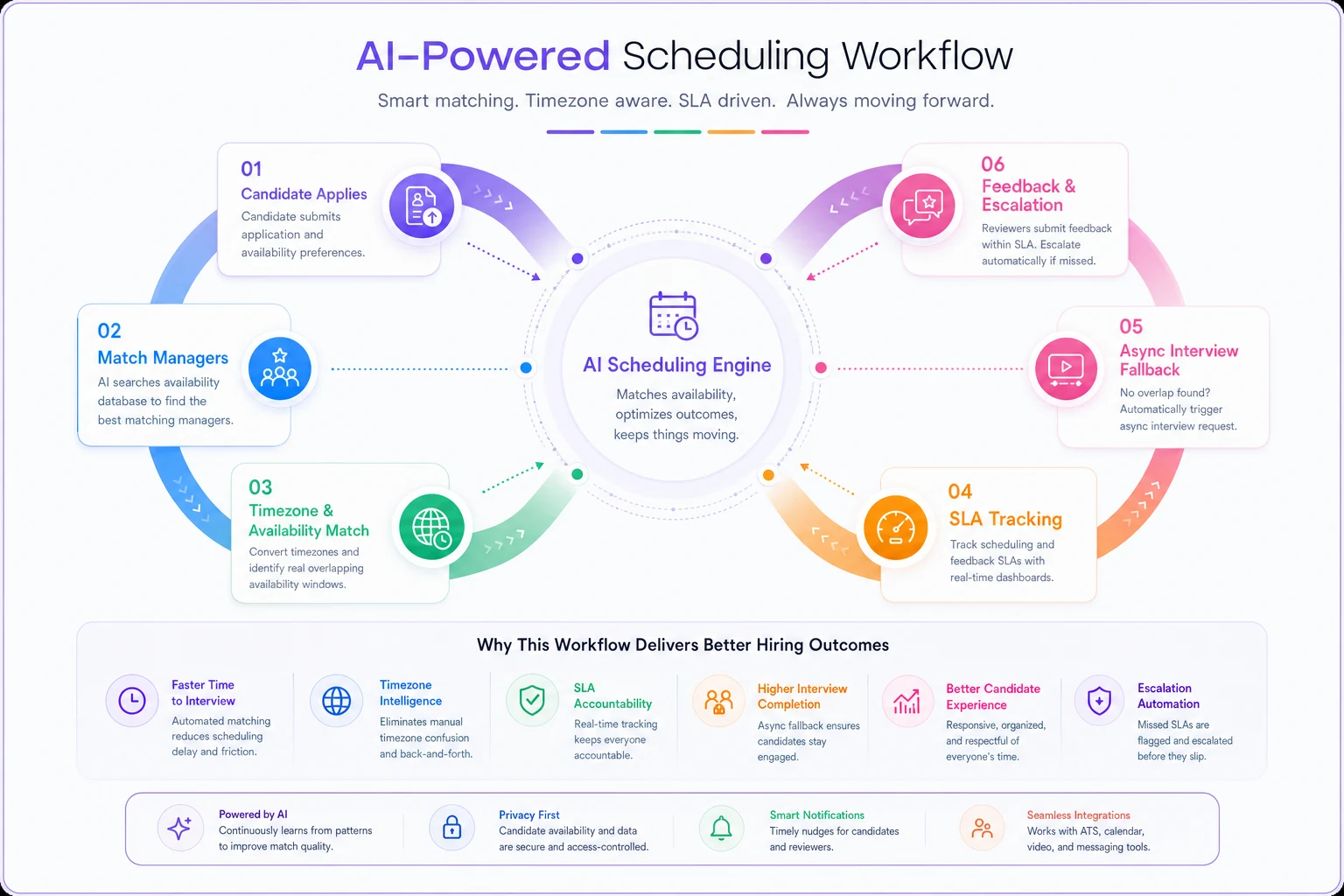
The diagram shows availability matching, SLA tracking, and async fallbacks.
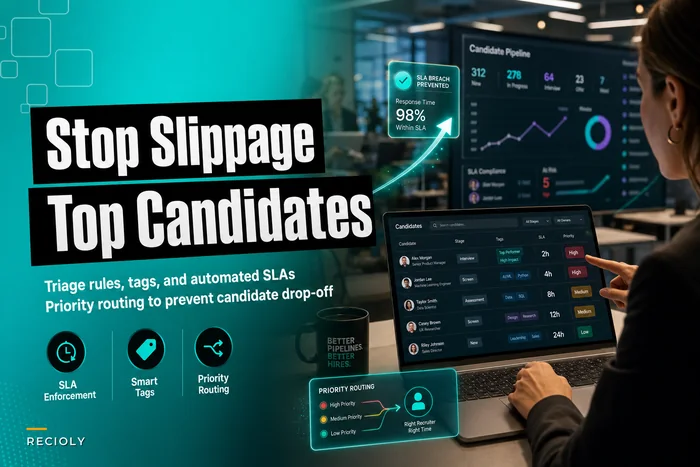
Modern platforms handle timezone conversion, availability matching, and SLA tracking automatically. When no calendar overlap exists, the system can trigger async interview workflows without a coordinator having to manually identify the problem and chase down alternatives. The candidate triage and prioritization side of the process also benefits — AI-assisted platforms surface at-risk candidates before they withdraw, not after.
More importantly, these platforms track fairness metrics continuously. You can see instantly if certain regions consistently get suboptimal slots or longer wait times, which lets you adjust policies before candidates start complaining — or worse, start talking about it publicly.
The coordinator's role shifts from calendar Tetris to relationship building. That's a better use of their skills anyway.
A distributed team's scheduling transformation
A 200-person SaaS company expanding from US-only to global hiring ran into everything described above. Before implementing structured scheduling:
-
Average time-to-schedule
6 days
-
Candidate drop-off rate
28%
-
Recruiter time on scheduling
~18 hours/week
-
Candidate NPS
31
After rolling out timezone windows, pre-availability requirements, and automated SLA tracking:
-
Average time-to-schedule
1.5 days
-
Candidate drop-off rate
11%
-
Recruiter time on scheduling
~3 hours/week
-
Candidate NPS
67
The biggest surprise wasn't the candidate improvement — it was manager satisfaction. Having documented availability windows eliminated surprise evening interviews and cut rescheduling by around 70%. Managers who initially pushed back on submitting availability slots became the loudest advocates for the system.
Moving beyond timezone chaos
Distributed hiring isn't going away. The talent market keeps getting more global, and companies still treating scheduling as an ad-hoc process will keep losing top candidates to those who've built actual operational infrastructure.
Start with one role, one timezone pair. Document the scheduling windows. Set up pre-availability collection. Implement basic SLAs. Measure what changes.
You don't need to solve everything at once. But you do need to stop assuming distributed scheduling will work itself out. Your candidates in Singapore, São Paulo, and Stockholm deserve better than 6am interview slots and week-long silences.
The companies winning global talent right now aren't always the ones with the biggest brands or the highest pay. They're the ones where a developer in Bangalore gets the same scheduling consideration as one in Boston — not identical slots, but real operational equity. That's what distributed hiring candidate experience actually means in practice.
The infrastructure exists. The frameworks are proven. The only question is whether you build it before your competitors do.
Ready to elevate your hiring process?
Join 1,500+ recruiting teams using Recioly to save time, improve collaboration, and hire smarter.