
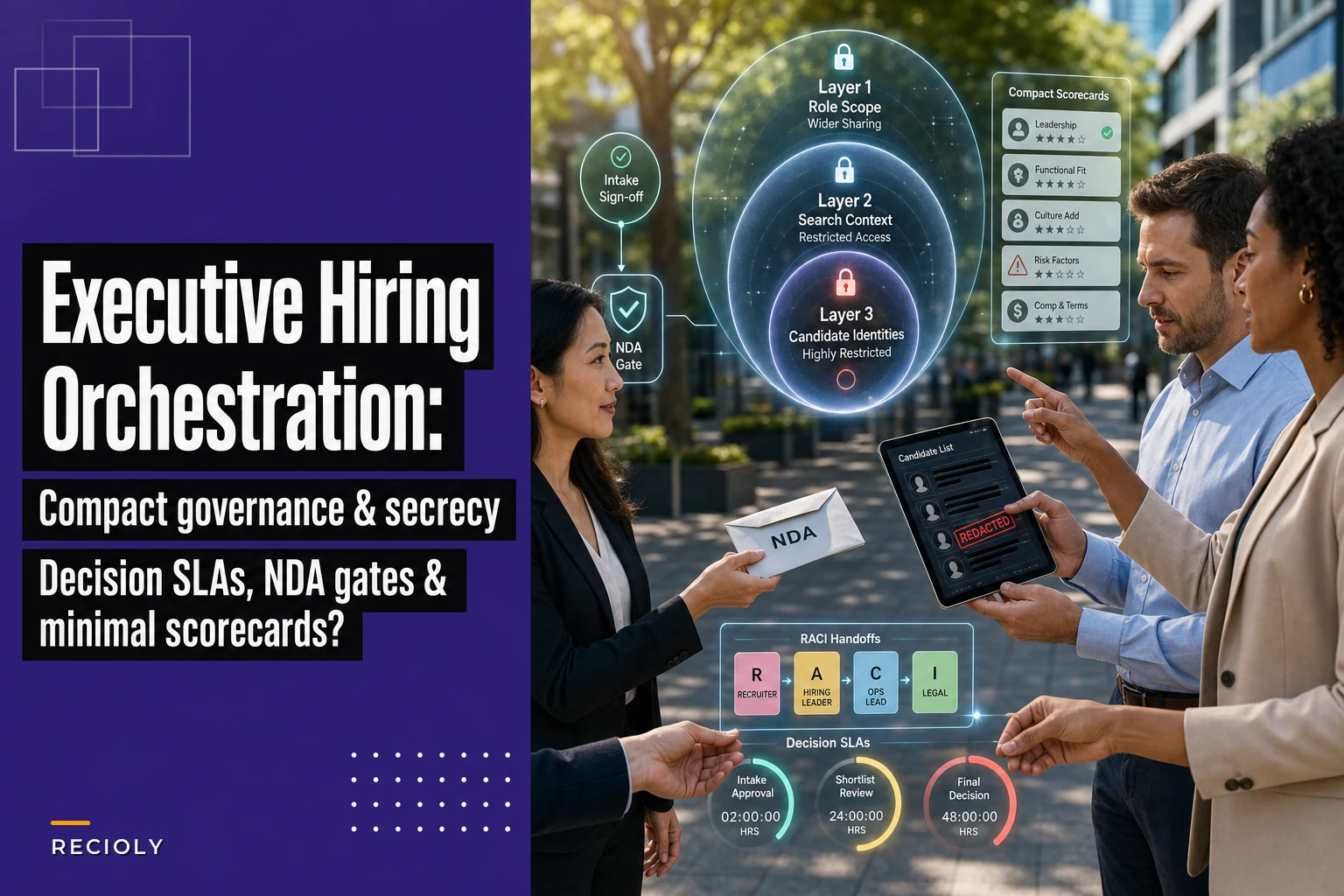

Executive searches break differently than every other kind of hire. The volume is low, the stakes are absurdly high, and the thing that usually keeps recruiting honest — a shared pipeline everyone can see — is exactly what you can't have. When you're replacing a sitting CFO who doesn't know they're being replaced, or quietly scoping a new Chief Revenue Officer while the current one is still shaking hands at the sales kickoff, transparency becomes a liability.
So teams overcorrect. They lock everything down so tightly that nobody knows who's supposed to do what, decisions sit for three weeks because "we can't put it in the ATS," and the whole thing runs on the search lead's memory and a Google Doc named finalFINALv3. Then the candidate accepts a competing offer because your board sync kept slipping.
The fix isn't more secrecy or more process. It's lightweight enforceable governance — a small set of rules that control who sees what, who decides what, and how fast decisions have to move, without turning the search into a bureaucratic swamp.
The core tension: confidentiality vs. coordination
Every executive search is a fight between two forces pulling in opposite directions.
Confidentiality says: shrink the circle, kill the paper trail, keep names out of systems. Coordination says: everyone involved needs enough context to move fast and make good calls. Push too hard on either side and the search fails — one way loudly, one way quietly.
Teams tend to treat this as binary. Either it's a "confidential search" (chaos, no records, decisions in hallways) or a "normal search" (leaks, awkward internal questions, candidates spooked). The better model is compartmentalization: instead of hiding everything from everyone, you decide precisely what each person needs to know and give them that and nothing more.
That single shift — from blanket secrecy to structured need-to-know — is what makes governance possible on a confidential search at all.
Compartmentalized intake: the first control point
Intake is where most exec searches quietly go wrong. On a normal req, intake is a kickoff meeting and a job description. On a confidential exec search, intake is a security decision.
Never lose track of top talent again.
Recioly helps you manage every stage of recruiting efficiently, from application to offer.
- Centralized candidate tracking
- Automated interview scheduling
- Collaborative hiring workflows
No credit card required
The mistake looks like this: the search kicks off, and to "align stakeholders," someone loops in the full leadership team, an EA, two board members, and a friendly external advisor — all in one thread, all with the candidate's current company named in plain text. Now eleven people know a competitor's VP of Engineering is quietly looking, and the odds that stays quiet for six weeks are basically zero.
-
Layer 1 — Role scope What the role needs, comp band, success profile. Can be shared relatively widely because it doesn't reveal a specific candidate or a sensitive replacement situation.
-
Layer 2 — Search context Why the search exists (replacement? quiet upgrade? new function?). Need-to-know only.
-
Layer 3 — Candidate identities Names, current employers, referral sources. Restricted to the search lead, the hiring executive, and whoever runs interviews.
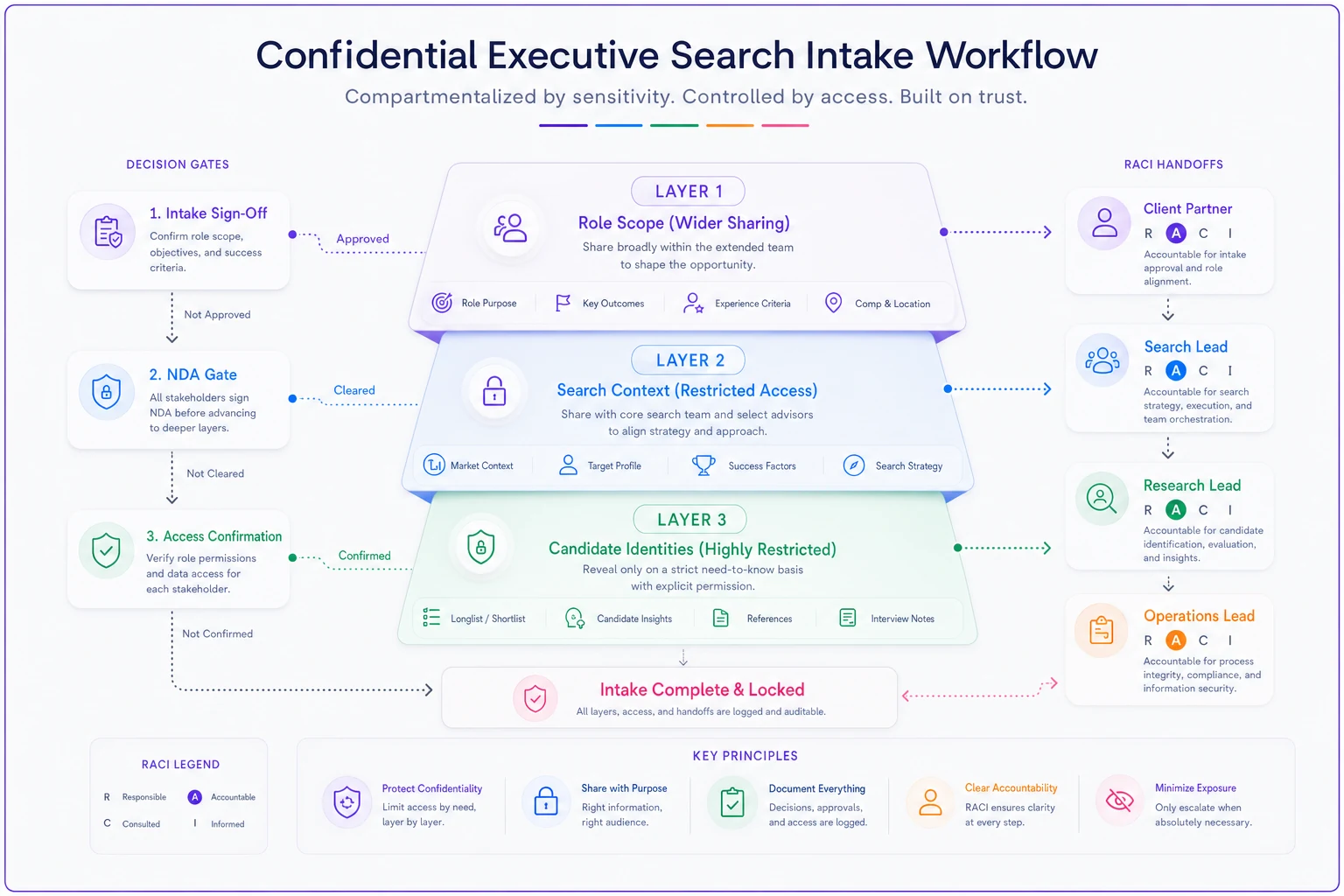
The diagram shows how information narrows from Layer 1 to Layer 3 and where NDAs and RACI sign-offs sit in the intake flow.
A mid-size SaaS company running a confidential COO search kept Layer 1 open to the exec team so they could pressure-test the success profile, but Layer 3 stayed with exactly four people. When a board member casually asked "so who are we talking to?" the search lead had a pre-agreed answer — "candidate identities are compartmentalized until finalist stage" — and everyone had already signed off on that rule at intake. No awkwardness, because the boundary was set before anyone tested it.
You don't earn the right to say "I can't tell you that" in the middle of a search. You earn it by making compartmentalization an explicit, agreed rule at intake, so it reads as governance, not as one person being cagey.
NDA rules that actually match the risk
NDAs on exec searches tend to be either theater or absent. Theater looks like a generic mutual NDA that nobody reads and nobody would ever enforce. Absent looks like "we trust everyone here" — until a name shows up in a Slack channel it shouldn't.
| Involvement level | What they access | NDA requirement |
|---|---|---|
| Role scoping (Layer 1) | Success profile, comp band | Existing employment confidentiality obligations sufficient |
| Search context (Layer 2) | Reason for search, org sensitivity | Signed acknowledgment of search-specific confidentiality |
| Candidate access (Layer 3) | Names, employers, materials | Named-search NDA + logged access |
| External parties (advisors, references) | Candidate identity | Standalone confidentiality agreement before any name shared |
The row people skip is the external one. References are where confidential searches leak most, because you're literally calling people at or near the candidate's current company. One clumsy "we're considering her for a senior role" to the wrong contact and the news travels back before dinner.
Handle reference confidentiality as its own procedure: candidate picks the references, candidate confirms it's safe to contact each one, and the reference gets a confidentiality framing at the start of the call, not buried at the end. This is also where our workflow around a 48–72 hour reference-check process with consent scripts intersects — the scripts matter even more when secrecy is on the line, because there's no room to improvise.
Compact scorecards: enough to be defensible, small enough to stay quiet
Full interview scorecards are a problem on confidential searches for a strange reason: they create a rich paper trail about a sensitive person. You want some documentation — enough to make a defensible decision and survive later scrutiny — but a sprawling 40-field rubric with the candidate's name at the top, floating around six interviewers' inboxes, is both a confidentiality risk and overkill.
The answer is a compact scorecard. Fewer fields, tighter definitions, centralized storage, and — critically — candidate identity separated from evaluation content wherever possible.
-
Anonymized candidate reference (e.g., "Candidate C-3," not the name, on the scoring form itself)
-
Two or three role-critical competencies, scored against a defined bar — not "leadership" in the abstract, but "has scaled a function from ~50 to ~300 people through a fundraise"
-
Evidence field — the non-negotiable
what specifically the candidate said or did that supports the score
-
Risk / reservation field — the thing that would make you hesitate
-
Recommendation — advance / hold / no, with a one-line rationale
The evidence and risk fields do the heavy lifting for defensibility. You can reconstruct why a decision was made without documenting every stray thought. And by scoring against an anonymized reference, the sensitive linkage between name and evaluation lives in one controlled place, not scattered across the panel's notes.
Teams either go full-bureaucracy (huge rubrics that interviewers half-fill because they're annoying) or full-vibes (no scorecard, decisions defended later with "he just felt right," which collapses the moment anyone questions it). Compact scoring threads the needle.
Stakeholder RACI: the fastest way to kill decision drift
Exec searches stall because nobody's sure who actually decides. The board thinks it's the CEO. The CEO thinks the board wants a vote. HR thinks they're driving. The result is a finalist sitting in silence for eleven days while everyone waits for someone else to move.
-
Search lead — Responsible for driving the process, maintaining compartmentalization, scheduling, and keeping the timeline honest.
-
Hiring executive (usually CEO or the exec the role reports to) — Accountable for the final hire decision.
-
Board / committee — Consulted on finalist selection and comp for the most senior roles; not in the loop on early-stage candidates.
-
HR / TA lead — Responsible for comp benchmarking, offer mechanics, and governance compliance.
-
Legal — Consulted on NDAs, non-competes, and any sensitive departure situation.
The single most valuable line in an exec RACI is the one that distinguishes Consulted from Informed. Confused searches almost always have too many people accidentally in the Consulted column — meaning the process can't move until all of them weigh in. Move people to Informed aggressively. A board member who gets a clean summary at finalist stage doesn't need to be consulted on the semi-finalist round.
This connects directly to the same discipline that makes hiring managers accountable on regular roles. The principles in our work on enforceable hiring manager enablement translate cleanly to executives, who ironically tend to be the least disciplined about following a defined evaluation process.
Secrecy procedures: the operational hygiene
Governance rules are useless if day-to-day handling leaks. A few concrete procedures that separate clean confidential searches from messy ones:
-
Naming conventions. The search gets a codename. Documents, calendar holds, and channels reference the codename, never the role or the candidate. "Project Harbor sync," not "COO replacement interview — J. Rivera."
-
Channel discipline. One controlled channel for Layer 3, and it's not your general recruiting tool if that tool is broadly visible internally. Pick where sensitive info lives and enforce it.
-
Calendar minimalism. Interview blocks show as "External meeting — hold," with details sent separately to the confirmed circle. EAs booking rooms is a classic leak vector.
-
Materials handling. Resumes and candidate decks live in one access-controlled location with named permissions, not forwarded around. When someone leaves the circle, their access gets pulled — a step teams almost always forget.
-
A leak plan. Decide in advance what you do if it gets out. Who talks to the candidate, what the internal message is. Improvising this in the moment goes badly.
Use a codename consistently across calendars and documents to avoid accidental exposure.
Most of these cost nothing. They're just decisions made in advance instead of under pressure. The pattern across searches that stay quiet isn't heroic secrecy — it's boring, consistent hygiene that everyone agreed to upfront.
Decision SLAs: the part that saves the hire
The uncomfortable truth about exec searches: the confidentiality usually holds fine. What kills them is speed. A strong candidate being courted by two other companies will not wait three weeks for your board to "find time." The secrecy that protects the search also slows it down, because you can't loop people in casually.
-
Post-interview debrief — within 48 hours of the final panel interview. No letting impressions decay for a week.
-
Advance/hold decision — within 3 business days of debrief.
-
Finalist-to-board summary — packaged and sent within 2 days of selecting finalists.
-
Board/committee response window — a hard 5-business-day window, agreed in advance, with a named fallback decision-maker if the window is missed.
-
Offer construction — comp package modeled and ready within 3 days of the go decision.
The fallback rule in #4 is the one that matters most. If you don't pre-agree what happens when the board window blows past five days, the search just waits indefinitely. Naming a fallback — "if the committee hasn't responded by day five, the CEO proceeds with a documented decision" — is what keeps a confidential search from dying of politeness.
A real scenario
A roughly 400-person healthcare tech company needed to replace a Chief Product Officer who didn't yet know they were being managed out. An earlier attempt had cratered: the search leaked internally because interview holds showed up on shared calendars with the role in the title, the exec team all had visibility into candidate names, and a strong finalist walked after sitting in two and a half weeks of silence while the board "got aligned."
On the reset, they ran it differently. Codename for everything. Layer 3 restricted to four people. Compact five-field scorecards with anonymized candidate references. A RACI that moved two board members from Consulted to Informed until finalist stage. Decision SLAs with a hard board window and a named fallback.
The difference wasn't subtle. The search stayed genuinely quiet — the outgoing exec found out at the planned time, not through the grapevine. Time from final panel to offer dropped from well past three weeks to around six days. The finalist accepted, partly because the process felt decisive rather than chaotic. Candidates read your internal competence through how fast and cleanly you move.
When this level of governance makes sense — and when it doesn't
This isn't for every senior hire. Standing up codenames, tiered NDAs, and formal SLAs is real overhead, and applying it to a Director role that everyone already knows is open just creates friction.
It makes sense when:
-
The role is a confidential replacement of a sitting executive
-
The candidate pool includes people at competitors who'd be endangered if it leaked
-
Board or committee involvement is required
-
A leak would create material internal disruption or a market/regulatory issue
It's overkill when:
-
The opening is already public or internally known
-
There's no board layer and the decision-maker is a single exec who can move fast
-
The candidate pool is external and unbothered by exposure
Who should not do a full compartmentalized search: teams without a single accountable search lead. The whole model depends on one person owning compartmentalization and the timeline. Run this by committee with no clear driver and you get the worst of both worlds — the overhead of secrecy with none of the discipline.
Keeping it enforceable without an army
Rules that live in someone's head aren't rules. The searches that hold together are the ones where the compartmentalization layers, the RACI, and the SLAs are written into a short one-page charter agreed at intake — and where the process itself nudges people to comply. Access that's actually restricted. Holds that are actually generic. Clocks that someone actually watches.
You don't need heavy tooling to do this, but you do need something that centralizes the sensitive layer, tracks who has access, timestamps decisions, and flags when an SLA clock is about to breach. Whether that's a purpose-built workflow platform or a tightly controlled setup you assemble yourself, the requirement is the same: the governance has to be enforced by the system, not by the search lead's willpower, because willpower fails at week three when everyone's tired and a decision is overdue.
Get compartmentalized intake, tiered NDAs, compact scorecards, a clean RACI, real secrecy hygiene, and decision SLAs working together, and a confidential exec search stops being a white-knuckle exercise. It becomes something you can actually run twice the same way — which, for a process this high-stakes, is the whole point.
Ready to elevate your hiring process?
Join 1,500+ recruiting teams using Recioly to save time, improve collaboration, and hire smarter.