

The problem with coding take-homes isn't the take-home itself. It's what happens after 40 of them land in your inbox in the same week and every hiring manager wants "quick feedback." Grading slows to a crawl, reviewers start skimming, and the plagiarism checks—if they happen at all—turn into someone eyeballing the code for vibes.
That's exactly the gap where bad hires walk through, and where good candidates get graded by whoever happened to be tired that afternoon.
This piece is narrow on purpose. It's about grading take-homes plagiarism controls as an actual operational workflow: how to triage fast, catch copied or AI-generated submissions without becoming paranoid, and standardize the pass/fail decision so it survives scrutiny later.
Start with the failure pattern, not the rubric
Here's what usually breaks first.
A team sends out a take-home—say, "build a small REST API with two endpoints and basic tests." The prompt is decent. The problem is that nobody defined what a fast review looks like versus a deep one. So every submission gets the same treatment: someone clones the repo, runs it, pokes around for 30–45 minutes, and writes a paragraph.
Multiply that by 30 candidates and you've burned two full engineering days. The natural reaction is to speed up, which means reviewers stop reading tests, stop checking edge cases, and start rubber-stamping anything that "runs."
The plagiarism side rots at the same time. When you're rushing, you don't notice that two candidates from the same bootcamp cohort submitted suspiciously similar folder structures, identical variable naming, and the same off-by-one bug in the same place. Copied work looks clean on a fast skim. That's the trap.
The fix isn't "review harder." It's separating triage from deep evaluation, and making both cheap to run.
A two-speed triage model
Most teams review linearly—first come, first served—which means your strongest and weakest candidates get identical attention. That's backwards.
Never lose track of top talent again.
Recioly helps you manage every stage of recruiting efficiently, from application to offer.
- Centralized candidate tracking
- Automated interview scheduling
- Collaborative hiring workflows
No credit card required
Run a fast triage pass on everything, then only invest deep-review time on the ones that survive.
The fast pass is a compact heuristic check. You're not grading quality yet—you're answering "is this worth a real review, and are there any red flags?"
| Check | Fast-pass question | Time budget |
|---|---|---|
| Does it run? | Clones and starts without hand-holding | 3–5 min |
| Complexity sanity | Is the solution wildly over- or under-built for the prompt? | 2 min |
| Edge cases | Did they handle the obvious ones (empty input, bad input)? | 3 min |
| Test presence | Are there tests, and do they actually assert something? | 2 min |
| Similarity signal | Any match against prior submissions or common sources? | automated |
| Effort signal | Commit history, README, comments—signs of real work vs. a paste job | 2 min |
If a submission clears the fast pass, it goes to deep review. If it fails on "does it run" or throws a similarity flag, it gets triaged out or routed for a closer look before anyone spends 40 minutes on it.
In practice: a batch of 30 take-homes that used to eat two days gets a first cut in an afternoon, and deep review only happens on the 10–12 that earned it.
Complexity checks that catch the extremes
The two things worth flagging fast are over-engineering and under-engineering, because both tell you something and both are quick to spot.
Over-engineering on a small prompt—someone builds a full plugin architecture, dependency injection framework, and Docker Compose setup for a two-endpoint API—usually signals one of two things: they copied a boilerplate template wholesale, or they can't scope. Neither is automatically disqualifying, but it changes what you look for in deep review.
Under-engineering—no error handling, no tests, everything crammed in one file—tells you where their bar sits. Again, not an instant fail. A junior candidate under time pressure might still show good instincts inside that mess.
The heuristic: don't grade complexity as good or bad during triage. Just tag it. Tags like over-scoped, minimal, no-tests, clean-baseline let you route submissions to the right depth of review and to reviewers who can judge fairly. A staff engineer wasting 40 minutes on a clearly minimal junior submission is a scheduling problem you can avoid.
Automated similarity checks, and their limits
This is where most teams either do nothing or over-trust a tool.
-
Cross-candidate similarity — comparing submissions in the same batch against each other. This catches the "two people shared a solution" case, which is more common than people think, especially with public prompts.
-
Public-source similarity — matching against GitHub, Stack Overflow, and known tutorial repos. If your prompt is a slightly-reworded LeetCode problem, expect matches.
-
AI-generation signals — harder, noisier, and honestly the least reliable of the three right now. Treat any "AI-written" score as a reason to look closer, never as evidence on its own.
The rule that matters operationally: a similarity flag is an escalation trigger, not a verdict. Copied structure can have innocent explanations—everyone follows the same framework conventions, everyone names the file server.js. What you're looking for is distinctive overlap: the same unusual approach, the same specific comments, the same weird bug reproduced identically.
Genuinely copied submissions tend to share the idiosyncratic choices—an oddly named helper function, an unnecessary intermediate variable, the exact same edge case ignored. Legitimate independent solutions converge on the obvious stuff and diverge on the weird stuff. Copied ones match on the weird stuff. That distinction alone resolves most false alarms.
Quick-pass rubric fields
The deep review still needs structure, or you drift back into vibes-based grading. But a take-home rubric doesn't need 25 fields. It needs a handful of decisive ones.
-
Correctness — does it actually solve the stated problem, including the edge cases the prompt implied?
-
Code clarity — could another engineer maintain this without a translator?
-
Testing — do tests exist, and do they test the right things (not just the happy path)?
-
Judgment — did they make reasonable tradeoffs given the time box, and note them?
Four fields, scored simply—say 1 to 3, where 2 is "meets bar." Resist the urge to add weighting spreadsheets. The value is in every reviewer scoring the same dimensions, not in decimal precision.
One field that pays for itself: a short "would I want this person's PRs in my repo?" gut-check, written as one sentence. It surfaces disagreements that the numeric scores hide, and it's what calibration sessions actually chew on.
This is the same drift problem that shows up everywhere else in hiring. If your reviewers aren't aligned on what a "2" means, your scores are noise. The mechanics in an interviewer calibration program that stops score drift apply directly to take-home grading, and it's worth running the same quarterly calibration on your take-home rubric that you'd run on live interviews.
Escalation triggers: when to stop trusting the fast pass
The whole point of triage is speed, which means you need clear rules for when a submission jumps out of the fast lane and gets careful human attention.
-
Similarity flag on distinctive code, not just boilerplate.
-
Score spread between two reviewers is large—one reviewer's "clear pass" is another's "clear fail."
-
Complexity mismatch with the résumé—a claimed senior submits minimal work, or a stated junior submits suspiciously polished, idiomatic code with no rough edges.
-
Commit history looks off—one giant commit at the deadline, or timestamps that don't line up with the time window you gave.
-
The candidate is otherwise strong and you're about to reject on the take-home alone. High-stakes rejections deserve a second set of eyes.
That last one matters more than people admit. Take-homes have real false-negative rates. Good engineers bomb them because of unclear prompts, life getting in the way, or misreading scope. Before a take-home becomes the sole reason someone's out, someone senior should confirm the call.
A quick workflow you can actually run
Here's the flow end to end, tool-agnostic:
-
Intake — submission lands, gets logged with candidate, prompt version, and timestamp.
-
Automated pass — similarity check runs across the current batch and known sources; results attached to the record before any human looks.
-
Fast triage — reviewer spends ~10–15 minutes running the heuristic checklist, applies tags, and marks
deep-review,reject, orescalate. -
Deep review — only for survivors; scored on the four rubric fields plus the one-line gut check.
-
Escalation handling — anything triggered goes to a senior reviewer with the specific flag noted, not just "please look at this."
-
Decision log — final call recorded with the rubric scores and any escalation notes attached.
Here's a quick visual of that flow.
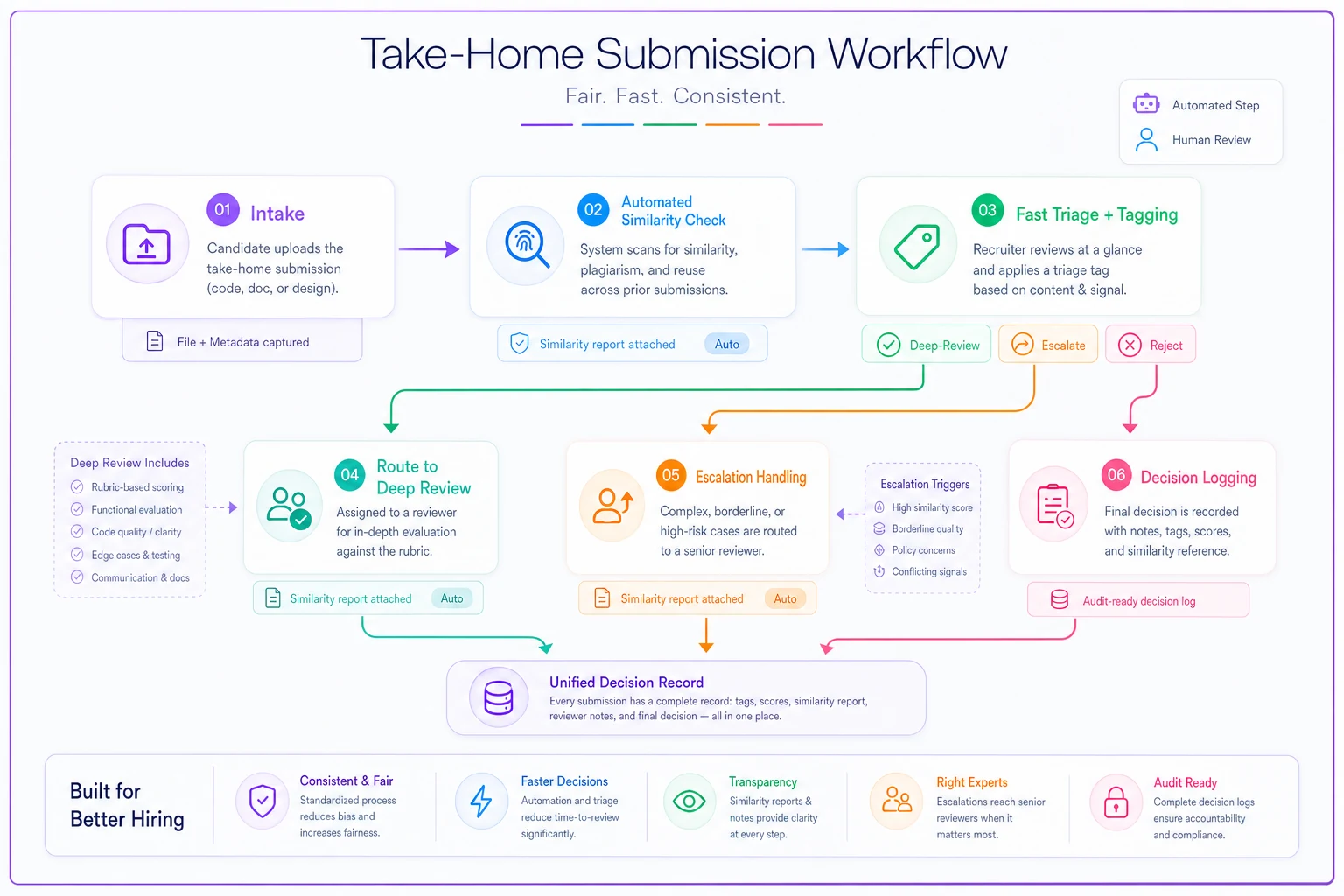
The tagging, routing, and log steps are where a lightweight workflow platform earns its place—not by grading for you, but by making sure automated similarity results land on the record before a human reviews, routing escalations to the right person automatically, and keeping a timestamped decision trail so a rejected candidate's file actually explains the "why." When those handoffs are manual, they're the first thing that gets skipped in a busy week, and skipping them is exactly how copied work sneaks through.
When take-homes make sense—and when they don't
When they work well: roles where you can define a small, self-contained, realistic problem and where the candidate pool can reasonably spare 2–4 hours. Backend, data, and full-stack roles at mid-level tend to fit.
When they're a bad idea: senior and staff hires who will (rightly) refuse unpaid multi-hour work, high-volume funnels where you can't review submissions fast enough to be fair, and prompts so generic they're one search away from a full solution.
Who should skip them entirely: teams without the bandwidth to review consistently. An ungraded or inconsistently graded take-home is worse than none—it burns candidate goodwill and gives you a false sense of signal. If you can't staff the review, a structured live exercise or a well-scored async format serves you better. For roles where you're leaning async anyway, the review-panel approach in when to use asynchronous interviews and how to score them reliably pairs naturally with the rubric fields above.
A realistic before/after
A roughly 25-person product company was running take-homes for backend roles and drowning. Around 20–30 submissions a month, no triage step, every one getting a full review from whichever engineer happened to be free. Turnaround from submission to decision was stretching past a week, and two hires in six months turned out to have leaned heavily on copied solutions that rushed reviewers had passed.
They didn't add fancy tooling. They added a fast-pass heuristic, ran cross-batch similarity checks before human review, cut the rubric to four fields, and set explicit escalation triggers.
Over the next quarter: first-cut turnaround dropped to under two days, deep-review time went only to submissions that earned it, and the similarity checks caught two batch-level matches that would've sailed through before. Reviewer complaints about grading fatigue mostly went away, because nobody was doing 40-minute reviews on submissions that failed the 10-minute check.
Nothing exotic. Just triage before depth, automated checks feeding the record early, and a small set of rules for when to slow down.
Fast grading and real plagiarism control aren't in tension—they fail together when you don't separate triage from deep review. Cheap heuristics on everything, real time only on what survives, similarity flags treated as reasons to look rather than verdicts, and clear escalation rules for the calls that matter. Do that, and you stop trading speed for rigor. You get both, and your rejections actually hold up when someone asks why.
Ready to elevate your hiring process?
Join 1,500+ recruiting teams using Recioly to save time, improve collaboration, and hire smarter.