


A senior engineer accepts a competing offer on a Tuesday morning. By 10am they've quietly declined three interviews — including the final panel they were supposed to run at 2pm that day for one of your best candidates. Nobody on the recruiting side knows until 1:52pm, when the recruiter pings the interviewer and gets an out-of-office reply.
Now you've got a candidate who took PTO, a hiring manager who wants a decision by Friday, and a panel with a hole in it. The recruiter scrambles, finds nobody, and reschedules. The candidate — who was already lukewarm after a slow process — ghosts two days later.
That's not a people problem. That's a missing orchestration layer. Interviewer backup orchestration is the set of rules that decides, before anyone drops, who covers the gap, when you keep going versus reschedule, and who gets told what. Most teams don't have it written down. They improvise, and improvisation at 1:52pm is how good candidates slip away.
This article is only about that: the rules, templates, and decision trees that keep a panel resilient when a panelist disappears. Not interview design. Not scheduling tools in general. Just the backup machinery.
Why panels break at the worst possible moment
Panels don't usually fail because interviewers are flaky. They fail because the whole system assumes everyone shows up, and there's no defined fallback when that assumption breaks.
A few patterns show up again and again:
The single-point-of-failure interviewer. One person is the "only" one who can assess system design, or the only bilingual interviewer, or the only one the hiring manager trusts for culture-add. When that person is out, there's no plan B because the role was never designed to have one.
Silent cancellations. The interviewer declines the calendar invite but doesn't tell the recruiter directly. The decline sits in an inbox nobody's watching. This is shockingly common — the calendar does its job, but the human signal never reaches the person who can act on it.
Last-minute conflicts that nobody escalates. Someone gets pulled into a production incident or a customer escalation at 11am. They assume "someone will handle it" or they just plan to reschedule. There's no rule telling them what to do with the slot they're about to vacate.
The deeper issue is that most teams treat backup as a reaction instead of a standing policy. When you scale, this gets worse fast — more panels, more interviewers, more collisions. If you've already worked on role-family interview tracks and interviewer capacity buffers, backup orchestration is the natural next layer: capacity buffers give you bodies, backup rules tell you how to deploy them under pressure.
The real cost of a dropped panelist
The reschedule itself feels cheap. It isn't.
Never lose track of top talent again.
Recioly helps you manage every stage of recruiting efficiently, from application to offer.
- Centralized candidate tracking
- Automated interview scheduling
- Collaborative hiring workflows
No credit card required
A typical example looks like this: a mid-size team running around 40–50 onsite loops a month. Roughly one in eight loops has at least one interviewer drop within 24 hours of the panel. That's five or six scrambles a month. Each scramble burns maybe 30–45 minutes of recruiter time hunting for a sub, plus the coordinator rework, plus the hiring manager's irritation.
But the expensive part is downstream. When a panel partially collapses and you reschedule, candidates read it as disorganization. Decline rates on rescheduled finals tend to run noticeably higher than clean ones — and for passive candidates juggling multiple processes, a reschedule is often the nudge that tips them toward the competitor who kept their word.
So the cost isn't "35 minutes of recruiter time." It's 35 minutes plus a measurable bump in late-stage declines, concentrated on exactly the candidates you fought hardest to get into a final loop. Losing one strong final-round candidate a quarter to a preventable reschedule dwarfs the operational time.
The two decisions that matter when someone drops
When a panelist falls out, there are really only two questions, and most teams answer them badly because they answer them in a panic.
Decision 1: Can a qualified backup cover this slot in time?
Decision 2: If not, do we proceed with a reduced panel or reschedule?
Everything else is detail. The trick is deciding these in advance with rules, so the person on the hot seat isn't making a judgment call under stress.
Rotation and backfill rules
The foundation is a named backup for every panel slot — not "the team," an actual person. Every interview slot in a loop should map to a primary interviewer and at least one designated backup who's calibrated for that competency.
-
Every competency has a bench of at least 2 qualified interviewers. If a competency only has one qualified person, that's a staffing risk you fix before it bites you, not during a drop.
-
Rotation distributes load so no single person is always the backup. The backup role rotates weekly. Otherwise your "reliable" senior person quietly becomes the dumping ground for every gap and burns out.
-
Backups are pre-confirmed as available, not just qualified. Being on the bench means your calendar is held soft for that window. A qualified backup who's double-booked isn't a backup.
-
The backfill trigger is time-based. If a primary hasn't confirmed by a set threshold before the panel, the backup is auto-engaged — you don't wait for the primary to formally decline.
Enforce the rotation schedule in your calendar system so backup assignments and soft holds are visible to everyone.
That last point is the one people skip. Don't wait for a decline. Treat non-confirmation as a soft drop and start moving.
Mandatory backups for critical slots
Not every slot needs the same protection. A mandatory backup — someone actively holding the time, briefed on the candidate, ready to step in — should be required for:
-
Final-round panels for senior or hard-to-fill roles
-
Any slot assessing a competency with a thin interviewer bench
-
Loops for candidates flagged as high-priority or at flight risk
-
Panels where the candidate has already rescheduled once (you don't get a third chance)
For early-stage screens with deep benches, a soft backup (named but not holding time) is usually enough. Match the protection to the stakes. Over-protecting every screen wastes capacity; under-protecting finals loses candidates.
The candidate options matrix: proceed vs. reschedule
This is the decision most teams get wrong. When no backup is available, they default to reschedule because it feels safe. Often it's the worst option.
| Scenario | Backup available? | Candidate priority | Recommended action |
|---|---|---|---|
| Non-critical slot, 4+ panel loop | No | Any | Proceed; convert dropped slot to async or add later |
| Critical competency slot | Yes | Any | Backup covers, brief them fast |
| Critical competency slot | No | High / flight risk | Proceed with reduced panel + schedule a short follow-up for the missing signal within 48h |
| Critical competency slot | No | Standard | Offer candidate: proceed-reduced OR reschedule (their choice) |
| Final panel, candidate already rescheduled once | No | Any | Proceed reduced, never reschedule again |
| Any slot | No | Candidate traveled / took PTO | Proceed in some form; a bare reschedule here is the highest-risk move |
The principle running through this: protect the candidate's momentum first, panel completeness second. You can always backfill a missing competency signal with a focused 30-minute follow-up. You usually can't un-ghost a candidate who felt jerked around.
One underrated option in that matrix: giving the candidate the choice. "We've had an interviewer conflict for one of your four sessions. We can proceed with the remaining three today and I'll set up a short follow-up for the last one, or we can move the whole thing to Thursday — totally your call." Candidates who feel in control rarely hold it against you. Candidates who get a unilateral reschedule often do.
SLA-bound decision trees
Rules only work if they're bound to time. "Find a backup" means nothing without "by when." Tie each step to a deadline measured from the panel start time.
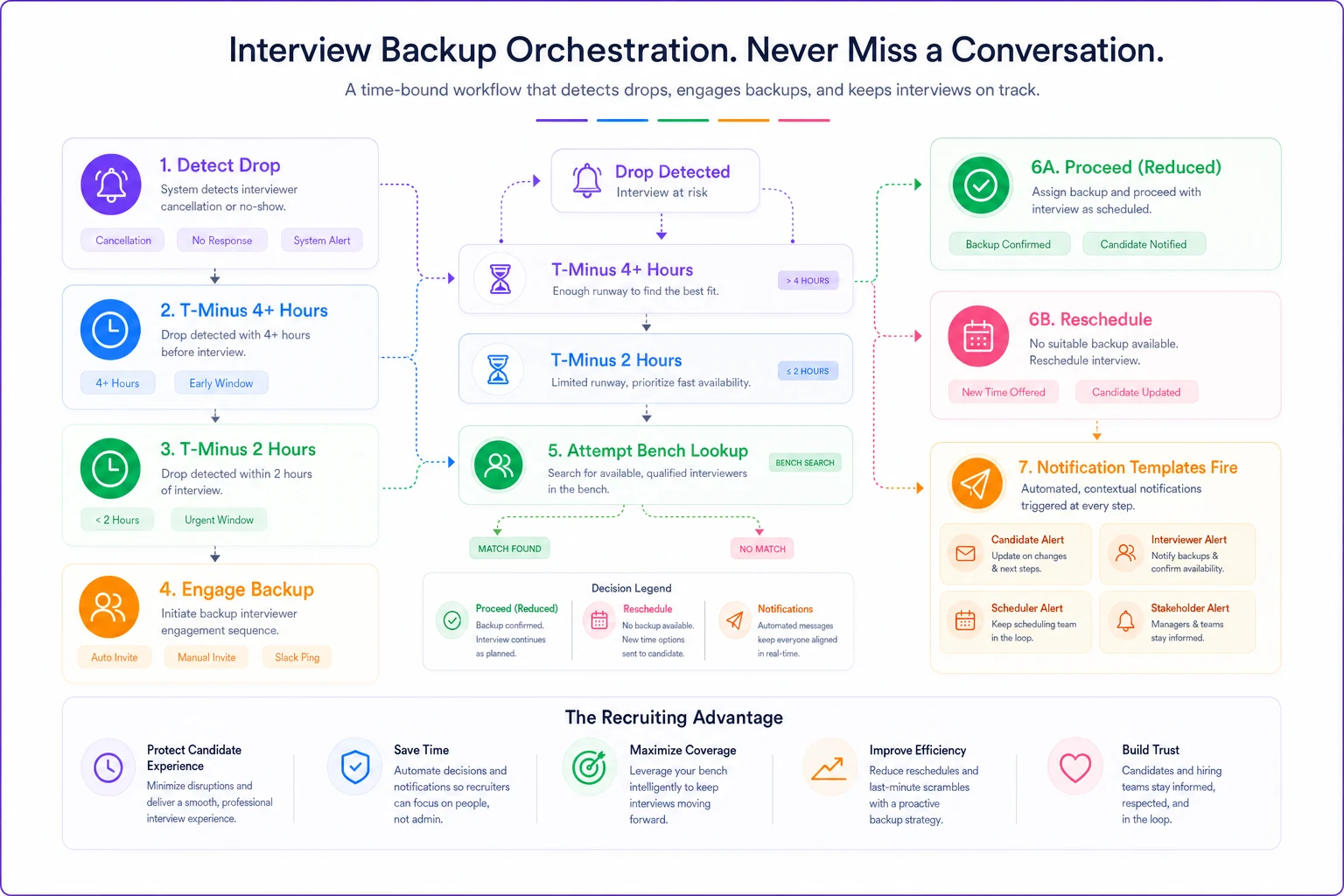
A concrete decision tree for a drop detected inside 24 hours:
-
Drop or non-confirmation detected (T-minus anything). Recruiter/coordinator is alerted immediately — not via a buried calendar decline.
-
T-minus 4+ hours Engage the designated backup. Backup confirms within 1 hour. If confirmed → brief them (candidate resume, scorecard, interview focus) and you're done.
-
T-minus 4+ hours, backup can't cover Check the competency bench for anyone else available. One attempt, time-boxed to 30 minutes.
-
No backup found, T-minus 2 hours Go to the options matrix. Decide proceed-reduced vs. candidate-choice reschedule based on slot criticality and candidate priority.
-
If proceeding reduced Notify remaining panelists, confirm the follow-up plan for the missing signal, update the scorecard so nobody's waiting on an assessment that won't come.
-
If rescheduling Candidate gets the news within the hour, with a concrete new time already proposed — never "we'll get back to you."
The SLA numbers should match your context. A team with a thin bench might need longer lead times; a well-staffed team can compress these. The point is that every branch has a deadline, so nobody sits on a decision waiting for perfect information.
Here's a quick visual of the SLA-driven workflow to make the timing clear.
This matters even more for distributed loops, where a drop can collide with timezone constraints and shrink your pool of available backups to almost nothing. If you run panels across regions, the timezone rules and recruiter pre-availability approach pairs directly with these SLAs — pre-availability is what makes the "engage backup within 1 hour" step actually achievable when your bench is spread across the globe.
Auto-notify templates that cut the scramble
Half the delay in a drop isn't the decision — it's writing the messages. By the time you reschedule, you're composing three or four notes under pressure and probably botching the tone on at least one. Pre-write them. Keep them short, and make the variables obvious.
A minimal template set:
-
Backup engagement (to interviewer) "Need you to cover [competency] for [candidate] at [time] today — primary had a conflict. Brief and scorecard attached. Can you confirm in the next hour?"
-
Candidate proceed-reduced notice "Quick heads-up: one of your interviewers hit a conflict. We're going ahead with the rest of your sessions as planned, and I'll set up a short follow-up for the last piece. Nothing changes on your end for today."
-
Candidate choice offer "We've had an interviewer conflict for one session. Two options: keep today's remaining sessions and I'll arrange a brief follow-up, or move everything to [alt time]. Whatever's easier for you."
-
Reschedule notice "I'm sorry — we need to move your [time] session. Here's the earliest clean slot: [new time]. Does that work, or would you prefer [alt]?"
-
Panel heads-up (to remaining interviewers) "Loop for [candidate] is now 3 instead of 4 — [interviewer] dropped. [Competency] will be covered in a follow-up. Proceed as normal."
Notice what these do: they state the action already taken, give the recipient one clear thing to do, and never apologize their way into making the candidate anxious. The candidate-facing ones especially should sound calm and handled, because the whole goal is to signal that this is a routine blip you've got covered — not a crisis.
Keeping the whole thing from falling apart manually
The honest problem with everything above: it's a lot of moving parts to run by hand. Watching for silent declines, triggering backups on a clock, picking the right matrix branch, firing the right template to the right person within SLA — do that across dozens of loops a month and the orchestration itself becomes the bottleneck.
This is where workflow and scheduling platforms with built-in automation earn their keep. The useful pieces to look for: calendar monitoring that flags a non-confirmation as a soft drop instead of waiting for an explicit decline, rules that auto-engage a named backup when a confirmation threshold passes, and notification logic that routes the right template to the right person the moment a branch is triggered. The decisions — who's on the bench, when you proceed versus reschedule, how you treat a flight-risk candidate — stay yours. The automation just makes sure the clock-driven steps actually fire on time instead of depending on a recruiter noticing a decline in a crowded inbox.
The test is simple: if a panelist drops at 1pm, does the system start working on it before a human notices, or does the whole chain wait on someone checking their calendar? If it's the latter, the automation isn't buying you much.
When reduced panels are fine — and when they're not
Proceeding with a reduced panel is the right call more often than teams think, but not always.
It makes sense when: the missing competency can be assessed cleanly in a short follow-up, the remaining panel still covers the decision-critical signals, or the candidate is at real risk of walking if you delay. A four-person loop that proceeds as three-plus-a-follow-up loses almost nothing in signal and keeps the candidate's momentum intact.
-
the missing competency can be assessed cleanly in a short follow-up
-
the remaining panel still covers the decision-critical signals
-
the candidate is at real risk of walking if you delay
It's a bad idea when: the dropped slot was the single most decision-relevant interview (the hiring manager's, or the one competency the whole hire hinges on), or when proceeding would mean the panel can't actually reach a defensible decision. Rushing to a thumbs-up or thumbs-down on half the evidence is how you make a bad hire look like a fast one.
-
the dropped slot was the single most decision-relevant interview
-
proceeding would mean the panel can't actually reach a defensible decision
Who should not lean on reduced panels at all: teams making senior or high-blast-radius hires where every competency genuinely needs live assessment. For those, invest in mandatory backups up front rather than planning to limp through with a partial panel. The cost of a backup bench is trivial next to the cost of a mis-hire at that level.
A short real scenario
A fintech company running about 35 technical loops a month kept losing final-round candidates to reschedules — somewhere around one or two strong finalists a quarter would drop off after a panel got moved. Digging in, the pattern was consistent: an engineer would decline the invite the morning of, the decline would sit unseen, and the recruiter would find out an hour before and reschedule by default.
They changed three things. First, every competency got a two-person bench with a weekly-rotating backup. Second, non-confirmation by 4 hours out became an automatic trigger to engage the backup, not a wait-and-see. Third, they stopped defaulting to reschedule — finals with a dropped non-critical slot proceeded reduced, with a short follow-up for the missing signal.
The reschedule rate on finals dropped by more than half within a quarter. Just as important, the recruiters stopped spending part of every week firefighting panels. The hiring managers noticed the loops just felt steadier. No dramatic revenue story — just fewer good candidates lost to a problem that was never really about the candidates at all.
The takeaway
Dropped panelists are inevitable. Lost candidates aren't. The difference is whether you've decided — in advance, in writing, bound to a clock — who covers the gap, when you proceed versus reschedule, and how you tell the candidate in a way that reassures instead of rattles.
Build the bench. Name the backups. Bind the decisions to SLAs. Pre-write the messages. Do that, and a 1:52pm "out of office" reply stops being a crisis and becomes a thirty-minute non-event that the candidate never even feels.
Ready to elevate your hiring process?
Join 1,500+ recruiting teams using Recioly to save time, improve collaboration, and hire smarter.

