


Most recruiting teams don't discover integration debt until it's already expensive. The ATS syncs with the CRM, the CRM pushes into the scheduling tool, the assessment vendor fires a webhook, and everything looks fine during the demo. Then six months later a recruiter notices that offer-stage candidates aren't showing up in the dashboard, source attribution is split across three fields, and nobody can say with confidence where a candidate's consent record actually lives.
That gap — between "it works in the sales demo" and "it works reliably in production for two years" — is where TA technology procurement governance lives. It's not about picking better vendors. It's about writing the procurement and onboarding process so that data quality, API behavior, and integration stability are contractual obligations, not hopeful assumptions.
This is a practical playbook: the contract clauses worth fighting for, the API and schema behaviors you should require before signing, the pre-production tests that catch failures vendors won't mention, and the recruiter-facing acceptance checklists that keep everything honest after go-live.
Why integration debt accumulates quietly
Integration debt is sneaky because nothing breaks loudly. A sync doesn't fail — it just drops 3% of records. A field doesn't disappear — it silently starts arriving as null after a vendor-side schema change nobody told you about. Attribution doesn't collapse — it just gets a little fuzzier every quarter until your sourcing reports stop matching reality.
Across a lot of recruiting stacks, the same root causes keep showing up:
-
The buyer evaluated features, not data contracts. The demo showed a beautiful candidate profile. Nobody asked what happens to that profile when a required field is missing, or how the vendor handles a mid-contract API version bump.
-
Integration was treated as an IT afterthought. TA signed the deal; IT got handed the connection work weeks later with no spec, no test data, and no acceptance criteria.
-
Nobody owns the seams. The ATS vendor blames the scheduling vendor, the scheduling vendor blames the middleware, and the recruiter just knows interviews aren't landing on calendars.
The pattern worth internalizing: integration debt is almost always a procurement failure, not an engineering failure. By the time your technical team is debugging a broken webhook, the real mistake happened months earlier — during a contract negotiation where nobody specified what "working" actually meant.
The contract clauses that actually prevent debt
Vendor contracts in TA tend to be generous about uptime and silent about data behavior. That's backwards. A tool can hit 99.9% uptime and still corrupt your attribution model, because "up" and "correct" are different things.
Never lose track of top talent again.
Recioly helps you manage every stage of recruiting efficiently, from application to offer.
- Centralized candidate tracking
- Automated interview scheduling
- Collaborative hiring workflows
No credit card required
| Clause | What it protects | What happens without it |
|---|---|---|
| API versioning & deprecation notice | Requires 90+ days written notice before breaking changes | Vendor ships a v2 API, your sync breaks on a Tuesday, no warning |
| Schema stability commitment | Field names, types, and enums can't change without notice and migration window | A status field silently gains new enum values your logic doesn't handle |
| Data export on exit | Full structured export (not PDFs) within a defined window at termination | You're hostage at renewal because your data is trapped |
| Data quality warranty | Vendor warrants completeness/accuracy of records they return | Missing 5% of candidates becomes "not our problem" |
| Audit & log access | You get access to integration logs and error rates | You can't prove whose system dropped the records |
| Rate limit transparency | Published, contractual rate limits with advance notice of changes | Your bulk sync starts throttling silently during a hiring surge |
| Security & consent handling | Defines how candidate consent and PII flow across the integration | Consent records get decoupled from candidate data — a compliance landmine |
That last one matters more than most teams realize. Consent isn't a checkbox that travels cleanly between systems. If your assessment vendor doesn't preserve consent context when it hands data back to your ATS, you've created a gap that nobody notices until an audit or a deletion request surfaces it. Your contract language here should connect directly to your broader candidate data governance runbook so retention schedules and cross-border rules stay intact across the integration, not just inside each individual tool.
One underrated clause: the right to run acceptance tests before payment milestones. Tie a portion of implementation fees to passing a defined validation suite and vendors suddenly get very responsive about edge cases.
The API behaviors you should require — and test — before go-live
A sales engineer will tell you the API "supports everything you need." That statement is true and useless. What you actually need are specific guaranteed behaviors under real conditions.
-
Idempotent writes. If the same create/update call fires twice (and it will, because networks retry), you shouldn't get duplicate candidates. Duplicate records are the number-one quiet killer of recruiting data quality.
-
Predictable pagination. Cursor-based, stable ordering, no records silently skipped or repeated when a dataset changes mid-pull. Offset pagination on a live dataset will lose you records during any active sourcing push.
-
Explicit error semantics. A
200with an empty body is not success. You need real status codes, machine-readable error payloads, and documented retry guidance. -
Webhook delivery guarantees. At-least-once delivery, signed payloads, a replay mechanism for missed events, and a documented retry/backoff policy. "Fire and forget" webhooks lose events during any vendor-side outage, and you won't know which ones.
-
Timestamp and timezone discipline. Every record should carry a reliable
updated_atin a consistent format (UTC, ISO 8601). Incremental syncs depend on this entirely. One vendor using local server time will quietly break your "pull everything changed since X" logic. -
Rate limit headers. The API should tell you how close you are to a limit, not just reject you when you hit it.
A schema contract is your real defense
Beyond the API, write down the schema contract — the explicit agreement about what fields exist, their types, which are required, and what the allowed values are. This is the document that lets you detect drift.
-
candidate_id— required, string, globally unique, immutable -
email— required, validated format -
stage— required, enum from an agreed, fixed list -
source— required, enum (this is your attribution backbone — never let it be free text) -
consent_status— required, enum, with timestamp -
updated_at— required, UTC ISO 8601
The point isn't the specific fields. It's that the moment a value arrives outside this contract, your validation layer flags it — instead of your reports quietly absorbing garbage for three months.
Pre-production validation: the tests vendors hope you skip
Demos run on clean data. Production runs on messy reality — candidates with two email addresses, re-applicants, mid-pipeline role changes, bulk imports during a hiring spike. The tests below are where most integrations actually fail, and almost nobody runs them before go-live.
Run every one of these in a sandbox with realistic volume before you sign off:
-
Volume/load test. Push 10x your normal daily record volume. Watch for throttling, timeouts, and dropped records. Hiring surges are exactly when your integration is most needed and most likely to buckle.
-
Duplicate/retry test. Fire the same write twice and three times. Confirm no duplicate records. Then confirm the vendor's dedup logic matches your definition of a duplicate.
-
Malformed data test. Send a record missing a required field, a bad enum value, a wrong type. Confirm it's rejected cleanly with a useful error — not silently accepted or silently dropped.
-
Incremental sync integrity test. Change 50 records, then run an incremental pull. Confirm you get exactly those 50 — not 48, not 52, not all of them.
-
Deletion/consent propagation test. Delete a candidate or revoke consent on one side. Confirm it propagates correctly and within the expected window. This is the test that saves you during an audit.
-
Failure recovery test. Kill the connection mid-sync. Restart it. Confirm it resumes cleanly with no lost or double-counted records.
-
Schema drift detection test. Have the vendor push a minor schema change in sandbox. Confirm your validation layer catches it instead of passing bad data downstream.
Run the incremental sync integrity test during a simulated hiring surge to surface timestamp and ordering issues.
The incremental sync integrity test is the one that exposes the most problems, because it depends on the vendor's timestamp discipline being correct — which it often isn't. If a vendor can't pass this reliably in a sandbox, don't let them near production.
Acceptance criteria: defining "done" so it's not negotiable later
Acceptance criteria turn fuzzy promises into pass/fail gates. Without them, "the integration is working" becomes a matter of opinion — usually the vendor's opinion, right before an invoice.
-
Incremental sync returns 100% of changed records across three consecutive test runs
-
Zero duplicate records created across 1,000 retried write operations
-
All malformed records rejected with machine-readable errors; zero silent drops
-
Consent revocation propagates end-to-end within the contracted window (e.g., 24 hours)
-
Error rate under sustained 10x load stays below an agreed threshold
-
Schema validation layer flags 100% of injected drift cases
Tie these to a payment milestone and you've transformed acceptance from a conversation into an obligation. This is also where TA procurement governance connects to your broader vendor strategy — the same discipline you apply to a single integration should roll up into how you manage the whole stack, which is the core idea behind TA vendor portfolio architecture and governance.
Here's a simple workflow visualization.
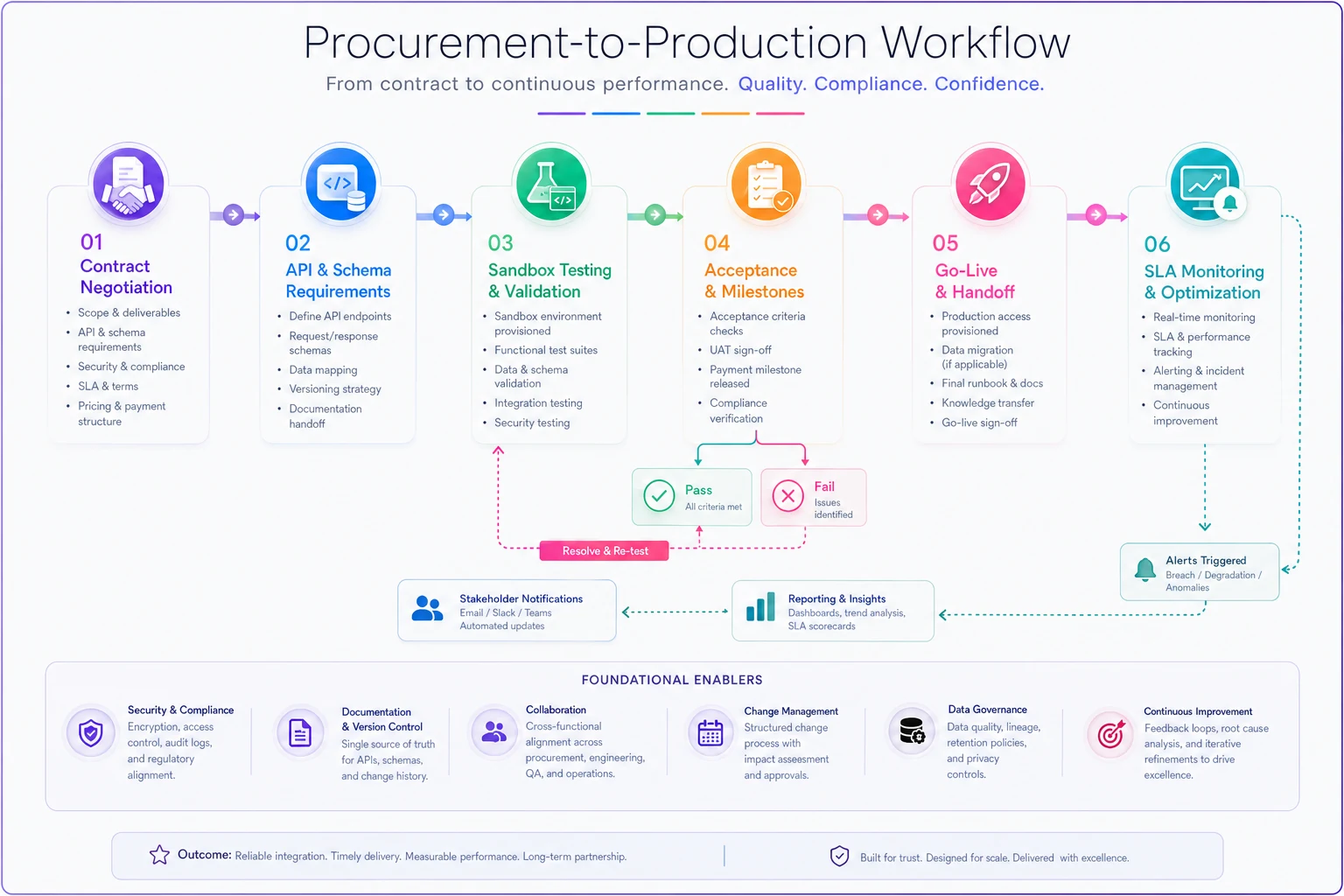
Tie acceptance criteria to measurable tests and payment milestones so vendors have real incentives to fix edge cases before they affect your hires.
A recruiter-facing acceptance checklist
Engineers test the plumbing. But recruiters are the ones who'll notice when it leaks into their daily work. The final acceptance gate should be a recruiter walking through real workflows, not an engineer confirming a 200 response.
-
[ ] A candidate I create in System A appears correctly in System B within the expected time
-
[ ] Source/attribution shows up correctly, not as "unknown" or blank
-
[ ] Scheduling an interview actually lands on the right calendar in the right timezone
-
[ ] A candidate who moves stages updates everywhere, not just in one tool
-
[ ] Duplicate candidates don't appear when someone re-applies
-
[ ] Consent and communication preferences carry over correctly
-
[ ] Reporting numbers match what I see in the actual pipeline (spot-check 10 candidates)
-
[ ] When something fails, I can tell it failed — I'm not finding out a week later from a missing candidate
That last checkbox captures the whole philosophy. The worst integration failures are silent ones. A system that fails loudly is annoying; a system that fails quietly costs you hires and you never even know it happened. Recruiters doing this walkthrough before launch have caught more real problems than any automated test suite — because they're looking at whether the workflow makes sense, not just whether the API returned a 200.
Sample SLA language for ongoing operations
Go-live is not the finish line. Integration debt accumulates over the life of the contract, so your SLA needs to cover steady-state operations, not just launch.
-
Data freshness SLA "Synced records will reflect source changes within [X minutes/hours] for 99% of records measured monthly."
-
Data completeness SLA "No more than [0.5%] of records will be dropped or incomplete in any 30-day window, with root-cause reporting on breach."
-
Error-rate SLA "Integration error rate will remain below [X%], with alerting to the customer on sustained breach."
-
Change-notice SLA "Vendor provides [90 days] written notice of any breaking API or schema change, plus a migration window and support."
-
Incident response SLA "Integration-affecting incidents acknowledged within [1 hour], with status updates every [4 hours] until resolved."
-
Remediation & credits Define what happens when SLAs are missed — service credits, escalation, and a repeated-breach exit clause.
Write in measurement and reporting obligations, not just targets. An SLA you can't measure is a sentence, not a commitment. Require the vendor to report error rates and freshness metrics monthly so you're not the one building dashboards to police them.
A real scenario: the attribution that quietly broke
A mid-sized tech recruiting team — roughly 12 recruiters, running an ATS wired to a sourcing CRM and an assessment platform — onboarded a new scheduling vendor without a schema contract or acceptance tests. The demo was clean. Everyone signed off.
About four months in, the head of TA noticed something off: sourcing reports showed agency and referral hires at numbers that didn't match the recruiters' gut sense. Digging in, they found the scheduling integration had been overwriting the source field with a default value whenever a candidate was rescheduled. Somewhere between 15 and 20% of mid-pipeline candidates had lost their original attribution.
The damage wasn't just reporting. They'd been reallocating sourcing budget based on numbers that were quietly wrong for a quarter — underfunding a referral channel that was actually their strongest, and overspending on an agency that looked better than it was.
The fix wasn't technical heroics. They wrote a schema contract that locked source as immutable after creation, added a validation layer that flagged any attempt to overwrite it, and re-ran acceptance tests before trusting the data again. Within a couple of reporting cycles, attribution stabilized and the budget conversation got honest. The expensive part was the four months of decisions made on bad data — exactly the cost that upfront procurement governance exists to prevent.
When this level of rigor makes sense — and when it doesn't
This makes sense when: you're integrating systems that share candidate data, feed reporting, or touch consent and compliance. Anything in your attribution path, your pipeline-of-record, or your candidate data flow deserves the full treatment. The more decisions ride on the data, the more the governance pays for itself.
This is overkill when: you're trialing a lightweight tool that doesn't touch your system of record — a one-off sourcing extension, a Slack notification bot, something you could rip out in an afternoon with zero data consequences. Writing a schema contract for a read-only toy is bureaucracy for its own sake.
Who should be careful applying this: very small teams with no technical support. If you don't have anyone who can run a sandbox test or read an API log, you can still use the contract and recruiter checklist portions — those protect you without requiring engineering. Just be honest that your enforcement capability is limited, and lean harder on contractual notice periods and clean exit clauses as your safety net.
Bringing it together
Teams that avoid integration debt aren't smarter about technology. They're just more disciplined at the boundary — the moment before signing, when leverage is highest and problems are cheapest to prevent. Once the contract is signed and the integration is live, every fix costs more and every bad data point has already poisoned a report somewhere.
Treat procurement as the place where data quality gets decided, because it is. Write the schema contract. Require the API behaviors. Run the pre-production tests that vendors would rather skip. Hand recruiters a real acceptance checklist and actually listen when they say something feels off. Put measurable SLAs in place so steady-state operations stay honest after the launch excitement fades.
Integration debt doesn't announce itself. It shows up quarters later as a budget decision made on bad numbers, a candidate who slipped through a broken sync, or a consent record that can't be found during an audit. The governance work above won't make vendor onboarding faster — but it will keep your recruiting data trustworthy long after everyone's forgotten how good the demo looked.
Integration debt doesn't announce itself. It shows up quarters later as a budget decision made on bad numbers, a candidate who slipped through a broken sync, or a consent record that can't be found during an audit.
The governance work above won't make vendor onboarding faster — but it will keep your recruiting data trustworthy long after everyone's forgotten how good the demo looked.
Ready to elevate your hiring process?
Join 1,500+ recruiting teams using Recioly to save time, improve collaboration, and hire smarter.