
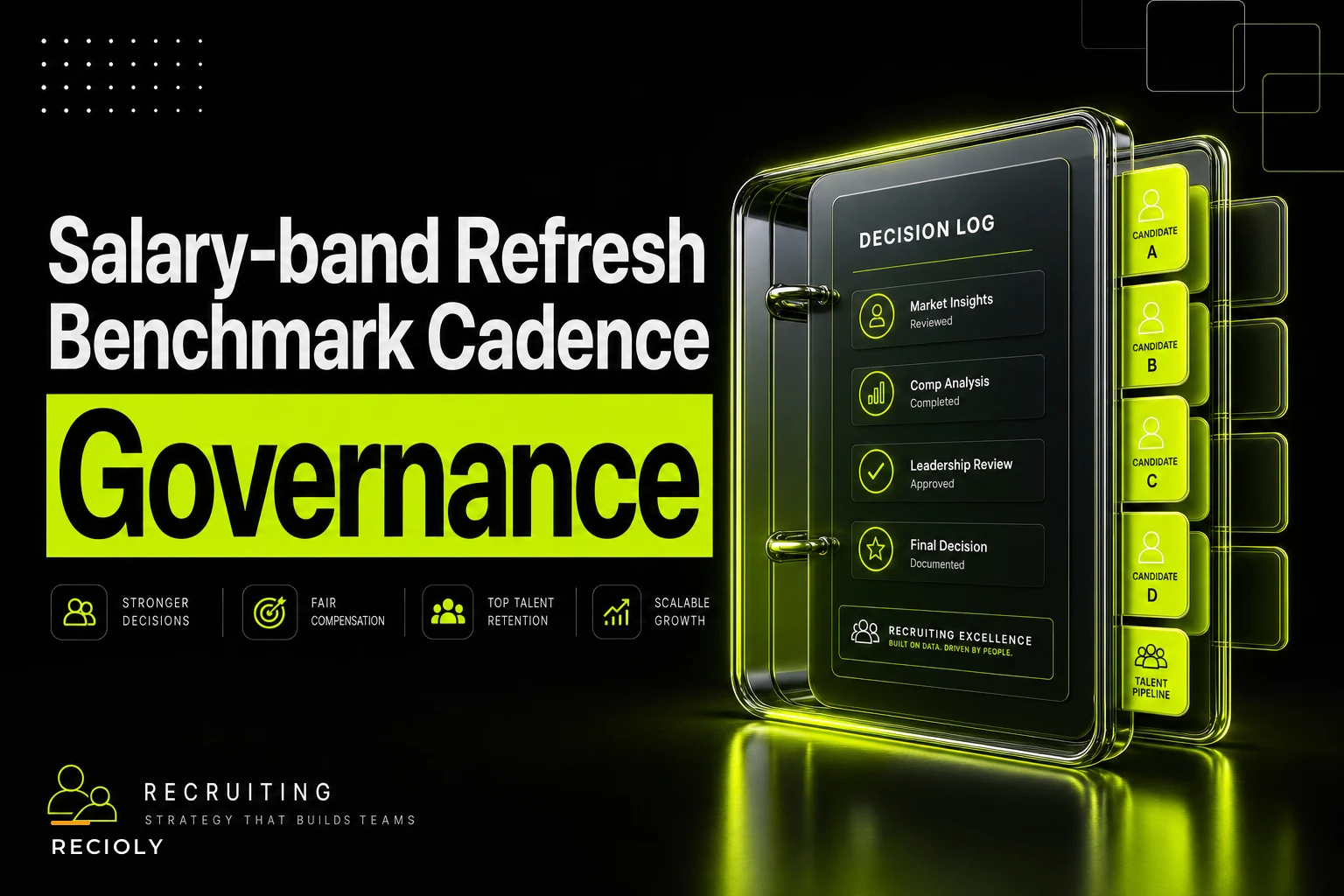

Most comp refreshes don't fail because the data is wrong. They fail because nobody agreed on when the refresh happens, who owns each input, and which market sources actually count. So you get a scramble every time a hiring manager says "our band is below market" mid-negotiation, and TA ends up relitigating the whole thing with nothing to fall back on.
This is a cadence and template problem, not an analytics problem. Below is the operational scaffolding for a salary band refresh process that runs on a schedule, pulls from approved sources, routes through named owners, and leaves an audit trail you can defend when Finance or Legal asks how you landed on a number.
The failure pattern: refreshes that happen only when something breaks
Here's what a broken cadence looks like in practice. A company sets bands in January during budget planning. Those bands sit untouched until June, when a recruiter loses a senior backend candidate to a competitor paying 18% more. The hiring manager escalates. Someone pulls three data points from whatever survey they can access that afternoon, decides the band is stale, and bumps it—no documentation of which sources, no comparison against prior band logic, no check on whether the other six engineering bands have the same gap.
Three weeks later another role breaks the same way. Nobody connected the two.
What tends to happen across TA orgs that hit this wall: the comp data was never wrong, it was just never refreshed on a rhythm. So every adjustment became a one-off emergency. And emergency adjustments are where compression, inconsistency, and pay-equity exposure creep in quietly. A band moved reactively for one candidate rarely gets reconciled against peers in the same family, and six months later you have two engineers at the same level hired four months apart sitting $22k apart for no documented reason.
The fix isn't better survey data. It's a cadence that forces the refresh to happen before the pressure hits, plus templates that make each refresh consistent enough to audit.
Set the cadence first: quarterly scan, annual rebuild
Don't refresh everything every quarter—that burns the team out and creates band churn that compensation teams hate. Split it.
Never lose track of top talent again.
Recioly helps you manage every stage of recruiting efficiently, from application to offer.
- Centralized candidate tracking
- Automated interview scheduling
- Collaborative hiring workflows
No credit card required
Annual (full rebuild): Every band gets re-benchmarked from scratch against approved sources. New role families get added. Geographic differentials get revisited. This is the heavy lift and should align with your budget cycle so the numbers actually land in planning.
Quarterly (targeted scan): You're not rebuilding. You're scanning for movement—which families drifted enough to warrant an off-cycle adjustment. A quarterly scan touches maybe 15–25% of bands: the ones in hot markets or showing offer-decline signals.
| Cadence | Scope | Trigger | Primary owner | Output |
|---|---|---|---|---|
| Annual rebuild | All bands, all families | Calendar (tied to budget) | Comp lead | New band structure for next FY |
| Quarterly scan | Flagged families only | Calendar + exception signals | TA ops | Adjust / hold decision per family |
| Off-cycle exception | Single band or role | Live decline or offer gap | TA ops → Comp | Documented one-off adjustment |
The off-cycle row is the one that saves you. Without a defined exception path, every urgent comp problem either reroutes through the annual process or gets handled ad hoc. A named path with a named owner turns the June backend-engineer scramble into a logged, repeatable decision instead of a fire drill.
What should trigger an off-cycle exception
-
Two or more declines in the same family citing comp within a 60-day window
-
A single offer where the candidate's current comp exceeds your band midpoint (not max)
-
A hiring manager providing a verified competing offer above band max
-
A market source showing more than 10% movement in a family since last refresh
When none of those are present, the answer is "hold until the next quarterly scan." Writing this down kills roughly half the one-off escalation debates before they start.
Data intake templates: standardize what you collect before you benchmark
Refreshes feel inconsistent because each one pulls different inputs. One quarter someone uses base only; the next someone includes equity; a third includes a sign-on they shouldn't have. You can't compare across refreshes if the intake shape keeps changing.
Lock a single data intake template that every refresh fills in identically. At minimum it captures, per role family and level:
-
Current band (min / mid / max) and the date it was last set
-
Source values pulled from each approved market source—keep them separate, don't blend before you can see them
-
Internal reference points
actual comp of current employees at this level, offer-accept and offer-decline comp from the last two quarters
-
Compa-ratio spread
where your current people sit against the existing midpoint
-
Geographic differential applied, if any
-
Pay component scope
base only, or base + target bonus—pick one and never mix within a family
The single most common intake mistake: pulling a market number that includes variable comp and comparing it against a base-only band. That one error alone can make a band look 12–15% low when it's actually fine. Standardizing scope in the template prevents it.
Keep source values unblended in the intake sheet so you can see spreads between sources.
Keep source values unblended in the intake sheet. You want to see that Source A says $142k and Source B says $128k for the same cut—that spread is signal, not noise. Averaging them before you record them hides the disagreement, and the disagreement is often where the real decision lives.
Approved market sources: decide what counts before the debate starts
Half the arguments in comp refreshes are really arguments about which data to trust. A hiring manager pastes a number from a crowdsourced salary site; the recruiter trusts a purchased survey; nobody agreed in advance which one wins.
Maintain a short, explicit list of approved market sources with a tier and a weight:
-
Tier 1 — Primary surveys (purchased, role-matched, refreshed annually). Highest weight. These anchor the band.
-
Tier 2 — Secondary benchmarks (aggregators, industry-specific datasets). Used to corroborate or flag divergence.
-
Tier 3 — Directional signals (crowdsourced sites, candidate-reported comp, recruiter market intel). Used only to trigger a closer look, never to set a band directly.
The rule that prevents most fights: Tier 3 can open a question but can't answer it. A candidate claiming they make $160k is a reason to check Tier 1, not a reason to move the band. This one boundary stops the "but Levels.fyi says..." spiral that derails so many refresh discussions.
Document why each source is approved and when it was last refreshed. A survey that's 14 months old is a Tier 1 source pretending to be current. Note the vintage next to every source so stale data gets caught before it does damage.
Owner RACI: who actually touches each step
Refreshes stall when ownership is fuzzy. "Comp handles it" and "TA handles it" both being half-true means nothing moves until someone escalates. Assign a real RACI per step.
| Step | Responsible | Accountable | Consulted | Informed |
|---|---|---|---|---|
| Pull market data | TA ops / analyst | Comp lead | — | TA leadership |
| Fill intake template | TA ops | Comp lead | Finance (scope) | — |
| Flag families needing change | Comp lead | Comp lead | TA leadership | HRBPs |
| Approve band changes | Comp lead | HR/Finance exec | Legal (equity) | Hiring managers |
| Publish updated bands | TA ops | Comp lead | — | All recruiters, HMs |
| Log decision + rationale | TA ops | Comp lead | — | Audit |
The row people skip is the last one. Logging the rationale is the step that makes the whole thing defensible. If you adjusted the backend band 9% in Q2, there should be a record showing which sources drove it, what the internal spread looked like, and who approved it. Without that log, you're reconstructing decisions from memory when pay-equity questions come up a year later.
Fuzzy accountability also bleeds into downstream workflows. When bands aren't clearly owned and published, offer approvals get messy fast—which is why a clean band refresh feeds directly into a functioning offer approval workflow with pre-approvals and routing matrices. If the band is current and published, most offers clear the gate automatically instead of pinging comp for every number.
The refresh workflow, start to finish
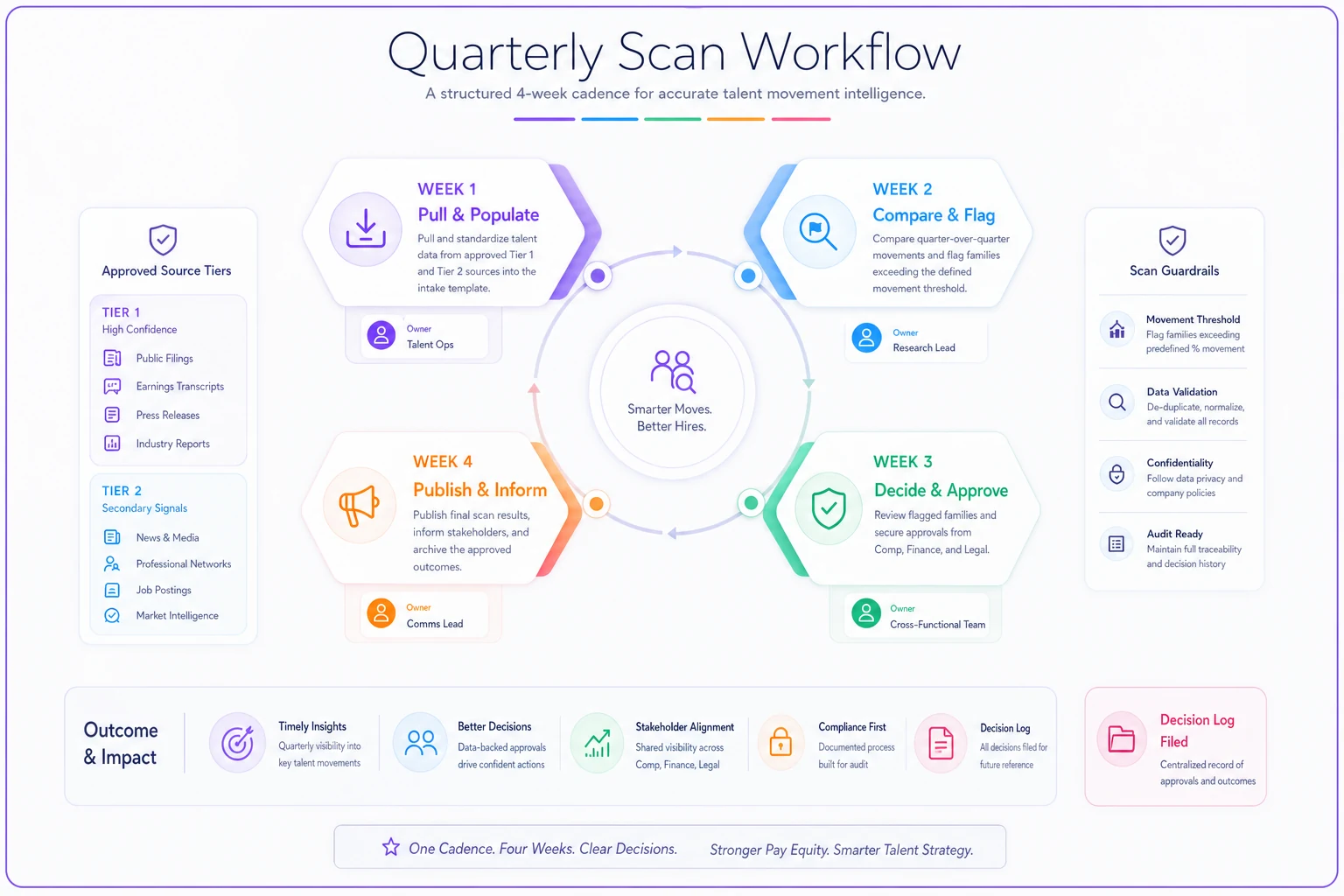
Here's how a quarterly scan actually runs when the cadence and templates are in place:
Visual of the quarterly scan workflow.
-
Week 1 — Pull and populate. TA ops pulls current values from Tier 1 and Tier 2 sources into the standard intake template for every flagged family. Internal reference points—current employee comp, recent offer accept/decline comp—get added from ATS and HRIS exports.
-
Week 2 — Compare and flag. Comp lead reviews each family's intake sheet. Families where the market midpoint has moved more than a defined threshold—say 5–7%—get flagged for a change decision. Everything else gets a documented "hold." The threshold matters: too low and you're churning bands constantly; too high and you drift until something breaks.
-
Week 3 — Decide and approve. Flagged families go to the approval step. Comp lead proposes new band values with the intake sheet attached as evidence. Finance checks budget impact; Legal reviews anything that touches equity-sensitive families. Decisions get logged with rationale.
-
Week 4 — Publish and inform. Updated bands go out to recruiters and hiring managers. Everyone touching offers works from the current number. The decision log gets filed against the audit checklist.
What this workflow prevents: nobody adjusts a band in a Slack thread. Every change moves through the same four-week path with the same evidence attached. When the next scan rolls around, you can see exactly what changed and why.
One downstream benefit worth naming—when bands stay current on this rhythm, your offer-decline reasons get cleaner to diagnose. If comp is genuinely at market and you're still losing candidates, the problem is somewhere else in the process, which is exactly what an offer-acceptance analytics approach is built to surface. A stale band muddies that analysis; a current one clarifies it.
Exception handling: the off-cycle path that doesn't blow up the system
Exceptions are where disciplined processes quietly fall apart. One urgent approval outside the cadence, then another, and six weeks later the "approved" bands don't match what's actually being offered.
Keep off-cycle exceptions real but contained:
-
Define the ceiling. An off-cycle adjustment can move a single band or role, not a whole family. Family-wide moves wait for the quarterly scan.
-
Require the same evidence. The same intake template, scoped to the one band. No shortcut data.
-
Set an expiry. An off-cycle adjustment is provisional until the next scan reconciles it against the family. This stops one-off moves from permanently distorting the structure.
-
Log it loudly. Off-cycle changes go in the same decision log, tagged as exceptions, so the next refresh sees them immediately.
The expiry rule is the one teams forget. An emergency bump that never gets reconciled becomes permanent compression nobody intended. Forcing provisional status means the next quarterly scan has to look at it—it's not optional.
Audit checklist tied to your TA workflows
Before closing any refresh—quarterly or annual—run the band structure against this checklist. It ties the comp refresh back to the hiring workflows that actually consume the bands.
-
- [ ] Every flagged family has a completed intake template with source values recorded separately
-
- [ ] All market sources used are on the approved list, with vintage dates noted
-
- [ ] No band was moved on Tier 3 data alone
-
- [ ] Pay-component scope (base vs. base + bonus) is consistent within each family
-
- [ ] Internal compa-ratios checked for compression against the new midpoints
-
- [ ] Every change has a logged rationale and a named approver
-
- [ ] Off-cycle exceptions from the prior period are reconciled or re-flagged
-
- [ ] Updated bands published to all recruiters and hiring managers with an effective date
-
- [ ] Offer approval routing reflects the new band values
-
- [ ] Decision log filed and retrievable for pay-equity review
If any box is unchecked, the refresh isn't done—it's a draft that'll cause a problem later.
When this level of process makes sense—and when it doesn't
When it makes sense: You're hiring across multiple role families, in more than one geography, at enough volume that inconsistent bands create real equity and velocity problems. Once you're running around 40+ hires a year across several families, the ad-hoc approach starts leaking money and exposing you to compression issues you can't see coming.
When it's overkill: A 12-person company hiring six people a year doesn't need a four-week quarterly scan. A lightweight annual check against one or two sources, documented in a shared sheet, is enough. Building full RACI and exception-expiry machinery at that volume creates process overhead that outweighs the risk.
Who should not do this yet: Teams without a clean source of internal comp data. If you can't reliably export current-employee comp and recent offer accept/decline values, fix that first. The best cadence in the world produces garbage decisions if the internal reference points aren't trustworthy. Get the data clean, then layer the cadence on top.
A real scenario
A mid-size SaaS company, around 240 employees, was setting engineering and sales bands once a year during budget season and touching nothing in between. Over roughly eight months they lost four senior engineers in offer negotiations—each one handled as a separate fire drill with whatever data someone could grab that day. By the time they looked back, two engineers hired a quarter apart at the same level were sitting about $20k apart. A pay gap nobody had actually decided to create.
They moved to a quarterly scan on flagged families plus an annual rebuild, with a locked intake template and a three-tier source list. The first quarterly scan flagged two families—backend engineering and enterprise sales—and held everything else. Both adjustments ran through the four-week workflow with logged rationale.
The change wasn't dramatic on paper, but the chaos dropped noticeably. Off-cycle escalations fell by more than half over the next two quarters because recruiters were working from current bands instead of discovering gaps mid-negotiation. And when a pay-equity review came up later, Comp pulled the decision logs instead of reconstructing eight months of ad-hoc choices from email threads. That retrieval alone was worth the whole exercise.
The takeaway
A salary band refresh process works when the cadence decides when it happens, the templates keep every refresh consistent, the source tiers settle which data counts, the RACI names who owns each step, and the audit checklist ties it all back to the offer workflows that consume the bands.
None of that requires fancier survey data. It requires agreeing—in advance—on the rhythm and the rules, so the next time a hiring manager says "we're below market," you already have the process to answer the question instead of starting an argument.
Ready to elevate your hiring process?
Join 1,500+ recruiting teams using Recioly to save time, improve collaboration, and hire smarter.