

Most TA teams treat vendors like a one-time purchase. You run the evaluation, sign the contract, do a kickoff call, and then nothing happens until the renewal email lands eleven months later and everyone scrambles to remember whether the thing actually worked.
That gap — the dead zone between signing and renewal — is where almost all the damage happens. Vendors quietly drift out of alignment with your hiring volume. Integrations rot. Someone leaves the team and nobody owns the relationship anymore. By the time renewal shows up, you're not making a decision, you're reacting to a deadline.
TA vendor lifecycle management is the opposite of that. It's treating every vendor as a relationship with a beginning, a middle, and an end you plan for in advance — onboarding, ongoing reviews, renewal logic, and a sunset process that doesn't blow up your hiring pipeline when you cut something loose.
This is the playbook for running that whole cycle on purpose instead of by accident.
Why the lifecycle breaks (and it's usually not the vendor's fault)
The failure pattern is almost always structural. A vendor underperforms and people assume the product is bad. Sometimes it is. But far more often the vendor was onboarded badly, never reviewed, and left to run on autopilot while the business around it changed.
Here's what that looks like in practice. A 40-person recruiting team buys a sourcing tool when they're hiring 200 people a year. Eighteen months later they're hiring 500, half of them in two new countries, and the tool — which was great at volume US sourcing — was never reconfigured for the new reality. Nobody flagged it because nobody owned the quarterly check-in. The tool didn't get worse. The fit did.
-
No single owner. Procurement signs it, a recruiter uses it, IT integrates it, finance pays for it. Four people touch the vendor and none of them own its outcome.
-
No baseline. You can't tell if a vendor declined if you never wrote down what "good" looked like on day one.
-
Renewal treated as a formality. The auto-renew clause fires, finance pays, and the decision gets made by default rather than analysis.
-
Sunsetting has no process. Cutting a vendor feels risky because nobody's mapped what breaks when you unplug it, so teams keep paying for tools they barely use.
If your vendor stack has grown faster than your governance, this is worth reading alongside how a healthy portfolio gets structured in the first place — our breakdown of TA vendor portfolio architecture and governance covers the layer above individual contracts.
The lifecycle as one continuous loop
Think of this as four phases that feed each other, not four separate events. What you capture during onboarding becomes your review baseline. What you learn in reviews drives the renewal decision. The renewal decision determines whether you're heading toward expansion or sunset. A clean sunset feeds lessons back into how you onboard the next vendor.
Never lose track of top talent again.
Recioly helps you manage every stage of recruiting efficiently, from application to offer.
- Centralized candidate tracking
- Automated interview scheduling
- Collaborative hiring workflows
No credit card required
Onboarding sets the baseline → Quarterly reviews track drift against that baseline → Renewal decision uses accumulated review data → Sunset or renew → lessons loop back into onboarding standards.
The whole point is that by the time you reach a renewal, the decision is already mostly made. You've been watching the signal all year. There's no scramble because there's no surprise.
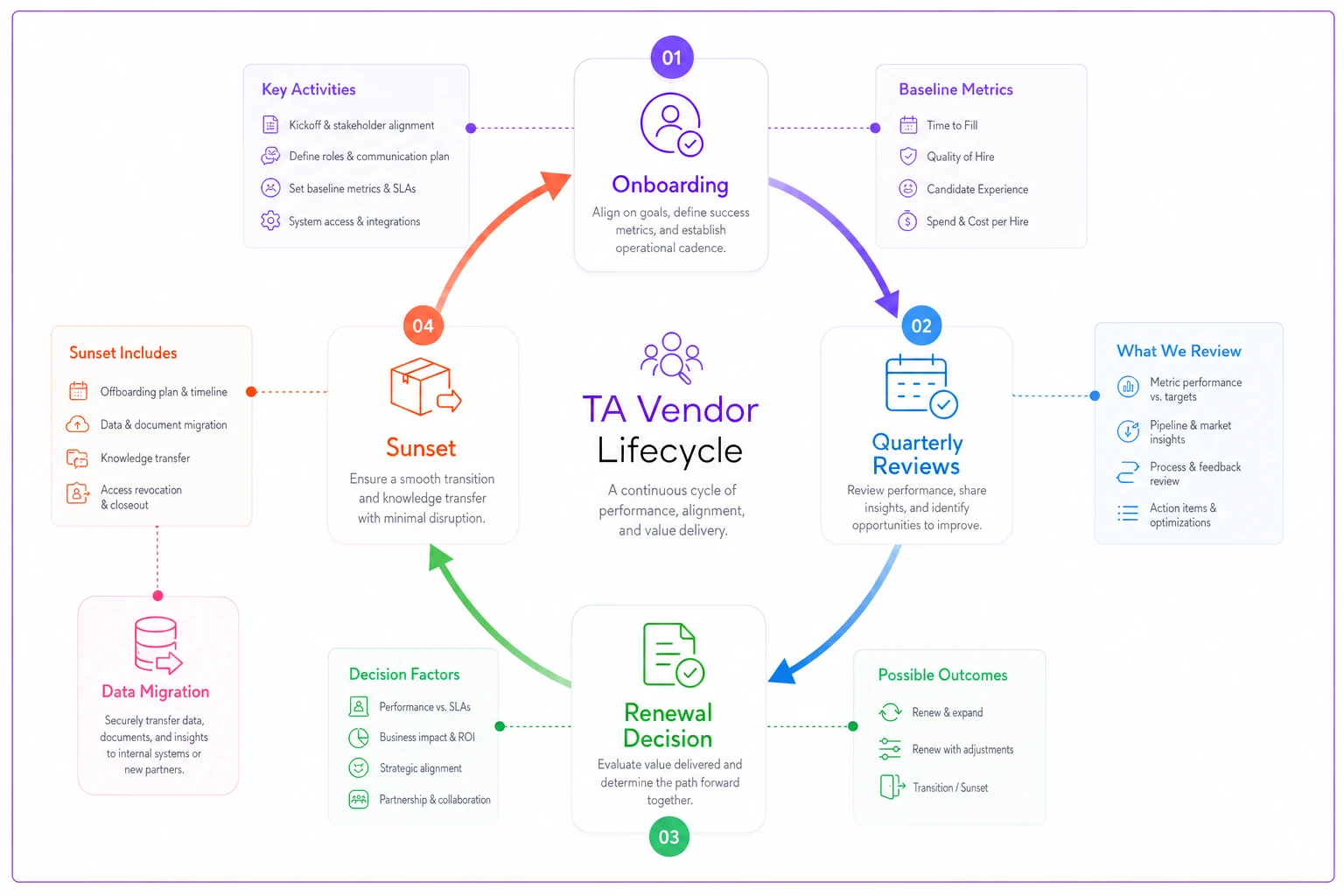
Here's a simple visual of the continuous loop to keep on your reference board.
Phase 1 — Onboarding: capture the baseline or regret it later
The single biggest onboarding mistake is skipping the baseline. Everyone's excited about the new tool, the sales engineer is helpful, the demo data looks great — and nobody writes down the numbers you'll measure against twelve months from now.
Your onboarding should produce a one-page record that answers: who owns this, what does success look like, how is it wired into our stack, and how do we get out if we need to.
Onboarding checklist:
-
- [ ] Assign a single named vendor owner (not a team — a person)
-
- [ ] Document the business problem this vendor solves in one sentence
-
- [ ] Define 3–5 success metrics with target thresholds (e.g. "sourcing tool should produce ≥15% of qualified pipeline for engineering roles")
-
- [ ] Record the baseline for each metric before the vendor is live
-
- [ ] Map every integration point and who maintains it
-
- [ ] Confirm data ownership and export format — can you get your data out, and in what shape?
-
- [ ] Log contract terms
renewal date, auto-renew clause, notice period, price escalators
-
- [ ] Set the review cadence and put the first quarterly review on the calendar now
-
- [ ] Capture the switching cost estimate (what would it take to replace this?)
Estimate switching cost on day one while migration details are fresh — it's far easier than reconstructing them later.
That last item matters more than people realize. If you don't estimate switching cost on day one — while you still remember what the migration involved — you'll massively overestimate it later. And that inflated fear is exactly what keeps dead vendors on payroll.
The integration mapping deserves real attention too, because every connected vendor adds hidden maintenance weight. If you've watched integration debt pile up before, our guide on preventing integration debt with TA technology procurement governance pairs directly with this step.
Phase 2 — Quarterly reviews: catch drift while it's small
A quarterly review isn't a status meeting. It's a structured check against the baseline you set during onboarding, run in about 30 minutes per vendor with the owner and one finance or ops person.
The goal is to answer three questions honestly: Is it still performing? Is it still worth the money? Is it still the right fit for where we're headed?
Quarterly review template:
| Section | What to check | Signal |
|---|---|---|
| Performance | Actuals vs. baseline metrics | Green / Yellow / Red |
| Usage | Active seats, feature adoption, login frequency | Underused = overpaying |
| Cost | Spend vs. value delivered, cost per outcome | Trend over quarters |
| Support | Ticket volume, resolution time, escalations | Rising tickets = trouble |
| Fit | Still aligned to current hiring volume & geos? | Business change check |
| Risk | Security, compliance, data handling updates | Any new exposure |
The row most teams miss is usage. Performance can look fine while adoption quietly collapses. A tool that ten recruiters loved but only two still open is a tool you're about to overpay to renew. Usage data is your earliest warning — it drops long before the performance metrics do.
Keep the output of each review to a single color-coded summary plus two or three action items. Three yellow quarters in a row on the same metric means you start the renewal analysis early, not at the eleventh hour.
A sample quarterly review comms template Keep the vendor side of this lightweight. Here's the note that goes out ahead of the call: > Subject: Q[X] review — [Vendor] — [date] > > Hi [name], it's time for our quarterly check-in. Ahead of the call, could you send over: current active-seat count, [key metric] for the quarter, open support tickets, and anything new on your roadmap that affects us? We'll walk through performance against our targets and talk through the next quarter. 30 minutes should do it. That's it. The internal review is where the real work happens — the vendor call just fills in gaps and surfaces roadmap changes.
Phase 3 — Renewal decisions: make it a verdict, not a reflex
By renewal time you should have three or four quarters of review data sitting in front of you. The decision comes down to a concrete set of criteria rather than gut feel.
-
Performance. Did it hit its baseline metrics across the year? Consistently, or only early on?
-
Value for money. Is cost per outcome holding steady or getting worse? Compare against alternatives you actually know about.
-
Adoption. Is usage growing, flat, or declining among the people who should use it?
-
Fit trajectory. Will it still fit your hiring plan 12 months from now, or are you about to outgrow it?
-
Switching cost. What does replacement realistically cost in money, time, and pipeline risk — updated from your onboarding estimate?
-
Relationship health. Support quality, responsiveness, roadmap alignment.
A clean way to land the decision:
-
- Renew as-is — strong across the board, no contract changes needed.
-
- Renew and renegotiate — performing but overpriced, underused seats, or terms need tightening.
-
- Renew short-term — borderline, buy yourself two quarters to evaluate a replacement.
-
- Sunset — failing on performance or fit, and switching cost is manageable.
When renegotiation makes sense: the tool works but you're paying for 50 seats and using 20, or you've grown enough that volume pricing should kick in. Vendors almost always have room to move at renewal because losing a customer costs them more than the discount.
When you should just sunset: the tool failed its baseline for multiple quarters, adoption is dead, and you've confirmed the switching cost won't wreck your pipeline. Don't renew out of inertia. The auto-renew clause is designed to exploit exactly that inertia.
Phase 4 — Sunsetting: the part everyone does badly
Cutting a vendor is where TA teams get burned, because a tool that looks peripheral is often quietly load-bearing. You unplug the sourcing tool and discover it was feeding candidate data into your ATS through an integration nobody documented. Now recruiters are missing profiles and nobody knows why.
A disciplined sunset avoids that. This is why the onboarding integration map and data-export check matter so much — they're what make the sunset safe.
Sunset checklist:
-
- [ ] Confirm the replacement (if any) is live and validated before you cut the old one
-
- [ ] Export all your data in a usable format — verify it actually opens and is complete
-
- [ ] Map every downstream integration the vendor feeds and reroute each one
-
- [ ] Notify every internal user with a date and a "what to use instead"
-
- [ ] Check the contract for notice period and send formal cancellation in writing
-
- [ ] Confirm data deletion from the vendor's side (compliance, not optional)
-
- [ ] Revoke all access, API keys, and SSO connections
-
- [ ] Run a two-week overlap where both systems exist as a safety net, if budget allows
-
- [ ] Document what you learned — feed it back into onboarding standards
The overlap window is the step people skip to save money, and it's the one that saves you from a disaster. Two weeks of paying for both tools is cheap compared to a hiring freeze caused by a broken pipeline mid-quarter.
Migration triggers — knowing when to pull the cord
You don't wait for renewal to start a migration. These signals mean start planning the switch now:
-
Two or more consecutive red quarters on a core metric
-
A security or compliance incident the vendor can't resolve quickly
-
Adoption dropping below a usable threshold despite enablement effort
-
A major price increase disconnected from added value
-
The vendor getting acquired and the roadmap you bought into evaporating
-
Your hiring volume or geography moving past what the tool supports
Any one of these starts the clock. The earlier you trigger, the more leverage you have and the calmer the migration.
Sunset comms template
> Subject: We're retiring [Vendor] on [date] > > Team — we're sunsetting [Vendor] effective [date]. Going forward, use [replacement / new process] for [function]. Your data has been exported and migrated; nothing is lost. [Owner] is running the transition — questions go to them. Training on the replacement is [date/link]. Please stop creating new work in [Vendor] as of [earlier date].
> Hi [name], we've decided not to renew our contract, effective [date] per our [X-day] notice terms. Could you confirm the cancellation, the data-deletion process, and any offboarding steps on your end? Appreciate the partnership.
Keep the vendor note clean. You may want to work with them again, and a messy exit follows you.
A real scenario: the sourcing tool nobody owned
A mid-size tech company, around 60 people in TA, was running three overlapping sourcing tools. Total spend was somewhere around $140k a year across all three. No single owner on any of them, no reviews, all three on auto-renew.
When they finally ran a lifecycle audit, the picture was ugly. One tool had roughly 45 licensed seats and about 12 active users. Another duplicated a feature their ATS already did natively. The third was genuinely good but massively overpriced for their usage tier.
They worked the playbook. Sunset the duplicate entirely. Renegotiated the overpriced one after showing the vendor their actual usage data — knocked the cost down by a meaningful margin. Consolidated onto the tool that actually worked and ran a two-week overlap during migration so no pipeline broke.
Annual sourcing-tool spend dropped to somewhere in the $85k–$95k range, recruiters stopped bouncing between three interfaces, and every remaining vendor now has a named owner and a quarterly review on the calendar. The savings were nice. The fact that it won't drift back into chaos is the real result.
Who should NOT over-engineer this
If you've got three vendors and a five-person team, you don't need quarterly reviews with color-coded tables. A simple owner-per-vendor plus an annual honest look is plenty. The full lifecycle machinery earns its keep once you're past roughly eight to ten vendors, multiple people touching each contract, and spend big enough that a bad renewal actually hurts.
The failure mode for small teams isn't too little process — it's copying a big-company governance framework they can't maintain. Match the rigor to the scale. A lightweight version you actually run beats a heavy one you abandon by Q2.
Pulling it together
The teams that run vendor relationships well aren't smarter negotiators or luckier buyers. They just never let the relationship go dark. They capture a baseline at onboarding, watch for drift every quarter, make renewal a verdict backed by data, and sunset cleanly when the fit is gone — with the integration map and data exports already in hand.
Do that and renewals stop being emergencies. You stop paying for tools nobody opens. And when you do cut something, your pipeline doesn't even notice. That's the whole payoff of treating vendor management as a continuous loop instead of a series of one-off decisions made under deadline pressure.
Ready to elevate your hiring process?
Join 1,500+ recruiting teams using Recioly to save time, improve collaboration, and hire smarter.