

The worst place to discover a work-authorization problem is at the offer stage. By then you've run four interview rounds, negotiated comp, maybe looped in the exec sponsor — and now immigration counsel is telling you the candidate's OPT clock runs out in five months and the role doesn't support an H-1B transfer this cycle. Everybody's upset, the req reopens, and you've lost a month.
This happens more than people admit, and it almost never happens because of bad recruiters. It happens because work-authorization questions get treated as a back-office legal detail instead of a front-of-funnel triage field. The fix isn't more immigration expertise on the recruiting team. It's a small set of pre-screen fields, a few hard triage rules, and decision gates that stop a candidate from advancing before the authorization picture is clear.
This is a checklist-first walkthrough — something you can drop into your intake and screening process this week.
Where the breakdown actually starts
The default failure is quiet. A recruiter sources a strong candidate, the candidate is enthusiastic, and nobody asks a direct authorization question early because it feels awkward or legally risky. So the req moves forward on an assumption — usually that "we'll sort visa stuff out later if they're good enough."
Later arrives, and the picture is messier than anyone expected. A few patterns come up repeatedly:
-
The candidate is on an immigration status that technically allows work now but requires sponsorship within a window the role can't support.
-
The role is in a country where the company has no entity, so there's no legal path to employ this person without a PEO arrangement nobody budgeted for.
-
The candidate holds authorization tied to a spouse's visa that's about to lapse.
-
Multiple time zones and legal jurisdictions are involved, and "remote" quietly turned into "international employment with tax and immigration consequences."
None of these are exotic. What makes them expensive is that they surface in week four instead of day one.
A useful mental model: work-authorization isn't one yes/no question. It's a combination of the candidate's current status, the role's location and entity, the required start date, and the sponsorship the company is willing to fund. Any one of those can kill a match. Triage is about checking all four before the funnel gets deep.
The pre-screen fields that do the heavy lifting
You don't need a legal questionnaire. You need four or five structured fields captured at application or during the first recruiter screen, phrased carefully and consistently. The goal is to capture enough to route the candidate — not to make an immigration determination.
Never lose track of top talent again.
Recioly helps you manage every stage of recruiting efficiently, from application to offer.
- Centralized candidate tracking
- Automated interview scheduling
- Collaborative hiring workflows
No credit card required
Here's the minimum set worth capturing early:
| Field | What you're actually capturing | Why it matters at triage |
|---|---|---|
| Current work authorization (for the target country/countries) | Authorized without sponsorship / authorized with future sponsorship needed / not currently authorized | The single biggest routing signal |
| Sponsorship requirement window | Needs sponsorship now, within 12 months, within 2–3 years, or never | Separates "fine for years" from "time bomb" |
| Status type (optional, free-text or dropdown) | The specific visa or permit category, if the candidate volunteers it | Helps counsel scope feasibility fast |
| Preferred/possible work location | Country, and whether relocation is acceptable | Flags entity and tax problems early |
| Earliest realistic start date | Date, plus any status-driven constraints | Catches start-date conflicts before offer |
A couple of things matter about how you phrase these. Ask about authorization relative to the specific country of the role — not "are you authorized to work" in the abstract. A candidate authorized in the UK but not Germany will answer "yes" to the vague version and you'll miss it entirely. Keep the sponsorship question forward-looking: "Will you now or in the future require sponsorship to continue working in [country]?" The "in the future" clause is what catches the OPT-to-H-1B gap that wrecks timelines.
Keep the sponsorship question explicitly tied to the target country and include an "in the future" option to catch status transitions like OPT-to-H-1B.
Keep the actual legal determination out of the recruiter's hands. The pre-screen is a sorting tool. Anything ambiguous gets escalated, not guessed.
Because these fields touch immigration status, treat the data accordingly — it's sensitive, often jurisdiction-regulated, and shouldn't sit in free-text notes scattered across your ATS. How you collect, store, and retain it ties directly into your broader candidate data governance runbook, especially for cross-border roles where consent and retention rules differ by country.
Quick triage rules that keep recruiters out of legal territory
The reason authorization questions get skipped is that recruiters are (rightly) nervous about making decisions that look discriminatory or legally risky. The way around that isn't avoidance — it's a small rule set that tells the recruiter exactly what to do with each answer, so they're never improvising.
-
Green — advance normally. Candidate is authorized for the target country without sponsorship, or holds authorization that comfortably outlasts any realistic start-and-ramp window. No gate, no escalation.
-
Yellow — advance, but flag for early feasibility check. Candidate will need sponsorship at some point, or the status has a time constraint that might fit depending on specifics. The candidate keeps moving through screening, but a parallel feasibility question goes to immigration counsel or the mobility team now, not at offer. The gate: you can interview, but you can't extend an offer until feasibility returns a yes.
-
Red — pause before investing interview time. The role has no legal employment path for this candidate's situation — wrong country with no entity, sponsorship the company has already ruled out for this role level, or a status that expires before any plausible start date. Don't ghost them; escalate to confirm there's truly no path, and if there isn't, close the loop honestly.
The important design choice: yellow candidates don't stop. Nothing kills candidate experience faster than freezing a strong person for two weeks while legal "looks into it." Yellow runs the feasibility check in parallel with interviews. The decision gate only bites at offer.
One rule worth hard-coding: no offer leaves the building for a yellow candidate until feasibility is documented as cleared. That single gate prevents the most expensive version of this problem.
Vendor and agency escalation templates
When you use external recruiters or RPO partners, authorization problems multiply. The vendor is incentivized to submit candidates and doesn't always carry the same context about which roles can sponsor and which can't. You end up paying to interview people who were never employable for that req.
> Subject: Work-auth feasibility check — [Candidate ref] / [Req #] > - Target country/location: __ > - Candidate current authorization status (as stated): _ > - Sponsorship required? Now / future / never: _ > - Earliest start + any status-driven constraints: _ > - Reason for escalation (what's unclear): __ > > Do not submit until TA confirms feasibility.
Make that last line non-negotiable in the vendor SLA. In practice, vendors respect gates that are written into the engagement and ignore ones that live in a recruiter's head. If a partner repeatedly submits red-lane candidates, that's a scorecard issue — the pattern belongs in your regular vendor review, not a one-off conversation.
Also worth doing: give vendors a fixed list of which open reqs can sponsor and which cannot, refreshed when it changes. Most vendor misfires here come from them genuinely not knowing. Clarity upstream cuts the escalation flood downstream.
Decision gates, placed where they actually prevent waste
The whole system rests on two gates. Everything else is supporting detail.
Gate 1 — Advance-to-interview gate. Before a candidate enters the formal interview loop, their triage lane is recorded. Green and yellow proceed. Red pauses for confirmation. This gate costs about thirty seconds per candidate and saves the three-week disasters.
Gate 2 — Offer gate. No offer is approved for any yellow-lane candidate until feasibility is documented and cleared by whoever owns that call — mobility, legal, or an immigration partner. This is the gate that stops late-stage surprises cold.
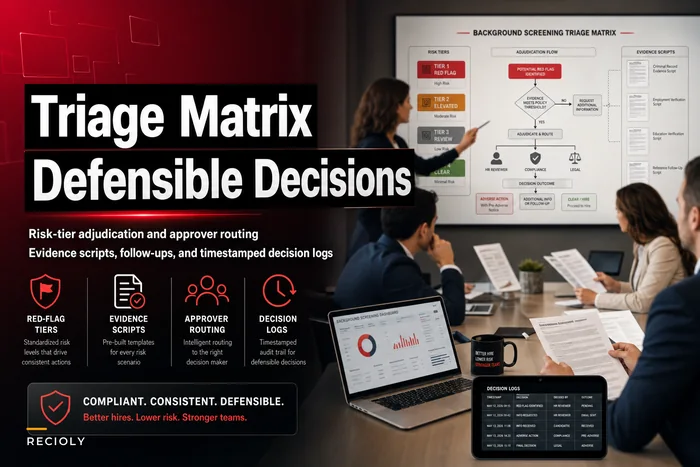
Both gates need to be logged, not verbal. A recruiter saying "yeah, legal said it's fine" in a hallway is how the exact same problem recurs six months later with a different candidate and nobody can reconstruct who approved what. The same discipline you'd apply to any high-stakes advancement decision — timestamped, attributable, reviewable — applies here. It mirrors the tiered, evidence-backed approach in a background screening triage matrix: known red-flag tiers, a scripted check, and a documented remediation path rather than ad-hoc judgment calls.
Here's a simple visual to share with stakeholders showing how triage lanes feed the two gates and where feasibility checks run in parallel.
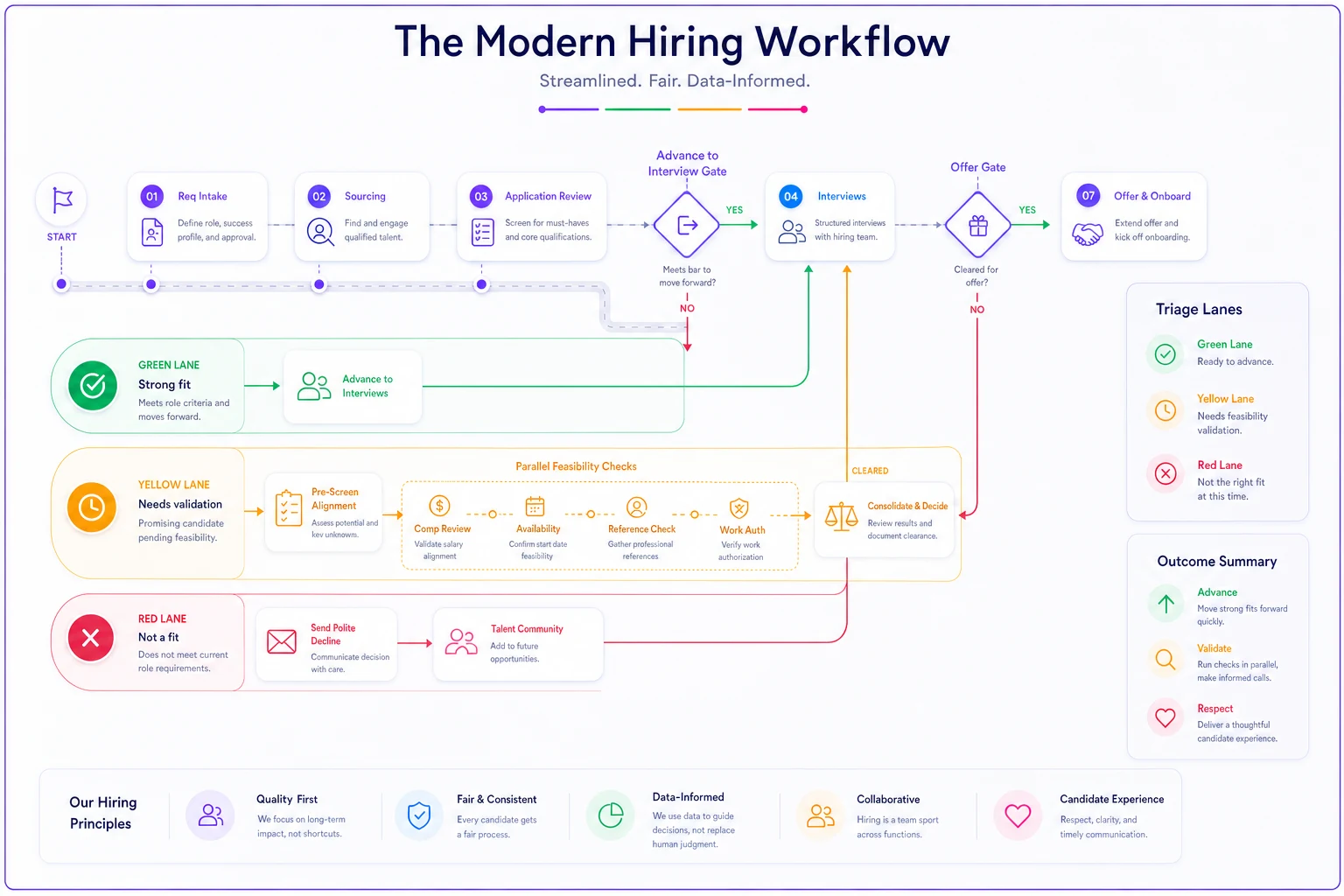
Use this diagram in intake docs and vendor SLAs so the process is understandable at a glance.
A real scenario
A mid-sized software company — roughly 200 employees, hiring aggressively for backend and data roles — kept hitting the same wall. Several times across a couple of quarters, strong candidates reached final rounds before anyone realized the role couldn't support the sponsorship window the candidate needed. One data engineering search reopened twice for this reason. Each reopen cost somewhere between three and four weeks of recruiter and hiring-manager time, plus the morale hit of telling a finalist no for a reason that should've surfaced in week one.
They didn't buy anything fancy to fix it. They added three pre-screen fields, a three-lane triage rule, and the two gates above. The feasibility check for yellow candidates moved to the start of the interview loop instead of the offer stage.
Over the next two quarters, the late-stage authorization surprises essentially stopped. A few candidates still fell into the red lane — but now that happened at screening, after maybe thirty minutes of recruiter time, instead of after full interview loops. The data engineering req closed on the next attempt. Nobody called it transformative; it just removed a recurring, avoidable drain that had been quietly taxing the team.
When this level of rigor makes sense — and when it's overkill
This full structure pays off when you're hiring across multiple countries, pulling from candidate pools that require sponsorship, or running searches where entity and tax questions are live. In those situations, the triage fields and gates save real time and money.
It's overkill when you're a single-country team hiring exclusively from a locally-authorized talent pool, where "are you authorized to work in [country]?" is genuinely a one-field yes/no. Adding lanes and vendor templates there would just be process for its own sake.
One group should be careful: teams that treat these fields as license for recruiters to make immigration judgments. That's the fastest way to create legal exposure. The entire design assumes recruiters sort and route, and that actual feasibility determinations sit with someone qualified to make them. Keep that boundary clean and the system protects you. Blur it and it becomes a liability.
Putting it in place this week
You don't need a project. You need to add a few fields, write down three lanes, and enforce two gates.
-
Add the pre-screen fields to your application form or recruiter screen script.
-
Write the three triage lanes and what action each requires — one page, no more.
-
Publish the list of which open reqs can and can't sponsor, and share it with every vendor.
-
Hard-code the offer gate
no offer for a yellow candidate without documented feasibility clearance.
-
Log every gate decision with who approved it and when.
Authorization surprises feel unavoidable mostly because most teams never built a place to catch them early. Once that catch point exists at the top of the funnel, the week-four disasters quietly stop — not because the immigration landscape got simpler, but because you stopped discovering it at the worst possible moment.
Authorization surprises feel unavoidable mostly because most teams never built a place to catch them early. Once that catch point exists at the top of the funnel, the week-four disasters quietly stop — not because the immigration landscape got simpler, but because you stopped discovering it at the worst possible moment.
Ready to elevate your hiring process?
Join 1,500+ recruiting teams using Recioly to save time, improve collaboration, and hire smarter.