
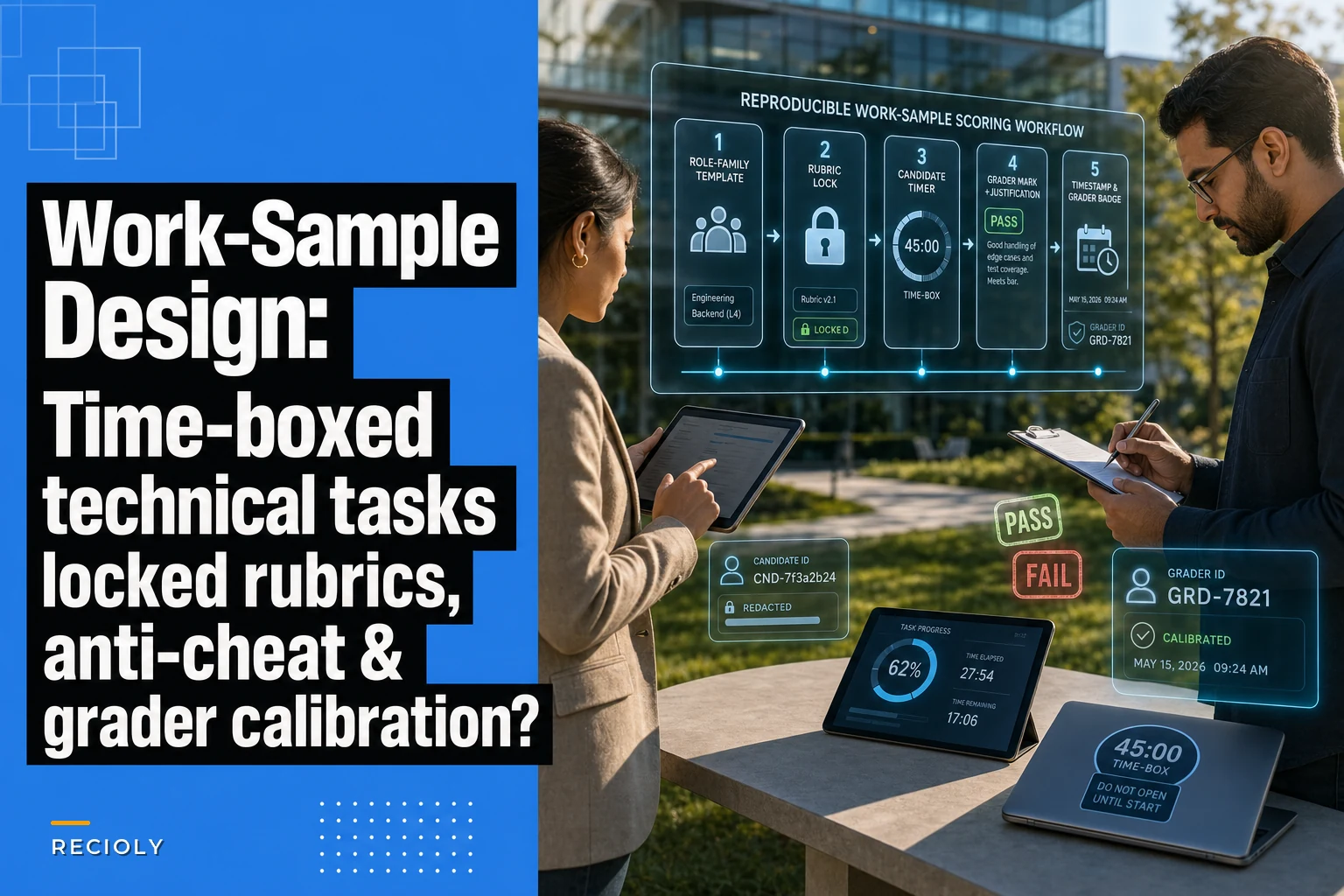

Most teams design work samples the wrong way around. A hiring manager opens a req, decides they want "something to see if the candidate can actually code," and spins up a fresh exercise from scratch. Two weeks later the next manager does the same thing, slightly differently, with a slightly different grading approach. Now you have forty work samples, zero consistency, and no way to compare a backend candidate scored by one manager against a backend candidate scored by another.
The fix isn't a better single exercise. It's a smaller number of reusable, role-family-anchored work samples — each with a locked rubric, a time-box that's enforced instead of suggested, and a scoring template that produces the same output no matter who grades it.
This is the part of work sample design for technical hires that nobody wants to do because it feels like overhead. It's actually the thing that lets you scale past ten engineering hires a quarter without the whole evaluation quietly falling apart.
Why per-req work samples wreck your pipeline
The failure mode is subtle because each individual work sample looks fine in isolation. The problem shows up in aggregate.
When every hiring manager owns their own exercise, you get drift on three axes simultaneously. Difficulty drift — one team's take-home takes 90 minutes, another's eats a full weekend. Scope drift — one asks for a working API endpoint, another asks for a system design doc, and they're both supposedly hiring for "mid-level backend." Grading drift — one grader cares about test coverage, another only checks if it runs.
A typical example looks like this: a Series B company hiring across platform, data, and product engineering ends up with eleven distinct take-homes. Candidate A scores a 4/5 on the data exercise. Candidate B scores a 4/5 on the platform exercise. The debrief treats those scores as equivalent. They aren't measuring the same thing. The 4/5 on data came from a grader who gives partial credit generously; the 4/5 on platform came from someone who starts everyone at 5 and deducts. Same number, completely different standards.
This usually happens when work sample creation gets treated as a hiring-manager task instead of a recruiting-ops asset. The exercise belongs to the person, walks out the door when they leave, and never gets audited. Six months later nobody can tell you why the bar shifted.
Role-families, not roles
The unit that actually scales is the role-family, not the individual job title. You don't need a separate work sample for "Senior Backend Engineer, Payments" and another for "Senior Backend Engineer, Growth." You need one backend sample tuned by level, reused across teams.
Never lose track of top talent again.
Recioly helps you manage every stage of recruiting efficiently, from application to offer.
- Centralized candidate tracking
- Automated interview scheduling
- Collaborative hiring workflows
No credit card required
A practical grouping that holds up across most engineering orgs:
| Role-family | What the sample actually tests | Format | Time-box |
|---|---|---|---|
| Backend / API | Data modeling, correctness under edge cases, API design | Take-home repo + short extension task | 2 hrs capped |
| Frontend / UI | Component structure, state handling, accessibility basics | Scoped UI build from a spec | 2 hrs capped |
| Data / Analytics Eng | SQL reasoning, pipeline logic, data validation | Dataset + transformation task | 90 min capped |
| Infra / Platform | Debugging, systems reasoning, tradeoff explanation | Broken-repo debug + written rationale | 90 min capped |
| Full-stack (mid) | Integration across layers, pragmatism | Small feature end-to-end | 2.5 hrs capped |
The win here isn't the table itself — it's that once you lock these five, a new req almost never needs a new exercise. The hiring manager picks a family and a level. That's the entire decision. You've converted a two-week design task into a thirty-second selection.
One thing worth saying plainly: resist the urge to make these "realistic to our codebase." The more you customize toward your exact stack, the less reusable the sample becomes and the more you leak proprietary context. Role-family samples should test the capability, not simulate your Tuesday.
Time-boxing that's actually enforced
"Suggested 2 hours" is not a time-box. It's a trust exercise that disadvantages the candidates who are honest about how long they spent and rewards the ones who grind for six hours and claim two.
-
Hard structural caps — the take-home only tests what's genuinely achievable in the stated window, and you grade against that scope. If someone over-delivers, you don't reward the extra work; you grade the required portion. Simplest fair approach.
-
Timed release windows — the candidate receives the exercise and a fixed clock (say, a 3-hour window from open to submit). This controls elapsed time but adds stress and accessibility concerns, so it fits better in live or synchronous settings.
Pro-tip: Grade only the required scope and ignore gold-plating to keep time-boxing fair.
The pattern that keeps appearing: teams write a two-hour exercise, candidates spend five, and graders unconsciously reward polish that only existed because of those extra three hours. You end up selecting for available free time, not skill. Candidates with caregiving responsibilities or a current full-time job get filtered out for reasons that have nothing to do with the job.
A clean rule: grade only the required scope, ignore gold-plating, and state the expected time honestly in the prompt. If your "2-hour" exercise consistently takes strong candidates four hours, it's not a 2-hour exercise. Re-scope it.
Minimal rubric fields: pass/fail beats graded more often than you think
The instinct is to build a rich rubric — ten dimensions, each on a 1–5 scale, weighted. It feels rigorous. In practice, granular scales invent precision that doesn't exist and amplify grader bias, because the difference between a 3 and a 4 on "code quality" is mostly vibes.
For most work samples, a small number of pass/fail gates plus one or two graded dimensions produces more reliable decisions than a ten-field matrix.
A minimal rubric that holds up:
-
Correctness (pass/fail) Does it do what was asked on the core cases? Binary.
-
Edge handling (pass/fail) Did they handle the obvious failure modes, or ignore them?
-
Readability (graded, 1–3) Could a teammate maintain this? Low/medium/high.
-
Reasoning quality (graded, 1–3) From their notes or a short writeup — do they understand their own tradeoffs?
Four fields. Two binary, two on a tight three-point scale. A three-point scale forces graders to commit — there's no mushy middle to hide in the way there is on a five-point scale where everyone gravitates toward 3.
Use pass/fail when the dimension has a clear right answer (does it compile, does it handle the null case). Use a tight graded scale only where judgment genuinely varies (readability, reasoning). Anything you can't reliably distinguish between a 3 and a 4 on shouldn't be a 1–5 field in the first place. This is the same core problem covered in common scorecard mistakes that wreck hiring decisions — fake precision is worse than honest coarseness.
When graded scales actually earn their keep
Graded dimensions make sense for senior and staff roles where the how matters as much as the whether. At that level you genuinely want to distinguish strong-but-standard from exceptional judgment. For junior and mid roles, lean heavily toward pass/fail — you're confirming competence, not ranking artistry.
Anti-cheating controls that don't punish honest candidates
Take-homes have a cheating problem, and the LLM era sharpened it considerably. But most anti-cheating measures punish honest candidates more than they catch dishonest ones. Proctored lockdown environments, keystroke logging, webcam surveillance — these create a hostile experience and still get beaten by anyone determined enough.
-
Require a short written rationale for key decisions. Someone who copied a solution usually can't explain why they chose it under a two-minute follow-up.
-
Add a live extension in the debrief. Give them 15 minutes to modify their own submission. Candidates who built it move fast; candidates who didn't tend to freeze on code they've "never actually seen."
-
Rotate problem variants per role-family. Three interchangeable versions of the backend sample means a leaked prompt has a shelf life, not a permanent advantage.
-
Design for understanding, not memorization. If the exercise rewards reasoning over a known-answer algorithm, a copied solution doesn't help much.
The live-extension step is the single highest-leverage anti-cheating control, and it's almost free. You're not accusing anyone. You're just asking them to touch their own work in front of you. Fabrication tends to fall apart pretty quickly on contact with a follow-up question.
For plagiarism-specific tooling on coding take-homes, that's a topic of its own — the point here is that your structural design should carry most of the anti-cheating load before any detection software gets involved.
Grader calibration: the part everyone skips
You can have a perfect rubric and still get garbage data if two graders interpret "pass" differently. Calibration is what turns a shared template into shared judgment.
-
Take three real past submissions per role-family — one clear pass, one clear fail, one borderline.
-
Have every grader score them independently, blind, using the rubric.
-
Compare in a 30-minute session. The clear pass and clear fail should align. The borderline is where the real conversation lives.
-
Write down the resolution — "we count partial edge handling as a fail if the null case crashes" — and attach it to the rubric as a grading note.
-
Re-run with fresh examples quarterly.
Those written resolutions are the actual asset. Over time you build a set of worked examples that a new grader can read to understand where the line actually sits. This is the same discipline behind a real interviewer calibration program that stops score drift — the work sample is just another place drift creeps in when nobody's watching.
A concrete example: for the data-eng sample, one grader was passing submissions that produced correct output but silently dropped malformed rows. Another was failing them for not logging the drops. Neither was wrong — they'd just never aligned on what mattered. The calibration note now reads: "Silent data loss on known-bad input is a fail regardless of output correctness." That one sentence removed an entire category of grader disagreement.
Reproducible scoring templates
The last piece is making the score reproducible — meaning two people grading the same submission land in roughly the same place, and anyone reviewing later can reconstruct why a decision was made.
A reproducible template captures:
-
Which role-family sample and variant was used
-
The locked rubric fields with the grader's marks
-
A one-line justification per field (not optional)
-
The live-extension result, if applicable
-
A timestamp and grader identity
Below is a brief workflow that shows how those elements flow from sample selection to a stored, reproducible record.
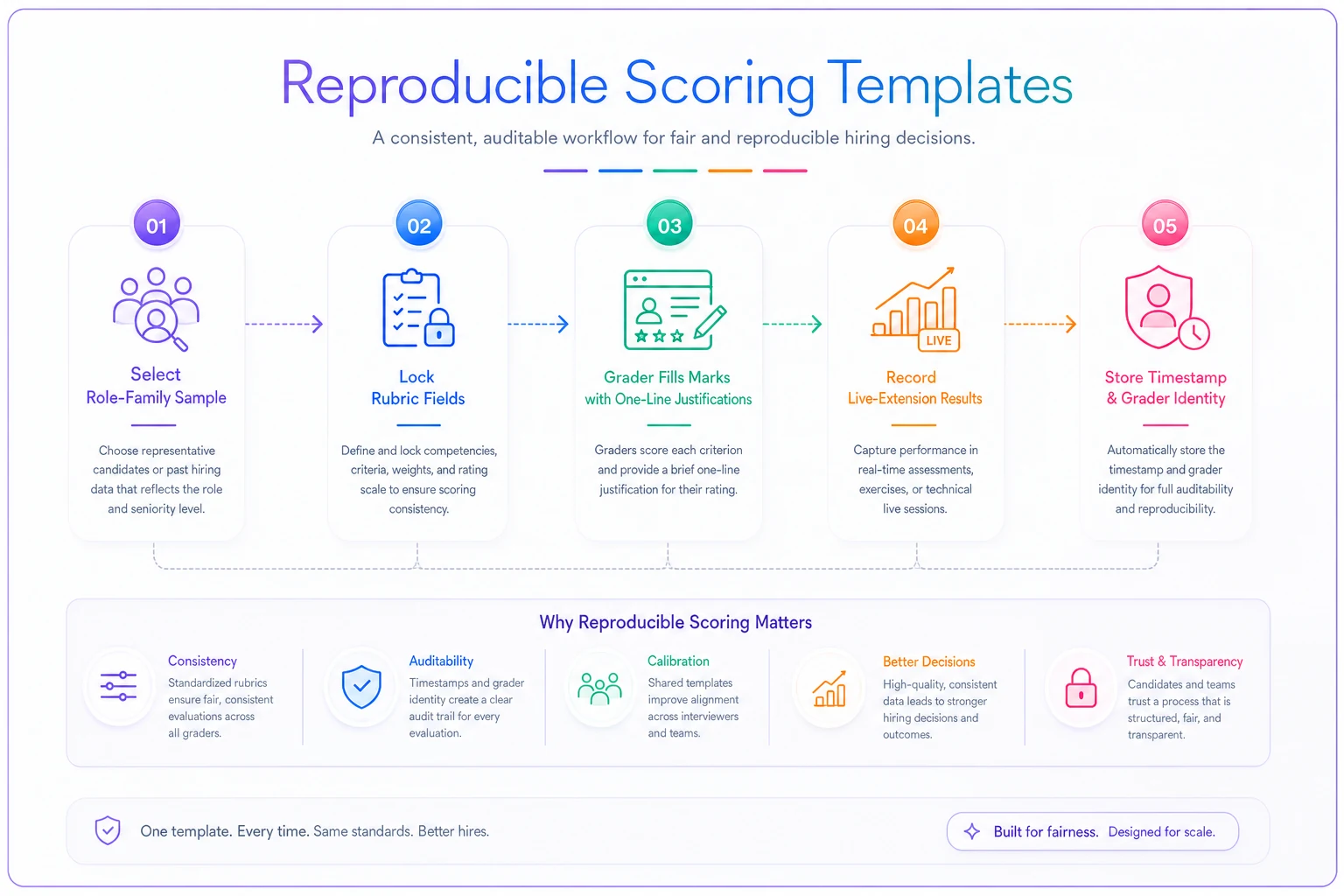
The one-line justification per field is what makes it reproducible instead of just recorded. "Readability: 2 — clear naming, but no separation between IO and logic" tells a future reviewer something. "Readability: 2" tells them nothing.
Store these as structured records, not free-text blobs in an email thread or a Slack DM that evaporates. When work-sample results live inside your ATS or a dedicated assessment workflow as consistent fields, you can finally do something per-req exercises never allowed: compare candidates across teams, audit whether a role-family's bar has drifted, and identify graders who run systematically hot or cold. The format matters more than the tool — any system that enforces the same fields every time beats a brilliant rubric that nobody fills in the same way twice.
A real scenario
A mid-sized fintech was hiring across backend, data, and infra — roughly 25–30 engineering hires planned for the year. Each team ran its own take-home. Debrief disagreements were constant, and two offers in the prior quarter had gone to candidates who later struggled badly on exactly the skills the work sample was supposed to catch.
They collapsed eleven ad-hoc exercises into four role-family samples, moved to the four-field minimal rubric (two pass/fail, two on a three-point scale), added a 15-minute live extension to every debrief, and ran one calibration session per family using three sample submissions each.
The changes weren't dramatic on paper, but a few things shifted over the next couple of quarters. Grader disagreement in debriefs dropped noticeably — borderline arguments that used to eat 20 minutes got resolved by pointing at a calibration note. Time spent creating exercises dropped to nearly zero since new reqs just picked a family. And two candidates who would've passed the old take-homes got caught by the live extension when they couldn't modify their own submissions. Hard to quantify a bad hire you didn't make, but the team felt pretty confident that was the biggest win.
When this is worth it — and when it isn't
Worth it when you're hiring enough technical roles that consistency across graders and teams actually matters — roughly ten-plus engineering hires a year, multiple hiring managers, more than one person grading. That's where drift compounds and where reusable samples pay back the setup cost.
Not worth it if you're hiring two engineers a year and the founder grades everything personally. The overhead of building role-family samples and running calibration sessions won't return much when one person already applies one consistent (if informal) standard.
Who should skip the heavy version: very early teams, and teams where the work sample is already a formality because the real signal comes from a live pairing session. If the take-home isn't actually driving decisions, fixing it is polishing something you should probably just cut.
The honest summary: per-req work samples feel flexible but quietly destroy your ability to compare candidates. Role-family samples with locked rubrics, enforced time-boxes, structural anti-cheating, and calibrated graders trade a bit of upfront design work for an evaluation process you can actually trust at scale — and defend when someone asks why one candidate got the offer and another didn't.
Ready to elevate your hiring process?
Join 1,500+ recruiting teams using Recioly to save time, improve collaboration, and hire smarter.