

Most talent acquisition teams don't fail because their recruiters are bad. They fail because the operating model that worked at 8 hires a quarter quietly becomes a liability at 80. Nobody notices the moment it breaks. It just slowly gets harder to answer basic questions — who owns intake, why did that offer sit for six days, which vendor is actually pulling weight — and suddenly you're running a team on tribal knowledge and heroics.
The frustrating part is that talent acquisition operating model maturity isn't really about hiring more people or buying better software. It's about knowing which stage you're actually in, and resisting the urge to install machinery you're not ready to run. A five-person team trying to operate like a 40-person function ends up with governance overhead nobody follows. A 40-person team still operating like five ends up with chaos wearing a nice ATS.
This is a staged blueprint. Four stages, each with its own artifacts, RACI expectations, KPIs, tooling assumptions, and — most importantly — the specific triggers that tell you it's time to move up. The goal isn't to rush to Stage 4. Plenty of great teams live happily in Stage 2 for years. The goal is to match your operating model to your actual scale, and to know the warning signs before things snap.
The core problem: operating models drift, they don't upgrade
TA operating models rarely get designed. They accrete. Someone adds a scorecard because a bad hire scared everyone. Someone adds an approval step after a comp mistake. Someone buys a sourcing tool because a competitor had one. Six months later you've got a Frankenstein workflow with no single owner and three different definitions of "time to fill."
What shows up across scaling teams isn't pain in the tools — it's pain in coordination. Handoffs get dropped. Two recruiters work the same candidate. A hiring manager thinks the recruiter owns scheduling, the recruiter thinks the coordinator does, and the candidate ghosts because nobody followed up for four days.
This happens everywhere for structural reasons, not personal ones. Every stage of growth changes three things at once:
-
Who decides (a founder green-lights every hire at 10 people; that's insane at 300)
-
What gets measured (gut feel works at small scale; it silently rots at large scale)
-
How work is coordinated (a Slack channel is fine until it isn't)
When those three shift at different speeds, you get drift. Decision rights stuck in Stage 1 while volume is screaming Stage 3. That mismatch is the actual disease. The staging model below is really a diagnostic for catching it early.
The four stages at a glance
Before going deep, here's the map. Notice how the artifacts change more than the activities — everyone sources, screens, and closes. What changes is how explicit and instrumented each step becomes.
Never lose track of top talent again.
Recioly helps you manage every stage of recruiting efficiently, from application to offer.
- Centralized candidate tracking
- Automated interview scheduling
- Collaborative hiring workflows
No credit card required
| Dimension | Stage 1: Founder-led | Stage 2: Structured | Stage 3: Systematized | Stage 4: Optimized |
|---|---|---|---|---|
| Team size (rough) | 1–4 recruiters | 5–12 | 12–30 | 30+ |
| Decision owner | Founder / Head of Talent | TA Lead + HMs | TA Ops + role-family leads | Distributed w/ governance council |
| Primary artifact | Shared tracker + intake notes | RACI + KPI dashboard | SLAs, playbooks, attribution model | OKRs, forecasting, vendor scorecards |
| Tooling reality | ATS + spreadsheets | ATS + basic dashboard | ATS + BI + assessment stack | Integrated stack + analytics warehouse |
| Governance | Informal, verbal | Weekly ops review | Governance gates per stage | Quarterly council + audit cadence |
| Biggest risk | Key-person dependency | Inconsistent quality | Process rigidity | Over-engineering |
The table makes it look clean. It isn't. Most teams straddle two stages — Stage 2 tooling, Stage 1 governance, Stage 3 volume. That's normal. The work is closing the gaps between them.
Stage 1: Founder-led — get it hired, worry about the system later
At this stage, speed beats structure. You've got one to four people doing everything: sourcing, screening, scheduling, closing. The founder or hiring manager is deeply involved in nearly every decision, which is actually fine here. The whole operation fits in someone's head.
What breaks at Stage 1 isn't process — it's memory and dependency. Everything lives with one or two people. When that recruiter takes a vacation, hiring stops. When the founder gets busy, offers stall. There's no artifact that would let a new person pick up a req cold.
The right artifacts here are deliberately minimal:
-
A single shared candidate tracker (yes, a spreadsheet is fine)
-
A lightweight intake note per role
must-haves, deal-breakers, comp range, target start
-
A basic scorecard so interview feedback isn't just "vibes"
-
One weekly 20-minute pipeline sync
That's it. Adding a full RACI matrix here is premature — there aren't enough people to allocate roles across. But you should write down the deal-breakers and comp ranges, because those are the things that cause rework when they're only in someone's head.
Sample Stage 1 OKR:
-
Objective
Make hiring predictable enough to plan around.
-
KR1
90% of open roles have a written intake note before sourcing starts.
-
KR2
Median time from application to first recruiter response under 2 business days.
-
KR3
No offer sits unapproved longer than 48 hours.
Migration trigger out of Stage 1
You've outgrown Stage 1 when you can't answer "where is candidate X" without asking a person, or when two recruiters have collided on the same candidate more than once in a quarter. That's coordination debt, and it means the shared-tracker-in-someone's-head model is done.
Stage 2: Structured — assign ownership, start measuring
This is where most scaling teams live, and where the most avoidable mistakes happen. Volume is now high enough that informal coordination fails, but the team isn't big enough to justify heavy ops infrastructure. The move here is to make ownership explicit and start measuring a handful of things honestly.
The defining artifact of Stage 2 is the owner RACI. Not a 40-row corporate spreadsheet — a tight one that answers the questions that actually cause fights.
Sample Stage 2 RACI (core handoffs):
| Activity | Recruiter | Hiring Mgr | Coordinator | TA Lead |
|---|---|---|---|---|
| Intake / role calibration | R | A | I | C |
| Sourcing & pipeline | A/R | I | — | C |
| Interview scheduling | C | I | A/R | I |
| Scorecard completion | I | A/R | — | C |
| Offer approval | R | C | — | A |
| Candidate comms | A/R | I | C | I |
The point of that grid isn't the letters. It's forcing the conversation: does the hiring manager know they're Accountable for scorecards, not just a participant? Getting managers to actually own their part of the process is its own discipline — a real hiring manager enablement playbook starts paying off here, because a RACI is worthless if half the people in it never agreed to their row.
On the measurement side, Stage 2 needs a real KPI dashboard — but a small one. The mistake is measuring 30 things. Pick the five that actually drive decisions:
-
Time in each stage (find the bottleneck)
-
Interview-to-offer ratio (quality signal)
-
Offer acceptance rate (comp/experience signal)
-
Recruiter active req load (capacity signal)
-
Source-of-hire (spend signal)
If you're building this from nothing, sequencing matters — schema first, then attribution, then the models. A stage-by-stage KPI approach with enforceable decision rules will save you from the classic Stage 2 trap: a dashboard nobody trusts because the underlying definitions were never agreed on.
Governance at Stage 2 means a weekly operations review where the dashboard is actually looked at and one bottleneck gets an owner and a fix. If the review devolves into status updates, you don't have governance — you have a meeting.
Migration trigger out of Stage 2
You're ready for Stage 3 when a single TA Lead can no longer hold the whole operation in their attention — usually somewhere past 12–15 recruiters, or when you're hiring across genuinely different role families (sales, engineering, and warehouse ops, for example) that need different playbooks. When one person becomes the coordination bottleneck for everything, that's the signal.
Stage 3: Systematized — playbooks, SLAs, and attribution that holds up
Stage 3 is where the operation stops depending on any single person's judgment and starts depending on documented systems. This is the hardest transition because it requires the TA Lead to give up control they've held tightly. Teams that don't make this shift end up with a bottleneck at the top and burned-out senior people.
The artifacts multiply here, and for good reason:
-
Role-family playbooks — sourcing channels, screening criteria, and interview tracks differ enough per family that one-size processes cause quality drift
-
SLAs with teeth — response times, scheduling windows, offer turnaround, each with an owner and an escalation path
-
A real attribution model — you cannot make spend decisions at this scale on source-of-hire guesses
-
A migration milestone checklist for onboarding new recruiters into the system quickly
Stage 3 migration milestone checklist (for adopting the systematized model):
-
- [ ] Every role family has a documented playbook with defined interview stages
-
- [ ] SLAs published, owned, and visible on the dashboard
-
- [ ] Escalation thresholds defined (e.g., candidate untouched 48h auto-flags)
-
- [ ] Attribution model reconciles spend to hires across systems
-
- [ ] Governance gate defined per pipeline stage with a decision owner
-
- [ ] New-recruiter ramp path documented (playbook → shadow → owned reqs)
-
- [ ] Vendor performance measured against the same SLAs internal teams use
That last point matters more than people expect. At Stage 3 you're almost certainly running agencies, sourcing tools, and assessment vendors — and they need to be held to the same standard as your internal team. Building a coherent vendor portfolio architecture with real governance is what stops your stack from becoming a pile of overlapping subscriptions nobody can justify.
Sample Stage 3 OKR:
-
Objective
Run TA as a repeatable system, not a set of heroic individuals.
-
KR1
100% of role families operating on a documented playbook.
-
KR2
85% of reqs meet published stage SLAs.
-
KR3
Attribution model covers 90%+ of hires by source.
Governance gates become formal here. Each pipeline stage has a gate — intake approved before sourcing, calibrated scorecards before offer, comp signed off before verbal. The gate isn't bureaucracy; it's the thing that lets you not review every decision personally while still trusting the output.
Migration trigger out of Stage 3
The move to Stage 4 is subtler and rarer. It's less about volume and more about needing to optimize rather than operate. When your systems run smoothly but you can't answer "what's our best marginal dollar in TA" or "should we build this capability in-house or keep buying it," you've hit the ceiling of Stage 3.
Stage 4: Optimized — forecasting, experimentation, and marginal decisions
Stage 4 is where TA operates like a mature business function with its own P&L thinking. The systems from Stage 3 are running; now the work is deciding where to invest, where to automate, and where to stop doing things that don't pay off.
The distinctive artifacts:
-
Capacity forecasting models tied to headcount plans, not reactive to last month's chaos
-
A running experimentation backlog — you're testing sourcing channels, screening formats, and interview structures with actual hypotheses
-
Vendor scorecards feeding renewal and consolidation decisions
-
A governance council rather than a single owner, with a quarterly cadence and an audit function
The KPIs shift from operational to strategic: quality of hire tracked past 90 days, cost per quality hire (not just cost per hire), forecast accuracy, and diversity outcomes measured as rolling trends rather than one-off snapshots.
Sample Stage 4 OKR:
-
Objective
Turn TA into a forecastable, optimizable investment.
-
KR1
Headcount forecast accuracy within ±10% quarter over quarter.
-
KR2
Cost per quality hire down a meaningful margin year over year.
-
KR3
At least 6 completed experiments with documented learnings per quarter.
The Stage 4 trap is over-engineering. Teams that reach this stage sometimes keep adding governance, dashboards, and process until the machine costs more to maintain than the value it produces. A good governance council spends as much time retiring processes as adding them. If ops overhead is growing faster than hiring volume, you've over-built.
When each stage is the wrong move
Maturity models get misused as ladders everyone's supposed to climb fast. They're not.
When Stage 3+ is a bad idea: if you're hiring under roughly 30 people a year, most of the systematized apparatus is pure overhead. You'll spend more time maintaining playbooks than they save you. Stay lean.
Who should not jump to Stage 4: any team whose Stage 3 foundations aren't actually solid. Forecasting on top of untrustworthy data produces confident nonsense. If your attribution model doesn't reconcile, fix that before you build capacity models on it.
When staying in Stage 1 makes sense: genuinely small or stable teams with tight founder involvement and low volume. The dependency risk is real, but the coordination cost of premature structure can be worse. Just write down the deal-breakers so a bus factor of one doesn't kill you.
A real scenario: the Stage 2-to-3 wall
A regional healthcare staffing group — around 14 recruiters, hiring across clinical and admin roles — hit the classic wall. Their volume had roughly doubled in a year to something like 220 hires annually, but the operating model was pure Stage 2: one TA Lead approving intake, reviewing offers, and mediating every hiring-manager dispute.
The symptoms were textbook. Offer turnaround had crept from about 2 days to over 5. Two role families were using the same generic interview loop, and clinical quality-of-hire was slipping. The TA Lead was working weekends and still the bottleneck.
They didn't buy new software. They moved to Stage 3 deliberately: split into two role-family tracks with distinct playbooks, published SLAs with a 48-hour escalation flag, and delegated intake approval to family leads with a governance gate the TA Lead only reviewed on exceptions. It took about a quarter to stabilize.
The outcome wasn't dramatic in a hockey-stick way — it was quieter. Offer turnaround settled back under 3 days. The TA Lead stopped being on the critical path for routine reqs. And when a busy month hit, the system absorbed it instead of the people. That's what a stage transition actually looks like: less heroics, more predictability.
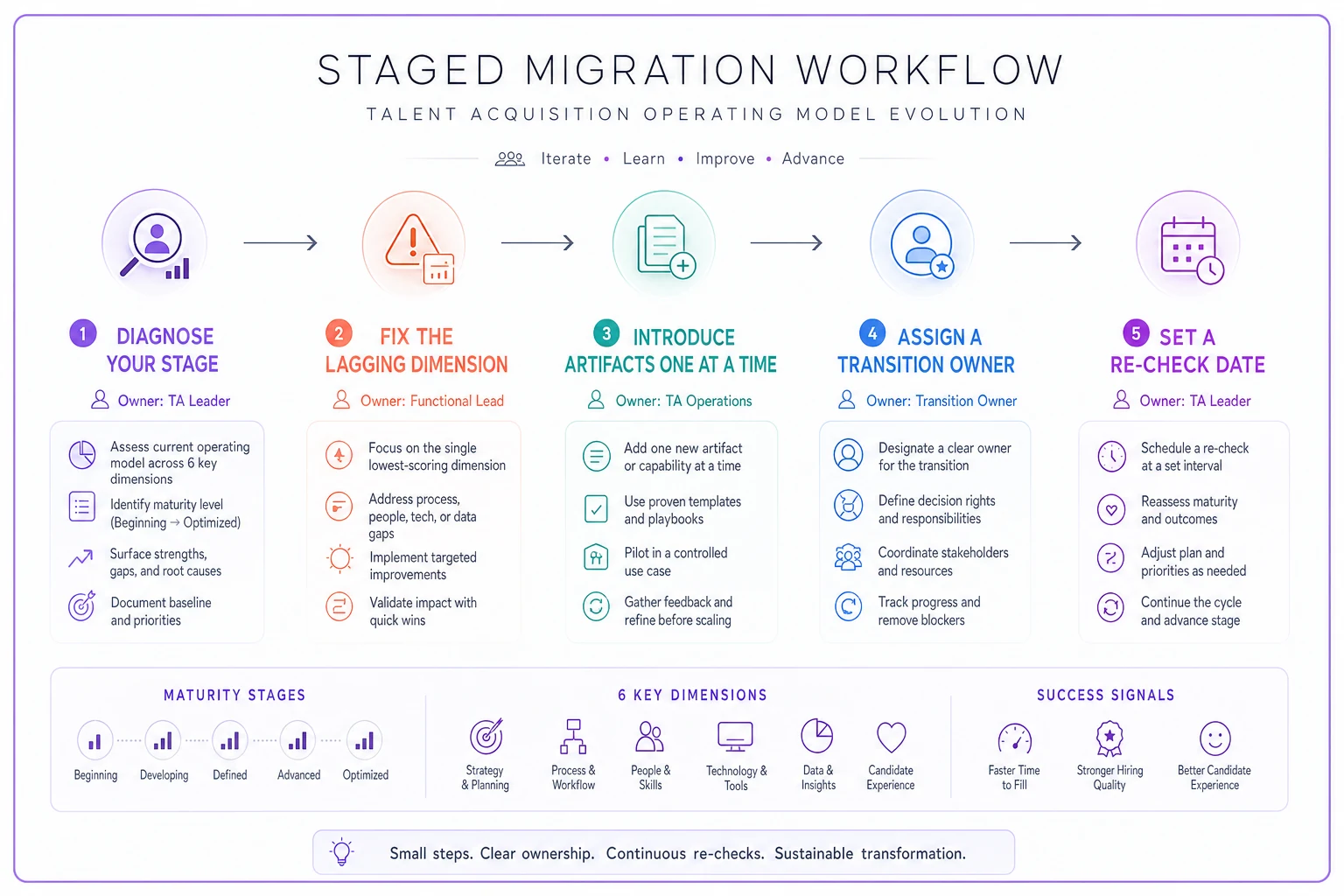
How to actually run the migration
Stage transitions fail when teams try to change everything at once. A cleaner sequence:
-
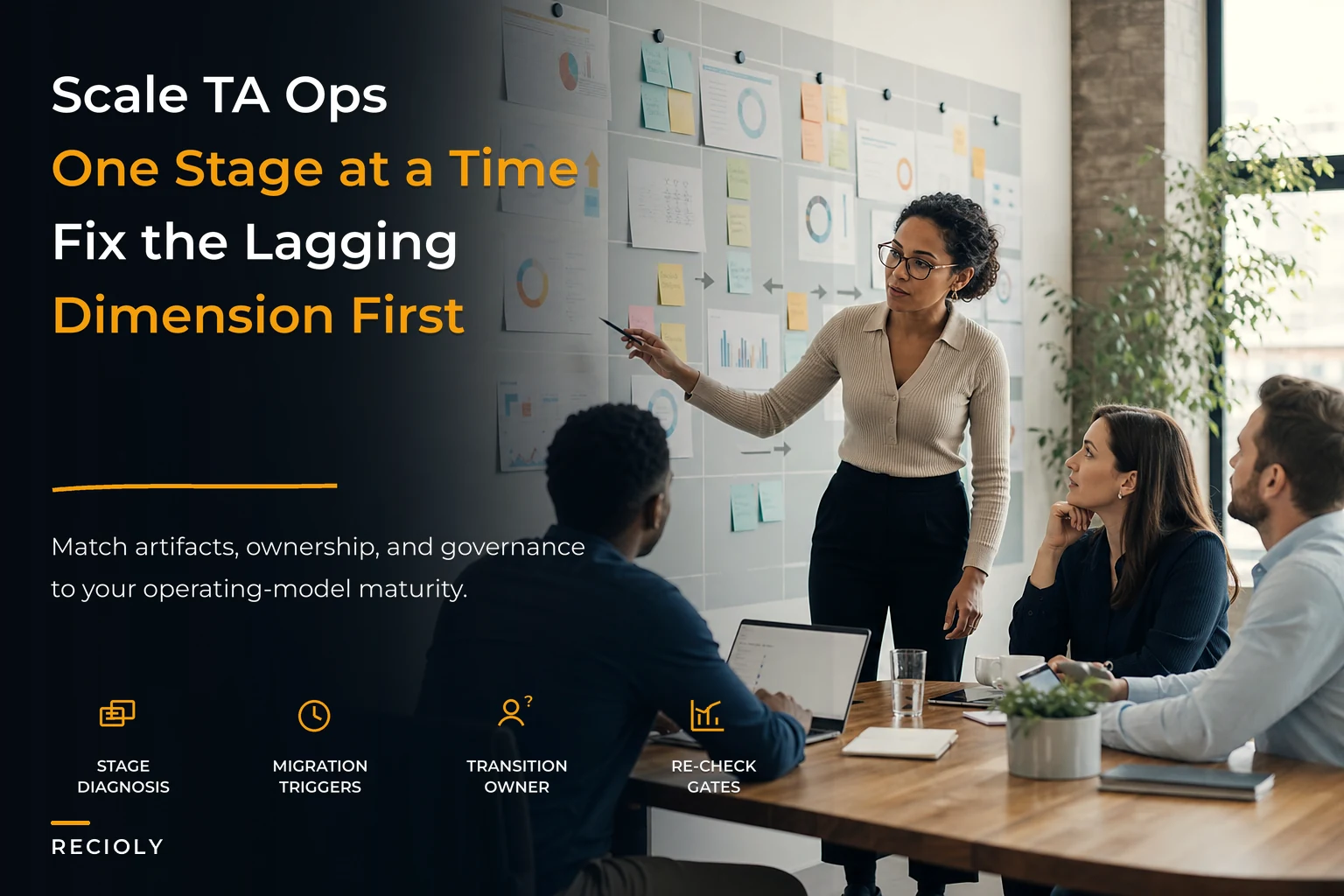
Diagnose your real stage per dimension — you're probably split across two. Rate decision rights, measurement, and coordination separately.
-
Fix the lagging dimension first. If your volume is Stage 3 but governance is Stage 1, don't buy tools — assign decision rights.
-
Introduce one artifact at a time. RACI, then dashboard, then SLAs. Each one needs to stick before the next.
-
Assign an owner to the transition itself. "The whole team" owns nothing.
-
Set a re-check date. Revisit in a quarter. Most drift happens in the gap between "we designed it" and "we checked if it's followed."
The single biggest predictor of a successful transition isn't the artifacts. It's whether someone owns making them real. A perfect RACI that nobody enforces is decoration.
Assign the transition owner a single metric (e.g., percent of roles on new playbooks) to prove progress.
Visualized, the migration sequence looks like this.
A perfect RACI that nobody enforces is decoration.
The takeaway
Scaling TA isn't about reaching the highest stage. It's about closing the gap between the stage your volume demands and the stage your operating model actually runs at. Most of the pain teams feel — dropped handoffs, stalled offers, untrustworthy metrics, burned-out leads — traces back to that mismatch, not to bad people or missing tools.
Figure out where you honestly are on each dimension. Fix the one that's lagging. Add structure only when the coordination cost of not having it exceeds the overhead of maintaining it. Do that consistently, and your operating model grows with you instead of quietly breaking underneath you.
Ready to elevate your hiring process?
Join 1,500+ recruiting teams using Recioly to save time, improve collaboration, and hire smarter.